Carcassonne: Gendarmerie Motorcycle Rally

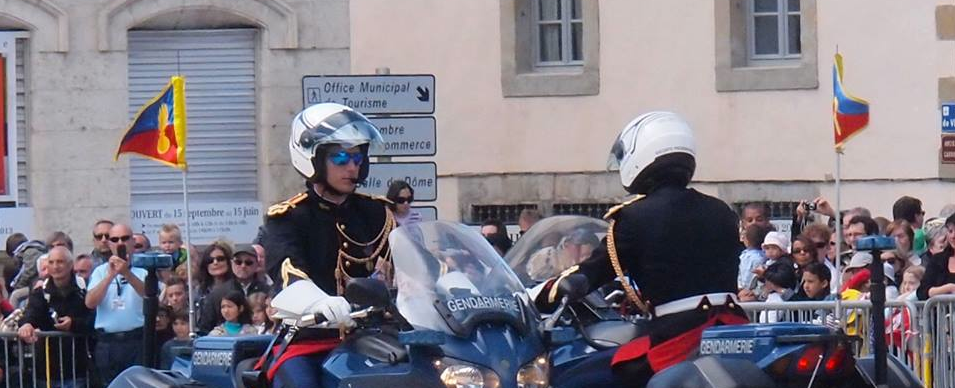
We attended the “Rallye Motocycliste Organis Par la Gendarmerie de l’Aude,” the Second Annual Motorcyclist Rally Sponsored by the Gendarmerie of Aude.

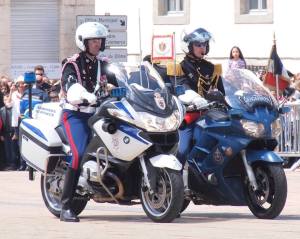
The free event in Square Gambetta included fast paced precision drills by motorcycle officers from the Republican Guard unit (presidential escort unit) of Gendarmerie Nationale of France and the Compagnie des Carabiniers du Prince of Monaco (royal family escort unit), amazing motorcycle stunts by the Republican Guard, music from a French Naval pipes and drums band, and a dramatic helicopter hoist delivery of a gendarme and his canine followed by a canine demonstration.  There were also driving safety exhibits, vendor displays, and recruiting by the Gendarmerie Nationale.

In addition to the local dignitaries, Prince Pierre of Monaco attended the event to observe his royal motorcycle escorts perform with the Gendarmerie Nationale Republican Guard.

Tracy and I both had to shake our heads at the French Naval pipe and drum band playing “Scotland the Brave” and the Disney symphony type music to entertain the crowd before the rally began, but especially at the segment when cowboy hat wearing country line dancers joined in and danced to the bagpipes and drums!

Monégasque Carabiniers on white bike and French Gendarmerie on blue bike
Gendarmerie Nationale Republican Guard Stunt Team

This slideshow requires JavaScript.

French Beverages, Part 3: Coffee

In my younger days I was generally known as one of the only three cops in America that didn’t drink coffee.  That didn’t change in my  academic career.  It took visiting Italy and France and their excellent espresso to convert me into a dedicated coffee drinker.

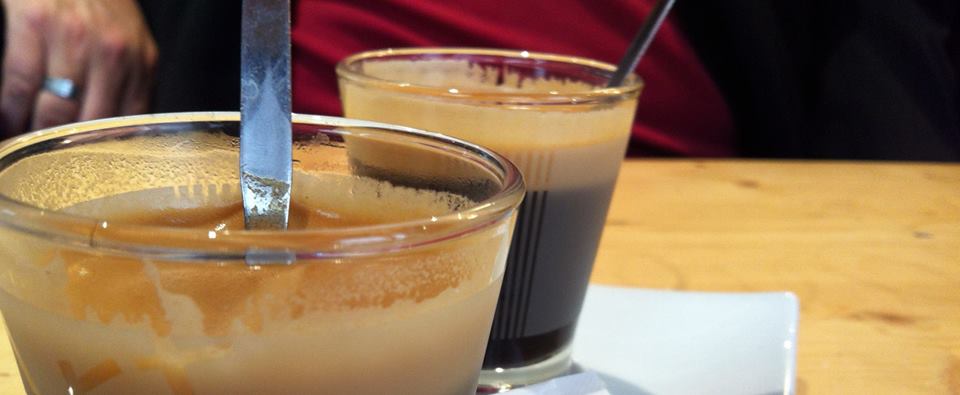
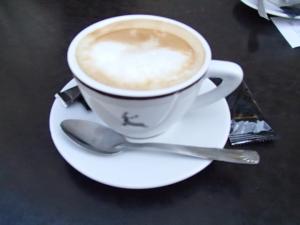
For breakfast in Carcassonne Tracy and I enjoy Café Crème (Ca-fay Khrem), like an Italian cappuccino, a large steaming cup of espresso with steamed milk and a topping of foamed milk.  Unlike Italian cappuccino or cafe latte there is no artistic patterns on top, just rich creamy coffee with a dollop of foam.  In France the norm is not having a big breakfasts so Café Crème is often a meal unto itself or maybe with a croissant or a pain au chocolat (a flakey chocolate-filled viennoiserie pastry that is a favorite here in Southwest France.)

Café crème
Café crème

After 10:00 or 11:00 in the morning there is Café (Ca-fay) to enjoy (although many will enjoy Café for breakfast.)  Café (also called Café Noir or Café Express) is drawn from an espresso machine just like an Italian espresso and rich with dark reddish-brown foam called “crema,” and served in a demitasse cup or small glass.  In France and Italy milky coffee drinks like Café Crème are only consumed in the early morning, Café can be enjoyed all day long.

Café
Café
Café
Café

Coffee in France is always served with sugar (sucre (Coo-khruh), real sugar, either granulated or sugar cubes.  (Although a person could also request artificial sweetener, edulcorant  [Ay-doohl-co-hrahn].)  There is frequently a small ginger cookie or small chocolate to accompany  your coffee in our part of France.

There are many cultural expectations to having coffee in France.  Like I previously said, Café Crème, is not ordered after breakfast time.  There are seldom paper “go cups” available, coffee is meant to be savored slowly, not to be drunk on the run.  Coffee is not served during a meal (there is wine for that); coffee is reserved for after the meal is finished as a capstone to the event.  If you enter a restaurant only for coffee, either sit at a table without place settings or stand at the counter.  Drinking coffee while standing normally cost less than coffee while sitting at a table.

While our coffee drinking normally includes just Café Crème and Café there are some other coffee choices.

Noisette  (Nwah-zett) is an Café with a dash a cream.  Noisette is French for “hazelnut” and refers to the color of the coffee.  A noisette is similar to a small Italian Macchiato coffee.

Café au Lait (Ca-fay a lay), coffee with cream.  Depending who you talk to, this either this is an acceptable synonym for Café Crème or is a phrase only used in a restaurant by tourists.  I’ve also been told Café au Lait is a term only used by a French person in their own kitchen.

Café Allongé (ah-lohn-zhay), “extended coffee,” is espresso with additional hot water to make a more traditional American-style cup of coffee.

There is an option to order your Café as déca (Day-kah) or décaféiné (Day-kah-fay-uhn-ay) for a decaffeinated coffee.  This is something Tracy strongly believes cancels a major reason for coffee in the first place and is perhaps is even a venial sin.

And for non-coffee drinkers there is Chocolat chaud (Shah-ko-lah show),  hot chocolate that is normally made with rich, top-quality chocolate and is often served in demitasse cup.

France is definitely a “coffee culture” where few activities are as relaxing as sitting in the town square, sipping your café, and watching the world go by.  “Un autre café, s’il vous plaît.”  Another coffee, please.

French Beverages, Part 2: Languedoc-Roussillon’s Vin de France and Vin de Pays

“You know, every glass of wine here is French wine.”  Me sharing the extremely obvious with Tracy.

The Languedoc-Roussillon region in Southwest France, where we are living, is the largest area in France in terms of vineyard acreage.  The region is known for its Blanquette de Limoux, the world’s oldest sparkling wine, and many high quality red wines like Corbières, Cotaeux du Languedoc, Côtes du Roussillon, Fitou, Minervois, Saint Chinian, and Costières de Nimes.

Languedoc-Roussillon (Wikimedia Commons)
Languedoc-Roussillon
(Wikimedia Commons)

Languedoc-Roussillon is also known as the “Wine Lake” of France where the majority of inexpensive wines in France are produced. So much wine is produced in Languedoc-Roussillon that France worries the “Wine Lake’s” surplus drives down the export price of French table wine.  More than 1/3 of all grapes grown in France are grown in the Languedoc-Roussillon region.

The everyday wines are called Vin de France, (previously called “Vin de Table“) the lowest level of the three tiers in the current wine classification system in France.  But don’t let the term “lowest level” deceive you, these are flavorful wines that enhance any meal or are enjoyable simply by the glass.  Any wine in France is all about its terroir:  the environment, climate, soil, geography, and weather that makes up the intangibles that combined with the variety of grapes and the skill of the winemaker creates the final taste of the wine.

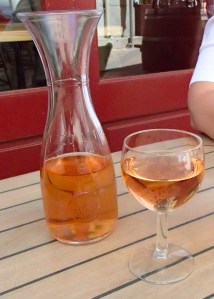
Pichet de Vin
Pichet de Vin

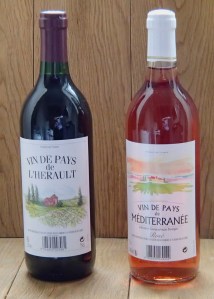
The mid-level category of French wines are Indication Géographique Protégée wines (IGP), an intermediate category basically replacing the former Vin de Pays (“country wine”) category.  These IGP/Vin de Pays wines are simple varietal French wines that include Vin de Pays d’Oc from Languedoc-Roussillon. Vin de Pays d’Oc is the largest portion of all Vin de Pays wines produced in France.

Vin de Pays
Vin de Pays

Appellation d’Origine Protégée (AOP) is the highest category of French wine replacing the previously used category of Appellation d’Origine Contrôlée (AOC) wines.  We look forward to touring some of the local vineyards in the near future and tasting some of these top-tier AOP wines.  Restaurants in Carcassonne offer high quality AOC wine lists in addition to their basic house wines.

AOP Seal (Wikimedia Commons)
AOP Seal
(Wikimedia Commons)

Most of Tracy and my wine consumption has been Vin de France and Vin de Pays.  These inexpensive reds, white, and rosé wines have proven to be delicious.  “Un demi-pichet de vin,” (a half litre carafe of a restaurant’s vin de France) has never been a bad experience.  Restaurants carefully choose even the house wine with their reputations in mind.  Rosé wines are a respected wine choice and hold a prominent place in many of France’s major wine regions, including Languedoc-Roussillon.

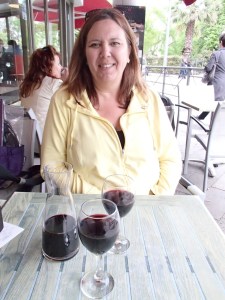
Tracy enjoying "un pichet of vin rouge."
Tracy enjoying “un pichet of vin rouge.”

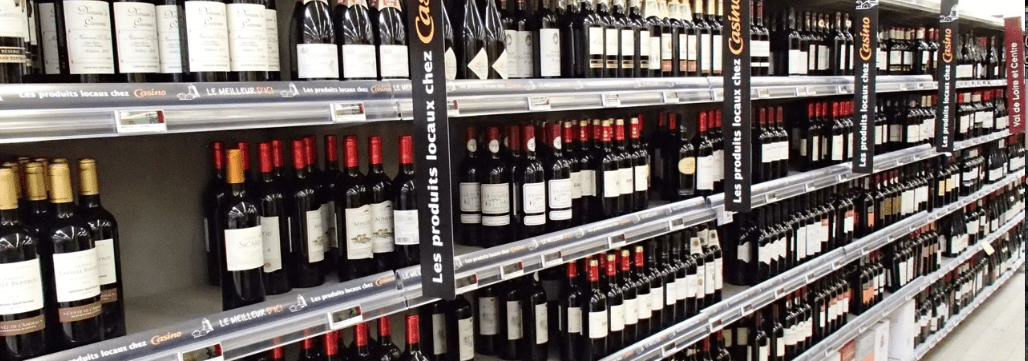
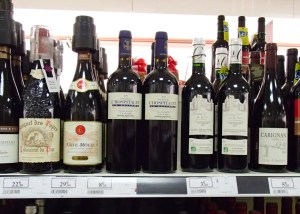
Shopping for wine is an embarrassment of riches.  The wine section in every store offers a huge range of quality, varieties, and price points.  It is difficult to narrow down your choices from so many offerings.  I was stunned to even see “boxed” vin de France meant for inexpensive table wine. Two of our most recent purchases, a red and a rosé, were both under 2 Euro and they were delicious!

Shelves of Wines
Shelves of Wines
Shelves of Wines
Shelves of Wines
Shelves of Wines
Shelves of Wines
Varied wines and prices

Tracy and I greatly enjoy our new tradition of a glass of wine with lunch and dinner.  And there is nothing like a leisurely afternoon, sitting in the town square of Place Carnot, and  lingering with a carafe of wine as Tracy and I just enjoy the view, conversation, and people watching.

Win-Win and Wrinkle-Free Shirts

I had a run in with a little old lady the other day at the market. It wasn’t verbal, otherwise I would not have been able to participate anyway. It was all about the squint of her eyes.

Alan and I were walking through the stalls at the market. It was a nice warm day — this is the rainy season so we enjoy them when they happen — and we were without jackets. Alan’s permanent press shirts get wrinkled here, not exactly sure why but assume it’s the tiny washer/dryer combo and no room to fluff clothes.

As we were passing a group of three older ladies, he was in front of me, one of the ladies caught my eye, she gave me a look of disapproval, pointed at the back of his wrinkled shirt, then tsk-tsk’d me as she shook her head from side to side, her curly gray hair bouncing around her frowning, squinty-eyed face.

Her disapproval of my duties to Alan’s laundry kind of amused me at first. I mean, for heaven’s sake, I’m married to a full-grown adult who can wash, dry and iron his own clothing. We’ve been married nearly 13 years and the only time I’ve ironed something for him is if I was already using the thing for myself and asked if he needed anything pressed. Alan is fully capable of ironing his shirts in France, too.

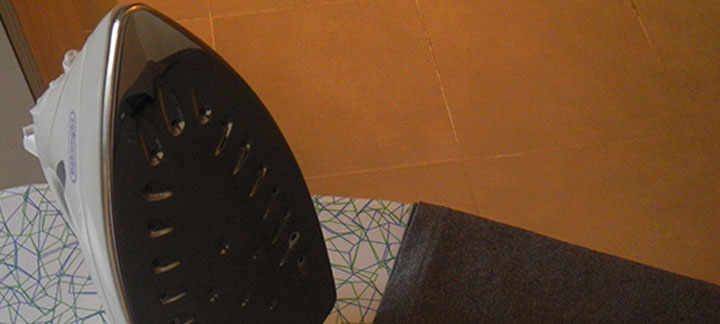
But by the following Saturday, when Alan was getting ready to hit the market and pulled a shirt out of the closet that had a wrinkle on the back, I grabbed it and said, “hold on, just let me hit it with the iron first, can’t have the little old ladies at the market tsk-tsk’ing me again.”

I’m still a little amazed that I caved to peer-pressure from a little old lady. But, I alao avoided looks of disapproval from the gray-haired crowd at the market this time, so . . . win-win, and Alan gets wrinkle-free shirts!

French Beverages, Part 1: Pastis

Pastis is an anise-flavored liqueur and popular aperitif in France.

Ricard is the number one pastis beverage in the world, its recipe unaltered since its creation by Paul Ricard in 1932. A refreshing apperitif, Ricard is a long-time favorite in France, especially in the southern regions of the country. Over 130 million liters of pastis is sold each year in France, more than two liters per inhabitant.  The name “pastis” originally comes from the regional dialect occitan’s word, pastís, meaning “mash-up.”

Ricard Pastis
Ricard Pastis

Pastis’ popularity grew following the French ban on absinth. One reason for the popularity of pastis can be attributable to the demand for anise flavored drinks created by absinthe decades earlier. There is also an old tradition in the Mediterranean of anise-based liquors like Sambuca, Ouzo, Arak, and Mastika.

The principal ingredients of Ricard is star anise, a rare spice that grows in southern Chinese and in the north of Vietnam, licorice from Syria, and aromatic herbs from Provence. Pastis is not absinthe and does not does not contain grand wormwood (artemisia absinthium), the herb from which absinthe gets its name. Absinthe obtains its base flavor from green anise, not the star anise which Ricard uses. Pastis’ flavor comes from licorice root which is not used in absinthe. Also, absinthes are normally bottled at 45 to 74% ABV, while pastis is typically bottled at 40 to 50% ABV. Finally, unlike absinthe, pastis is classified as a liqueur  because it contains sugar.

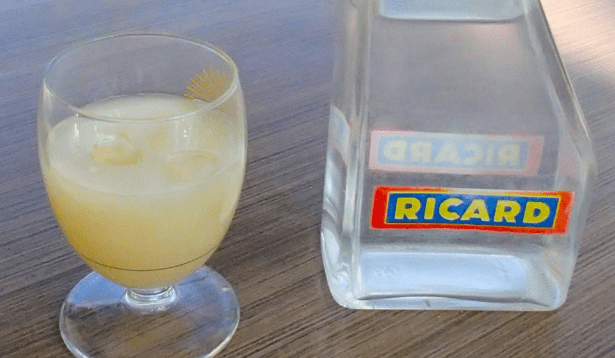
Pastis is normally served with the liqueur presented in one glass and accompanied by carafe of cold water.

The liqueur is diluted with the water according to the drinker’s preference, traditionally about 5 parts water to 1 part Ricard. Diluting the liqueur creates the “French Milk” effect as the water is added. The combination of liqueur and water ‘louches,’ and turns the diluted beverage cloudy and white in appearance. The drink is then consumed cold and is considered a refreshing beverage for hot days. Ice cubes may be added after diluting the pastis.

Pastis before dilution with water
Pastis after dilution with water and 'louching' starting
Pastis after dilution with water and ‘louching’ starting

Enjoying the Open Air Market

One of our goals with our new retired life is to eat healthier.

In the past it was always faster and often more convenient to swing by a “drive-up window” and pick up a quick meal.  Even though I knew better about nutrition, it was quick and satisfying to grab Quarter Pounder with Cheese, a Baconator, or Extreme Sausage Sandwich.  I love a good cheeseburger, et. al, but “everything in moderation” and sometimes I wasn’t moderate in my dining habits. (You would think that after documentaries like “Super Size Me” I would have long ago been avoiding fast foods.)  Please don’t think Tracy and I raised the kids on fast food and that we didn’t use healthy foods to prepare meals, but we also took our fair share of “short-cuts” to the “drive-up.”

With a major change in environment and limited access to fast food, Tracy and I wanted to create new eating habits that actually follow the USDA Food Pyramid recommendations we previous ignored if it wasn’t convenient.  (But still enjoy an occasional, emphasis on “occasional,” indulgence.)

Tracy and I both love to cook and try new recipes. Now we have a lot of brand new ingredients to explore with our cooking.  We want to minimize meat and emphasize vegetables, fruits, and grains. We also wanted to use farm fresh, local foods as much as possible and avoid frozen, canned, and pre-packaged foods.  There are no excuses as we now have the time with retirement to enjoy making our meals completely from scratch.

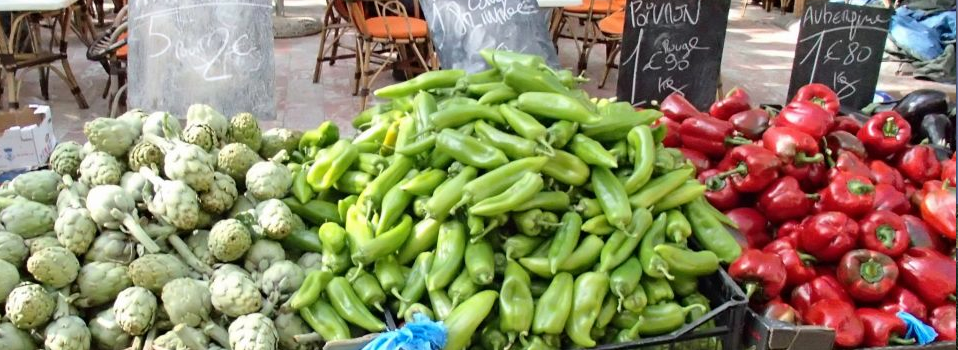
One pleasure has been shopping at the open air market in Place Carnot.  Every Tuesday, Thursday, and Saturday is market day in Carcassonne.  The town square in Place Carnot is full of tables with vegetables, fruits, honey, breads, meats, and flowers.  We are now shopping for seasonal and fresh foods, usually directly from and sold by the farmers themselves.  (There are also some imports from Spain, Italy, and North Africa also available.  The country of origins on all foods are clearly identified.)  Colors are often vivid with some shocking differences in foods’ colors that we only used to see in heirloom and heritage produce in the U.S.

I realize I am stating the obvious regarding the local food being is raised for its taste, rather than its ability to be trucked long distances and to last longer on store shelves.  There are many new and different flavors to experience.  (And new names for old favorites:  mushroom are des champignons, potatoes are des pommes de terre, and strawberries as des fraises.)  Yes, I already knew about the improved quality of local foods but it’s an evolution for me to experience it on a continuous basis.  I never had or took the time to shop farmer’s markets or to garden at home.  (I have a “black thumb” when plants are involved.  There were only silk plants in my old office.) Previously tt was always a matter of running by the supermarket’s vegetable section or stocking frozen vegetables in the freezer.

The experience of shopping at the open air market is a theater upon itself:  all different kinds of people coming and going, the various interactions between buyers and sellers, people looking for the best quality at the best value, friendly “bonjours” and “au revoirs,” and us standing in the middle of it.  We are already choosing our favorite vendors.  We have our farmer with the freshest and best tasting tomatoes.  There is our “Melon Man” who insists we taste a slice of his cantaloupes first before he hand-picks the ripest melons for us.  There are the vendors who are exceedingly patient with my limited French when they ask for, “Trois euros cinquante-cinq centimes” (3 euros 55 cents) and make a point to write the amount out on a pad of paper or show me the amount on the calculator.

And the best part is, of course,  cooking and eating our bounty then returning to the market do it all again.

This slideshow requires JavaScript.

Wow, One Month Already

It’s hard to believe that we’ve been here a month already. Time has sure passed quickly as we worked on settling in to our new community.

So far in the last 30 days, we’ve made two train trips to Montpellier; had a sick computer and a sick puppy; rode the bus – mostly successfully; shopped at the open-air market, found a grocery store we like; selected a favorite coffee bar; visited a medieval citadel; taken lots of long walks along the river; have been to the tourist office, the post office, the bank, the veterinary office, the butcher, the pharmacy, the train station and one of the museums.

We’ve talked to people from France, Germany and England, taken hundreds of photos and studied zero French.

We’ve been able to keep in touch with the kids, our family and friends through social media sites and e-mail. Major plus as we miss the kids quite a bit.

We read from others that dealing with OFII would be time-consuming and difficult process but haven’t found that to be true. Within our first 30 days, we mailed our documents to them with the requested copies of our passport, visa and visa stamp. We received our notification that the materials were received within 10 days of our arrival. Ten days later we received our letters from OFII with the time and date of our meeting for our medical exam and general interviews. Definitely not the nail-biting situation we had expected.

Now that we are settled into our Carcassonne home and have completed our first month abroad we are creating a schedule for travel, adding French lessons into our daily routine and making plans for our OFII trip in May.

Living in Carcassonne is wonderful, but it still feels a little like being on vacation and Alan and I keep reminding each other that we don’t need to rush around trying to see everything possible each day. We have 11 more months to wander and explore, learn some French, do some out-of-town travel, visit a friend or two also living abroad and drink more wine.

So far, life is great. Alan and I are so grateful for the opportunity we’ve been given and the love and support of our kids, family and friends.

Our Carcassonne Home

This post is mostly for my mom, so she can see where we are living!

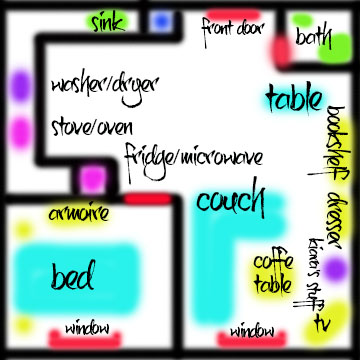
Our apartment here in Carcassonne is approximately 550 square feet, maybe a little bigger. So as I sit here listening to “Good Life” by One Republic I thought I would post a few photos of our home here in Carcassonne, France.

This first image is not to scale, just a general layout of the apartment that I threw together in Photoshop.

apartment layput

The apartment is roughly a square and there isn’t a ton of insulation so you do hear the neighbors from time to time, but after living with eight kids noises don’t really bother us anymore! However, you can also hear the church bells from St. Nazaire in Le Cite and from St. Michael’s down the street. It’s a happy sound and one that I fell in love with while we were in Italy, although the bells in Italy are much, much louder!

In addition to the church bells, we had the added treat of someone playing the sax with gusto late last night. But these are comfort noises and we had no trouble sleeping.

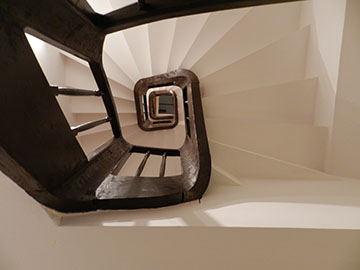
Most buildings in our area date from the late 15th to early 16th Century but we do not have an exact date on when our building was built. We do know that the interior was nearly completely gutted and remodeled about 5 years ago. The new owner, our landlord Jason Carr, did a fantastic job keeping as many of the original details as he could salvage. The handrail on the staircase is original to the building and was handcrafted to fit the narrow space a long time ago.

staircase

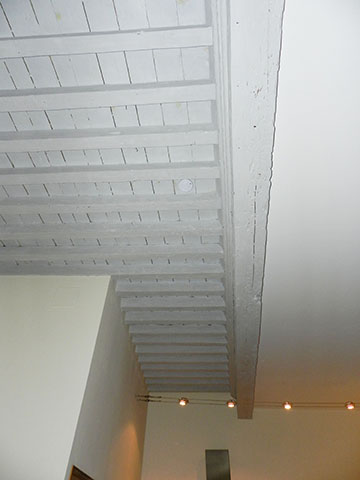
In addition to the handrail, nearly half of the ceiling in our apartment as well as the two big beams are also original to the building. They were repainted in the original whitewash color (which has a slightly blueish tint). One section also has three of the original nails, hand hammered and looking a bit like large horseshoe nails.

nails

There is a city council group that deals with renovating old buildings and they check that anything that can be seen from the street is restored or as near to period as is possible to achieve when someone renovates an old building in the Ville Basse. We are lucky to be in the front apartment and therefore have some of the original ceiling and beams in our apartment.

DSCN7772 DSCN7773

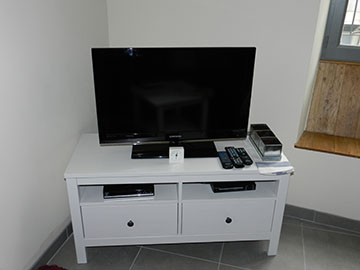
In the living room the furniture is mostly from IKEA, but it’s solid and comfortable, a lot of blue which Alan loves and the minimalist approach to filling the apartment works well for me as I have an issue with clutter. There is a flat-screen tv with both French and UK satellite channels, but we rarely turn it on. The couch converts into a double bed for guests which will be useful in the near future. The windows in both the living room and bedroom have small window seats and large shutters than can be fully open to allow passive solar, closed part way for privacy or even closed fully to keep out the hot summer sun. We love that the shutters here are practical and not just a design feature.

DSCN7770 DSCN7761

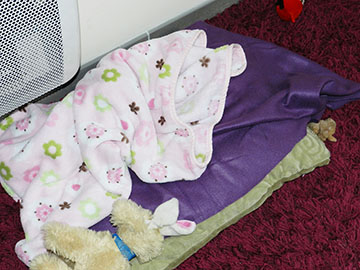
We did set up Kiara’s stuff in front of the heater. Our poor little girl hardly has any hair and is not a real fan of tile floors, so keeping her from shivering is a constant battle. But she loves, loves, loves the rug, even though it’s practically magenta in color, so much for her taste in decor.
DSCN7760

She also has her own little espresso cup for water and a travel container for her dry food – which she rarely eats.

DSCN7759

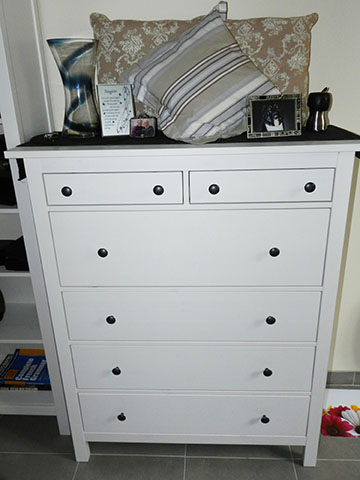
The dresser is in the living room, which we both thought odd at first. I added some of the pillows from the couch to break up the white on white color, a couple of photos I brought with me (the small one on the left of the pillow is my Mom and Dad, on the right is our Max), a knick knack that my mom got me before we left about daughters, and we use the vase to store wine bottle corks!
DSCN7758

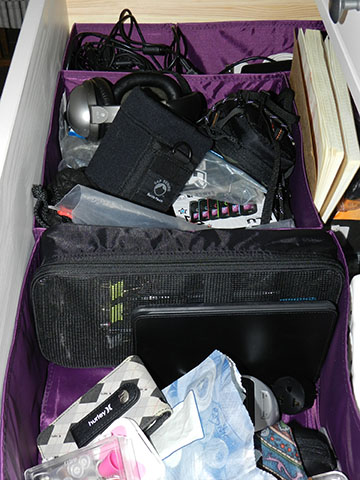
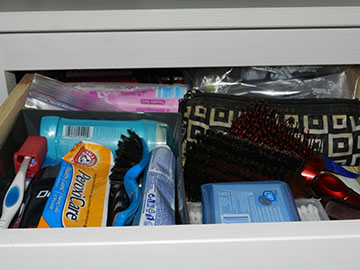
However, since the dresser serves as a place to store camera/photo equipment cords and backup drives (first full width drawer), our bath stuff (top left), Kiara’s closet (top right), the “overflow” drawer (bottom) as well as a dresser for socks and stuff, it’s becoming less of an oddity than it was on day one.

DSCN7756 DSCN7754 DSCN7755

DSCN7757

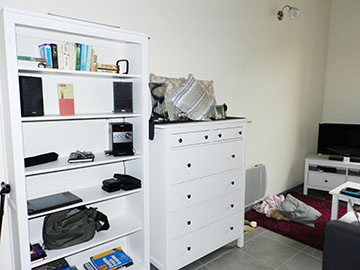
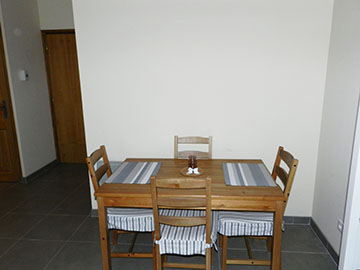
There is a bookcase that we use to house our laptops and camera stuff next to the dining room table and next to the dresser.
DSCN7751

DSCN7750

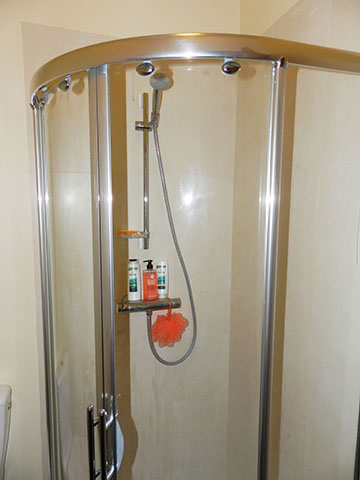
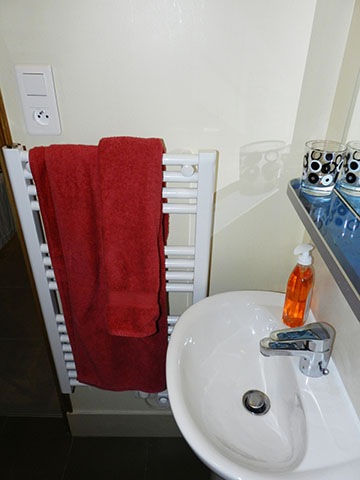
The bathroom shares the wall in the dining room and is surprisingly spacious for a European bath. The corner shower allows more space than we anticipated. Our hotel in Florence in 2011 made taking a shower an epic event, it was just wide enough for me to stand in without turning and I had to duck to get my hair wet. Alan’s relief when he saw the shower in this apartment was practically comical. The one feature I really like is the towel heater. Not only does it warm your towel while you shower it radiates just enough heat to be comfy while doing your hair too.
DSCN7744 DSCN7747

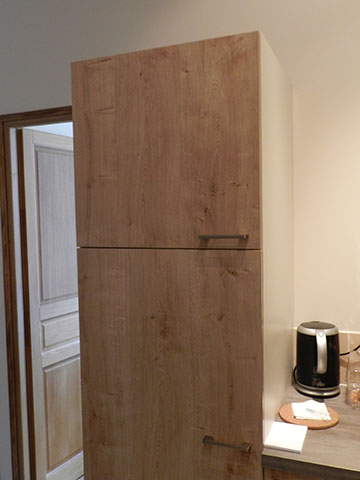
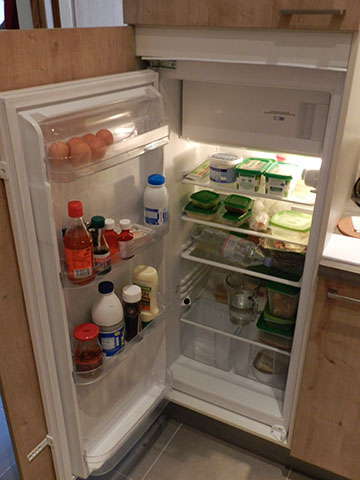
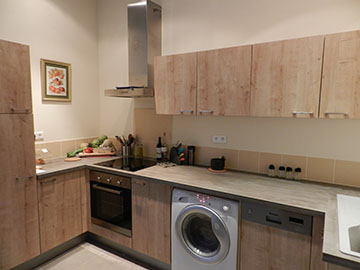
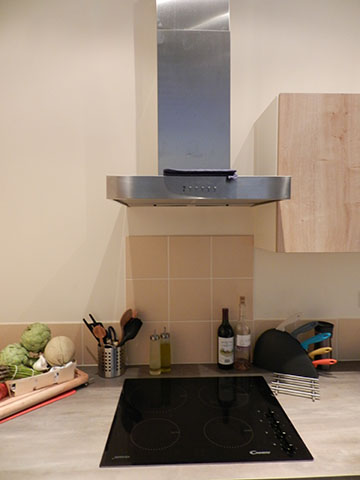
The kitchen is actually larger than the one we had in our apartment in Sparks. The fridge looks like a pantry as well as the cabinet that houses the microwave. The crisper drawers in the fridge are each about 7″ x 7″ x 6″ they are “cute.” The kitchen already had dishes, cookware, flatware, glasses, and cooking utensils. But we still picked up a few things which we felt were a big necessity like a corkscrew, mortar and pestle (which weighs about 10 pounds), bottles for olive oil. We also picked up drawer organizers for the dresser in the living room (I dislike clutter in drawers too). Probably the oddest thing in the kitchen is the washer/dryer combo unit. The barrel inside is only about 9″ deep and it takes approximately 4 hours to do a small load of laundry, but it gets the clothes clean and doesn’t make a lot of noise.
DSCN7738 DSCN7737

DSCN7734DSCN7735

DSCN7736

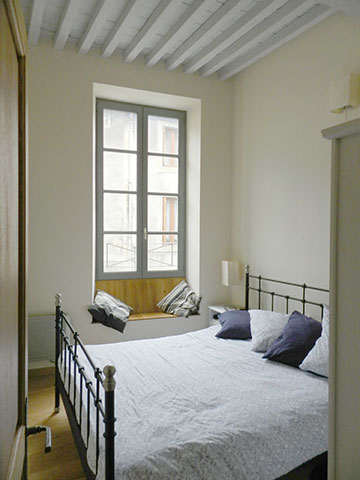
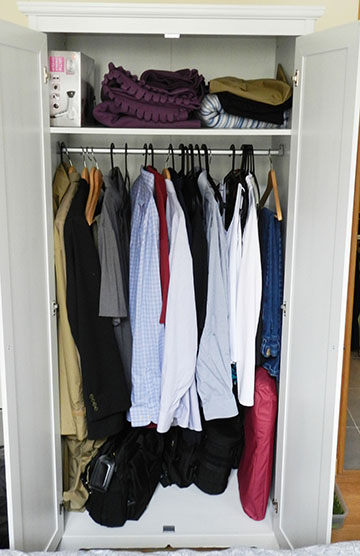
The bedroom is on small side but when the door is closed and the heater is on, it’s super cozy. We had really minimized our possessions before moving, so even the small armoire is more than enough room for all our clothing, though we did pick up additional hangers from IKEA so that everything had a hanger of its own. Another weird issue of mine. The pink thing in the bottom of the closet is Kiara’s travel playpen, it’s like a mini pop-up tent with tons of room for her and her stuff.

DSCN7729 DSCN7731

We feel like we’re getting a handle on the European apartment and small space lifestyle. We still find challenges once in a while, but all in all, it’s a nice space in a historic area. Alan and I have heard that tourist season is a little crazy in our neighborhood, but we are not expecting it to be any different than Hot August Nights or the Rib Cook-off events we’ve attended for years.

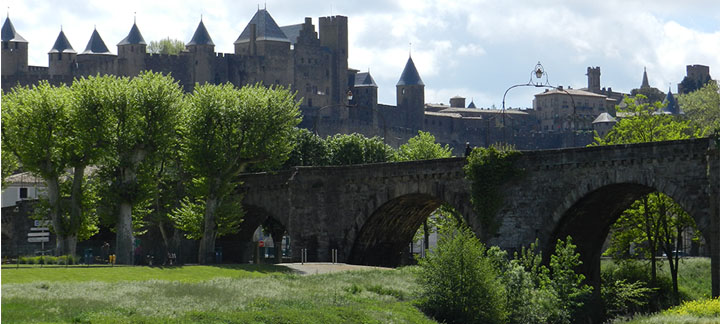
We know that small and minimalist spaces and apartment living may not work for everyone, but did we mention that there is a freakin’ CASTLE in the backyard??
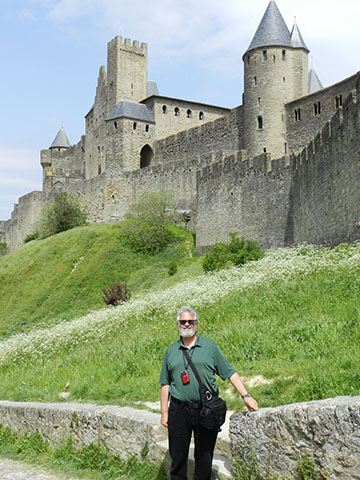
castle

Flavor Hell

A few weeks ago I posted an article titled “Funny French Foods” where I had found some cute and/or funny foods in the grocery store. Today’s article is dedicated solely to potato chips. Some of you who know me well will know that I love potato chips and believe that chip/sandwich pairing is a real art. I cannot even enjoy a sandwich unless there are potato chips on the plate, and of course, I have my own favorite combinations: tuna sandwich with crunchy cheetos, roast beef and provolone sandwich with sour cream and onion potato chips, etc.

Image the horror of walking into the “Walmart of France” Geant Casino and finding the following assortment of chip flavors.

cream-blackpepper and light

Cream and Black Pepper (the ones on the right are Light chips)

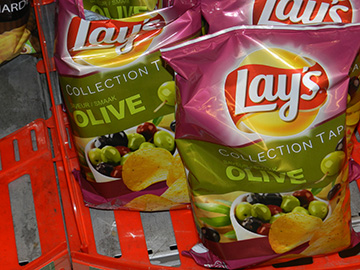
olive

Collection of Tapas Olives – I like olives, but in a potato chip?

mustard-pickle

Mustard and Pickle [raised eyebrows] hmmmm

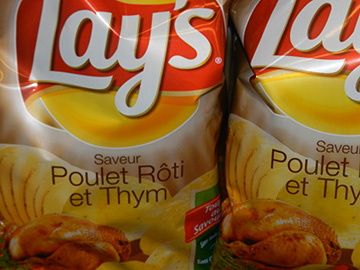
roast chicken and thyme

Roasted Chicken with Thyme (not quite chicken ‘n waffles)

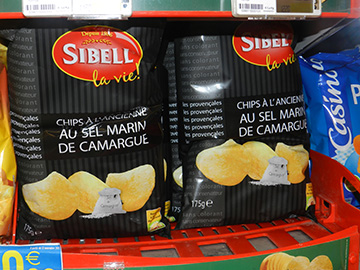
sea salt from the Camargue

Sea salt from the Camargue (located south of Arles, France between the Mediterranean Sea and the two arms of the Rhone River Delta – I looked it up on Wikipedia)

provence

The Herbs of Provence — we keep seeing this everywhere, but haven’t yet figured out just exactly what the herbs are — my guess, lavender.

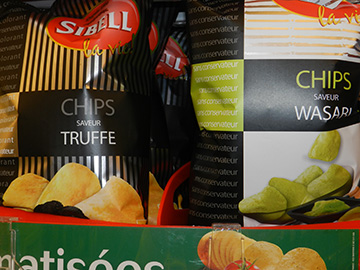
truffle and wasabi

For the refined palate — truffle and wasabi

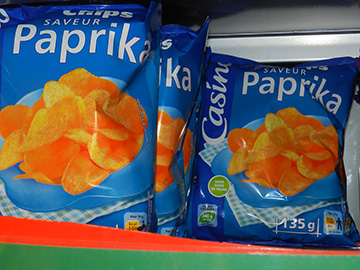
paprika

Paprika — in a potato chip, this is just wrong, wrong, wrong

bbq-ribs

For your dining pleasure — BBQ Rib flavored potatoes — mmm, mmm good

old-summergrill

These basically translate as Old Chips with grilled summer flavor — probably not making it into the shopping cart

chorizo

Chorizo flavored chips — ack!

marinatedchicken

Then of course, more chicken, this time Marinated Chicken flavored chips — I am beginning to notice the French love chicken flavored things, not sure why

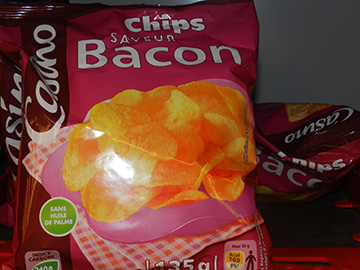
bacon

Bacon — potato chips even the dog will love!

chewableblondes-sourcream-herb

According to Google Translate this is a bag of “Chewable Blondes” with sour cream and herb flavors. I had to translate it twice because I was having trouble believing the first translation.

There are other types of chips and Alan even found my “comfort food” chips when I was ill during our second week here. But these really are the ones filling up the shelves and not just the oddity that we find on occasion. I must say that I do miss my Nacho Cheese Doritos, they were my “go to” chip whenever Alan made sandwiches!

We have a joke between us, Alan makes a sandwich and we get two slices of bread, a slice of cheese, a slice of meat and if he’s feeling like a chef, a slice of lettuce.

I make a sandwich and we get two slices of 12 grain bread with hummus, feta cheese, slices of sun-dried tomato flavored turkey, shredded romaine, clover sprouts, mini sweet pepper slices and chips that are perfectly chosen to enhance the flavor of the sandwich.

I miss my chips, but there may be some adventurous flavors awaiting me . . . however, I will not lower myself to the Paprika flavored chips, never, never.