Learning to Speak French in France

“So . . .  do you speak French?”  A common question I was asked last year before we departed to France,  the answer was, “Hardly a word.”

Our backstory explains how Tracy and I, through a convoluted process, came to retire in France.  Prior to our retirement we did two years of Italian language study at Truckee Meadows Community College and using Italian Rosetta Stone computer software. (Our original retirement location was Italy.)  My high school and college foreign language was German, Tracy’s was Latin.

Now approaching our first year anniversary in France there is still the question, “Do you speak French?”  Tracy describes that I have an effective set of French “coping phrases” for life at the market, cafe, train station and my accent has gotten much better, but I’m still not to a conversational level.  We haven’t found it to be true that with “total immersion you will pick up the language just like that” followed by snapping fingers.  If anything, I am disappointed in my limited progress acquiring a good command of conversational French due to a lack of sufficient effort on my part.

While recently in Montpellier we met a delightful pair of five-year old French girls on the tram who chatted in English with Tracy and me.  I decided that by the end of 2014 I wanted to speak basic conversational French as well as these five-year olds spoke English (I won’t even get in to the question, “Are you smarter than a Fifth Grader.)   This seemed like a reasonable and obtainable goal.  So I made a New Years resolution to stay on a comprehensive learning schedule for French language acquisition.

There are lots of methods for second-language acquisition.  I know that I am more of a physical/aural learner so I selected audio learning systems.  Tracy decided to stay with Rosetta Stone French because she found Rosetta Stone effective for her previously while learning Italian.  (I also liked Rosetta Stone, but I wanted a system that starts with conversations and doesn’t require performing the learning in front of a computer.)  We would have liked to attend a French language class in a traditional classroom, but there was no cost-effective classes in Carcassonne (but there are some really expensive one-on-one tutoring available.)

The programs I picked are certainly not the best and only options, but these are the learning programs I selected for my personal andragogy (adult self-learning) and learning style.  The biggest success factors I think for any adult second-language learner is their motivation and perseverance.  There is no “Magic Bullet” of the perfect learning program, no “learn French in just 10 days.” Learners must be consistent and actively involved in their self-education  like any other pursuit – golf, cooking, knitting, playing a musical instrument – there is no passive approach to mastery.

I reverted back to my pre-retirement “Type A,” overachiever personality and selected three distinctly different learning programs to learn with rather than selecting just one system.  My hope was that the different language programs would overlap subject matter, fill in holes, and reinforce the material in other programs.  I wanted audio programs for use on my iPod that could be transportable and not require that I sit at a computer to work on my language studies.  I wanted to listen and re-listen to a lesson while taking a walk, cooking, riding the bus, doing dishes, or shopping.

Pimsleur French

Pimsleur French
Pimsleur French

First, I selected Pimsleur French (http://www.pimsleur.com/Learn-French)  which is a traditional audio learning program.  The Pimsleur Method has been teaching millions of students since the 1960’s and is considered by many to be a solid, tried-and-true method that stresses active participation, not rote memorization.  Although it emphasizes formal language and is somewhat dated with its lack of computer graphics, it is still frequently rated in the top 5 or higher of language learning programs.  (http://learn-french-software-review.toptenreviews.com/pimsleur-french-unlimited-review.html)   The Pimsleur system uses four principles in its teaching method:  anticipation with “challenge and response” similar to having a conversation, graduated-interval recall to reinforce vocabulary, a core vocabulary of the most commonly used French words, and what Paul Pimsleur called organic learning, auditory learning similar to how children learn language by hearing examples and then repeating what is heard.  The lessons are in 30 minute blocks that allows total effort without fatigue.

Amazon.com offers Pimsleur French levels I, II, & III for approximately $350.00 (in January 2014).

Coffee Break French
CoffeeBreak French
CoffeeBreak French

Secondly, I picked Coffee Break French (http://radiolingua.com/shows/french/coffee-break-french/) as a second-language acquisition tool.  The audio lessons are available as a free iTunes download and from the Radio Lingua Network website (http://radiolingua.com/).  (There is also Coffee Break Spanish and Coffee Break German available as well as a series of brief audio lessons in 24 languages ranging from Arabic to Zulu.)   The original concept was to make language training conveniently available “during a daily coffee break.”  These well produced audio lessons use the fun learning device of the instructor, Mark Pentleton (an experienced French and Spanish teacher), working with a college-aged student.  This Socratic technique makes the lessons fun and upbeat while allowing the student to act as a proxy for me in a classroom.  Most lessons are in 20 minute blocks, with approximately 100 lessons currently available and new lessons being frequently added.  Part of the charm of Coffee Break French is that the instructor Mark Pentleton is Scottish.  Although his English instruction has a distinctive Scottish burr, his French pronunciation is properly accented.  While there is paid supplemental content available from the Radio Lingua Network,  I only needed the professional lesson guides to accompany the audio lessons. Well worth the extra cost as I the lesson guides have helped me with my reading of printed French, building my vocabulary, and to better understand the conjugation of French verbs.

Coffee Break French has emphasis on proper French grammar as part of the lessons, something the Pimsleur program does not dwell upon.  Like the Pimsleur method, the lessons revolve around conversations based on real-life daily activities.

I selected the Bronze membership, which provides a set of 40 lesson guides for £27.00 (in January 2014), although there are periodic discounts and I was able to purchase the lesson guides for just £21.60.

FrenchPod 101

FrenchPod 101
FrenchPod 101

Finally, I selected FrenchPod 101. (http://www.frenchpod101.com/) A popular audio language program with free audio lessons, but I haven’t found FrenchPod 101 as well-organized or structured as the Pimsleur or Coffee Break French.  What I do like is that the FrenchPod 101 offers lots of cultural insights, daily life in France, and casual French phrases.  The cultural insights was one thing I greatly enjoyed in our TMCC Italian class with our professor, Carlo, who described his growing up and living in Italy.  The lessons are usually less than 10 minutes with an energetic native French speaker and an American who is fluent in French.  The discussions sound like two college-aged people talking about speaking French or living in France.  The lessons include the use of casual and informal French language along with proper formal French.  The lesson guides are helpful, but frequently do not exactly match the lessons’ dialog.  There are about 300 lessons, but it is difficult to organize the lessons into a well structured schedule of study.  It seems that the parent company, LanguagePod 101, (http://www.languagepod101.com/) provides the free audio lessons as a device to market paid subscriptions its to online training platform.  I  used my initial seven-day free trial to download the audio lessons and lesson guides that I was actually interested in using.   Another learner who wants to work from their computer might like to join the “FrenchPod 101 Learning Community” and use its additional tools.

I use FrenchPod 101 as a supplement for its cultural insights and expanding my knowledge of informal French.  I wouldn’t use this for my primary learning tool.  

I do one lesson each from Pimsleur French, Coffee Break French, and FrenchPod 101 everyday, Monday through Friday.  I leave the weekend free to rest or catch up on any overdue work.

Supplements

Duolingo
Duolingo

Duolingo

I use the free language-learning site Duolingo on my Kindle as educational entertainment.  Its graphics are very similar to Rosetta Stone learners’ interface. It is a very worthwhile learning platform that I should consider working with more often.  Amazing quality for a free service.  It’s pretty fun too.

Flashcards

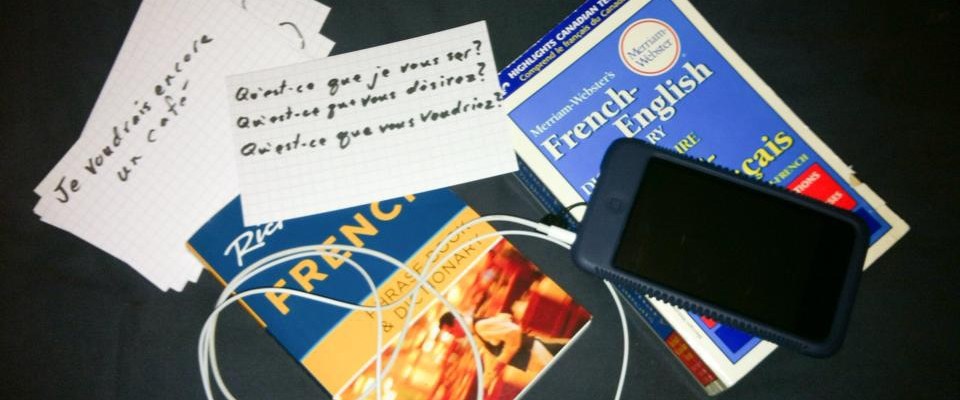
Being a physical learner, I find creating my own flashcards has the dual purpose of physically writing words down that I can later use to quiz myself.  The audio learning programs do need supplements to assist me in learning to read French better.

Readings: French Newspapers, Menus, Grocery Items

I do my best to read the local newspaper online and physical newspapers while in cafes, as well as review menus, and read the names describing items in the store.  The newspapers and menus challenge my reading comprehension.  I find shopping reinforces my vocabulary when I see a physical object (apples, shoes) next to a sign (pommes, chaussures.)  This is part of that “total immersion” experience to learning French.

Notebook

I keep a pen and notebook in the camera bag that I always carry.  I find new words while I am out in the community that I am unable to define and make a note, then check on the word once I return home.  Interesting how those words stick in my growing vocabulary.

Talk and Listen

I try to push myself to speak and to carefully listen to the local French people around me.  It makes me practice, increases my confidence, and forces me to try to “think in French” not “translate English into French.”

DELF Challenge
DELF
DELF

I wanted to set up some tangible goals to work toward with my French studies.  There is what is called the Common European Framework of Reference (CEFR) which is the guideline used in Europe to describe a person’s fluency in other languages.

The CEFR classifies learners into six levels:

A Basic User

A1 Breakthrough or beginner
A2 Waystage or elementary

B Independent User

B1 Threshold or intermediate
B2 Vantage or upper intermediate

C Proficient User

C1 Effective Operational Proficiency or advanced
C2 Mastery or proficiency

The French National Ministry of Education (Ministre de l’Éducation Nationale) provides testing for diplomas of achievement (Diplôme d’études en Langue Française – DELF) at each level of proficiency.  (I believe this is similar to the United States’  Test of English as a Foreign Language exams – TOEFL.)  There is a DELF exam for each of the six levels that test for four different language skills:  listening, speaking, writing, and reading.

So, if I am understanding this certification process correctly, I want to test my second-language acquisition progress with the DELF testing.  My goal is to earn at least the DELF A1 diploma in 2014.

So, with no “Magic Bullet,” I had better stay on track with my learning schedule for 2014. Someday soon I may be speaking as well as a five-year-old.

Carcassonne: Children’s Carnival

DELAYED POST, I am catching up our blog after our blogging hiatus while recovering from walking the Camino de Santiago.

November 24, 2013

Children’s’ Carnival

Just before Thanksgiving, Carcassonne offered a week-long Children’s Carnival at the west side of the Bastide, the traditional “old town.”

The carnival just “popped up” out of the blue.  Carcassonne seems to be very much be like Reno, Nevada with special events nearly every weekend.  We used the fun to expose Sami, the mini-pin puppy, to the excitement and noise.  We keep working on socializing her well with people and background noise.  We had fun sipping vin chaud (hot spiced wine) and watching happy children.

Tracy and Sami at the Children's Carnival
Tracy and Sami at the Children’s Carnival

This slideshow requires JavaScript.

Carcassonne: Thanksgiving 2013

DELAYED POST, I am catching up our blog after our blogging hiatus while recovering from walking the Camino de Santiago.

November 28, 2013

Tracy and I enjoying our first Thanksgiving abroad.  We celebrated the traditional American (and Canadian) holiday to keep our old family traditions alive while adopting new local traditions.

While our apartment does have an oven, it is a trifle on the small size.  So I located a large turkey breast, more than enough for the two of us (plus leftovers for cold turkey sandwiches and turkey omelets.)  Tracy had the experience of, after years of cooking extra-large turkeys, and sometimes more than one, for family gathering figuring out the correct timing for a single turkey breast.  Finally the challenge of converting  the fahrenheit temperatures to the oven’s celsius settings.

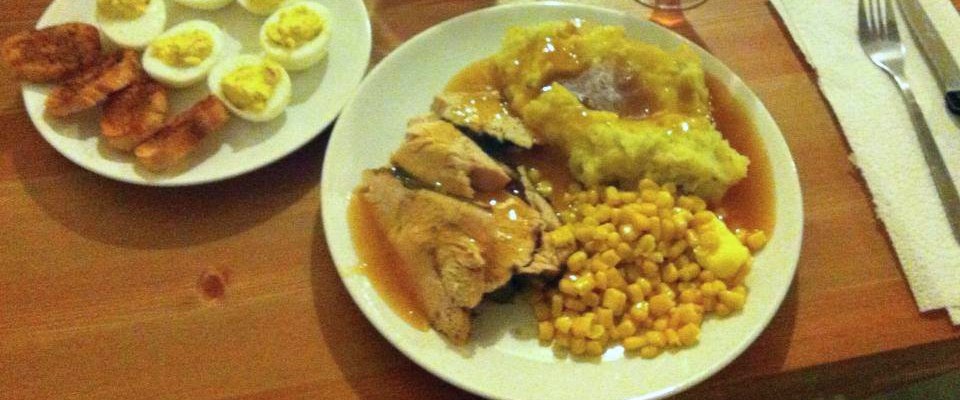
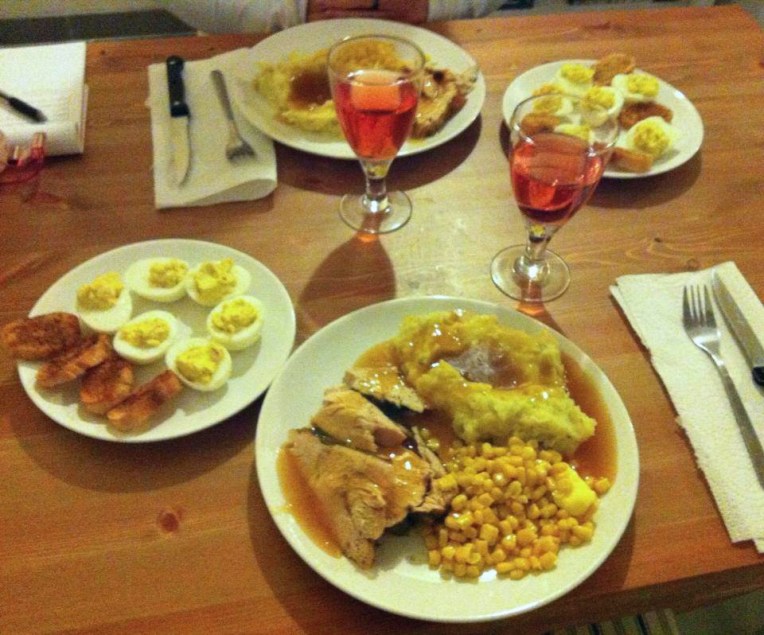
Tracy dominated our little French oven for some amazing turkey, mashed potatoes with gravy, corn, deviled eggs, garlic bread, with a local rosé wine. It was a classic, wonderful dinner followed by Religieuse creme puff pastries from our favorite pâtisserie.  Sami, the min-pin puppy, had her first “people food” with a Thanksgiving dinner all her own.

Wonderful quiet evening at home despite missing our large extended family back in the US, whom we visited with via FaceTime later in the evening.

Thanksgiving dinner 2013

Training: Camino de Santiago de Compostela Pilgrimage

With about three weeks to go until we leave for Saint-Jean-Pied-de-Port, Tracy and I are stepping up our training for the Camino de Santiago.

We have been adding weight to our backpacks and extending our daily training walk.  Our maximum had been 20 and 30 pounds respectively for a 7.5 mile walk.  We have also been taking Kiara the Chihuahua in her carrier to get both us and her used to the process.  (Kiara is now bored with the concept and usually just relaxes and watches the view from the window of her carrier or dozes.)

Tracy training for the Camino de Santiago
Alan training for the Camino de Santiago

We intend to publish an equipment list soon, but we are still “tweaking” our lists.  The biggest advice we read from pilgrims that have already completed the Camino is to minimize – minimize – minimize the weight.  500 miles is way too long a distance to carry miscellaneous items and extra weight  “just in case.”  We will probably keep working on minimizing our equipment until the day we leave.  We are currently considering the projected temperatures for the end of August and September and thinking if we need a jacket the first of October it might be better to buy one rather than carry one for 475 miles before we actually wear one.  Of course, weather is unpredictable so we will just have to (to borrow a quote from Hunter S. Thompson), “Buy the ticket, take the ride.”  The training and equipment is all part of the challenge of walking the Camino de Santiago.

We’re getting anxious to start and are sure our departure date will be here before we know it.

Carcassonne: Adam and Liz Exploring la Cité de Carcassonne and Canal du Midi

While visiting with us in Carcassonne, Adam and Liz had the chance to tour the medieval city, la Cité de Carcassonne, a couple of times.  We refer to it as “the castle in our backyard” since it is right up the street from our apartment.

Adam and Liz in front of the medieval city la Cité de Carcassonne
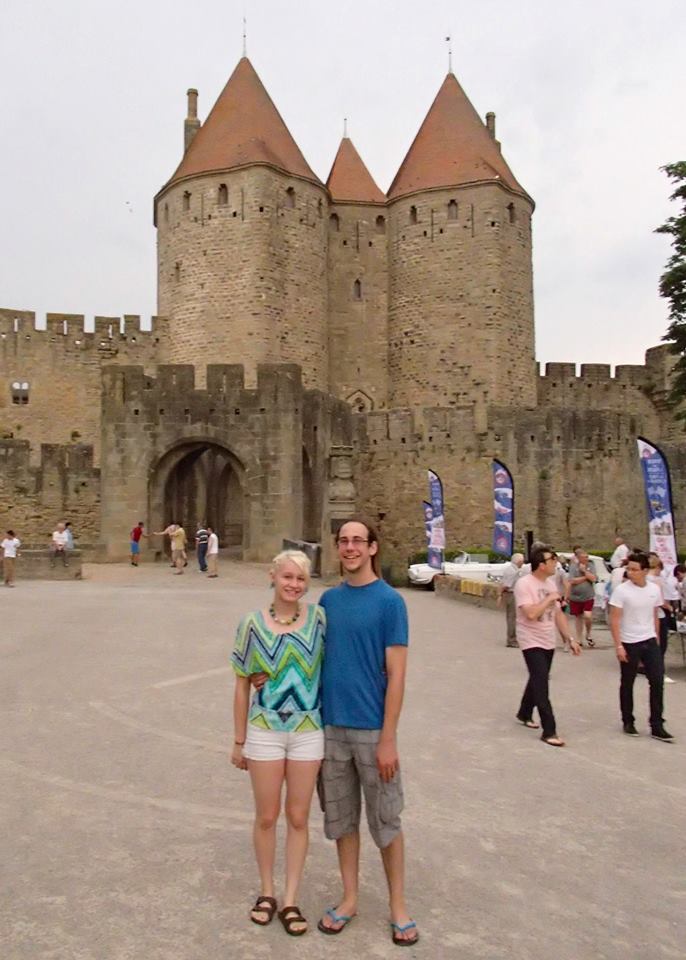
Adam and Liz in front of the Narbonne Gate of the medieval city la Cité de Carcassonne
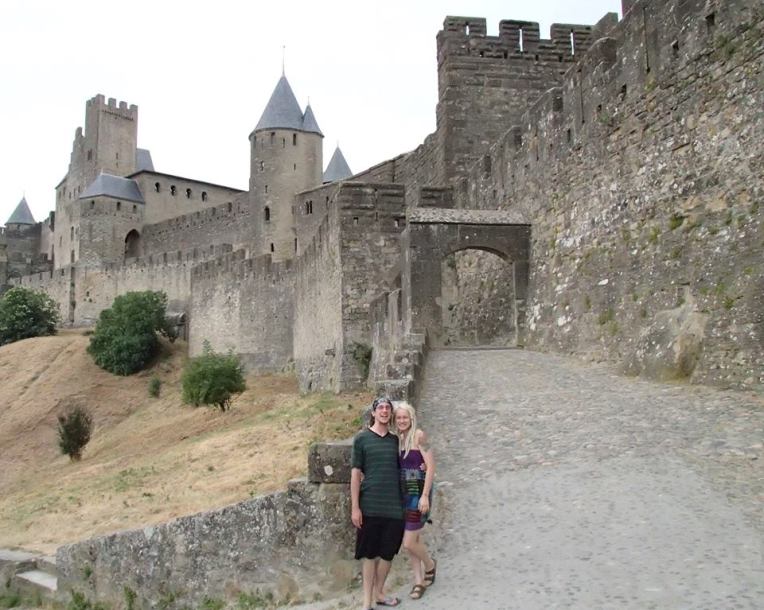
Adam and Liz in front of the Aude Gate of the medieval city la Cité de Carcassonne

A UNESCO World Heritage Site and dating back 2,500 years, the medieval city of a Cité de Carcassonne has 52 towers and two concentric walls with a total of three kilometer of ramparts.  Within the walls is a 12th century chateau built by the Trencavels, the Vicomtes de Carcassonne and the Basilique Saint-Nazaire-et-Saint-Celse de Carcassonne (the Basilica of St. Nazaire and St. Celse).  Jousting is still performed annually in the baileys of the citadel’s walls.

This slideshow requires JavaScript.

We were also able to take a short barge cruise with Adam and Liz down the section of the Canal du Midi that passes through Carcassonne.  The 17th century Canal du Midi, a UNESCO World Heritage Site,  is described by UNESCO as a “360-km network of navigable waterways linking the Mediterranean and the Atlantic through 328 structures (locks, aqueducts, bridges, tunnels, etc.) is one of the most remarkable feats of civil engineering in modern times. Built between 1667 and 1694, it paved the way for the Industrial Revolution.”  The canal is used primarily today for recreational boating.

Liz and Adam enjoying their Barge cruise on the Canal du Midi
Tracy and Alan having fun on a barge cruise on the Canal du Midi

This slideshow requires JavaScript.

During our explorations there was always time to relax, talk, enjoy a meal, or have a cold beverage.  Then on to exploring more of Carcassonne and France.

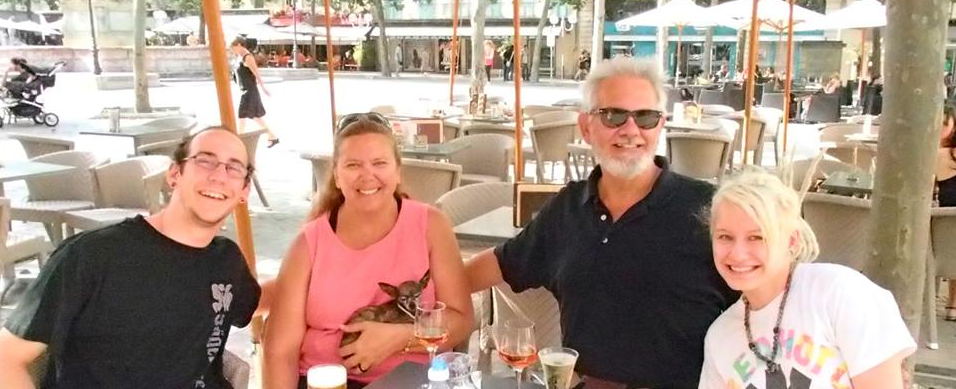
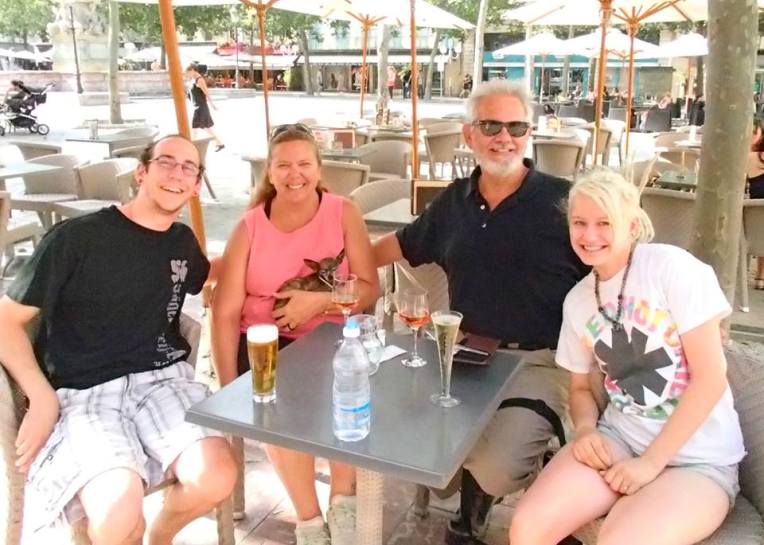
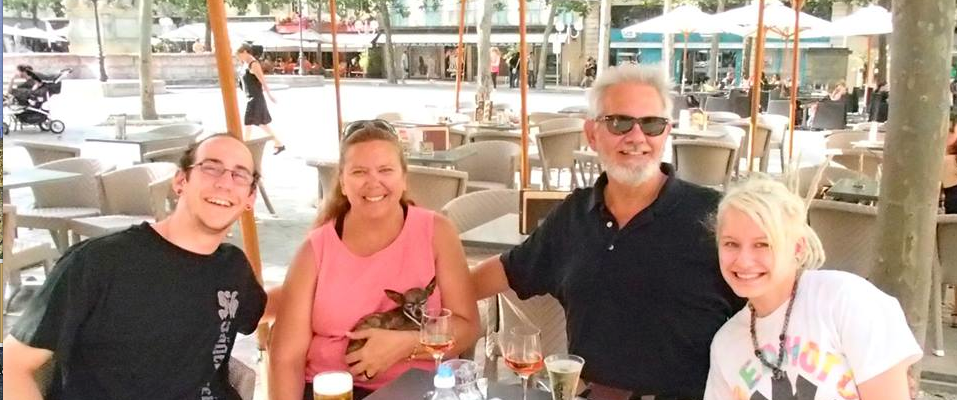
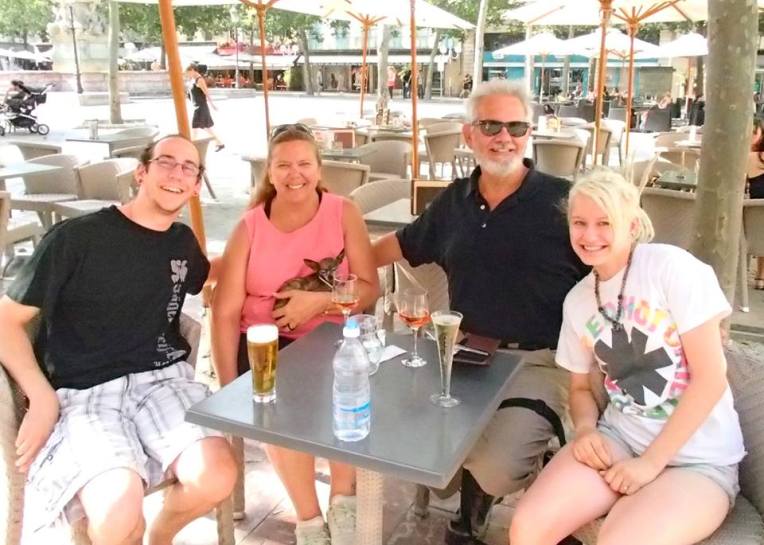
Adam, Tracy, Kiara, Alan, and Liz take a wine, beer, and champagne break in Place Carnot in the Bastide of Carcassonne
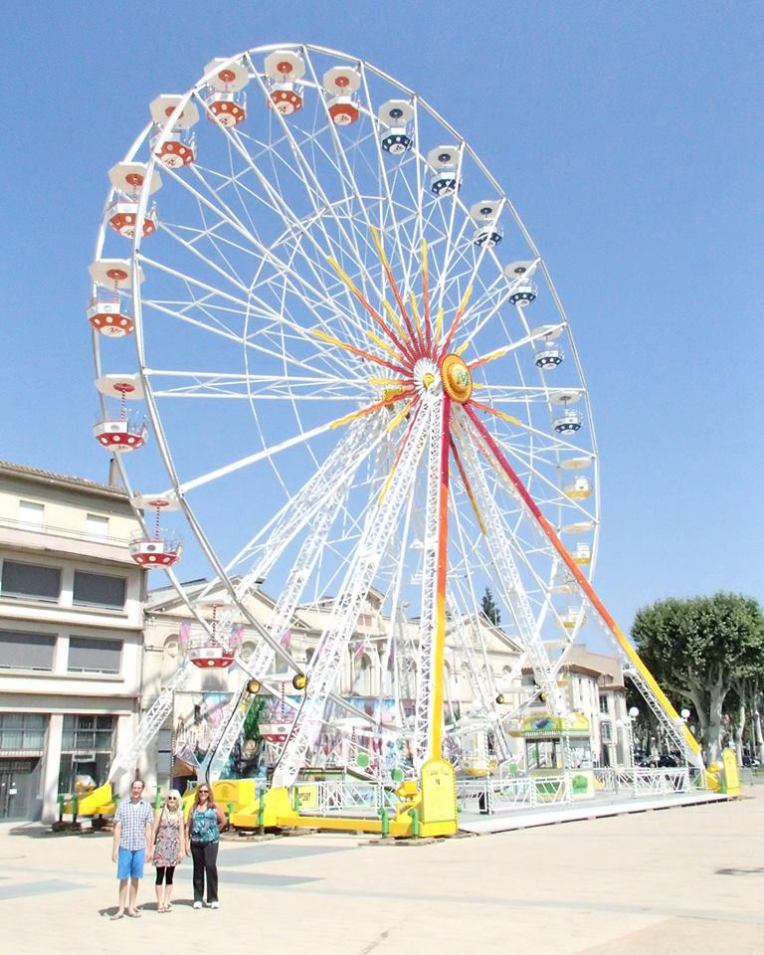
Adam, Liz, and Tracy with the Ferris Wheel set up in Square Gambetta for Festival de Carcassonne.


Carcassonne: La Fête Nationale Fireworks (Bastille Day)

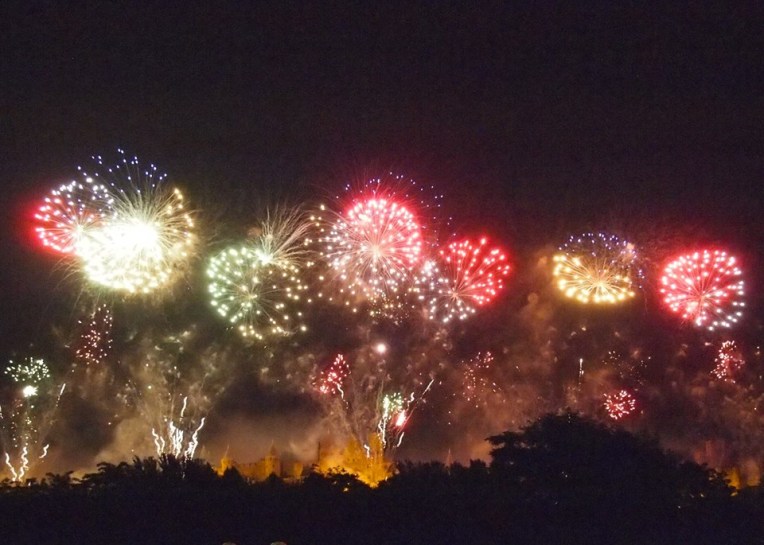
The La Fête Nationale (Bastille Day) fireworks in Carcassonne are famous throughout the world. In a beautiful medieval setting, the fireworks are lit among the ramparts and, as they shoot into the sky, they light the city below. The display has become extremely popular since its inception in 1898, with more than 700,000 people attending the festivities each year. It is the largest fireworks display in France with a full 25 minutes of pyrotechnics including “Burning the Cite,” immersing the medieval city of la Cité de Carcassonne in a red glow like the city is under siege and on fire.

Tracy, Adam, Liz, Kiara, and I watched from the banks of the river Aube along Quai Bellevue.  We arrived early and enjoy a picnic, Adam Juggled for the crowd, watch people play petanque, Kiara was doted on, drank wine, and we chatted with our neighbors while waiting for the fireworks to start.  A festive and friendly atmosphere.

La Fête Nationale (Bastille Day) is the French national holiday commemorating the storming of the Bastille on July 14, 1789, a pivotal event the anti-monarchy revolution.

Liz, Adam, Tracy, and Kiara enjoying a picnic while we wait for the fireworks to start.
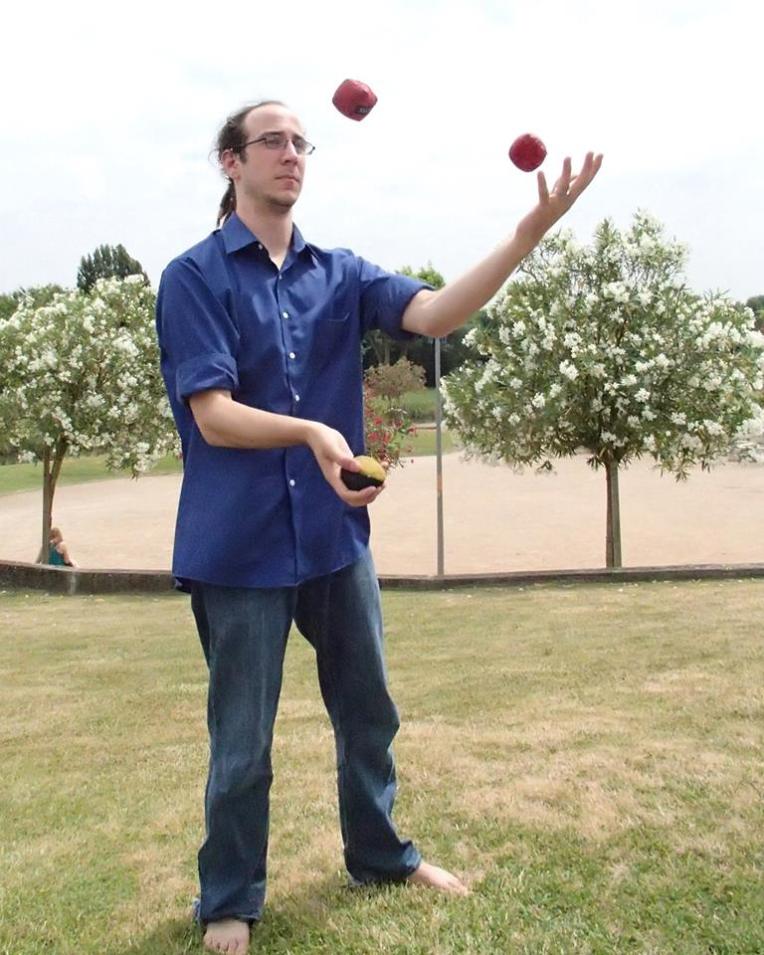
Adam juggling for the crowd while waiting for the fireworks
Fireworks over the medieval city of la Cité de Carcassonne

This slideshow requires JavaScript.

Carcassonne: 25ème Tour de l’Aude (25th Tour de l’Aude Vintage Car) Rally

With Adam and Liz newly arrived in Carcassonne, they had an opportunity to attend one of the many events that seem to be happening all year-long.  Their first event was at the medieval city of la Cité de Carcassonne:  the 25ème Tour de l’Aude des Voitures Anciennes en Pays Cathare (25th Annual Tour de l’Aude Vintage Car Rally through Cathare Country.)  Eighty plus cars from 1914 to 1945 of the most prestigious brands (Delage, Delahaye, Rolls Royce, Talbot, Bugatti …) from all over Europe. Like “Hot August Nights” for vintage European cars (plus a few US cars like a classic Mustang and Cadillac.)

Tracy, Liz, and Adam at the 25ème Tour de l'Aude des Voitures Anciennes en Pays Cathare (25th Annual Tour de l'Aude Vintage Car Rally.)
Tracy, Liz, and Adam at the 25ème Tour de l’Aude des Voitures Anciennes en Pays Cathare (25th Annual Tour de l’Aude Vintage Car Rally.)
Liz and Adam at the Narbonne gate of the medieval city of la Cité de Carcassonne

This slideshow requires JavaScript.

Getting A French Bank Account

A project I started in the first few weeks after we arrived in Carcassonne was setting up a French bank account.  This wasn’t the same as those people you read about in the news with numbered foreign bank accounts in Switzerland, the Cayman Islands, Bermuda, or Luxembourg as a tax dodge.  Our  intentions is to follow the financial rules and to stay under the $10,000 maximum balance in a foreign account that would require a FBAR, or “Report of Foreign Bank and Financial Accounts,” Treasury Form TD F 90-22.1 be filed with the US IRS.

We wanted a French bank account for three common sense reasons.

The first reason was that to minimize foreign transaction and conversion fees from our US bank.  An international wire transfer currently has a flat $35.00 fee compared to being “nickel and dimed” with withdrawals and conversion fees  every time we patronize French ATMs and businesses with our US bank cards. Being on a fixed income we want to minimize the monthly fees that we can control.  It would be less expensive for us to transfer one larger amount of cash into a French bank account and use a local debit card for purchases.

Secondly is that France was one of the innovators of the “Chip and Pin” style, EMV credit/debit card.  (EMV is Europay – Mastercard – Visa, a global standard for integrated circuit cards and “IC” card capable “point of sale terminals” and ATMs used to authenticate credit and debit card transactions.)  While a traditional US style cards will work in many ATMs and at some businesses in France, many businesses will only accept the “Chip and PIN” style card or not understand how to “swipe” a traditional US card.  We wanted greater flexibility in our day-to-day life and our US bank is not issuing “Chip and PIN” cards yet.  Regular US cards (with some exceptions) are not scheduled to transition to “Chip and PIN” EMV technology until 2015-2017.   On their recent visit to France, Adam and Liz found their US cards worked at the ATM but not in restaurants or clubs.

Finally, there are times when technology fails and an ATM or business does not get a response back from international data lines and computers with US-based cards.  We wanted a back-up in the event of sunspots, earthquakes, satellite outages, volcanos, undersea cable breaks, or the “Blue Screen of Death.” I like  “belt and suspender” redundancy.  We also wanted a backup in case our US card is lost or stolen.

The process of setting up a French bank account took about 12 weeks for us to complete from beginning to end.  Because our US bank is Bank of America, we selected French bank BNP Paribas (the fourth largest bank in the world) who is Bank of America’s foreign partner in France.  Because of this affiliation, Bank of America will waive some fees.

We made an appointment at the local BNP and met with a very helpful bilingual bank officer.  The only snag was that she was bilingual in French and Spanish. (We are very close to Spain in Carcassonne.)   Between our rudimentary French, my old police Spanish, basic Italian, Google Translate, and our bank officer’s very basic English we started the process for a bank account with the “Chip and PIN” style debit cards referred to as Carte Bleue.  We left the meeting with the paperwork started, but we needed to return with additional documentation of our residency.

Between our first and second appointment to the bank we had our meeting with OFII (L’Office Français de l’Immigration et de l’Intégration – French Immigration) which (after a medical exam, chest x-ray, and application review) granted us our Titre de Sejour (resident permits) to upgrade our original visas.

Titre de Sejour
Titre de Sejour

On our second appointment at the bank we brought photocopies of our Titre de Sejour and a detailed copy of our lease with rent receipts to prove our residency in Carcassonne.  What our bank officer normally needed by bank policy was also a utility bill (gas, electricity, a land-line telephone)  as further proof of residency at the address.  We explained (often using pantomime, Italian, and pidgin French) that all the utilities were in our landlord’s name and without a local bank account we could not start a utility account.  After conferring with her bank manager the solution was found to send us a registered letter at our address to sign and return as final proof of residency.  A very elegant and helpful solution.  We appreciated that the bank’s management could “think outside the box” and work with our odd circumstances.  In anticipation of the final approval by the bank manager, our bank officer finished the paperwork, assigned us an account number, and told us to return once the registered letter was signed to pick up the bank cards.

The registered letter arrived three days later which we signed and had the receipt sent back to the bank.  Soon after claim tickets for our Carte Bleue debit cards arrived in the mail along with “Welcome Customer” letters from BNP.

Now for the confusing part.  We went to the back to pick up the cards and were told that they hadn’t arrived from the manufacturer yet and to come back in a week.  A week later we were told the same thing.  The third week we were getting worried that with our inadequate French, we had missed a step in the process.  Should we have made an initial deposit into the account before the bank would release the cards?  The fourth week later we spoke with our Bank Officer who was able to convey that because of the internal electronics it takes the manufacturer four to six weeks to make the cards and asked us to be patient and the bank would call us when the cards arrived.

In the mean time our son Adam and his fiancée Liz arrived for a visit and we put the bank cards concerns on hold and had a great visit with them.  The day after Adam and Liz left, we received a call from the bank (I stumbled through the telephone conversation in French) that our cards had arrived.  After a short walk to the bank (with lunch on the way) we were proud owners of our Cartes Bleue and had officially established a functioning bank account in France.  It took two appointments over six weeks and six weeks of waiting for the cards to be manufacturer and arrive at the bank.

Another small step in establishing our expat life in Europe. Now we will work on the online International Transfer process with Bank of America. We expect to have everything set up, validated, and our first wire transfer completed by the middle of August – just in time for our Camino trip!

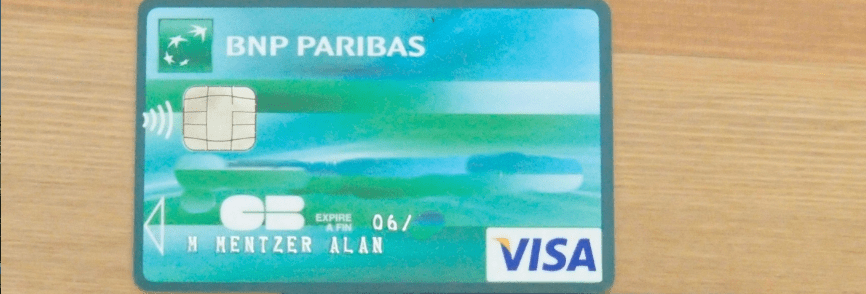
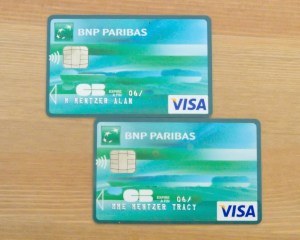
Alan and Tracy's Cartes Bleue
Alan and Tracy’s Cartes Bleue

Our First Visitors: Adam and Liz Travel to France

We were thrilled to have our first visitors since we started our expat life abroad.

Our youngest son Adam and his fiancée Liz spent 18 days with us.  We combined the visit with travel to Paris, Barcelona, the Mediterranean Sea, and sharing our adopted home in Carcassonne.  I plan to write about their visit by breaking it up into an individual blog postings for each of the different locations we enjoyed exploring together.

Alan, Tracy, Liz, and Adam in front of the Pyramid at the Louvre Museum in Paris

It was such a pleasure to share our new life with Adam and Liz (and to congratulate Adam on earning his bachelor degree just a few weeks previous to their visit.)  We explored shared interests in great cities, history, cultures, lifestyles, art, travel, architecture and enjoyed conversation, food, and drink.  Adam and Liz are vegetarians so we had an opportunity to examine a totally different food culture in our travels than we had previously had a chance to try.  Adam juggled on the streets of Paris, Liz sampled Sangria in Barcelona, we splashed in the Mediterranean, Adam and Liz demonstrated their Spanish language skills, we celebrated Adam’s 22 birthday (and Adam and Liz attended a performance of his favorite band that just happened to be in town on his birthday for Festival de Carcassonne), and all of us (including Kiara) watched France’s biggest fireworks extravaganza for Bastille Day with the medieval city of Carcassonne as a backdrop.

Adam, Tracy, Kiara, Alan, and Liz having a wine, beer, and champagne break in Place Carnot in the Bastide of Carcassonne

All in all, it was a spectacular visit which made us look forward to our next visitors.