600th Anniversary of the Procession de la Sanch à Perpignan

Tracy and my most recent micro-adventure was joining 10,000 other spectators at the 600th observance of the annual Procession de la Sanch (The March of the Penitents) in Perpignan on Good Friday, 2016. (La Sanch is pronounced “lah sank.”)
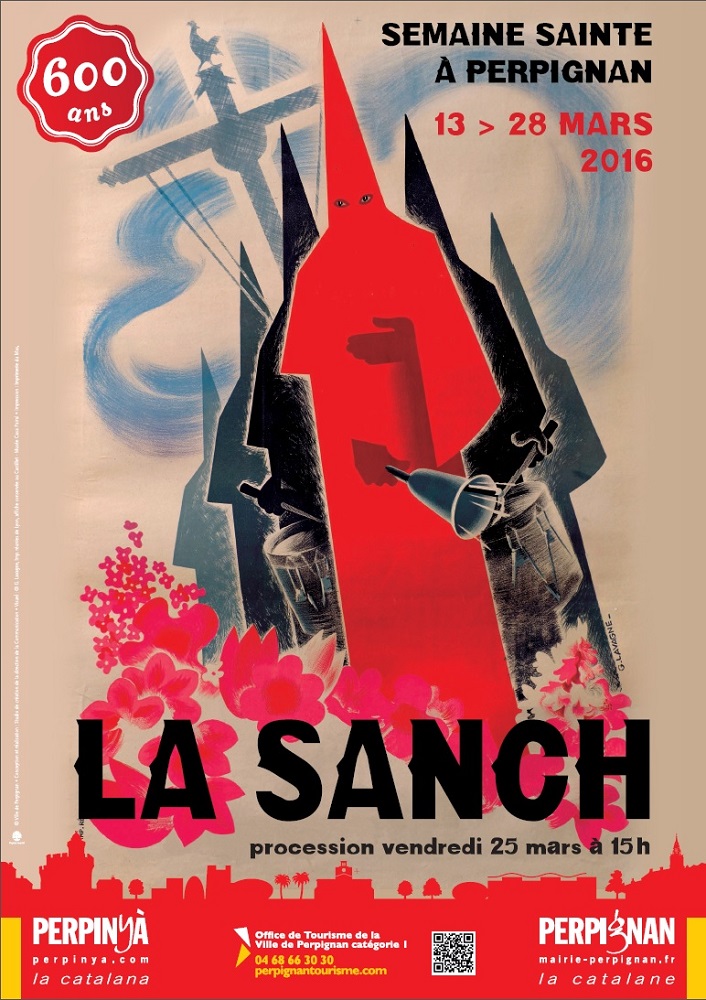
Poster of the Procession de la Sanch à Perpignan (Perpignan Tourism Office)
Poster of the Procession de la Sanch à Perpignan
(Perpignan Tourism Office)

Outside of Spain, the Procession de la Sanch isn’t really performed any longer. In France, it is only held in the southern Catalan country. The largest and most famous of the French penance processions still performed during the Semaine Sainte (Easter Holy Week) is the Procession de la Sanch a Perpignan. Nearby Arles-sur-Tech and Collioure also still perform la Sanch ceremonies, though on a smaller scale. The event was originally brought to Perpignan in 1416 by Saint Vincent Ferrier, a Valencian Dominican. (Remember, Columbus reached the “New World” in 1492, 76 years after the first Procession de la Sanch.) The Pyrénées-Orientales département (which includes Perpignan, Arles-sur-Tech and Collioure, sometimes referred to as Catalunya Nord) has strong Spanish and Catalan roots that has helped this French department retain a traditional event that is typical of the Semana Santa (Spanish Holy Week). The strength of this French-Catalan-Spanish blend can be easily seen in the departments’ flag, gold and red stripes, the same colors as those used in Catalan and Spanish flags.

The somber, masked procession began centuries ago as a method to support condemned men on their final march to execution and ensure their Christian burial. La Sanch’s robes and the conical hoods (the hood is called a Caperutx — today the entire ensemble is referred to as Caperutx) were worn by the executioners and the prisoners to conceal their identities. Apparently early on in history the victims and families of the victims were a bit too happy to pull them out of the procession and just beat them violently to death in the streets.

The Caperutx worn during La Sanch are either black (worn by the penitents representing death) or red (worn by the leader, the Regidor, representing blood), only the children and priests in the procession (representing the innocents and the saved) wear white. A Regidor, in his red Caperutx is at the head of the procession and rings an iron bell to warn of the coming procession. The robes worn in la Sanch, while reminiscent to the costumes worn by the Ku Klux Klan, actually predate the Klan’s by 500 years and have a completely different origin and meaning.

About 700 members of local associations, Confrérie de la Sanch, organize, march, and carry the approximately 35 “misteris” in the procession. (“Misteris” mean mysteries in Catalan.) The misteris are litters with life-size portrayals of scenes from the Passion of Christ. Weighing between 60 and 100 pounds, the misteris may be carried by up to eight persons. Some of the penitents in Caperutx carried drums and beat a steady, slow tattoo for the procession. Penitents also may sing”goigs,” traditional songs dating back before the 15th century, that recount the sadness of Mary’s suffering in Calvary. We didn’t hear a “goig” being sung while we were watching the procession.

The Procession de la Sanch takes three hours (from 3:00 to 6:00 p.m.) to circle the historic downtown of Perpignan and passing other parishes, starting and ending at Église Saint-Jacques (Saint James’ Church) which dates back to 1245.  

Prior to the procession start, we visited Église Saint-Jacques. We found a beautiful 13th century church with a unique bell tower that was built in the southern Gothic style. Its most unusual feature is that there are two Catalan-styled altarpieces at opposite ends of the single nave with the organ at the center. Inside the church were many of the Misteris with their fresh flowers being displayed before the procession. We had a wonderful opportunity to see the Misteris up close and appreciate their size and weight. We spoke with another visitor to the church who was admiring the Misteris. He was French, but had completed his doctorate at the University of Minnesota. He recounted the history of the event with us and told us we were very welcome there and encouraged us to have a look around the church. Since Tracy and I share an appreciation of sacred architecture, his invitation was quite welcome.
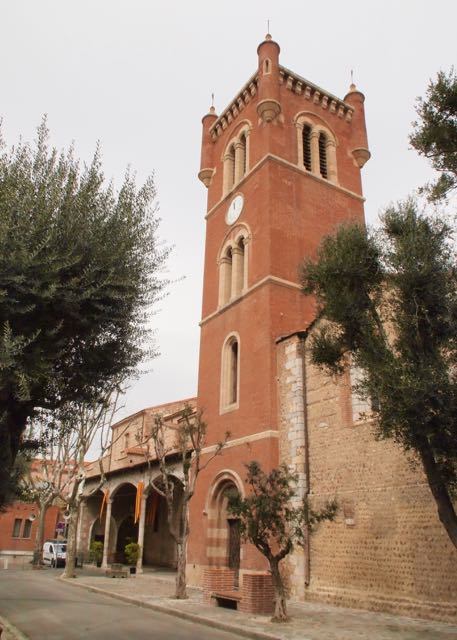
Église Saint-Jacques de Perpignan (Saint James' Church)
Église Saint-Jacques de Perpignan (Saint James’ Church)

This slideshow requires JavaScript.

We choose a location to watch the procession in Place Puig (Puig Square) in the Quartier Saint-Jacques which is also referred to as the Quartier Gitan because of its significant Gitan (Roma people, often called Gypsies or Gitanos in Spain) community. While waiting for the event to start we visited with a local Gitan man who explained the Gypsy history of the area and how the former military barracks adjacent to Place Puig were converted to public housing and was now home to primarily Gitan peoples.

Procession de la Sanch Map (Perpignan Tourism Office)

The procession was preceded with a loudspeaker explanation about the history and meaning of the event.  After the announcement we heard the tattoo of drums and the procession became a solemn, slow-moving parade.  Approximately 700 men, women, and children participated in the procession.  Although it is easy to fixate on the penitents wearing the Caperutx hoods and robes, there are a surprising number of women dressed in black marching in the procession.  The misteris on their litters looked impressively heavy as their were carried on the procession. Both the men and the women carried misteris.  The carriers had an unusual technique of using a forked walking stick under the carrying poles to support the weight of the misteris when the procession stopped and to trade carriers. The use of the forked sticks was performed without verbal direction with orders by tapped by the team leaders with their stick on the ground to alert the other carriers. Tracy noticed that several women were wearing heels up to 4 inches to allow all the women carriers to be the same height. Several of the hooded penitents wearing the Caperutx elected to walk the entire route and to carry the misteris in their bare feet. 

I spoke with one of the marchers who was collecting charity contributions from the crowd.  He attempted to chat with us in French, Spanish, Catalan, and, I think, Caló (Gitano-Roma) before I explained that our French and Spanish was very poor and that we were Americans. While saying he didn’t speak English, he spoke enough English welcome us, thank us for a supporting the procession,and gave us a prayer card with the “Our Father,” . . .  in Catalan, of course. It is always amazing to us the number of multilingual people we meet in the Pyrénées-Orientales département, even though English is seldom one of those second languages, usually the French people in this area of the south will most often also speak Catalan, Spanish, or Maghrebi (Moroccan Arabic – Darija.)

At the end of the official procession pasted, members of the public joined at the end of the parade and followed the official participants.

In all, it was a unique opportunity to watch the 600 year old Procession de la Sanch in person. A chance to observe a traditional Catalan and Spanish religious ceremony performed in a very secular modern France. To be involved in the conclusion to the penance and atonement of the Lenten season in a historic ritual dating back to 1416. It was an extremely powerful experience.

Wishing you all a very Happy Easter.
This slideshow requires JavaScript.


Parfait! Third Renewal of Our Residency Permits (Cartes de Séjour) Part 1

Our third effort at renewing our Cartes de Séjour (residency permits) was exceptionally easy. We seem to understand the renewal process well now and are experienced with the requirements at the Bureau des étrangers (immigration office) at the Préfecture des PyrénéesOrientales in Perpignan.  It also help that we started preparing in January although the permits do not expire until the end of March.

The Préfecture des PyrénéesOrientales is extremely responsive to e-mail.  I was uncertain about which forms to download from the Préfecture’s website, but an e-mail was answered in 24 hours with links to the correct forms and a currently list of supporting documents.  The list of documents was the same as last year. They were also kind enough to make an appointment for us to submit our renewal application.  The Préfecture’s e-mail responsiveness saved us from making a physical trip to Perpignan to pick up forms and make an appointment saving us a great deal of time while we were in the process of changing residences.

The list of supporting documents for our renewal appointment is actually short and straight forward.  Bring the original document and a copy of the following:

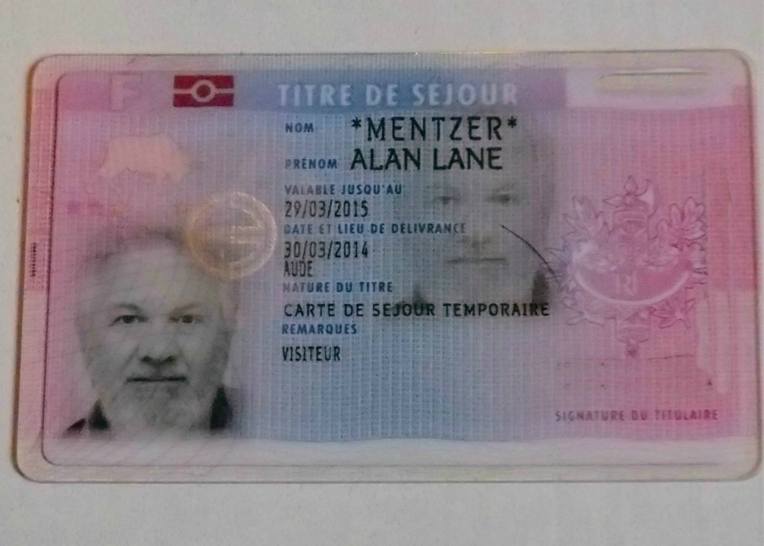
1. Current Carte de Séjour (residency permit) that is being renewed. Something that was different this time: during our appointment our Préfecture officer made an extra copy of both Carte de Séjours and added them to each other’s renewal application.

Carte de Sejour
Carte de Sejour

2. Passport with copies of pages with identification information, expiration dates, with all entry stamps, and visas.

3. Marriage certificate since our passports do not confirm marital status. This document was not specifically on our list from the Préfecture des PyrénéesOrientales but from past experience we knew marriage status had to be confirmed at each renewal.  There is also an attestation that we are married on the renewal form that our Préfecture officer witnessed us signing.

4. Birth certificate.

5. Proof of the location of residency with our lease, rent receipts from last year, and our power bill (A French Power Bill is the Ultimate Identity Document)

6.  Four recent passport-style photographs.  There are passport photo machines everywhere from retail stores to train stations.  Photos are required with almost all government applications.

7.  €106 payment for each of us submitted by timbres fiscaux (tax stamps.)  The tax stamps are sold in specific Tabacs (tobacco and convenience stores).  This was a bit more challenging since I couldn’t find a Tabac in Argelès-sur-Mer who sold them and in Perpignan I was also having difficulties.  We were finally sent to the Trésor Public (Public Treasurer) at the Centre Des Finances Publiques à Perpignan where there was a helpful gentleman at a cashier window who was happy to sell us the timbres fiscaux.

 Tax Stamps (timbres fiscaux)
Tax Stamps (timbres fiscaux)

8. Proof of financial independence equivalent to 12 times the monthly French minimum wage.  I had previously requested an income verification letter about our pensions from the Nevada Public Employees Retirement System.  We also prepared a translation including a conversion of dollars to euros at the current exchange rate.  That was the only document we bothered to translate.  We submitted a confirmation letter from our French bank that stated that we were customers in good standing too.

9. Sworn handwritten attestation not to exercise any occupation in France. There is also an attestation on the renewal form that our Préfecture officer witnessed us sign.  Our visa status is specifically for retirees and prohibits us from working in France.

10.  Self-addressed, stamped envelopes which are available from any supermarket or post office.

Tracy (A.K.A. the “Queen of Organization”) took my collection of paperwork, rearranged and organized our documents exactly in the order of the checklist, and made certain the required spaces on the renewal form were filled in.

Carte de Sejour Renewal Paperwork with our mobile file of personal documents

On our appointment date of March 15, (yes, the ominous ‘Ides of March’)  we took the €1 Bus the 23 kilometers (14.5 miles) from Argelès-sur-Mer to Perpignan.

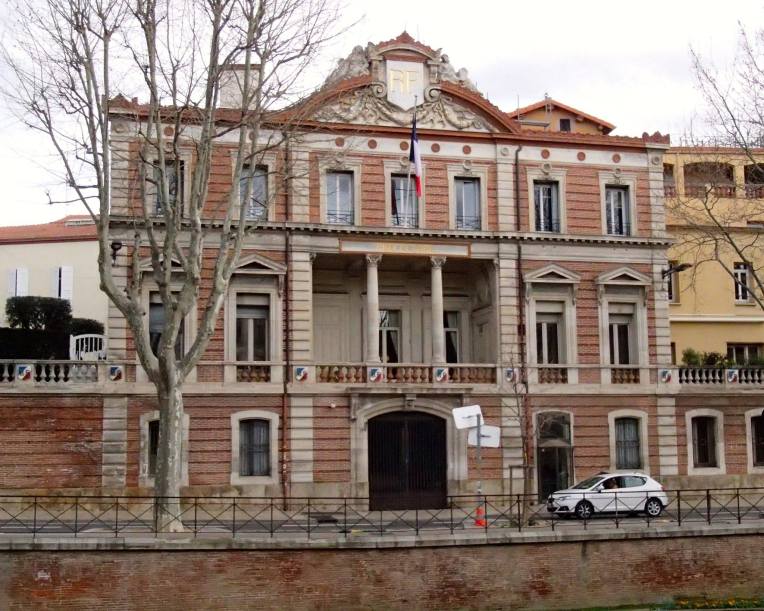
Préfet des Pyrénées-Orientales, Perpignan.

Our appointment was at 9:15. so we took the early bus and arrived in Perpignan with time to enjoy a café crème and a pain au chocolat before walking to Préfecture’s annex in the Hôtel D’Ortaffa located behind the actual Préfecture. We arrived as the office opened at 9:00 and waited as a police officer from the Police Nationale hand-checked the bags of visitors as they entered.

Tracy having a café crème at Le Grand Café de la Poste in Perpignan
Hôtel D'Ortaffa, Perpignan
Hôtel D’Ortaffa, Perpignan

There was a short line at the check-in window, but before we could reach the window, a young customer service representative in a red vest looked at our appointment e-mail and walked us into the immigration office.  We waited a couple of minutes and were called to a window for our appointment at exactly at 9:15.

Our very helpful and friendly immigration officer was extremely impressed with Tracy’s organization and deemed it “Parfait!” (Perfect!) The only issue was with the electronic fingerprint scanner which had difficulties reading my dry hands and it took several attempts to get readable prints.  Tracy had no such problems.

This renewal was much simpler than last years since we were not changing regions and we had a regular lease and power bill.

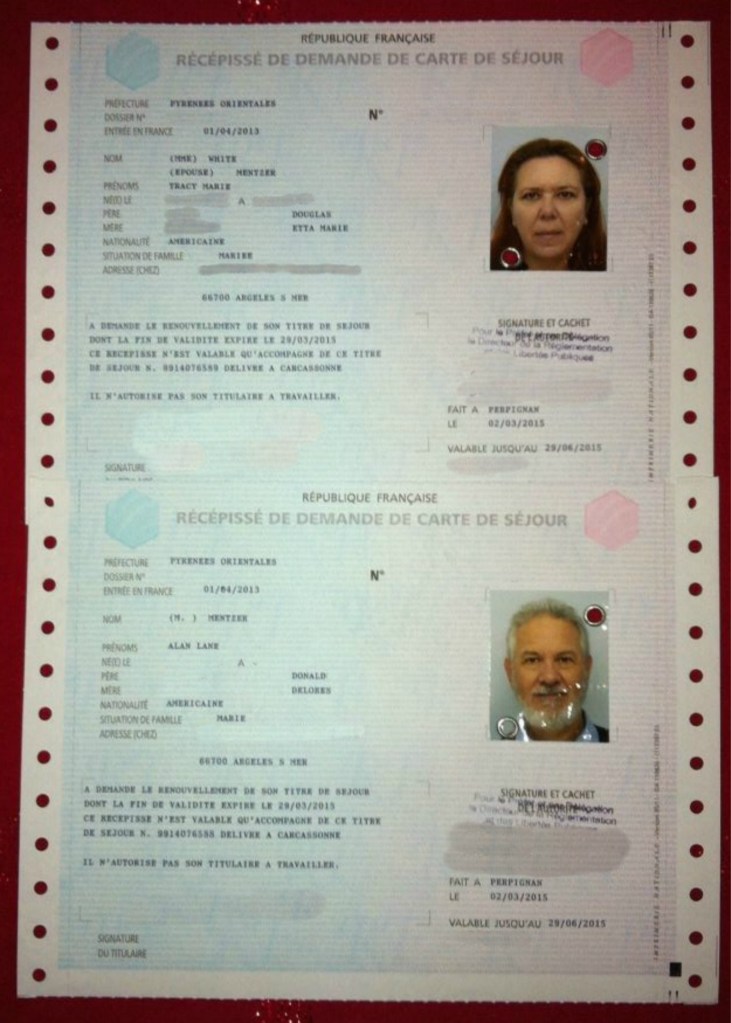
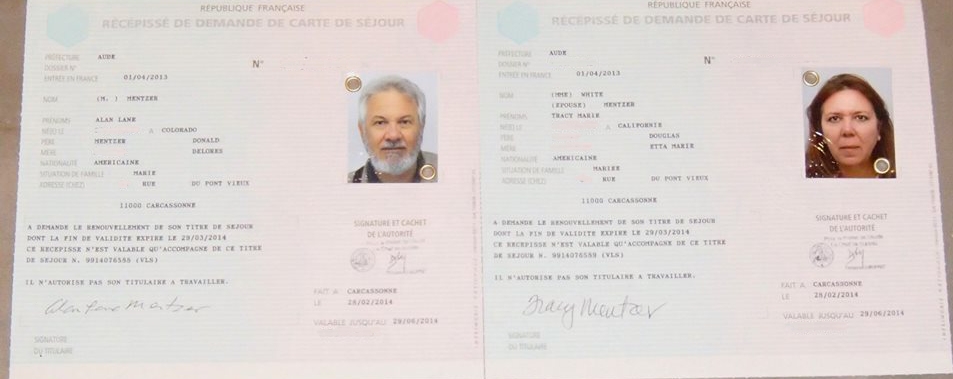
Our final step was to sign and accept our Récépissés de Demande de Titre de Séjour (receipt of application for residency permits) that serve as temporary Cartes de Sejours. Our immigration officer advised us that we will be sent notification letters that will let us know that we can return with our timbres fiscaux (tax stamps), passports, and Récépissés de Demande de Titre de Séjour to collect our new  Cartes de Sejours for 2016-2017.

Récépissés de Demande de Titre de Séjour 2015

Success!

And Tracy received official recognition that she is, “Parfait!” But I already knew that. We were “in-and-out” of the Préfecture in 45 minutes total after processing  both our renewals.  I know there is a stereotype of cumbersome French bureaucracy, but (“knock on wood”) we have had minimal challenges and all the representatives have been very patient and helpful.

Now we just have to wait for our notice in the mail to arrive and our return trip to Perpignan..

Tracy in front of the Castillet near the Prefecture in Perpignan

Related posts: First Renewal of Our Residency Permit (Titre de SéjourCartes de Séjour Arrived To Help Celebrate Our First Year In France,  Second Renewal of Our Residency Permits (Cartes de Séjour) Part 1, and Second Renewal of Our Residency Permits (Cartes de Séjour) Part 2


Voting in the Global Presidential Primary

Hello. My name is Alan and I’m a politics addict.

I was part of the Twenty-sixth Amendment’s first class of 18-year-old voters allowed to participate in federal elections and have voted in every election since. My first degree was in political science and I have a master’s degree in public administration and public policy. I have a personal philosophy of “voting for the person, not the party” and have changed my party affiliation numerous time to support a candidate I believed merited my support in a primary election and I have voted for local, state, and national candidates of all parties. I have volunteered to work on election campaigns. I follow elections, legislative sessions, and court decisions the way some people follow the NFL football season. I believe voting is a privilege and a duty and find it appalling that the US has such low voter participation. I strongly support programs like Oregon’s “Motor Voter” system to encourage more people to actively exercise their political franchise. Since moving to France Tracy and I have made a point of “voting back home” by use of absentee ballot.

Hello. My name is Alan and I’m a politics addict.

I can tell you that Tracy, who does not share my politics passion, puts up with my obsessive following of all things political with the same kind of patience that she did when the kids were little and telling her why they HAD TO hit their brother first.

I had recently — and by recently I mean every day since the Iowa Caucus and New Hampshire Primary — been lamenting the fact that our home state of Nevada has replaced primary elections with the caucus system since 2008. There is no option to participate by “absentee voting” in a caucus which requires face-to-face participation.

However, while reading about the upcoming March 1, 2016 “Super Tuesday” presidential primary elections, I discovered that Super Tuesday includes the Democrats Abroad Global Presidential Primary that we can participate in.

Global Presidential Primary logo (Democrats Abroad website)
Global Presidential Primary logo
(Democrats Abroad website)

Democrats Abroad is a fifty-two year old, official Democratic party organization representing US citizens living permanently or temporarily overseas. It has “state-level” recognition by the National Democratic Party for representing overseas voters. The Republican Party has a similar organization, Republicans Overseas, but the Republican National Committee does not considered Republicans Overseas a “state committee” and it does not conduct its own global primary.

From 1976 to 2004 Democrats Abroad have sent delegates to Democratic National Convention using a caucus system. Since 2008, Democrats Abroad have conducted Global Primary Elections for Democratic party voters among the approximately 8,700,000 Americans that live overseas.

US States by Population with the Number of Overseas Americans (Democrats Abroad website)
US States by Population with the Number of Overseas Americans
(Democrats Abroad website)

Participation in the Global Primary Election is extremely easy.

1.) Be living permanently or temporarily abroad.

2.) Take a couple of minutes to join Democrats Abroad via their website.  You list your name, date of birth, phone numbers, US voting address, and your physical address abroad. After completing your application you are sent a e-mail link to activate your membership account.

3.) You are then authorized to vote at one of the 121 official Voting Centers in more than 40 countries, during the week of March 1 to March 8. (There are ten Voting Centers throughout France.)

4.) If you are unable to vote in person (Toulouse is our closest Voting Center and we are in the middle of moving), you can e-mail, fax, or “snail mail” your ballot to Democrats Abroad.  In just a few minutes, Tracy and I downloaded, filled-in our indentification information, selected a candidate, signed, scanned, and e-mailed our ballots to Democrats Abroad ahead of the March 1 to March 8 physical voting period. A mailed ballot must be postmarked by March 8 and ballots received after March 13, 2016 as deemed invalid and will not be counted.

5.) Of course, you can only vote once for a presidential candidate: either through the Global Primary Election or through your home state. You can either vote absentee, or participate in the caucus in your home state. or participate in the Global Primary Election.

Based on the results of the Global Primary Election, Democrats Abroad will send 21 delegates to the 2016 Democratic National Convention in Philadelphia.  Our home state of Nevada will be sending 43 delegates to the Democratic National Convention.

Tracy told me I was “way too excited” about being able to vote in a primary election.

Hello. My name is Alan and have I mentioned that I’m addicted to politics?

Tracy is across the room on her laptop diligently searching for a 12-step program.


A Beautiful Valentine’s

My granddaughter Lillian had her first Valentine’s Day at school this week. As many of you know, Lillian has some very creative parents who strive to make each day imaginative and fun for this uber-special kid and her adorable big sister, Lorelei.

Because Lillian isn’t able to assemble her own cards, her Mommy — our daughter Danielle — made up the Valentine’s Day cards for her friends in class.

Being the Mom of a special needs kid comes with some unique challenges and time constraints. I love that my daughter is always able to find the time to do something as unique and special as the child she’s raising.

Lillian LOVES glow sticks. The kind that can be made into necklaces and bracelets are especially nice. This year Danielle shared Lillian’s love of glow sticks with special Valentine’s Day cards that read: “You Light Up My Life!”

Lillian has a classmate who is blind. But Danielle wasn’t about to leave this child out of the special joy of receiving a hand-made Valentine’s card, so she did one of the cards in Braille.

A little research on the Internet, the creative use of a ball-point pen as a stylus and voila, one hand-made Valentine’s card in Braille!

I cannot express enough how much I love this daughter of mine. She amazes me with the depth of creativity she employs to make sure her daughter’s childhoods are fun, loving, and special.

Kudos baby girl, you ROCK!


A French Power Bill is the Ultimate Identity Document

Tracy and I have never been so excited to receive a bill in our lives; yet we were smiling like new parents when we checked the mail and found our first electricity bill from EDF (Électricité de France). Also like a new parent, we photographed it, scanned it, and placed it carefully back in its envelope for  safe keeping.

To quote from “7 Things You Can’t Understand If You’re Not French,” an article by Kate Robinson.

“Your electrical bill is the most important document you own.”

Ah, the justificatif de domicile. Proof of residence is perhaps the most sought-after document in your personal arsenal of administrative papers. If you want to get your driver’s license, renew your passport, open a savings account (yes, at the same bank where you’ve had a checking account for the last two years) or do anything else involving a visit to a guichet (service counter like DMV), you’ll need to prove where you live. No, the address on the back of your state-issued ID card doesn’t cut it. You’ll need to print or dig out an electrical bill less than three months old.”

and from “You Know You’ve Gone Full-French When . . . ” by Rebeca Planter.

“You keep a relatively recent electric bill in your purse; never know when you’ll need to prove your address… again.”

Our previous rental contracts in France included the cost of utilities, so we never had to obtain an electricity, gas, or water account. That has frequently created a bureaucratic issue for us as to how to establish our physical address.  Just like visiting the Department of Motor Vehicles (DMV) back in the US, French government agencies have specific lists of approved documents they will accept as documentation.

Tracy and I have managed over the last few years in France without a utility bill to serve as our  justificatif de domicile (proof of physical address) by using alternative methods to establish our physical address like:  1.) having the bank send a registered letter to our apartment and returning it to the bank also by registered mail, 2.) producing a rental contract with a stack of signed rent receipts (having our own Quittance de Loyer book [rental receipt book] has repeatedly been a lifesaver for us), 3.) obtaining an “attestation sur l’honneur” (an affidavit) of occupation from our landlord, and 4.) obtaining from the Mairie (town hall) a memorandum stating we were residents of that town and listing our physical address.

Now, just in time for our application process for our third annual renewal of our Carte de Séjour (our Residency Permits, what in the US would be our “Green Cards”), we now possess the “Holy Grail” of French identity documents, an electricity bill.

EDF Electric Bill
EDF Electric Bill


Getting Internet Service in France

With moving to new unfurnished apartment (A Change of Address) in Argelès-sur-Mer, Tracy and I were faced with getting broadband internet service, something that had always been included as part of our previous furnished apartment rentals.  We very much rely on the internet for our communication and entertainment.

There are numerous options for internet service in France:  AliceBouygues TelecomFree, Orange, SFR, and additional smaller providers. Since we lack the language skills to really comparison shop well, we took the easy path by selecting Orange (formerly known as France Télécom), the largest national brand who provides service to more than 40% of France’s internet customers. A large “plus” for us was that Orange has an English language customer service line (+33  09 69 36 39 00) for sales, questions, service, and trouble-shooting. We liked the security of being able to resolve possible future problems in English rather than attempting to do so using our very limited French.  

Orange logo
Orange logo

I telephoned Orange, spoke with a service representative, and had the account arranged in a few minutes.  Installation was scheduled for a two-hour window in six days. Between my phone call and the appointment, I was told to expect the “LiveBox” (a combined modem and wireless router) to be delivered to our new apartment by La Poste (the French Post Office.)  The LiveBox device did arrived two days later. I also received also an e-mail reminder of my installation appointment (with the option to “click” on a button to delay the installation if necessary) and a mailed “hard copy” of my contract with Orange.)

Six days later while we were waiting to go to the apartment to meet the installation technician at 3:00, we received a phone call at 1:00 saying that the technician was ahead of schedule and asked if we could meet him early.  We went right over to the apartment and met our technician.  He set up the apartment’s LiveBox, went to the end of the block used his truck’s “snorkel” to “switch on” the connection on the telephone pole, and then went to the main control box down the block to activate our service.  The LiveBox is only the size of a hardback book and it is a “stand-alone” unit that does not require that it be connected to a dedicated computer.

The whole installation was done in less than an hour.  We then had active broadband internet as well as landline phone service that is included with the account.

Orange LiveBox
Orange LiveBox

In France the norm for internet service is by ADSL (Asymmetric Digital Subscriber Line) carried over the copper telephone lines. France is the second largest ADSL market in Europe after Germany.

An issue we had over the last year has been the slow internet speed and narrow bandwidth at our prior apartment in Argelès-sur-Mer. While the landlord’s provided internet service was technically “broadband,” at best it measured at .52 Mbps, most often at .42 Mbps with frequent periods of even slower and sometimes complete outages. Several times I attempted an internet ‘speed test’ and the return was so slow the test “timed out” with no results possible. Tracy, who enjoys Netflix, often had an episode repeatedly interrupted and she was forced to sit and watch the frozen show buffer and buffer and buffer and buffer.  Uploading photos to Facebook could be problematic, YouTube videos might never actually load, and often we both could not be on the internet at the same time.  Our biggest problem occurred when the internet was out-of-service during the November 13, 2015 Paris terrorist attacks and friends and family were unable to reach us to confirm our safety.

Our new internet service “speed test” shows an increase of more than 20 times faster download speed with at least 10.5 Mbps and a 300% increase in upload speed. The difference in “Ping” return is much better; 32 ms for our new service compared to an average 678 ms at the old apartment.

Netflix recommends a broadband connection speed of at least 1.5 Mbps download for standard viewing and 5.0 Mbps for high-definition. Skype recommends 0.1 Mbps for voice calls, 0.5 Mbps for video calls and 1.5 Mbps for HD video calls. (But since most speed tests measure download and upload speeds separately, a person making a Skype call needs higher internet speeds than the minimum recommendations because the communication is in two directions at the same time.)

While we were moving items to the new apartment this morning and putting together a new shelf unit, I received a follow-up call from Orange. They wanted to double-check how our appointment went, if everything was working properly and if we were pleased with the technician who installed our service. Very nice customer service from Orange so far.

So along with the excitement of moving into our new apartment, Tracy and I are thrilled to once more have efficient internet access and that the whole process was simple and easy.


Getting Renter’s Insurance and an Attestation d’Assurance Habitation in France

So with Tracy and I “upping our game” from living in a “furnished one year vacation rentals” to taking on a “Bail de Trois” (standard three-year lease) of an unfurnished apartment (A Change of Address), our real estate agent Camille advised us we needed to obtain renter’s insurance before we can take possession of the new apartment’s keys.  Contrary to renting a furnished apartment, there is an “obligation on the tenant of an unfurnished tenancy to take out insurance against the risk of fire, explosion, and infiltration of water etc. for which they may be responsible. The minimum insurance required by a tenant is for risques locatifs, but a more prudent policy would be for multi-risques d’habitation, which would include damage or theft to personal belongings. The tenant is required to supply the landlord with a copy of the insurance certificate each year.”  (French-Property.com)

Asking Camille if she had any insurance companies she recommended, she advised us there are many insurance companies available, but the quickest and simplest way would simply be contacting our French bank for coverage.  (Yes, in France you can get home, vehicle, and supplemental health insurance at the bank.  Pet insurance, too. Equally odd to US expats, you can set up a bank account and buy cell phones at the Post Office.) With visions of 1.) a long difficult conversation in our stumbling French, 2.) difficult to understand contract options – all in French legalese, and 3.) a delay in obtaining insurance resulting in a delay in getting the new apartment, we steeled ourselves and headed to our local branch of BNP Paribas.

The bank receptionist was very helpful and was happy to try to complete our request for renter’s insurance, although she did not speak English, she was patient with listening to our poor French.  After a moment she enlisted the help of Julien, a conseiller de clientèle bancaire (bank officer), who spoke English and who could make the transaction easier.  Julien’s excellent English was the result of working in his youth for a year outside Detroit as an au pair and then spending his final month in the US driving Route 66 across America.  His wife and he had just returned from a vacation in New York City.

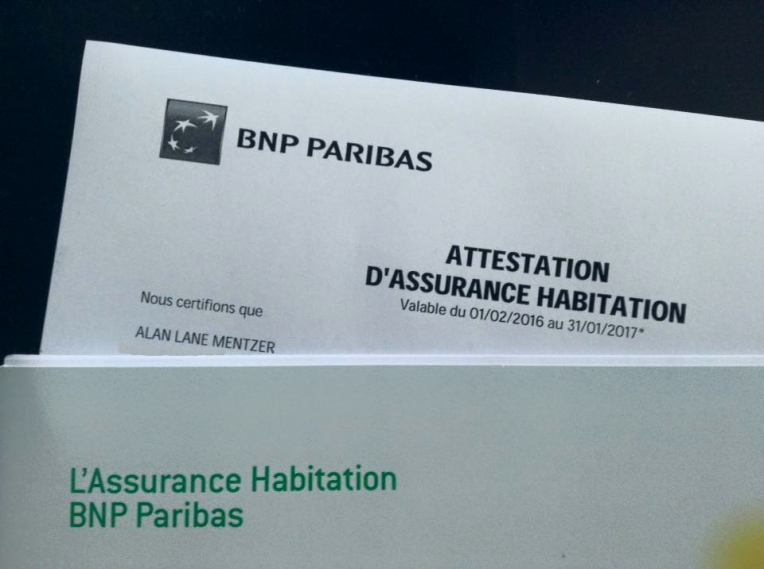
Julien made the process easy with €20,000 worth of liability, theft, and damage coverage for about €14 a month.  (More than enough coverage with Tracy and my minimalist lifestyle.) We elected to pay an annual premium rather than a monthly payment.  Three signatures and we had the document required for our real estate agent, an Attestation d’Assurance Habitation. We don’t think we ever purchased insurance coverage as easily before.  Quick, painless, and fun discussions with Julien about his experiences in America.

Attestation d'Assurance Habitation
Attestation d’Assurance Habitation

A Change of Address

IMG_2925

Each year in order to renew our Carte de Sejour (visa) the first document we must obtain is a lease. The lease must be for a minimum of one year. Our first three years in France we found apartments online through rentaplaceinfrance.com. It’s a great site that has the added benefit of owners who speak English as either a primary or secondary language.

But our current landlord is planning to sell the house this coming year so we needed to find a new place to live. We very much wanted to stay in the Pyrenees-Orientales region for access to the 1€ Bus and the benefits of a large city like Perpignan close by for culture, entertainment, travel, shopping, etc.

Before this year we didn’t much care where we ended up and felt that anywhere would be perfect as we seem to assimilate easily into whatever town or city we live. But a few things happened this year. One | Sami decided that she loved the beach and the ability to run leash-free. Two | We adopted a second dog, who also loves the beach (though he has currently lost his right to run leash-free, see Renaming the Dog for details). Three | We fell in love with this area. Four | We have friends living nearby. Five | We are already treated like locals.

So starting in June of 2015 we began looking for a new place in this region. We looked at AirBnB and found several options that were close to the beach but the first few we saw were just too small for year-round living. Next we looked at St. Cyprien, just 7 kilometers north of us as they have lovely biking paths and beach access, a larger Saturday market, and more restaurants that are open year-round. The two places we tried to rent didn’t pan out. In both instances the owner or property manager no-showed on the day we were supposed to view the apartment. We decided that it wasn’t really where we wanted to be anyway as they do not allow dogs on the beach or even on the promenade (which is asphalt and not dog-friendly in the heat of summer).

So we moved on to Plan B and stopped into a realty office here in Argeles, Foncia is a large chain of realty offices that can be found throughout France. We talked to an English-speaking realtor and told her that we were interested in a one-year lease somewhere on the Plage (Beach area) and gave her a price range that we would be willing to pay. She asked when we needed the rental and we told her April 1 of 2016. She asked for our e-mail address and promised to let us know if anything came up. We never heard from her.

We lost traction in our new home search August through October as we had returned to Spain to hike the Camino de Santiago a second time, but picked back up the search just after Thanksgiving. We had decided that the stress of finding an annual rental was beginning to be too much and thought we might try the Bail de Trois, a three-year lease.

We considered the pluses and minuses of a three-year lease:

  • + less stress while trying to get the coveted rental contract in time to renew our visas
  • + the lease automatically renews unless one party gives notice
  • + a power bill (a very important document for visa holders, proving that we actually live somewhere)
  • + a fixed address for a while
  • – apartments are not furnished, so we would need to adapt our minimalist lifestyle
  • + we can buy furnishings that we actually like and not have to live with someone else’s design choices
  • – there will be a huge financial obligation right at the outset for a bed, fridge, living room furniture, etc.
  • – if we decide to move we would need to give the owner three months notice instead of the 30 days that are required for a furnished apartment
  • – moving our furniture could be a hassle if we move as we do not own a car
  • – we would have to purchase rental insurance, and have an annual expense for maintenance on the large building for stuff like the water heater, furnace, etc.
  • – we would have to pay the taxe d’habilitation ourselves

In the end, we decided that the benefits far out-weighed the risks. So we started a new search by picking up all the “for rent” listings from local realtors, looking at their online offerings and checking all the rentals posted in their windows. Once we found one that seemed like a perfect match, we headed back to Foncia Realty as that was where it was listed.

Marita, the English-speaking realtor, was very helpful. We showed her the listing of the place we wanted to see and she immediately set up a viewing appointment for 10 am the very next day. We went to the apartment the following day and took a look around, it was PERFECT.

Just a block away from where we currently live, right behind our favorite boulangerie, a two-bedroom with a loft storage area, small (but equipped) kitchen and living room, and even a small terrace for the dogs. The price was great too, just 450€ per month. It would allow us to stay near the dog beach where we walk the dogs everyday and we could still stop for coffee and croissant each morning on our way back home. We put in our application, excited with anticipation of hearing a positive response in a day or two . . .

One month later, we still hadn’t heard anything from the owner. We had been checking in with Marita once a week to see if she had heard anything. Then after the first of the year, we finally got an answer. “The proprietor does not wish to rent to foreigners.”

We left the realty office quite dejected. It was an awfully long wait to get a negative answer. Concerned that we might not have a contract in time for our visa renewal if each time we looked at a place it took a month to get a response, we devised a new plan.

The rental process works a bit differently here. You find a place you’re interested in, you make an appointment to view it, if you like it you put in an application, then you wait. They do not show you multiple places and allow you to put in multiple applications. So we found our own work-around. We researched all of the local realty offices, went online to see if there was something listed online that wasn’t in their brochure, we went to the online “classifieds” (leboncoin.fr) as a friend suggested, then we compiled a list of our top choices and the list of realty agencies that each apartment was listed with, selecting a different realty office for each listing.

The following Monday we went to the agency that held the listing of our first choice. There we met Camille. Camille speaks a little English, she isn’t afraid to use a translation program when she isn’t sure of the English word, she was welcoming, warm, and charming. She immediately made us an appointment to view the apartment the following morning.

At 10 am Tuesday morning, we met her at the agency and she drove us a few blocks up the street to the apartment. The previous tenant was still in the process of moving out, which she apologized for, though it wasn’t necessary, we can imagine a space empty even when filled with houseplants.

When we said that we really liked it, she asked to make sure that it wasn’t too small a space. At just 38 m2, (approx. 410 square feet) it is a small space, but for just the two of us it was perfect.

It has a nice sized bathroom with room for the washing machine; a small, funky shaped kitchen — but with a nice big pantry; a small living room and bedroom — with the most amazing french doors; a balcony; a private entrance and staircase; and our own private terrace with a gate and room to park a car (for visitors as we are still sans car). But the nicest benefit is that we are just one block from Centre Plage where all the events happen in the summer, only 50 meters (150-ish feet) from the beach, 1/2 block from a year-round grocery store, and 1/2 block from the bus stop. And the price was amazing too, just 495€ and that includes water. (We normally use about 80€ of power each month, so that with our renter’s insurance which is 15€/month, plus €50 for Internet service and we will still save quite a bit from our current rent of 900€.)

Imagine our surprise when we finished our application and she said that she should have the answer the NEXT day! After waiting more than a month for an answer from our first attempt, 24 hours was a great improvement. We stopped back at her office the following day and were told that the owner had not called her back yet, and could we please come back on Friday thus giving him time to respond to her phone call.

Friday came and when we arrived at Camille’s office she smiled, shook our hands and offered us each a “Ça Va” and asked us to please sit down. She told us that she had heard back from the owner, who lives in Paris and only comes to Argeles two weeks each year, and that he had accepted our application. “When would you like to move in?”

I almost fell out of my chair. Just a few days earlier I had been chatting with my friend, Lisa, who told me that it was very hard to get a three-year lease as not too many French people want to rent to foreigners. It had me really worried about finding a lease in time to renew our visas. We had even put in place a back up plan if we weren’t able to secure a lease in time for our renewal appointment.

When would we like to move in??? “Well, since it’s nearly empty now, how about February 1st?” I told her. She said, “No problem. I will go by the apartment in a few more days and check to see if everything is out and then I will make up the contract. No worries.”

And she was right. No worries. We signed the lease on January 25. We picked up the keys on Monday, February 1. We have the electric now turned over in our name, Internet service is being installed on Feb. 8th, the couch should arrive in a week, the bed in about two weeks. The rest of our furniture will have to wait until we get the two large pieces into the space to see what else may fit. We’re planning to outfit the kitchen after we make the final move over there. Even the dogs have given their approval, met the neighbor and his dog, checked out the balcony and all of the rooms, and successfully navigated the stairs a few times.

We’re moving stuff over a bit at a time, one backpack each per day on our morning walk. We should have everything over there in a few days and we’re ready to settle in once the furniture arrives.

Et Voila! We have a long-term lease in France. Now who’s coming for a visit?