Franco-Canadian artist Marc Walter created five large sculptures in Carcassonne as part of the annual Festival de Carcassonne.
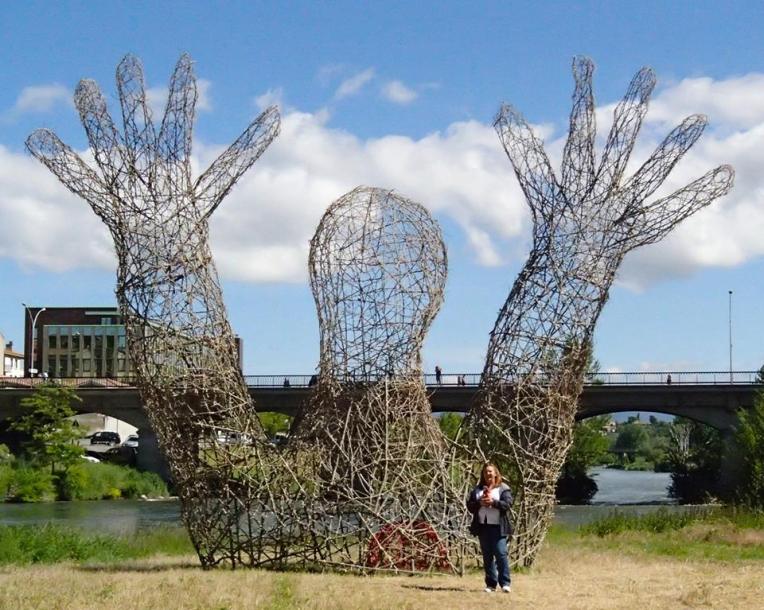
The first and largest is the “L’embrassade” (“The Hug”) sculpture located on the tip of l’île de la Cité Park and below the Pont Vieux (Old Bridge.) The sculpture is 7 meters tall and 9 meters wide. Marc Walter uses natural materials like wood, rock and earth to create his “Land Art” sculptures. For this project he used tree branches collected from Carcassonne’s public works after pruning the local trees. The sculpture is made by weaving the branches and securing with twine to created a large figure of a man with arms outstretched to the sky. A bright red heart can be seen inside the sculpture. The image is very reminiscent of an 3-D version of a Keith Haring painting.
Tracy and Kiara in front of Marc Walter’s “Land Art” Sculpture “L’embrassade” (“The Hug”)
This slideshow requires JavaScript.
In Square Gambetta the artist created four additional sculptures. Standing five to six meters high, I thought these “Invités du Coeur” (“Guests of the Heart”) sculptures had a Native America feeling. The weaving of the branches creates a vision of Indian basket weaving and the silhouette reminds me of woman with a blanket draped over her shoulders. Again created using recycled tree branches and twine, the four figures allow you to step inside and experience the art from the interior. Each sculpture has a distinctly red heart like the “L’embrassade” sculpture, but these figures were somewhat more abstract in appearance. We watched the artist and volunteers from the community build the sculptures over the last six weeks. I spoke briefly with artist Marc Walter while he was working. He was very friendly, accessible, and happy to discuss his work. I was thankful because of Marc’s Canadian roots I was able to communicate in English. He works very hard to actively involved the entire local community in the work as a collective effort in the art. The completion of the project was marked with a picnic celebration with the community invited to attend.
Tracy with one of the “Invités du Coeur” (“Guests of the Heart”) Marc Walter sculptures in Square Gambetta
This slideshow requires JavaScript.
In all, a remarkable exhibition of public art by artist Marc Walker using local recycled materials and involving community volunteers.
Carcassonne seems to have special events every week. This week was la Fête du Pain (the Bread Festival) sponsored by a local professional baking college, Saint Honoré Academy. (Saint Honoré is the patron saint of bakers.) All the events in Carcassonne reminds us of all the special event we used to experience in Reno, Nevada. French people really do take fresh baked bread seriously and we have found that in France, “Bread is king.”
The school set up both wood-fired and electric ovens in event tents on the perimeter of Square Gambetta We could smell freshly baked bread and hear the DJ’s music as we walked the block from our apartment to the Square. A dozen artisan bakers and apprentices were busy baking baguettes, breads, croissants, cakes, bread sculptures, and pies for exhibition and sale to the public. Many of the breads were created using the French twice-baked technique that makes that especially crusty bread that France is well-known for serving.
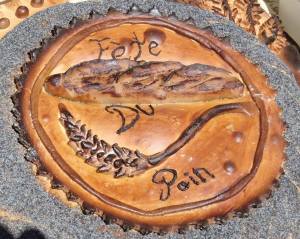
Fête du PainFête du PainFête du Pain – Baker working the wood fired oven
Tracy and I tried the pain au chocolat (chocolate croissant), a favorite of ours, and watched the bakers perform for the crowds. There was an area for children to decorate cookies and an inflatable “bounce house” with multiple food and craft vendors along the Square to visit as well.
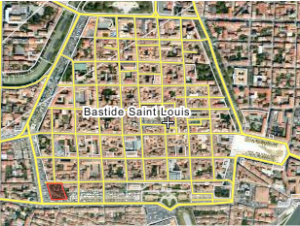
We discovered Jardin du Calvaire (Calvary Garden) located inside one of Carcassonne’s three remaining bastions. The “Big Tower” (also called the Bastion les Moulins [Tower of the Mills]) was built after 1359 and was part of the walls and fortifications that used to surround the Bastide Saint-Louis (Ville Basse) of Carcassonne. Located on the Southwest corner of the city, the bastion was later covered with windmills in 1599 to power mills grinding grain into flour for bakeries that would supply the city with “300 breads everyday for the poor.”
Location of the Jardin du Calvaire within Carcassonne’s Ville Basse
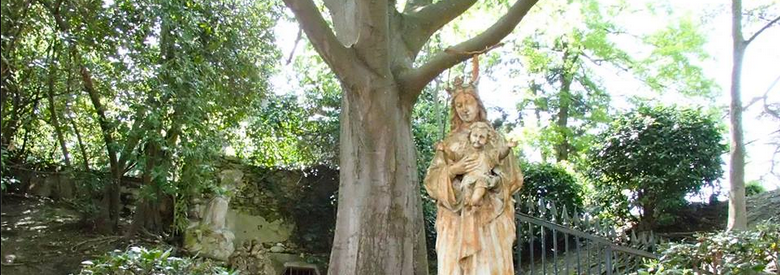
In 1825 a group formed to create the Jardin du Calvaire within the bastion. The leader of the group was Canon Cazaintre who is now buried on the site. The garden’s design was created by architect Jean-François Champagne. Jardin du Calvaire is circled with “Station of the Cross” shrines on its perimeter, has cypress and olive trees and laurels, and impressive sculptures reenacting the crucifixion on Calvary Hill. The crucifixion tableau is shielded by trees and cannot been seen from the regular garden; the sculptures can only be viewed after climbing to the top of the small hill in the garden. There is a small chapel built into the hill that represents the Holy Sepulcher and is illuminated with natural light from the crucifixion scene above.
Chapel within the Jardin du CalvaireWithin the Chapel in the Jardin du Calvaire
This urban garden is very peaceful with many benches along its paths. The restful quiet can make you forget that Jardin du Calvaire is situated alongside the major avenue of Boulevard Barbès.
One of Tracy’s favorite things about the garden are its numerous feral, but friendly cats cruising the garden and serving as unofficial “guardians” for the garden.
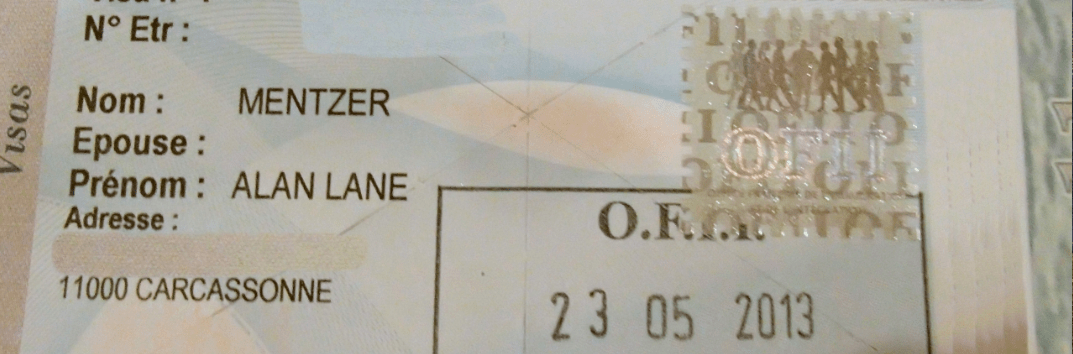
xamTracy and I are extremely excited that we have successfully completed our process for obtaining our Titre de Sejour (resident permits) at the OFII (L’Office Français de l’Immigration et de l’Intégration)office in Montpellier yesterday.
Titre de Sejour
The detailed process started in January 2013 when we first applied for our initial visa application at the French Consulate in San Francisco. After our visa request was accepted, the consulate gave us each a form, Demande d’Attestation OFII, that we would need to mail to the regional OFII office having jurisdiction over our new residence after our arrival in France. We added the Demande d’Attestation forms to our growing dossier of documents which we carefully hand carried on our flight to France.
During the first week in Carcassonne, we ventured to the post office to mail the Demande d’Attestation forms and supporting photocopies (passport page showing personal information with identification numbers, stamp from French immigration showing the date and point of entry, and the visa that was issued by the Consulate.) This involved using of our very limited French to mail a certified letter with receipt showing proof of posting. Titre de Sejour process is time sensitive and has to be completed within 90 days, so not knowing how long the French bureaucracy might take, we wanted to get it started as quickly as possible.
Surprisingly, we received back a confirmation letter back from OFII in a week’s time with an appointment set for May 23 for our medical exam and interview in Montpellier. At least that is what we discovered after a lengthy translation session with the five pages of correspondence enclosed. Thank goodness for Google Translate and a French-English dictionary. The medical exam appeared to be centered around a chest x-ray so we assumed the biggest concern for OFII was immigrants from developing countries with possible tuberculosis.
This past week was busy as we double-checked that we had all the additional supporting documents to bring for the appointment in our dossier. We needed proof of our address in the form of a rental agreement and rent receipts, our passports with our original visa, extra passport photos, and payment in the form of 241€ each in tax stamps.
The confirmation letter from OFII said that we could obtain the tax stamps at specially designated tabacs, tobacco stores, (basically your neighborhood “7-11” store.) That put me on the hunt for finding a “specially designated” tabac, again using my very limited French. Off to the friendly corner tabac at the end of our block, “Etes-vous en mesure de me timbre vendre pour montant de 241€?” “No,” but the very helpful woman escorted me out the door to point into town and give me a lengthy explanation of who could help me. I, of course, understood one word out of every four. So I smiled politely, said merci, and wandered into town to try my luck at another tabac. And another tabac, and another tabac, and still another tabac without success.
I thought I should take another tack and visit the Tourist Information office, mainly to speak with a bilingual person who might have an idea of which tabac might be able to help me. The three people at the Tourist Office conferred and, since this was a government issue, sent me to the Prefect office down the block. Unfortunately the Prefect closed at 4:00 so I went to the only government office that was open, the post office. La Poste does nearly everything in France, including having its own national banking service, so I hoped they might even have tax stamps along with their postage stamps. A very nice young woman with fairly good English explained that La Poste doesn’t issue tax stamps, but suggested the tabac/bar in front of the post office. Score! The proprietor was only too happy to sell me a four 90€, four 30€, and two 1€ tax stamps.
OFII
The day before the appointment we went to the train station for the seemingly simple task was getting train tickets to Montpellier, 90 miles east of Carcassonne. We had been to Montpellier a couple of times by train with no problems. However, the day of our appointment we learned that there was going to be a rail strike starting that evening when we needed to return home. Just when I was considering trying to telephone OFII and reschedule the appointment, the ticket agent nonchalantly scheduled us for a bus ride back to Carcassonne. Problem solved.
The morning of the appointment Tracy and I had a pleasant train ride to Montpellier and walked a block from the train station to the very conveniently located OFII office in a nondescript office business. We joined a diverse group of OFII clients waiting for our appointment at 1:30. The group included people from Asia, the Middle East, Africa, us from the US, and an older Australian couple that would play into this story. Once the office open the OFII staff systematically and efficiently processed the people in our group. The staff was very good about working with immigrants who may have limited skills speaking French.
We were kind of thrown for a loop when Tracy was called for her x-ray as “Tracy White,” her maiden name with a French pronunciation. But the confusion was temporary and Tracy was up and gone getting her chest x-ray. I later got confused where to go after my name was called for my x-ray and joined the wrong group. The staff patiently redirected my path and the x-ray process was quick and easy followed by an interview with a nurse on health issues, an eye exam, and height and weight measurements. Apparently a change in diet and walking everyday has very good for us since we’ve lost about 30 pounds since our arrival in France.
Next we were seen by the doctor who read our x-rays, reviewed our medical histories, and signed off on our medical clearances. We were given our x-ray films to take home ( “. . . lovely parting gifts”) which appears to be the norm for x-rays in France.
Chest X-ray
Now back to the Aussie couple. While we were waiting for our final interview, the Australian couple went in ahead of us for their final interview. I previously discussed how in this part of France any “generic English speaker” is assumed to be British. Well, apparently we also “all look alike” too. Granted that the Aussie man and I are “of an age” with grey hair, but by no stretch of the imagination could Tracy be confused with the Aussie’s rather dowdy wife who is about 20 years older than Tracy. However, the woman performing the Aussies’ final interview initially put our Titre de Sejour stickers into their passports. Once we walked in and she saw our paperwork, she realized she confused us with the only other English-speaking couple in the group; she sprinted to the elevator to catch the Aussies before that left the building. She and another OFII staff member carefully removed our Titre de Sejour stickers from the Aussies’ passports before the adhesive “set” and then re-applied our Titre de Sejour into our passports. For a while there Tracy and I would have been living in France under assumed identities and nationalities.
Our staff member kept apologizing for the mix up as she processed our tax stamps and final paper work. That was only “snag” in our entire residency process, so we were very pleased with how smooth the French bureaucracy had treated us. There were a few more final signatures and the use of a rubber stamp and we were then official residents of France. Our appointment at the OFII office lasted an hour and forty-five minutes from start to finish, I’ve spent more time than that waiting at DMV to register a car.
Nothing more to worry about with our residency until we start our renewal process in January. Hopefully by then the new four-year renewal period will be approved rather than the current annual renewal.
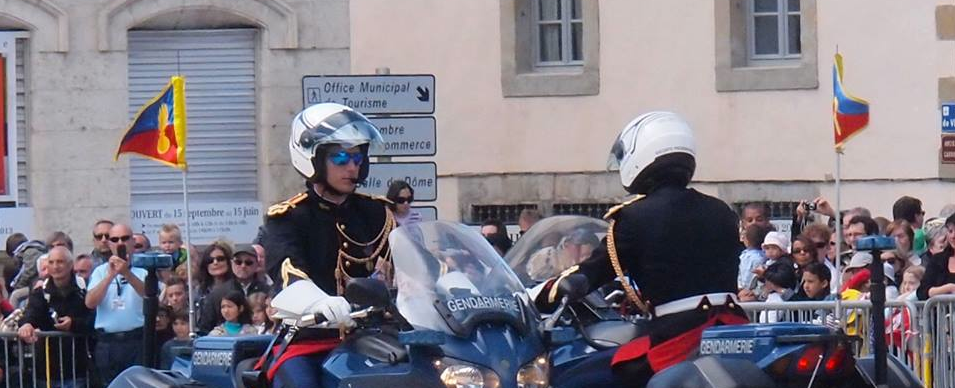
We attended the “Rallye Motocycliste Organis Par la Gendarmerie de l’Aude,” the Second Annual Motorcyclist Rally Sponsored by the Gendarmerie of Aude.
The free event in Square Gambetta included fast paced precision drills by motorcycle officers from the Republican Guard unit (presidential escort unit) of Gendarmerie Nationale of France and the Compagnie des Carabiniers du Prince of Monaco (royal family escort unit), amazing motorcycle stunts by the Republican Guard, music from a French Naval pipes and drums band, and a dramatic helicopter hoist delivery of a gendarme and his canine followed by a canine demonstration. There were also driving safety exhibits, vendor displays, and recruiting by the Gendarmerie Nationale.
In addition to the local dignitaries, Prince Pierre of Monaco attended the event to observe his royal motorcycle escorts perform with the Gendarmerie Nationale Republican Guard.
Tracy and I both had to shake our heads at the French Naval pipe and drum band playing “Scotland the Brave” and the Disney symphony type music to entertain the crowd before the rally began, but especially at the segment when cowboy hat wearing country line dancers joined in and danced to the bagpipes and drums!
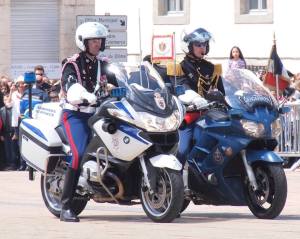
Monégasque Carabiniers on white bike and French Gendarmerie on blue bikeGendarmerie Nationale Republican Guard Stunt Team
In my younger days I was generally known as one of the only three cops in America that didn’t drink coffee. That didn’t change in my academic career. It took visiting Italy and France and their excellent espresso to convert me into a dedicated coffee drinker.
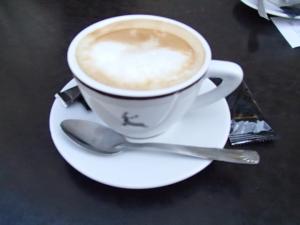
For breakfast in Carcassonne Tracy and I enjoyCafé Crème(Ca-fay Khrem), like an Italian cappuccino, a large steaming cup of espresso with steamed milk and a topping of foamed milk. Unlike Italian cappuccino or cafe latte there is no artistic patterns on top, just rich creamy coffee with a dollop of foam. In France the norm is not having a big breakfasts so Café Crème is often a meal unto itself or maybe with a croissant or a pain au chocolat (a flakey chocolate-filled viennoiserie pastry that is a favorite here in Southwest France.)
Café crème
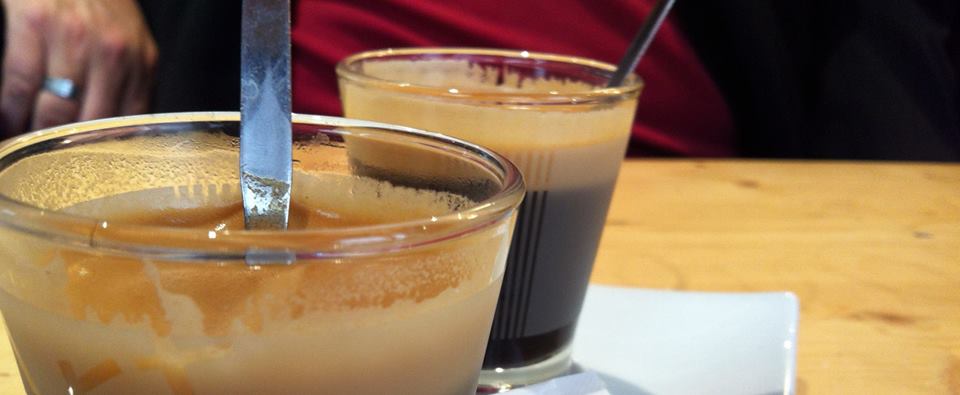
After 10:00 or 11:00 in the morning there is Café (Ca-fay) to enjoy (although many will enjoy Café for breakfast.) Café (also called Café Noir or Café Express)is drawn from an espresso machine just like an Italian espresso and rich with dark reddish-brown foam called “crema,” and served in a demitasse cup or small glass. In France and Italy milky coffee drinks like Café Crème are only consumed in the early morning, Café can be enjoyed all day long.
CaféCafé
Coffee in France is always served with sugar (sucre(Coo-khruh), real sugar, either granulated or sugar cubes. (Although a person could also request artificial sweetener, edulcorant [Ay-doohl-co-hrahn].) There is frequently a small ginger cookie or small chocolate to accompany your coffee in our part of France.
There are many cultural expectations to having coffee in France. Like I previously said, Café Crème, is not ordered after breakfast time. There are seldom paper “go cups” available, coffee is meant to be savored slowly, not to be drunk on the run. Coffee is not served during a meal (there is wine for that); coffee is reserved for after the meal is finished as a capstone to the event. If you enter a restaurant only for coffee, either sit at a table without place settings or stand at the counter. Drinking coffee while standing normally cost less than coffee while sitting at a table.
While our coffee drinking normally includes just Café Crème andCafé there are some other coffee choices.
Noisette(Nwah-zett) is an Café with a dash a cream. Noisette is French for “hazelnut” and refers to the color of the coffee. A noisette is similar to a small Italian Macchiato coffee.
Café au Lait (Ca-fay a lay), coffee with cream. Depending who you talk to, this either this is an acceptable synonym for Café Crème or is a phrase only used in a restaurant by tourists. I’ve also been told Café au Lait is a term only used by a French person in their own kitchen.
Café Allongé(ah-lohn-zhay), “extended coffee,” is espresso with additional hot water to make a more traditional American-style cup of coffee.
There is an option to order your Café as déca (Day-kah)or décaféiné (Day-kah-fay-uhn-ay)for a decaffeinated coffee. This is something Tracy strongly believes cancels a major reason for coffee in the first place and is perhaps is even a venial sin.
And for non-coffee drinkers there is Chocolat chaud (Shah-ko-lah show), hot chocolate that is normally made with rich, top-quality chocolate and is often served in demitasse cup.
France is definitely a “coffee culture” where few activities are as relaxing as sitting in the town square, sipping your café, and watching the world go by. “Un autre café, s’il vous plaît.” Another coffee, please.
We were on our way to lunch at Al Dente, and decided that Kiara would love to get out of the house (in her red and black sweater with the white skull and crossbones on the back) and enjoy a sunny but breezy day.
On our way to the restaurant we let her run through the grassy area at Square Gambetta. She was enjoying running through the clover at the far end of the square — Kiara lovesclover. She always does this petite little bow and rubs her whole face in the clover.
She’s been dealing with allergies and has been eating baby food for the last couple of weeks, but we still can’t keep her from rubbing her face in the clover.
Today for the first time ever, she noticed another animal was in the park with her . . . a pigeon. Kiara doesn’t believe that she is a dog and has never shown any interest in another single species of the animal kingdom that didn’t walk upright and speak. But today she noticed the pigeon, and for the very first time in her whole life, she chased a pigeon.
In less than two seconds, she went from being the tiniest thing in the entire square to being one badass dog. Not only was her entire attitude different, but she got really brave and braced two more pigeons. Alan and I were laughing out loud, watching our adorable little girl who is nervous around her own food dish, now chasing a bird.
Then she spotted the rest of the flock at the square, about 12 of them . . . and yep, she ran right over and chased them too. Only three of them took flight, but she didn’t even notice that the rest of them just looked at her and went back to eating. She came running back over so that Mom and Dad could say “Good Girl!”
Yup, two whole pounds of badass chihuahua in a red sweater with a skull on the back!
Then we took her to her favorite park after lunch. She was running in huge wide circles around Alan and I as we walked through the manicured landscape of her favorite park. There is lots of clover there as well so a few stops had to be made to rub her face in the clover.
Then she fell into her regular routine, running in big circles, stop to smell a flower, run in a big circle, catch up to Dad, run in a circle, wait for Mom, run in a big circle, stop to smell a flower.
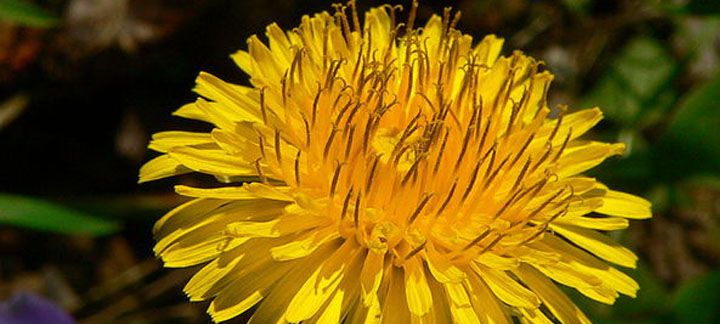
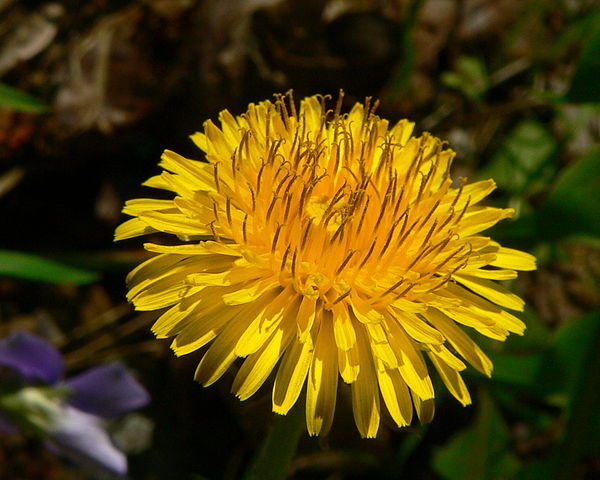
She has a thing about flowers, she likes to smell the flowers and sticks her little nose right on top of them. Especially dandelion flowers, which we think might be causing a bit of allergy symptoms for her, but she will stop to stick her tiny nose into the flowers anyway. Today we are a bit more certain that this bright yellow flower is the culprit. She threw up tiny yellow petals all over my sleeve after she ate one of the stupid things.
Kiara, our two-pound, badass, pigeon chasing dog . . . taken down . . . by a flower. The look on her tiny, expressive face told it all . . . “Flowers committed biological warfare Mommy, not my fault!”
Kiara’s nemisis: wanted for suspicion of biological warfare
Carcassonne is filled with historic houses of worship.
1. Basilique Saint-Nazaire-et-Saint-Celse de Carcassonne (Basilica of Saint Nazaire and Saint Celsus) Located within the citadel of la Cité de Carcassonne, the “Jewel of the City,” has a harmonious coexistence between the Romanesque and Gothic windows which are the finest in the South of France. The first church was built in the sixth century, under the reign of the Visigoths. The first written record of the church dates from 925. In 1096, Pope Urban II came to Carcassonne and blessed the construction of what would become the Basilica of Saint Nazaire and Saint Celsus. The building was completed in the first half of the twelfth century. The nave and aisles remain in the Romanesque style. Gothic alterations were completed in the fourteenth century. The church was rebuilt many times and eventually lost its cathedral status in 1803 to Saint Michael’s Cathedral in the Bastide. Saint-Nazaire-et-Saint-Celse received the title of Basilica in 1898 from Pope Leo XIII.
Basilique Saint-Nazaire-et-Saint-Celse de Carcassonne (Basilica of Saint Nazaire and Saint Celsus)Basilique Saint-Nazaire-et-Saint-Celse de Carcassonne (Basilica of Saint Nazaire and Saint Celsus)
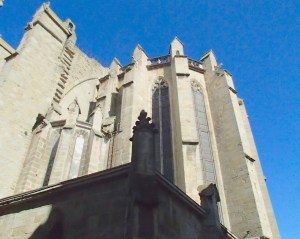
2.) Cathédrale Saint-Michel de Carcassonne (Saint Michael’s Cathedral of Carcassonne) The church was designed in the Languedoc Gothic style. Built and rebuilt over the thirteenth, fourteenth, and nineteenth centuries, Saint Michael’s Cathedral originated as a parish church until 1803 when it was elevated as the seat of the Roman Catholic bishop for Carcassonne replacing Saint-Nazaire-et-Saint-Celse as the Cathedral for the diocese and used by the Priestly Order of Saint Peter. The Cathedral is designated as a French National Monument. Rebuilding the church was required after the invasion of the Black Prince and the destruction of the Ville Basse in 1355. There was also a devastating fire in 1849 that ravaged the church. Famous architect Eugène Emmanuel Viollet-le-Duc, known for his restoration of French historical monuments, led nearly 20 years of extensive restoration to the church.
Cathédrale Saint-Michel de Carcassonne (Saint Michael’s Cathedral of Carcassonne)Cathédrale Saint-Michel de Carcassonne (Saint Michael’s Cathedral of Carcassonne)
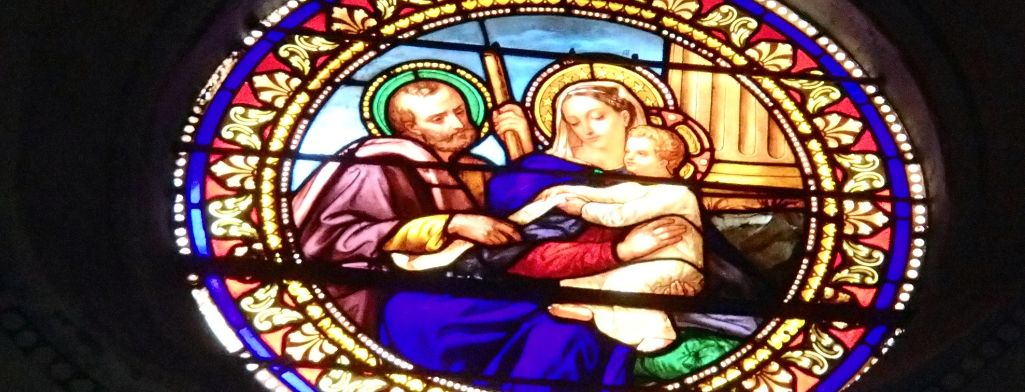
3.) Eglise Saint-Vincent (Saint Vincent Church) This thirteenth century Roman Catholic church was also designed in the Languedoc Gothic style with an impressive 23.5 meter high vaulted roof. Climbing the 234 steps of the 54 meter high octagonal bell tower will lead past the 47 bells to a view of the Ville Basse and La Cite’. In the fifteenth century, rose windows and stained-glass windows were added to the church.
Eglise Saint-Vincent (Saint Vincent Church)Eglise Saint-Vincent (Saint Vincent Church)
4.) Eglise des Carmes (Church of the Carmelites) The sparse Languedoc Gothic style Roman Catholic church was built at the end of the thirteenth century by the Order of the Brothers of Our Lady of Mount Carmel. There is also a Carmelite Covent. In 1966, the Carmelite chapel became a parish church and in the 1970s it became an annex parish to Saint Michael and Saint Vincent. The former convent, located on Rue de la Liberté, has been the offices of the diocese since 1981.
Eglise des Carmes (Church of the Carmelites)Eglise des Carmes (Church of the Carmelites)
5.) Chapelle Notre Dame de la Santé (Chapel of Our Lady of Health) This small Roman Catholic chapel was built on the west side of the Pont Vieux (old bridge) with money from the legacy of Jean de Saix in 1527 for the creation of the plague hospital. The chapel’s gothic interior features beautiful ribbed vaults and tiercerons. The chapel was used by patients and families of the former hospital.
Chapelle Notre Dame de la Santé (Chapel of Our Lady of Health)Chapelle Notre Dame de la Santé (Chapel of Our Lady of Health)
6.) Eglise Protestante Unie De Carcassonne – Communion Luthériens et Réformés (Protestant Church – French United Reformed Church) France is about 86% Roman Catholic, 7% Muslim, 2% Protestest, 1% Jewish, with 4% unaffiliated. This is literally the protestant church in Carcassonne. Apparently this church was established in 1562 by the Reformed Church of France after persecution of the Huguenots had subsided. There appears to have been a major renovation was started in 1888 and completed in 1890. Protestant church worshippers are mainly found in southeastern France.
Eglise Protestante Unie De Carcassonne – Communion Luthériens et Réformés (Protestant Church – French United Reformed Church)Eglise Protestante Unie De Carcassonne – Communion Luthériens et Réformés (Protestant Church – French United Reformed Church)
7.) Mosquée Salam à Carcassonne(Salam Mosque in Carcassonne) French of Maghreb origin (having at least one grandparent from the former French colonies of Algeria, Morocco or Tunisia) in France form the largest ethnic group after French of European origin. This Maghreb influence is also reflected in 7% of the population being Muslim.
Mosquée Salam à Carcassonne (Salam Mosque in Carcassonne)Mosquée Salam à Carcassonne (Salam Mosque in Carcassonne)
There is no Jewish Synagogue in Carcassonne. In 1394 Jews, blamed for the Black Death among other imaginary crimes, were expelled from Carcassonne and fled to Provence. After the invasion of France by the Nazis during World War II, a number of Jews returned and found refuge in Carcassonne, then in the unoccupied zone. Today the small Jewish population of Carcassonne has to travel to Toulouse or Montpellier for synagogue.
We have just completed the 2012 Year in Review. This is our second “year in review” and again we are amazed at how much we actually did over a twelve month time frame.
Much love to all who made our 2012 a great one!
To access the page, click the link above or go to the Year in Review drop down menu on the home page.
















 An Italian Point Of View