Carcassonne: Gendarmerie Motorcycle Rally

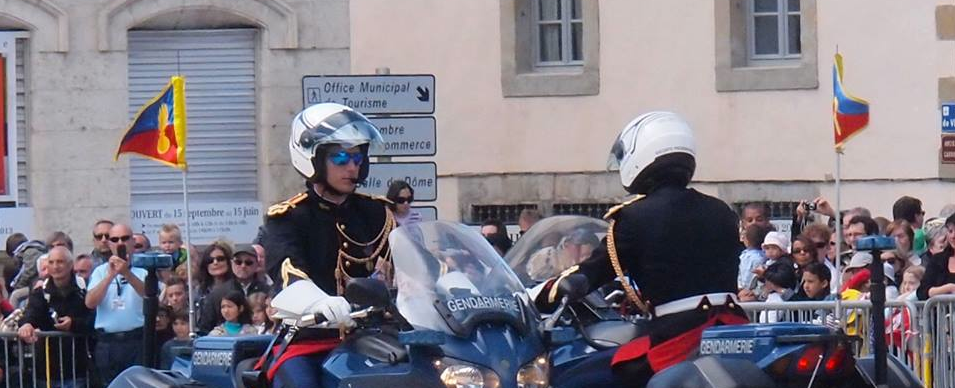
We attended the “Rallye Motocycliste Organis Par la Gendarmerie de l’Aude,” the Second Annual Motorcyclist Rally Sponsored by the Gendarmerie of Aude.

The free event in Square Gambetta included fast paced precision drills by motorcycle officers from the Republican Guard unit (presidential escort unit) of Gendarmerie Nationale of France and the Compagnie des Carabiniers du Prince of Monaco (royal family escort unit), amazing motorcycle stunts by the Republican Guard, music from a French Naval pipes and drums band, and a dramatic helicopter hoist delivery of a gendarme and his canine followed by a canine demonstration.  There were also driving safety exhibits, vendor displays, and recruiting by the Gendarmerie Nationale.

In addition to the local dignitaries, Prince Pierre of Monaco attended the event to observe his royal motorcycle escorts perform with the Gendarmerie Nationale Republican Guard.

Tracy and I both had to shake our heads at the French Naval pipe and drum band playing “Scotland the Brave” and the Disney symphony type music to entertain the crowd before the rally began, but especially at the segment when cowboy hat wearing country line dancers joined in and danced to the bagpipes and drums!

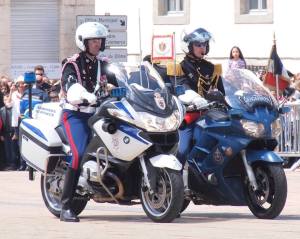
Monégasque Carabiniers on white bike and French Gendarmerie on blue bike
Gendarmerie Nationale Republican Guard Stunt Team

This slideshow requires JavaScript.

French Beverages, Part 3: Coffee

In my younger days I was generally known as one of the only three cops in America that didn’t drink coffee.  That didn’t change in my  academic career.  It took visiting Italy and France and their excellent espresso to convert me into a dedicated coffee drinker.

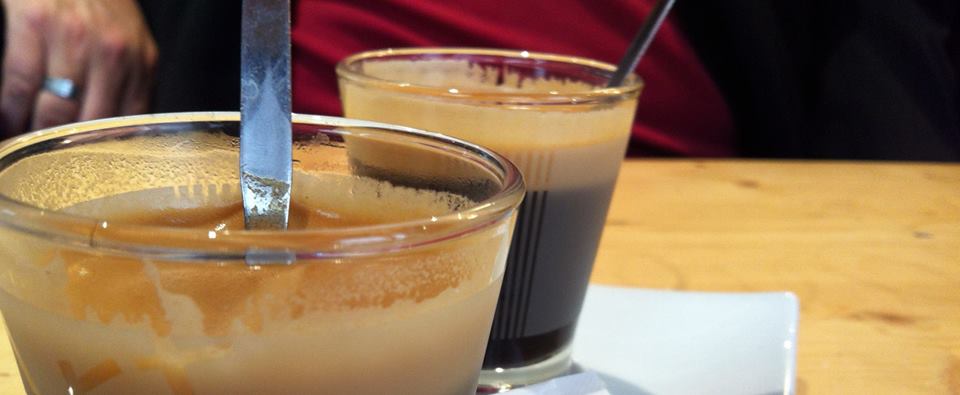
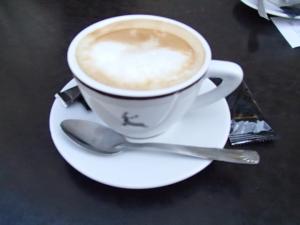
For breakfast in Carcassonne Tracy and I enjoy Café Crème (Ca-fay Khrem), like an Italian cappuccino, a large steaming cup of espresso with steamed milk and a topping of foamed milk.  Unlike Italian cappuccino or cafe latte there is no artistic patterns on top, just rich creamy coffee with a dollop of foam.  In France the norm is not having a big breakfasts so Café Crème is often a meal unto itself or maybe with a croissant or a pain au chocolat (a flakey chocolate-filled viennoiserie pastry that is a favorite here in Southwest France.)

Café crème
Café crème

After 10:00 or 11:00 in the morning there is Café (Ca-fay) to enjoy (although many will enjoy Café for breakfast.)  Café (also called Café Noir or Café Express) is drawn from an espresso machine just like an Italian espresso and rich with dark reddish-brown foam called “crema,” and served in a demitasse cup or small glass.  In France and Italy milky coffee drinks like Café Crème are only consumed in the early morning, Café can be enjoyed all day long.

Café
Café
Café
Café

Coffee in France is always served with sugar (sucre (Coo-khruh), real sugar, either granulated or sugar cubes.  (Although a person could also request artificial sweetener, edulcorant  [Ay-doohl-co-hrahn].)  There is frequently a small ginger cookie or small chocolate to accompany  your coffee in our part of France.

There are many cultural expectations to having coffee in France.  Like I previously said, Café Crème, is not ordered after breakfast time.  There are seldom paper “go cups” available, coffee is meant to be savored slowly, not to be drunk on the run.  Coffee is not served during a meal (there is wine for that); coffee is reserved for after the meal is finished as a capstone to the event.  If you enter a restaurant only for coffee, either sit at a table without place settings or stand at the counter.  Drinking coffee while standing normally cost less than coffee while sitting at a table.

While our coffee drinking normally includes just Café Crème and Café there are some other coffee choices.

Noisette  (Nwah-zett) is an Café with a dash a cream.  Noisette is French for “hazelnut” and refers to the color of the coffee.  A noisette is similar to a small Italian Macchiato coffee.

Café au Lait (Ca-fay a lay), coffee with cream.  Depending who you talk to, this either this is an acceptable synonym for Café Crème or is a phrase only used in a restaurant by tourists.  I’ve also been told Café au Lait is a term only used by a French person in their own kitchen.

Café Allongé (ah-lohn-zhay), “extended coffee,” is espresso with additional hot water to make a more traditional American-style cup of coffee.

There is an option to order your Café as déca (Day-kah) or décaféiné (Day-kah-fay-uhn-ay) for a decaffeinated coffee.  This is something Tracy strongly believes cancels a major reason for coffee in the first place and is perhaps is even a venial sin.

And for non-coffee drinkers there is Chocolat chaud (Shah-ko-lah show),  hot chocolate that is normally made with rich, top-quality chocolate and is often served in demitasse cup.

France is definitely a “coffee culture” where few activities are as relaxing as sitting in the town square, sipping your café, and watching the world go by.  “Un autre café, s’il vous plaît.”  Another coffee, please.

Kiara’s Nemisis

Kiara has had a very busy day today.

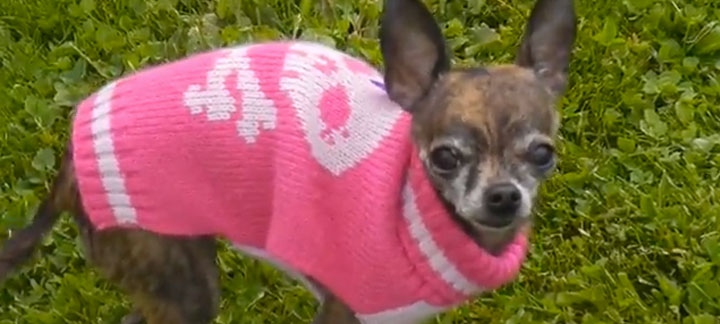
We were on our way to lunch at Al Dente, and decided that Kiara would love to get out of the house (in her red and black sweater with the white skull and crossbones on the back) and enjoy a sunny but breezy day.

On our way to the restaurant we let her run through the grassy area at Square Gambetta. She was enjoying running through the clover at the far end of the square — Kiara loves clover. She always does this petite little bow and rubs her whole face in the clover.

She’s been dealing with allergies and has been eating baby food for the last couple of weeks, but we still can’t keep her from rubbing her face in the clover.

Today for the first time ever, she noticed another animal was in the park with her . . . a pigeon. Kiara doesn’t believe that she is a dog and has never shown any interest in another single species of the animal kingdom that didn’t walk upright and speak. But today she noticed the pigeon, and for the very first time in her whole life, she chased a pigeon.

In less than two seconds, she went from being the tiniest thing in the entire square to being one badass dog. Not only was her entire attitude different, but she got really brave and braced two more pigeons. Alan and I were laughing out loud, watching our adorable little girl who is nervous around her own food dish, now chasing a bird.

Then she spotted the rest of the flock at the square, about 12 of them . . . and yep, she ran right over and chased them too. Only three of them took flight, but she didn’t even notice that the rest of them just looked at her and went back to eating. She came running back over so that Mom and Dad could say “Good Girl!”

Yup, two whole pounds of badass chihuahua in a red sweater with a skull on the back!

Then we took her to her favorite park after lunch. She was running in huge wide circles around Alan and I as we walked through the manicured landscape of her favorite park. There is lots of clover there as well so a few stops had to be made to rub her face in the clover.

Then she fell into her regular routine, running in big circles, stop to smell a flower, run in a big circle, catch up to Dad, run in a circle, wait for Mom, run in a big circle, stop to smell a flower.

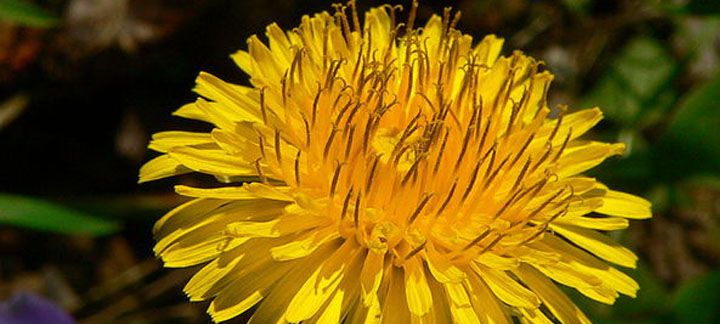
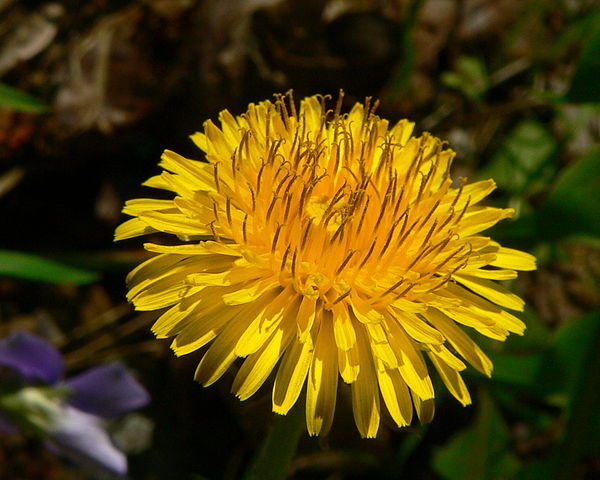
She has a thing about flowers, she likes to smell the flowers and sticks her little nose right on top of them. Especially dandelion flowers, which we think might be causing a bit of allergy symptoms for her, but she will stop to stick her tiny nose into the flowers anyway. Today we are a bit more certain that this bright yellow flower is the culprit. She threw up tiny yellow petals all over my sleeve after she ate one of the stupid things.

Kiara, our two-pound, badass, pigeon chasing dog . . . taken down . . . by a flower. The look on her tiny, expressive face told it all . . . “Flowers committed biological warfare Mommy, not my fault!”

Kiara's nemisis: wanted for suspicion of biological warfare on a two-pound chihuahua
Kiara’s nemisis: wanted for suspicion of biological warfare
French Beverages, Part 2: Languedoc-Roussillon’s Vin de France and Vin de Pays

“You know, every glass of wine here is French wine.”  Me sharing the extremely obvious with Tracy.

The Languedoc-Roussillon region in Southwest France, where we are living, is the largest area in France in terms of vineyard acreage.  The region is known for its Blanquette de Limoux, the world’s oldest sparkling wine, and many high quality red wines like Corbières, Cotaeux du Languedoc, Côtes du Roussillon, Fitou, Minervois, Saint Chinian, and Costières de Nimes.

Languedoc-Roussillon (Wikimedia Commons)
Languedoc-Roussillon
(Wikimedia Commons)

Languedoc-Roussillon is also known as the “Wine Lake” of France where the majority of inexpensive wines in France are produced. So much wine is produced in Languedoc-Roussillon that France worries the “Wine Lake’s” surplus drives down the export price of French table wine.  More than 1/3 of all grapes grown in France are grown in the Languedoc-Roussillon region.

The everyday wines are called Vin de France, (previously called “Vin de Table“) the lowest level of the three tiers in the current wine classification system in France.  But don’t let the term “lowest level” deceive you, these are flavorful wines that enhance any meal or are enjoyable simply by the glass.  Any wine in France is all about its terroir:  the environment, climate, soil, geography, and weather that makes up the intangibles that combined with the variety of grapes and the skill of the winemaker creates the final taste of the wine.

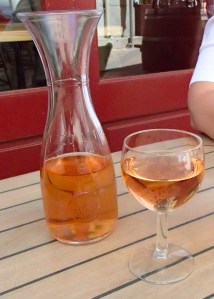
Pichet de Vin
Pichet de Vin

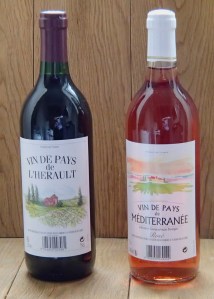
The mid-level category of French wines are Indication Géographique Protégée wines (IGP), an intermediate category basically replacing the former Vin de Pays (“country wine”) category.  These IGP/Vin de Pays wines are simple varietal French wines that include Vin de Pays d’Oc from Languedoc-Roussillon. Vin de Pays d’Oc is the largest portion of all Vin de Pays wines produced in France.

Vin de Pays
Vin de Pays

Appellation d’Origine Protégée (AOP) is the highest category of French wine replacing the previously used category of Appellation d’Origine Contrôlée (AOC) wines.  We look forward to touring some of the local vineyards in the near future and tasting some of these top-tier AOP wines.  Restaurants in Carcassonne offer high quality AOC wine lists in addition to their basic house wines.

AOP Seal (Wikimedia Commons)
AOP Seal
(Wikimedia Commons)

Most of Tracy and my wine consumption has been Vin de France and Vin de Pays.  These inexpensive reds, white, and rosé wines have proven to be delicious.  “Un demi-pichet de vin,” (a half litre carafe of a restaurant’s vin de France) has never been a bad experience.  Restaurants carefully choose even the house wine with their reputations in mind.  Rosé wines are a respected wine choice and hold a prominent place in many of France’s major wine regions, including Languedoc-Roussillon.

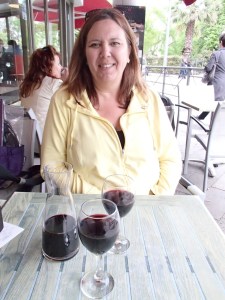
Tracy enjoying "un pichet of vin rouge."
Tracy enjoying “un pichet of vin rouge.”

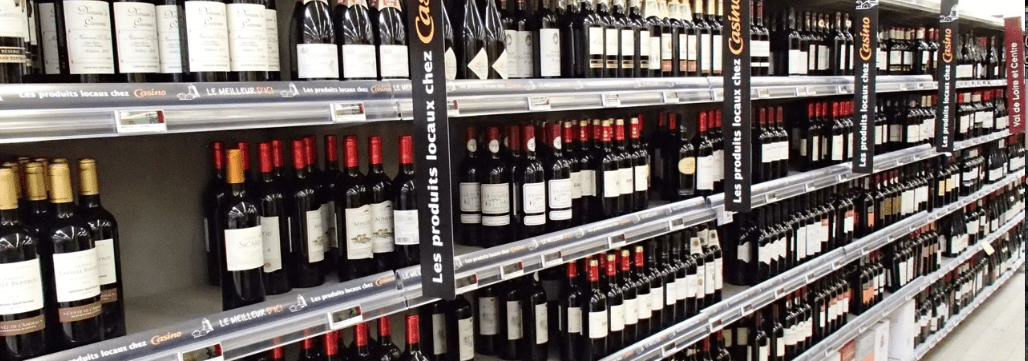
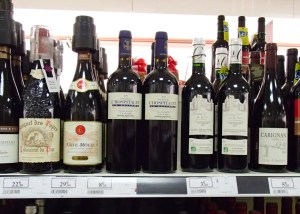
Shopping for wine is an embarrassment of riches.  The wine section in every store offers a huge range of quality, varieties, and price points.  It is difficult to narrow down your choices from so many offerings.  I was stunned to even see “boxed” vin de France meant for inexpensive table wine. Two of our most recent purchases, a red and a rosé, were both under 2 Euro and they were delicious!

Shelves of Wines
Shelves of Wines
Shelves of Wines
Shelves of Wines
Shelves of Wines
Shelves of Wines
Varied wines and prices

Tracy and I greatly enjoy our new tradition of a glass of wine with lunch and dinner.  And there is nothing like a leisurely afternoon, sitting in the town square of Place Carnot, and  lingering with a carafe of wine as Tracy and I just enjoy the view, conversation, and people watching.

Win-Win and Wrinkle-Free Shirts

I had a run in with a little old lady the other day at the market. It wasn’t verbal, otherwise I would not have been able to participate anyway. It was all about the squint of her eyes.

Alan and I were walking through the stalls at the market. It was a nice warm day — this is the rainy season so we enjoy them when they happen — and we were without jackets. Alan’s permanent press shirts get wrinkled here, not exactly sure why but assume it’s the tiny washer/dryer combo and no room to fluff clothes.

As we were passing a group of three older ladies, he was in front of me, one of the ladies caught my eye, she gave me a look of disapproval, pointed at the back of his wrinkled shirt, then tsk-tsk’d me as she shook her head from side to side, her curly gray hair bouncing around her frowning, squinty-eyed face.

Her disapproval of my duties to Alan’s laundry kind of amused me at first. I mean, for heaven’s sake, I’m married to a full-grown adult who can wash, dry and iron his own clothing. We’ve been married nearly 13 years and the only time I’ve ironed something for him is if I was already using the thing for myself and asked if he needed anything pressed. Alan is fully capable of ironing his shirts in France, too.

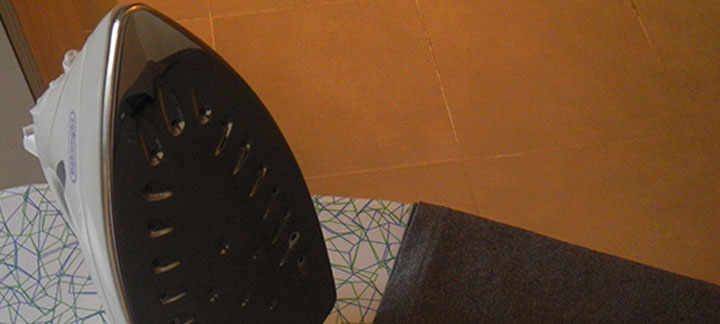
But by the following Saturday, when Alan was getting ready to hit the market and pulled a shirt out of the closet that had a wrinkle on the back, I grabbed it and said, “hold on, just let me hit it with the iron first, can’t have the little old ladies at the market tsk-tsk’ing me again.”

I’m still a little amazed that I caved to peer-pressure from a little old lady. But, I alao avoided looks of disapproval from the gray-haired crowd at the market this time, so . . . win-win, and Alan gets wrinkle-free shirts!

French Beverages, Part 1: Pastis

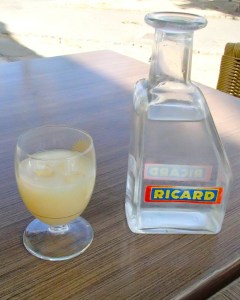
Pastis is an anise-flavored liqueur and popular aperitif in France.

Ricard is the number one pastis beverage in the world, its recipe unaltered since its creation by Paul Ricard in 1932. A refreshing apperitif, Ricard is a long-time favorite in France, especially in the southern regions of the country. Over 130 million liters of pastis is sold each year in France, more than two liters per inhabitant.  The name “pastis” originally comes from the regional dialect occitan’s word, pastís, meaning “mash-up.”

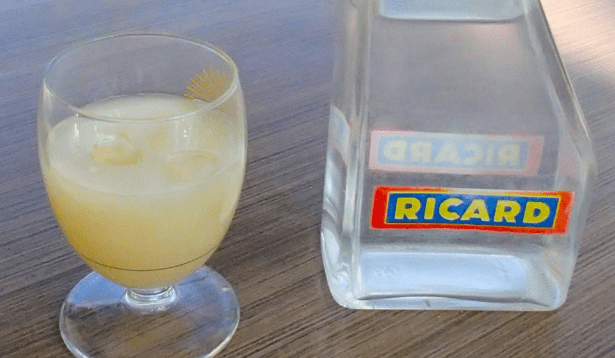
Ricard Pastis
Ricard Pastis

Pastis’ popularity grew following the French ban on absinth. One reason for the popularity of pastis can be attributable to the demand for anise flavored drinks created by absinthe decades earlier. There is also an old tradition in the Mediterranean of anise-based liquors like Sambuca, Ouzo, Arak, and Mastika.

The principal ingredients of Ricard is star anise, a rare spice that grows in southern Chinese and in the north of Vietnam, licorice from Syria, and aromatic herbs from Provence. Pastis is not absinthe and does not does not contain grand wormwood (artemisia absinthium), the herb from which absinthe gets its name. Absinthe obtains its base flavor from green anise, not the star anise which Ricard uses. Pastis’ flavor comes from licorice root which is not used in absinthe. Also, absinthes are normally bottled at 45 to 74% ABV, while pastis is typically bottled at 40 to 50% ABV. Finally, unlike absinthe, pastis is classified as a liqueur  because it contains sugar.

Pastis is normally served with the liqueur presented in one glass and accompanied by carafe of cold water.

The liqueur is diluted with the water according to the drinker’s preference, traditionally about 5 parts water to 1 part Ricard. Diluting the liqueur creates the “French Milk” effect as the water is added. The combination of liqueur and water ‘louches,’ and turns the diluted beverage cloudy and white in appearance. The drink is then consumed cold and is considered a refreshing beverage for hot days. Ice cubes may be added after diluting the pastis.

Pastis before dilution with water
Pastis after dilution with water and 'louching' starting
Pastis after dilution with water and ‘louching’ starting

The Bells of Saint Vincent’s

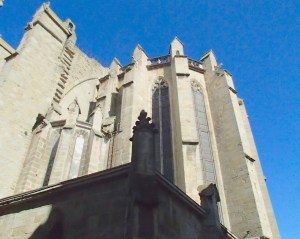
While enjoying a cup of cafe kreme (France’s version of cappuccino) we were treated to a concert via the bells of Saint Vincent’s Church just a block away.

The bells of the local Catholic churches ring hourly around here. We often find ourselves counting the chimes to tell the hour of the day. Every once in a while it sounds like the bell ringer (or electronic system used to ring the bells) goes haywire and you get 20 chimes at 1 p.m. It’s taken us a while to realize that the two Catholic churches, Saint Michael’s Cathedral and Saint Vincent’s Church have over 50 bells between them. That’s a lot of church bells.

Thankfully being raised Catholic I love the sound of bells. According the the Catholic Liturgical Calendar [courtesy of CatholicCulture.org] today is the Solemnity of the Ascension, the day when Jesus returned to his Father in Heaven, which would explain the joyous noise we were treated to this morning from this gorgeous Gothic church (see photo below) while we were enjoying our morning coffee.

So regardless of your spiritual beliefs or mine for that matter, here’s a clip of this morning’s impromptu concert. Enjoy!

Bells of Saint Vincent’s video

Eglise Saint-Vincent (Saint Vincent Church)
Eglise Saint-Vincent (Saint Vincent’s Church)

Carcassonne: Places of Worship

Carcassonne is filled with historic houses of worship.

1. Basilique Saint-Nazaire-et-Saint-Celse de Carcassonne (Basilica of Saint Nazaire and Saint Celsus) Located within the citadel of la Cité de Carcassonne, the “Jewel of the City,” has a harmonious coexistence between the Romanesque and Gothic windows which are the finest in the South of France. The first church was built in the sixth century, under the reign of the Visigoths. The first written record of the church dates from 925. In 1096, Pope Urban II came to Carcassonne and blessed the construction of what would become the Basilica of Saint Nazaire and Saint Celsus. The building was completed in the first half of the twelfth century. The nave and aisles remain in the Romanesque style. Gothic alterations were completed in the fourteenth century. The church was rebuilt many times and eventually lost its cathedral status in 1803 to Saint Michael’s Cathedral in the Bastide. Saint-Nazaire-et-Saint-Celse received the title of Basilica in 1898 from Pope Leo XIII.

Basilique Saint-Nazaire-et-Saint-Celse de Carcassonne (Basilica of Saint Nazaire and Saint Celse)
Basilique Saint-Nazaire-et-Saint-Celse de Carcassonne (Basilica of Saint Nazaire and Saint Celsus)
Basilique Saint-Nazaire-et-Saint-Celse de Carcassonne (Basilica of Saint Nazaire and Saint Celse)
Basilique Saint-Nazaire-et-Saint-Celse de Carcassonne (Basilica of Saint Nazaire and Saint Celsus)

2.)  Cathédrale Saint-Michel de Carcassonne (Saint Michael’s Cathedral of Carcassonne) The church was designed in the Languedoc Gothic style. Built and rebuilt over the thirteenth, fourteenth, and nineteenth centuries, Saint Michael’s Cathedral originated as a parish church until 1803 when it was elevated as the seat of the Roman Catholic bishop for Carcassonne replacing Saint-Nazaire-et-Saint-Celse as the Cathedral for the diocese and used by the Priestly Order of Saint Peter.  The Cathedral is designated as a French National Monument. Rebuilding the church was required after the invasion of the Black Prince and the destruction of the Ville Basse in 1355.  There was also a devastating fire in 1849 that ravaged the church. Famous architect Eugène Emmanuel Viollet-le-Duc, known for his restoration of French historical monuments, led nearly 20 years of extensive restoration to the church.

Cathédrale Saint-Michel de Carcassonne (Saint Michael's Cathedral of Carcassonne)
Cathédrale Saint-Michel de Carcassonne (Saint Michael’s Cathedral of Carcassonne)
Cathédrale Saint-Michel de Carcassonne (Saint Michael's Cathedral of Carcassonne)
Cathédrale Saint-Michel de Carcassonne (Saint Michael’s Cathedral of Carcassonne)

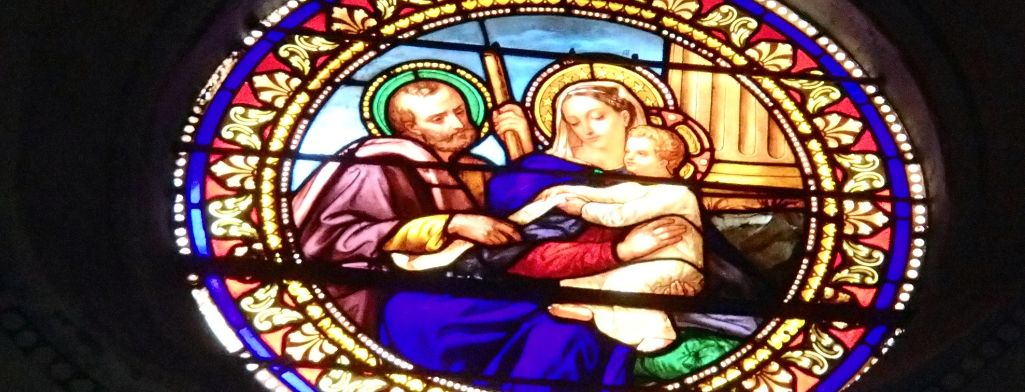
3.)  Eglise Saint-Vincent (Saint Vincent Church) This thirteenth century Roman Catholic church was also designed in the Languedoc Gothic style with an impressive 23.5 meter high vaulted roof. Climbing the 234 steps of the 54 meter high octagonal bell tower will lead past the 47 bells to a view of the Ville Basse and La Cite’.  In the fifteenth century, rose windows and stained-glass windows were added to the church.

Eglise Saint-Vincent (Saint Vincent Church)

4.)  Eglise des Carmes (Church of the Carmelites) The sparse Languedoc Gothic style Roman Catholic church was built at the end of the thirteenth century by the Order of the Brothers of Our Lady of Mount Carmel. There is also a Carmelite Covent. In 1966, the Carmelite chapel became a parish church and in the 1970s it became an annex parish to Saint Michael and Saint Vincent. The former convent, located on Rue de la Liberté, has been the offices of the diocese since 1981.

Eglise des Carmes (Church of the Carmelites)

5.)  Chapelle Notre Dame de la Santé (Chapel of Our Lady of Health) This small Roman Catholic chapel was built on the west side of the Pont Vieux (old bridge) with money from the legacy of Jean de Saix in 1527 for the creation of the plague hospital. The chapel’s gothic interior features beautiful ribbed vaults and tiercerons. The chapel was used by patients and families of the former hospital.

Chapelle Notre Dame de la Santé (Chapel of Our Lady of Health)

6.)  Eglise Protestante Unie De Carcassonne – Communion Luthériens et Réformés (Protestant Church – French United Reformed Church) France is about 86% Roman Catholic, 7% Muslim, 2% Protestest, 1% Jewish, with 4% unaffiliated. This is literally the protestant church in Carcassonne. Apparently this church was established in 1562 by the Reformed Church of France after persecution of the Huguenots had subsided. There appears to have been a major renovation was started in 1888 and completed in 1890. Protestant church worshippers are mainly found in southeastern France.

 Eglise Protestante Unie De Carcassonne - Communion Luthériens et Réformés (Protestant Church - French United Reformed Church)
Eglise Protestante Unie De Carcassonne – Communion Luthériens et Réformés (Protestant Church – French United Reformed Church)
Eglise Protestante Unie De Carcassonne - Communion Luthériens et Réformés (Protestant Church - French United Reformed Church)
Eglise Protestante Unie De Carcassonne – Communion Luthériens et Réformés (Protestant Church – French United Reformed Church)

7.) Mosquée Salam à Carcassonne (Salam Mosque in Carcassonne) French of Maghreb origin (having at least one grandparent from the former French colonies of Algeria, Morocco or Tunisia) in France form the largest ethnic group after French of European origin.  This Maghreb influence is also reflected in 7% of the population being Muslim.

P5110026
Mosquée Salam à Carcassonne (Salam Mosque in Carcassonne)
Mosquée Salam à Carcassonne à Carcassonne (Salam Mosque in Carcassonne)
Mosquée Salam à Carcassonne (Salam Mosque in Carcassonne)

There is no Jewish Synagogue in Carcassonne.  In 1394 Jews, blamed for the Black Death among other imaginary crimes, were expelled from Carcassonne and fled to Provence. After the invasion of France by the Nazis during World War II, a number of Jews returned and found refuge in Carcassonne, then in the unoccupied zone.  Today the small Jewish population of Carcassonne has to travel to Toulouse or Montpellier for synagogue.