Carcassonne: La Fête Nationale Fireworks (Bastille Day)

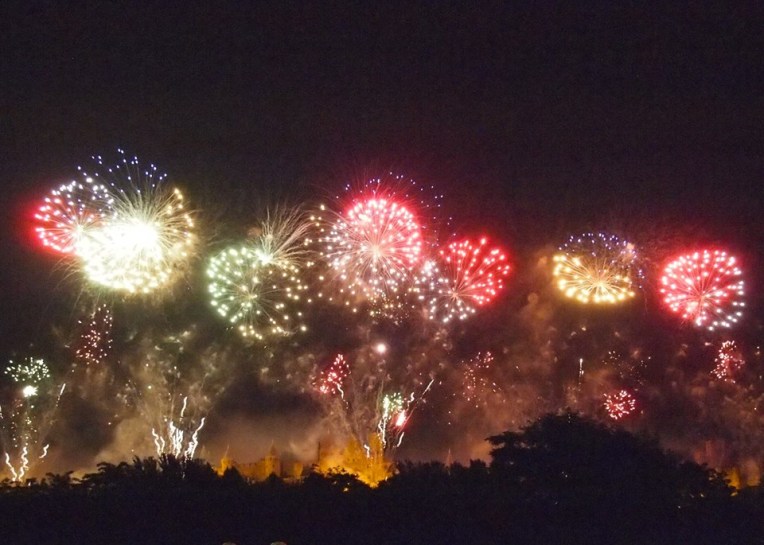
The La Fête Nationale (Bastille Day) fireworks in Carcassonne are famous throughout the world. In a beautiful medieval setting, the fireworks are lit among the ramparts and, as they shoot into the sky, they light the city below. The display has become extremely popular since its inception in 1898, with more than 700,000 people attending the festivities each year. It is the largest fireworks display in France with a full 25 minutes of pyrotechnics including “Burning the Cite,” immersing the medieval city of la Cité de Carcassonne in a red glow like the city is under siege and on fire.

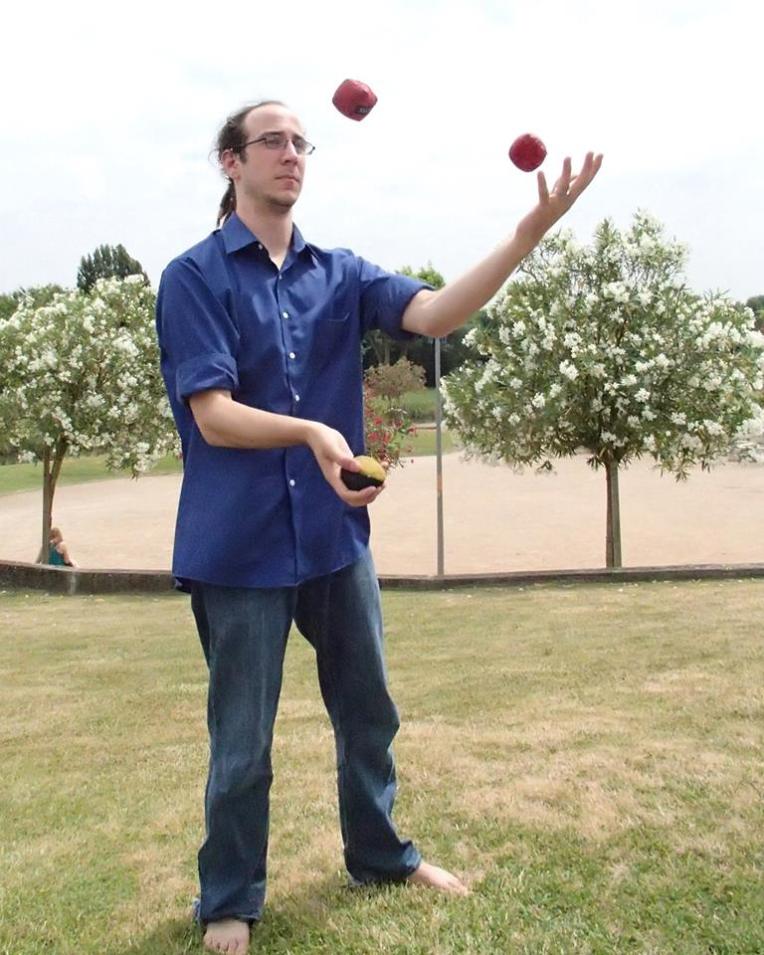
Tracy, Adam, Liz, Kiara, and I watched from the banks of the river Aube along Quai Bellevue.  We arrived early and enjoy a picnic, Adam Juggled for the crowd, watch people play petanque, Kiara was doted on, drank wine, and we chatted with our neighbors while waiting for the fireworks to start.  A festive and friendly atmosphere.

La Fête Nationale (Bastille Day) is the French national holiday commemorating the storming of the Bastille on July 14, 1789, a pivotal event the anti-monarchy revolution.

Liz, Adam, Tracy, and Kiara enjoying a picnic while we wait for the fireworks to start.
Adam juggling for the crowd while waiting for the fireworks
Fireworks over the medieval city of la Cité de Carcassonne

This slideshow requires JavaScript.

Carcassonne: 25ème Tour de l’Aude (25th Tour de l’Aude Vintage Car) Rally

With Adam and Liz newly arrived in Carcassonne, they had an opportunity to attend one of the many events that seem to be happening all year-long.  Their first event was at the medieval city of la Cité de Carcassonne:  the 25ème Tour de l’Aude des Voitures Anciennes en Pays Cathare (25th Annual Tour de l’Aude Vintage Car Rally through Cathare Country.)  Eighty plus cars from 1914 to 1945 of the most prestigious brands (Delage, Delahaye, Rolls Royce, Talbot, Bugatti …) from all over Europe. Like “Hot August Nights” for vintage European cars (plus a few US cars like a classic Mustang and Cadillac.)

Tracy, Liz, and Adam at the 25ème Tour de l'Aude des Voitures Anciennes en Pays Cathare (25th Annual Tour de l'Aude Vintage Car Rally.)
Tracy, Liz, and Adam at the 25ème Tour de l’Aude des Voitures Anciennes en Pays Cathare (25th Annual Tour de l’Aude Vintage Car Rally.)
Liz and Adam at the Narbonne gate of the medieval city of la Cité de Carcassonne

This slideshow requires JavaScript.

Getting Ready: Camino de Santiago de Compostela Pilgrimage

Ten weeks until departure.

Sometimes the universe presents a chain of events that require that you “make a leap of faith” and embrace it.

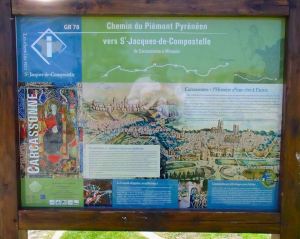
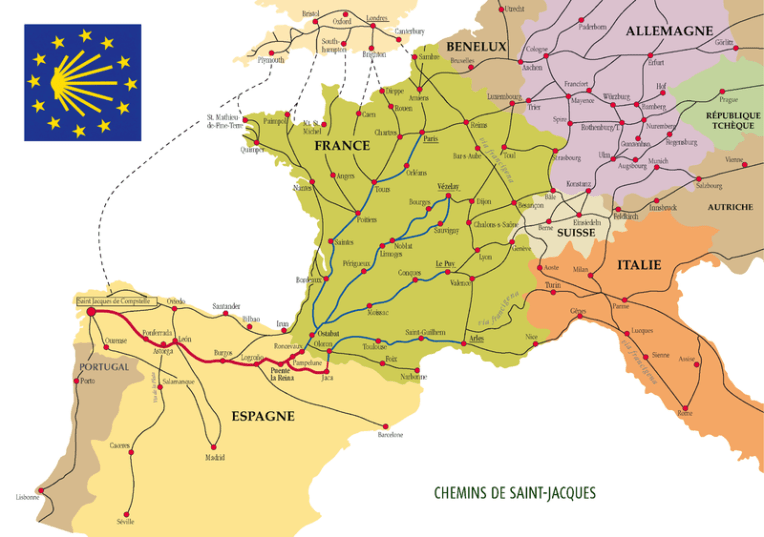
Recently fate led us to being on one of the secondary routes of the Camino de Santiago de Compostela pilgrimage trail. While living in Carcassonne we slowly realized that the start of the  Chemin du Piémont Pyrénéen branch of  Les Chemins de Saint-Jacques-de-Compostele (the French name for the Camino de Santiago de Compostela) was right at the end of our block.

Chemin du Piémont Pyrénéen

El Camino de Santiago de Compostela or The Way of Saint James is a series of pilgrimage trails across Europe all leading to Santiago de Compostela Cathedral in Galicia, Spain which Christian tradition holds is the resting place for Saint James the Greater, one of Jesus of Nazareth’s disciples.  Dating back 1,200 years, pilgrims of all faiths and backgrounds have been walking the Santiago de Compostela for religious, spiritual, or cultural reasons; for enlightenment; as penance; or as a personal challenge.

Map of Camino de Santiago - Chemins de Saint Jacques  From Wikimedia Commons
Map of Camino de Santiago – Chemins de Saint Jacques
From Wikimedia Commons

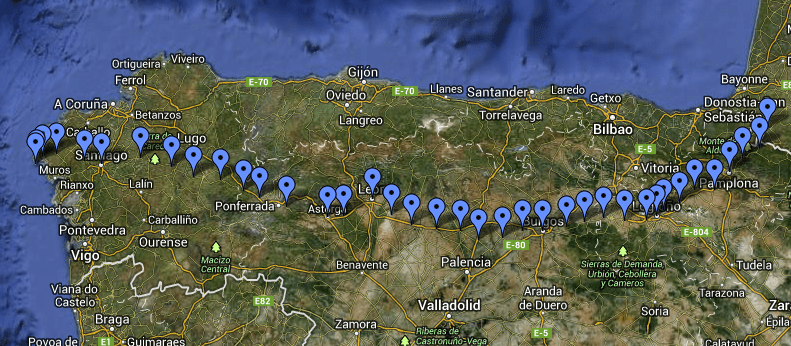
Tracy and I (with Kiara the micro-dog) have decided starting August 26 we will begin the pilgrimage and backpack the 500 miles (800 kilometer) path from Saint-Jean-Pied-de-Port on France’s Western border; over the Pyrenees Mountains and through Basque country; passing through the cities of Pamplona (famous for the “Running of the Bulls and Hemingway’s “The Sun Also Rises”), Logroño, Burgo, and León; across the Meseta plains; into the green hills of Galicia; and ending at the UNESCO World Heritage Site of the city of Santiago de Compostela and its cathedral.  The trek should take us a minimum of five weeks.

Camino de Santiago - The French Route (Google Maps)
Camino de Santiago – The French Route
(Google Maps)
Our preparations so far:
1.  Our hiking equipment has been obtained, most importantly our boots.  The number one issue we hear from every guidebook, website, and blog is to have shoes appropriate for you and to break those shoes in thoroughly.  I’m an old Boy Scout who has sprained his ankles frequently in the past so I’m an advocate of wearing boots for ankle support although there are many supporter of wearing lightweight hiking shoes for the Camino.  The hiking gear we didn’t bring to France was purchased at Decathlon Sports in Carcassonne (a French sports megastore.)  Many of the products we obtained are made by Quechua, a French version of “The North Face.”  We will post our final equipment list in a later blog.
Tracy's Camino Gear
Tracy’s Camino Gear
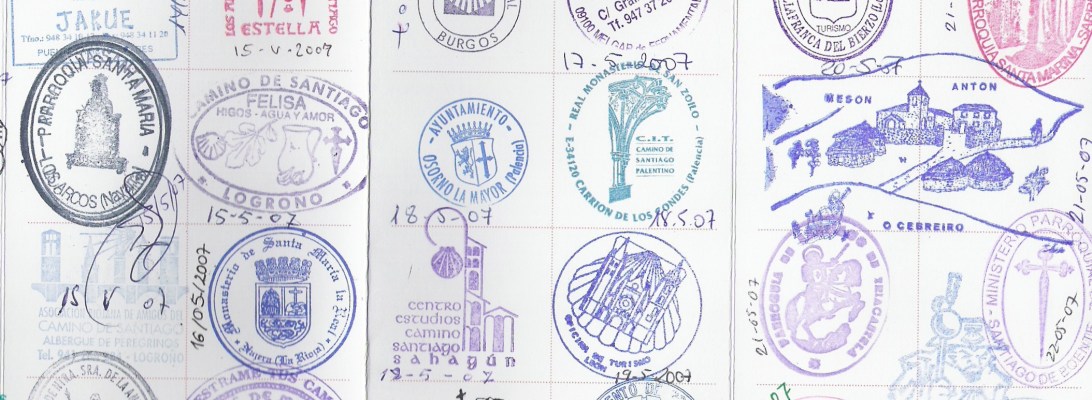
2.  We requested our credencial, our pilgrim’s passport, from American Pilgrims on the Camino (http://www.americanpilgrims.com), the United States’ confraternity for Camino pilgrims.  The credencial allows us to stay at pilgrim albergues and refugio (hostels along the route) and to authenticate our progress with sellos stamps (like a passport stamps) at albergues, churches, town halls, and police stations along the way.
3.  We researched and obtained guidebooks that explain the various routes, history, and provide maps of the Camino.  We selected John Brierley’s A Pilgrim’s Guide to the Camino de Santiago, the Confraternity of Saint James’ The Camino Francés: St-Jean-Pied-de-Port to Santiago de Compostela, and CaminoGuide.net’s Camino Francés.  We wanted some alternative views but  plan to only bring one guide with us on the Camino.  We have been reading blogs and forums about walking the Camino, we both greatly enjoyed and recommend http://www.girlsontheway.com/.
4.  We selected the Camino Francés as our route (Saint-Jean-Pied-de-Port, France to Santiago de Compostela, Spain across the entire Northern end of Spain), picked our departure date as the last week in August, and made hotel and train reservations for Saint-Jean-Pied-de-Port where we will start the journey.  We decided on a final night in a hotel to be well rested before our departure.  The hotel is located near the Pilgrim’s Office so we can arrange our final details before leaving.
5.  We have started a daily training regimen that includes walking the biggest hill nearby, the road to the medieval city of la Cité de Carcassonne.  The training is also part of our process to “break in” our boots and get acclimatized to carrying backpacks, something I did all through my youth and young adulthood but an activity I haven’t done in more than a decade.
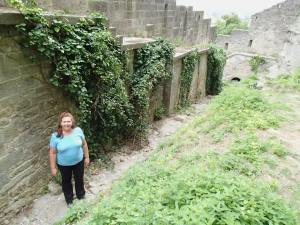
Tracy hiking the barbicane at la Cité de Carcassonne
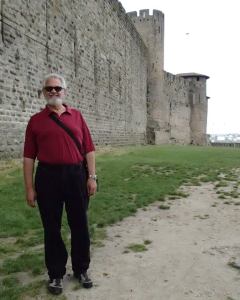
Alan hiking the bailey in la Cité de Carcassonne

6.  We obtained a chest carrier for Kiara.  Yes, Kiara the Chihuahua is traveling the Camino with us.  We understand that many albergues do not allow dogs, but we intend to camp whenever that occurs.  Kiara will do some daily walking, but most of her traveling will be as a passenger on her “beasts of burden” (the two of us) like the horseback pilgrims who also travel the Camino.

So our Camino preparations continue and we will post more updates as we go.

Tracy's boot over the scallop shell sign marking the Camino
Tracy’s boot over the scallop shell sign marking the Camino

Going for a Little Walk . . .

People say that the Camino finds you. We believe this to be true. Both Alan and I were aware of the Santiago de Compostela cathedral, in Spain. I even have a friend who took some amazing photos on a vacation once. But neither of us had never heard about the pilgrimage from St. Jean Pied-du-Port to Santiago de Compostela until right before we moved to France.

We were (and would be still if it were available here) major Rick Steve’s junkies, our DVR was full of 30 minute episodes from his trips all over Europe that we would watch over two or three nights – I kept falling asleep at about the 10 minute mark each night. During an episode when he was in Spain, he mentioned the Camino de Santiago de Compostela and the French Route from St. Jean Pied-du-Port. We found the episode interesting and then promptly forgot all about it in our rush to finish our pre-move checklist and goodbyes.

Upon arriving in France, we noticed that the little park up the street where we walk Kiara had signs that we couldn’t quite figure out. Blue background with yellow lines joined at the left and radiating out like a child’s drawing of the sun, or rather 1/3 of it. For weeks we couldn’t figure it out and eventually tuned it out as an oddity.

500px-Muszla_Jakuba

The other thing we noticed around the city was a stripe of white over a stripe of red. This pattern is found everywhere and with rather odd placement. Posts, railings, trashcans, trees, power poles, corners of buildings. It can be found painted, as reflective tape or decals. We reasoned that perhaps it had something to do with parking or some other obscure city ordinance that we would never figure out.

Way-Marker

Then two weeks ago, a construction crew was putting up a large signboard in Kiara’s park on the path that follows the Aude River. A few days later, we wandered over to take a look at it. It is a signboard that explains that the Arles Route (Arles to Toulouse) of the Camino de Santiago de Compostela runs through Carcassonne. The sign has great graphics showing the route through town.

We were both surprised to find out a couple of things: 1) the Camino doesn’t start just in St. Jean Pied-du-Port (there are a lot of starting points all over Europe) and 2) it literally runs right in front of our apartment.

I remembered a month ago while sitting in the window seat and having my morning coffee that a hiker with a scallop shell on his backpack walked up the street. I knew that the scallop shell meant that the person was walking or had walked the Camino from the Rick Steve’s episode I had seen a few months earlier. I figured that he had done it once before and thought “cool” and promptly put it out of my mind. Seeing him made total sense after seeing the signboard.

Alan did a little Google research about the Camino and found that Emilio Esteves had done an Indy film in 2010 called “The Way.” I found it in iTunes and downloaded it. We watched it last week and it took less than an hour for us to look at each other and say “Let’s do it.”

As I mentioned earlier, they say the Camino finds you and for us that is definitely true — since it is literally right outside our front door. So rather than waiting for “someday” we’ve decided to listen to the universe and go for a walk.

Currently we’re planning a pilgrimage to Santiago de Compostela in Spain. 500 miles over mountains and plains from St. Jean Pied-du-Port in France to Santiago, Spain.

There are three pilgrimages that all Catholics are encouraged to make in their lifetime, St. Peter’s in Rome (which we’ve done — in addition, the Bishop’s Office in Rome also encourages you to visit all four of the major basilicas while in Rome — you’re there any way — so we did in 2011), Santiago de Compostela (which we are planning) and Jerusalem (which has been on both our wish lists for sometime).

The Camino de Santiago can be done as a religious or non-religious pilgrimage. We discussed it and decided to do this as a religious one — technically religious/cultural. Alan isn’t Catholic, but I have been since my first breath, albeit non-practicing most of the time. I think God will overlook my absences since we’re usually on pretty good terms regardless of whether or not I sit in a pew on Sundays.

Pilgrims are given a special passport — a “credential” — that you get stamped along the way and a “compostela” upon arrival. The paper and printing methods have changed but the design of the document has remained unchanged for over a thousand years.

All pilgrims are encouraged to carry the symbol of St. James (who is buried in the church in Santiago) which is a scallop shell, we are getting a special one for Kiara for her carrier. We will have ours attached to our backpacks like all the other pilgrims. Additionally, Camino charms are sold in many of the towns along the way — Kiara will probably end up with new jewelry too.

There are auberges (pilgrim hotels) along the way which charge very little for dinner, a bed, breakfast and a place to shower, usually between 5 and 15 euro ($8 to $18 roughly). Most have washers and dryers so that you can keep your clothes clean on the journey. A few do not allow dogs, hence the need for the tent!

Our route will take us through the Pyrenees mountain range, starting on day one! We want to complete it in 5 weeks so we’ll need to hike an average of about 15 miles a day with a day of rest once or twice along the hike, but since we are retired we’re not too worried if we need extra time.

We have spent the last two days purchasing good hiking shoes, tent, sleeping bags and packs. We’ve loaded them up and weighed them. We are astonished at the new fabrics and technology in design that keeps everything weighing very little. Alan’s pack weighs under 20 pounds, mine weighs under 14. It’s still boggles my mind a bit! Kiara will be coming along in her special chest carrier that we purchased while we were still in Reno, I will be carrying her sweater, blanket and food. The plan includes letting her walk a little each day so she can do a “mini-Camino” or as we call it, a “Chi-Camino.”

We are now setting up a training schedule for the next 10 weeks, working up to the 15 miles a day that we’ll need to average in order to complete our little walk in five weeks. The Camino de Santiago de Compostela from St. Jean Pied-du-Port is 800 kilometers or roughly 500 miles.

Alan will be posting additional information in the next few days for anyone interested in learning more about the Camino. We are batting around ideas about how to do updates along the way, or whether we should just do one big update when we arrive home, we’ll let everyone know what we decide before we leave.

Buen Camino!

Carcassonne: Marc Walter Sculptures, “L’embrassade” and “Invités du Coeur”

Franco-Canadian artist Marc Walter created five large sculptures in Carcassonne as part of the annual Festival de Carcassonne.

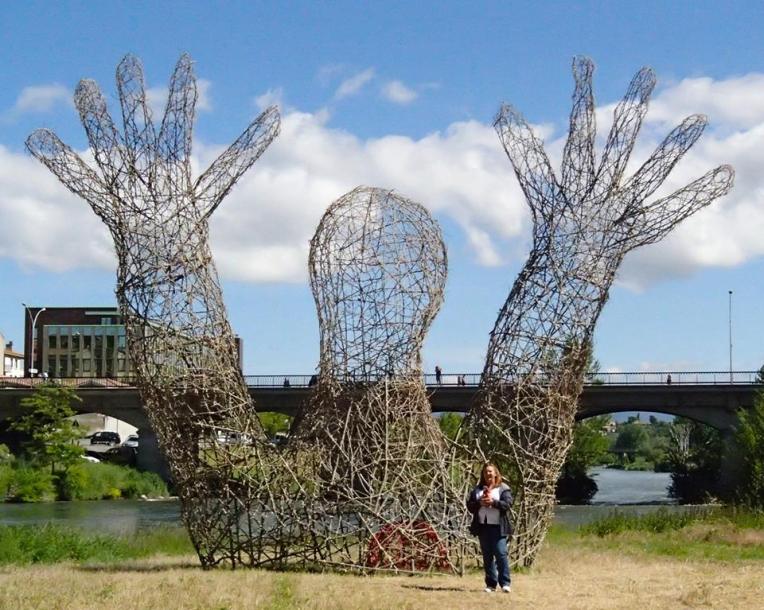
The first and largest is the “L’embrassade” (“The Hug”) sculpture located on the tip of l’île de la Cité Park and below the Pont Vieux (Old Bridge.)  The sculpture is 7 meters tall and 9 meters wide. Marc Walter uses natural materials like wood, rock and earth to create his “Land Art” sculptures. For this project he used tree branches collected from Carcassonne’s public works after pruning the local trees.  The sculpture is made by weaving the branches and securing with twine to created a large figure of a man with arms outstretched to the sky.  A bright red heart can be seen inside the sculpture.  The image is very reminiscent of an 3-D version of a Keith Haring painting.

Tracy and Kiara in front of Marc Walter's "Land Art" Sculpture "L'embrassade" ("The Hug")
Tracy and Kiara in front of Marc Walter’s “Land Art” Sculpture “L’embrassade” (“The Hug”)

This slideshow requires JavaScript.

In Square Gambetta the artist created four additional sculptures.  Standing five to six meters high, I thought these “Invités du Coeur” (“Guests of the Heart”) sculptures had a Native America feeling.  The weaving of the branches creates a vision of Indian basket weaving and the silhouette reminds me of woman with a blanket draped over her shoulders.  Again created using recycled tree branches and twine, the four figures allow you to step inside and experience the art from the interior.  Each sculpture has a distinctly red heart like the “L’embrassade” sculpture, but these  figures were somewhat more abstract in appearance.  We watched the artist and volunteers from the community build the sculptures over the last six weeks.  I spoke briefly with artist Marc Walter while he was working.  He was very friendly, accessible, and happy to discuss his work. I was thankful because of Marc’s Canadian roots I was able to communicate in English.  He works very hard to actively involved the entire local community in the work as a collective effort in the art.  The completion of the project was marked with a picnic celebration with the community invited to attend.

Tracy with one of the  "Invités du Coeur" ("Guests of the Heart") Marc Walter sculptures in Square Gambetta
Tracy with one of the “Invités du Coeur” (“Guests of the Heart”) Marc Walter sculptures in Square Gambetta

This slideshow requires JavaScript.

In all, a remarkable exhibition of public art by artist Marc Walker using local recycled materials and involving community volunteers.

To see more visit Marc Walker’s website at www.marcwalter.ca

A YouTube video creating the art is at http://www.youtube.com/watch?v=vNuHsObwnOA 

Franco-Canadian artist Marc Walker working on one of his "Invités du Coeur" ("Guests of the Heart") sculptures in Square Gambetta.
Franco-Canadian artist Marc Walker working on one of his “Invités du Coeur” (“Guests of the Heart”) sculptures in Square Gambetta.

Carcassonne: Oenovideo Film Festival and Terroirs d’Images Photo Exhibition

On May 30 through June 2, Cité de Carcassonne hosted Le 20e Festival Œnovidéo, véritable moment de rencontre internationale entre le monde du cinéma et du vin, vient de se clôturer (the 20th Annual Oenovideo International Grape and Wine Film Festival) and le 8e Torroirs d’Images Exposition Internationale de Photographies sur la Vigne et le Vin (the 8th Annual Terroirs d’Images Exhibition of  Vine and Wine Photography.)

Oenovideo Film Festival
Terroirs d'Images Photo Exhibition
Terroirs d’Images Photo Exhibition

The Oenovidéo International Grape and Wine Film Festival featured 26 films from 14 countries competing for the title of best film on the vine and wine in 2013.  The Terroirs d’Images Photo Exhibition hosted 105 photos from photographers from 14 countries on the theme “Enjoy and celebrate wines on five continents.

After going to the website I was able to request tickets to the film showings and to attend the photography exhibition.  The event’s headquarter was at Hôtel de la Cité Carcassonne, a four star hotel located inside the medieval city and next to Basilique Saint-Nazaire-et-Saint-Celse de Carcassonne (the Basilica of St. Nazaire and St. Celse).  The hotel has stunning private gardens where several events were held.

The films screened at the festival included several English language films including my favorite selection, “No Wine Left Behind,” a “kickstarter-funded” independent film which is described as, “When US Marine Sergeant Josh Laine returned from intense fighting in Iraq to his native Livermore, CA, he couldn’t find a job anywhere. When a girlfriend got him into wine, he decided to take a crack at winemaking and with the help of the other Marines that he served with, Lavish Laines Winery was born. The winery has since become a place where returning veterans can find a job, camaraderie, and a sense of purpose. The film follows Josh and his fellow vets as they try to take the winery from a garage start-up to a fully-fledged operation and in the process explores the challenges vets face in transitioning back to civilian life.”

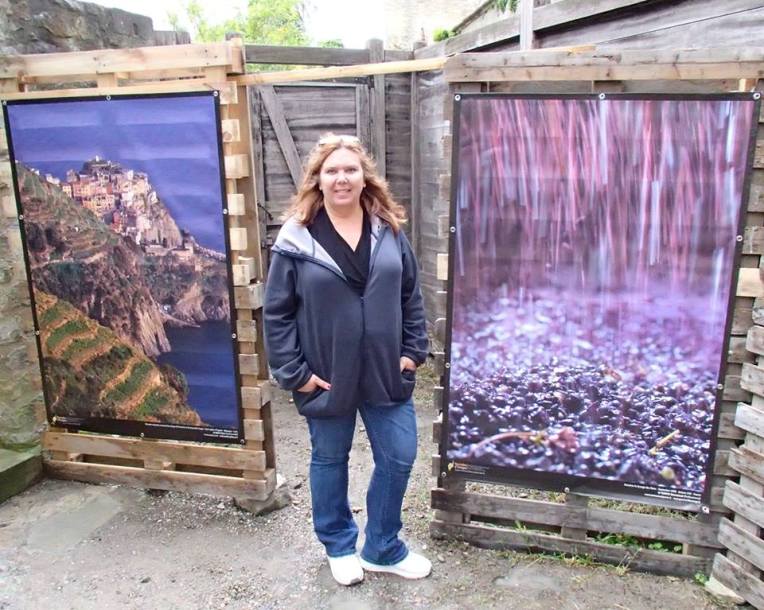
Tracy and I really enjoyed the Terroirs d’Images Photo Exhibition.  The gallery was set up inside le Cité de Carcassonne’s Trésau Tower and  the venue gave the photos a powerful setting.  The images were suspended on thin wires to emphasize the photographer’s work.  There was a “No Photos” inside the gallery rule, but I took one overall shot to give you an impression of the exhibition and the presentation of the art.

Photo gallery inside Trésau Tower.

Some of the photos were “blown-up” and displayed outside the gallery so I can share some of those below.

Tracy outside the exhibition with two photos displayed inside. Eighth Annual Terroirs d'Images International Photo Exposition.
Tracy outside the exhibition with two photos displayed inside. Eighth Annual Terroirs d’Images International Photo Exposition.

This slideshow requires JavaScript.

Carcassonne: Equiaude Parade and Cheval en Fête (Horse Festival)

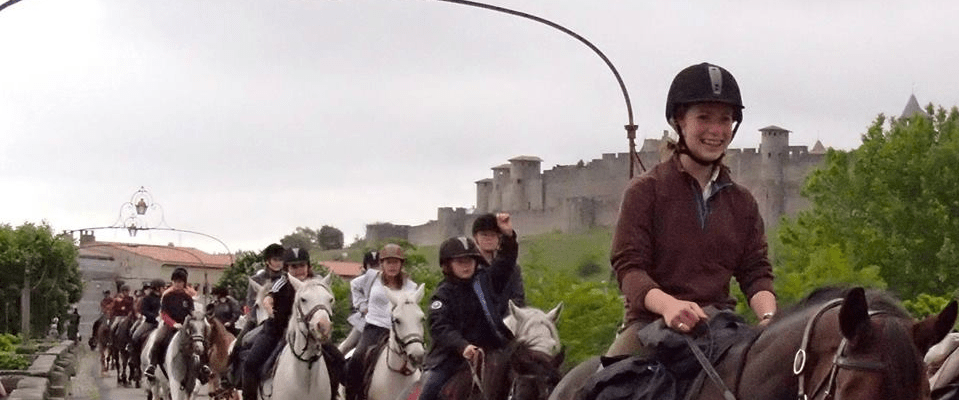
We had a great time at the Cheval en Fête (Horse Festival) today.  We watched more than 100 riders participate in the Equiaude Equestrian Parade.  The cavaliers rode from the medieval citadel of la Cité de Carcassonne, down and across du Pont Vieux (the Old Bridge), around Square Gambetta, through the streets of Carcassonne, and ending at the Hippodrome de la Fajeolle.

Equiaude Equestrian Parade passing over the Pont Vieux (Old Bridge) with la Cité de Carcassonne in the background.

The participants ranged from mature to the very young.  There appeared to be several riding schools with groups of young people in matching shirts singing together as they rode.  Riders were using western saddles, dressage saddles, Australian saddles, and jumping saddles and there was a couple of horse-drawn carriages also participating.  With the municipal police taking front and rear of the procession for safety, the parade passed through town with the children happily waving to spectators.

The parade is part of a two-day equestrian competition at Carcassonne’s hippodrome.  The Equiaude Parade (Equi = equestrian, Aude = our department in France) is anticipated in Carcassonne like the annual Reno Rodeo Cattle Drive.

Equiaude Equestrian Parade

It was odd not to see iconic American Mustangs or Quarter Horses among the horses, but there were some beautiful Arabians and Thoroughbreds, with ponies and horse/mule hybrids for the children.  While I’ve been in a saddle fewer times than I have fingers, Tracy is a former horsewoman who explained tack and horses breds as they passed.

The part we enjoyed the most was the smiles and laughter of all the young riders as they enjoyed being the center of the attention while waving to the spectators and singing in unison.

This slideshow requires JavaScript.

Carcassonne: Fête du Pain (Bread Festival)

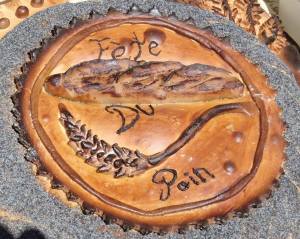
Carcassonne seems to have special events every week.  This week was la Fête du Pain (the Bread Festival) sponsored by a local professional baking college, Saint Honoré Academy.  (Saint Honoré is the patron saint of bakers.)  All the events in Carcassonne reminds us of all the special event we used to experience in Reno, Nevada.  French people really do take fresh baked bread seriously and we have found that in France, “Bread is king.”

The school set up both wood-fired and electric ovens in event tents on the perimeter of Square Gambetta We could smell freshly baked bread and hear the DJ’s music as we walked the block from our apartment to the Square.  A dozen artisan bakers and apprentices were busy baking baguettes, breads, croissants, cakes, bread sculptures, and pies for exhibition and sale to the public.  Many of the breads were created using the French twice-baked technique that makes that especially crusty bread that France is well-known for serving.

Fête du Pain
Fête du Pain
Fête du Pain
Fête du Pain
Fête du Pain - Baker working the wood fired oven
Fête du Pain – Baker working the wood fired oven

Tracy and I tried the pain au chocolat (chocolate croissant), a favorite of ours, and watched the bakers perform for the crowds.  There was an area for children to decorate cookies and an inflatable “bounce house” with multiple food and craft vendors along the Square to visit as well.

This slideshow requires JavaScript.

Carcassonne: Gendarmerie Motorcycle Rally

We attended the “Rallye Motocycliste Organis Par la Gendarmerie de l’Aude,” the Second Annual Motorcyclist Rally Sponsored by the Gendarmerie of Aude.

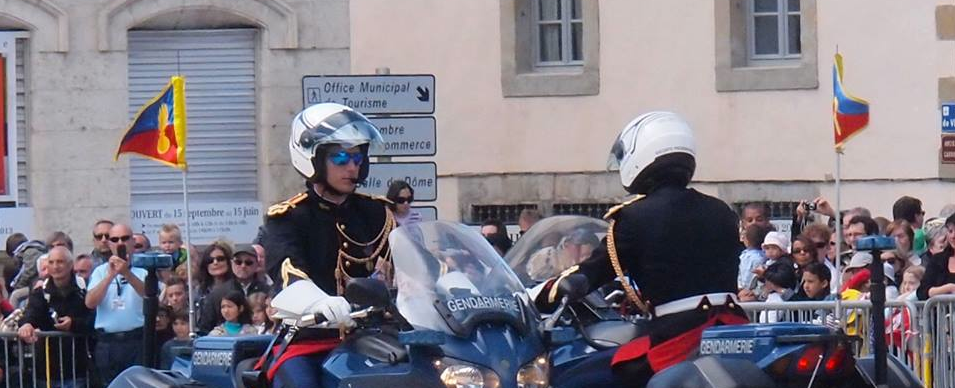
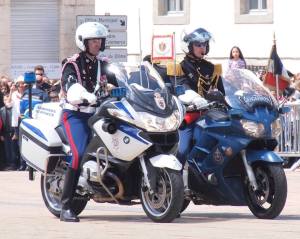
The free event in Square Gambetta included fast paced precision drills by motorcycle officers from the Republican Guard unit (presidential escort unit) of Gendarmerie Nationale of France and the Compagnie des Carabiniers du Prince of Monaco (royal family escort unit), amazing motorcycle stunts by the Republican Guard, music from a French Naval pipes and drums band, and a dramatic helicopter hoist delivery of a gendarme and his canine followed by a canine demonstration.  There were also driving safety exhibits, vendor displays, and recruiting by the Gendarmerie Nationale.

In addition to the local dignitaries, Prince Pierre of Monaco attended the event to observe his royal motorcycle escorts perform with the Gendarmerie Nationale Republican Guard.

Tracy and I both had to shake our heads at the French Naval pipe and drum band playing “Scotland the Brave” and the Disney symphony type music to entertain the crowd before the rally began, but especially at the segment when cowboy hat wearing country line dancers joined in and danced to the bagpipes and drums!

Monégasque Carabiniers on white bike and French Gendarmerie on blue bike
Gendarmerie Nationale Republican Guard Stunt Team

This slideshow requires JavaScript.