DELAYED POST, I am catching up our blog after our blogging hiatus while recovering from walking the Camino de Santiago.
December 24 and 25, 2013
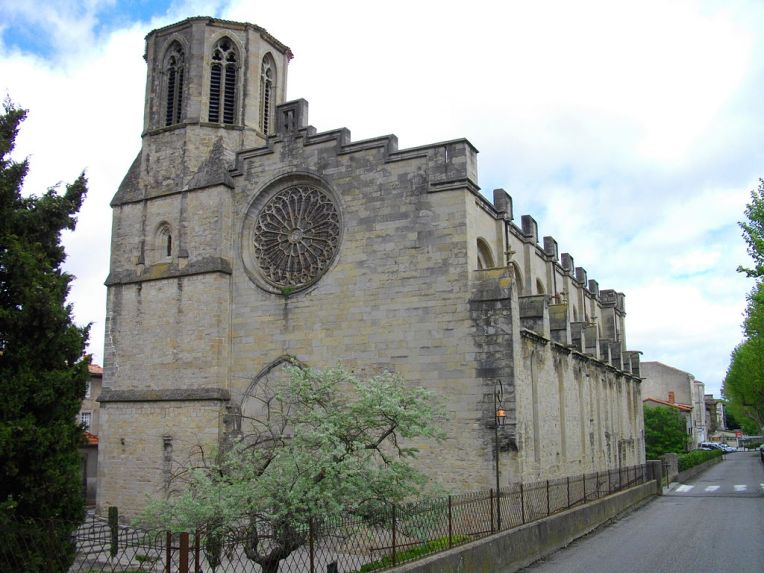
A quiet Christmas eve for us. Tradition in France is to attend la Messe de Minuit evening mass followed by a large family meal, le Réveillon. Tracy and I had planned to go to midnight mass at Cathédrale Saint-Michel de Carcassonne, but Sami, the min-pin puppy, was having terrible separation anxiety when we would leave her alone in the apartment. Rather than impose Sami’s whining on our neighbors, we spent the evening dining in and then took a midnight walk with Sami through the Bastide. Beautiful night walking through the quiet lanes, enjoying the lights.
Cathédrale Saint-Michel (Wikimedia Commons)
Père Noël (Father Christmas) was good to Sami Christmas morning. Sami scammed all sort of treats and toys from Père Noël . Tracy had previously knitted Sami her own Christmas stocking.
Sami opening her Christmas presents.
Christmas evening Tracy made a delicious Christmas dinner. Turkey roast, mashed potatoes, gravy, sautéed mushrooms, corn, green beans, toasted chèvre cheese on baguette, champagne, and religieuse pastries for dessert. Sami even got a small portion for her dinner. The nice thing about living in France is that if you want French champagne for dinner it only requires a walk to the end of the block.
We had a nice visit with some of Tracy’s family as they gathered for dinner, via FaceTime on her sister’s iPhone.
Wonderful Christmas, but we are missing our kids over the holiday.
DELAYED POST, I am catching up our blog after our blogging hiatus while recovering from walking the Camino de Santiago.
December 6, 2013
La Magie de Noël (The Magic of Christmas) Festival is a month-long (December 6, 2013 to January 5, 2014) celebration throughout Carcassonne.
There was a Christmas market in Square Gambetta with a Ferris wheel, carousel, and two children’s carnival rides.
In Place Carnot (the town square) the city had erected an ice skating rink. The rink had live and recorded music, food booths, and later at night “ice go karts” were available for the adventurous.
At Place d’Armes and Port Jacobin (Jacobin Gate) there was a large roller coaster and a children’s roller coaster and spin rides.
Jardin Andre Chenier (Andre Chenier Garden) had a simulated sled run, mild for children and steep for the more bold with several more children’s rides and food booths.
The final venue was up in the medieval la Cité de Carcassonne was a christmas crafts market behind the Basilique Saint-Nazaire-et-Saint-Celse.
During the month there was all kinds of live music scheduled at the different venues. The city businesses all had Christmas trees decorated with ribbons outside their front doors and there were Christmas lights hung over the streets. In short, the Christmas spirit was everywhere we walked. Square Gambetta is only a block away from our apartment and there were several special trips for seasonal specialties and stops for vin chaud (hot spiced wine.)
Tracy and Sami walking in the medieval la Cité de Carcassonne after visiting the Christmas craft fair.Alan and Sami walking in the medieval la Cité de Carcassonne after visiting the Christmas craft fair.
DELAYED POST, I am catching up our blog after our blogging hiatus while recovering from walking the Camino de Santiago.
December 8, 2013
To celebrate Carcassonne’s Fête de la Saint-Nicolas (Feast day of Saint Nicholas) there is the Marche aux Flambeaux (Torch Parade), an amazing parade from the medieval city of la Cité de Carcassonne across the Pont Vieux (Old Bridge) through Gambetta Square’s Christmas Market, the Bastide (the traditional town) to reach Place Carnot (the town square and marketplace).
Lead by Saint Nicholas, marchers in traditional medieval costumes, families, bands, and visitors all with flaming torches happily walk the route talking, laughing, and singing along the way. It is a wonderful start to the Christmas season in Carcassonne and one of the first events in the month-long La Magie de Noël (The Magic of Christmas) Festival.
We had a wonderful time joining in with the marchers, although Sami, the min-pin, was far less impressed with the volume of the music, especially the marching band’s drummers.
Tracy and Sami on the Pont Vieux (Old Bridge) waiting for the Marche aux Flambeaux (Torch March) to arrive. La Cité de Carcassonne in the background.Alan and Sami on the Pont Vieux (Old Bridge) waiting for the Marche aux Flambeaux (Torch March) to arrive. La Cité de Carcassonne in the background.
DELAYED POST, I am catching up our blog after our blogging hiatus while recovering from walking the Camino de Santiago.
November 24, 2013
Children’s’ Carnival
Just before Thanksgiving, Carcassonne offered a week-long Children’s Carnival at the west side of the Bastide, the traditional “old town.”
The carnival just “popped up” out of the blue. Carcassonne seems to be very much be like Reno, Nevada with special events nearly every weekend. We used the fun to expose Sami, the mini-pin puppy, to the excitement and noise. We keep working on socializing her well with people and background noise. We had fun sipping vin chaud (hot spiced wine) and watching happy children.
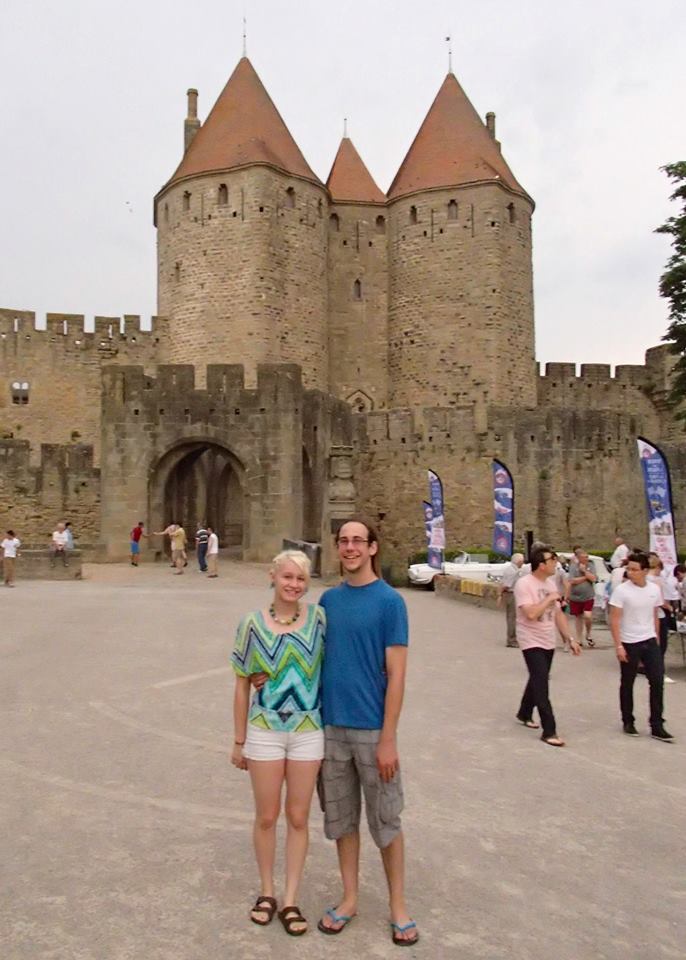
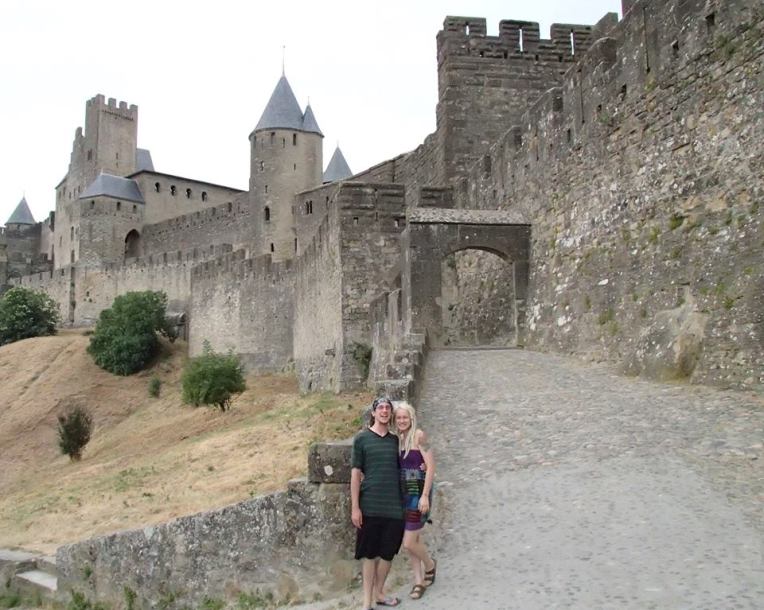
While visiting with us in Carcassonne, Adam and Liz had the chance to tour the medieval city, la Cité de Carcassonne, a couple of times. We refer to it as “the castle in our backyard” since it is right up the street from our apartment.
Adam and Liz in front of the medieval city la Cité de CarcassonneAdam and Liz in front of the Narbonne Gate of the medieval city la Cité de CarcassonneAdam and Liz in front of the Aude Gate of the medieval city la Cité de Carcassonne
A UNESCO World Heritage Site and dating back 2,500 years, the medieval city of a Cité de Carcassonne has 52 towers and two concentric walls with a total of three kilometer of ramparts. Within the walls is a 12th century chateau built by the Trencavels, the Vicomtes de Carcassonne and the Basilique Saint-Nazaire-et-Saint-Celse de Carcassonne (the Basilica of St. Nazaire and St. Celse). Jousting is still performed annually in the baileys of the citadel’s walls.
This slideshow requires JavaScript.
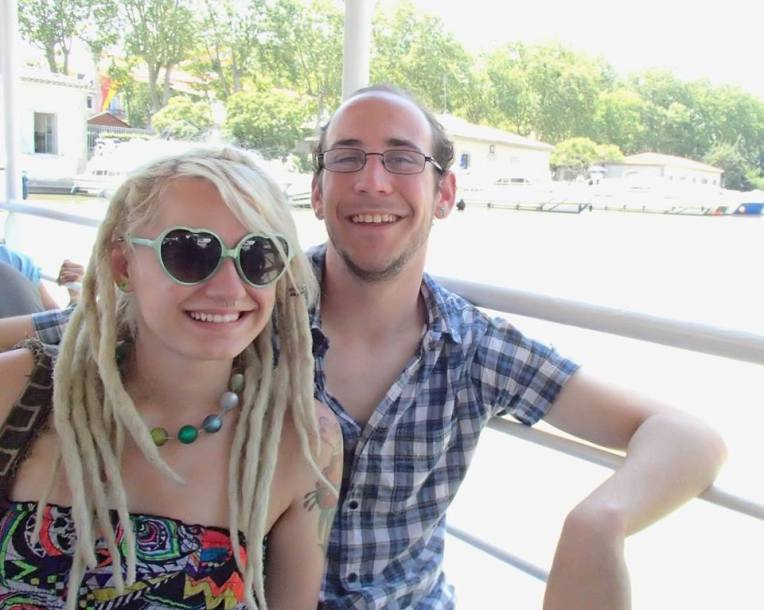
We were also able to take a short barge cruise with Adam and Liz down the section of the Canal du Midi that passes through Carcassonne. The 17th century Canal du Midi, a UNESCO World Heritage Site, is described by UNESCO as a “360-km network of navigable waterways linking the Mediterranean and the Atlantic through 328 structures (locks, aqueducts, bridges, tunnels, etc.) is one of the most remarkable feats of civil engineering in modern times. Built between 1667 and 1694, it paved the way for the Industrial Revolution.” The canal is used primarily today for recreational boating.
Liz and Adam enjoying their Barge cruise on the Canal du MidiTracy and Alan having fun on a barge cruise on the Canal du Midi
This slideshow requires JavaScript.
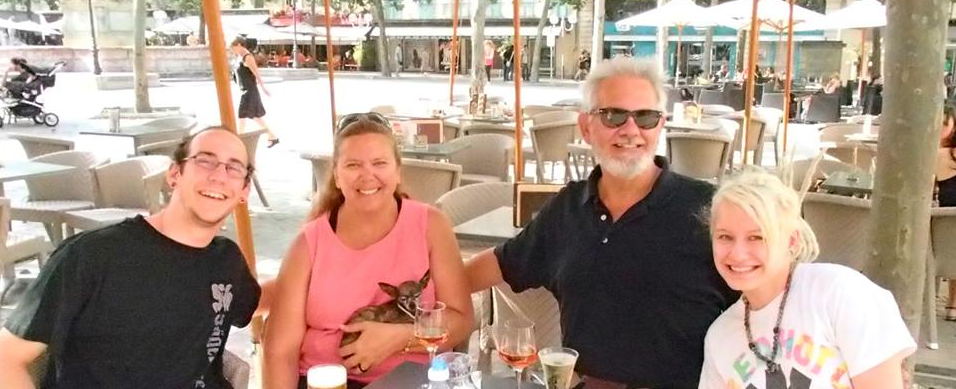
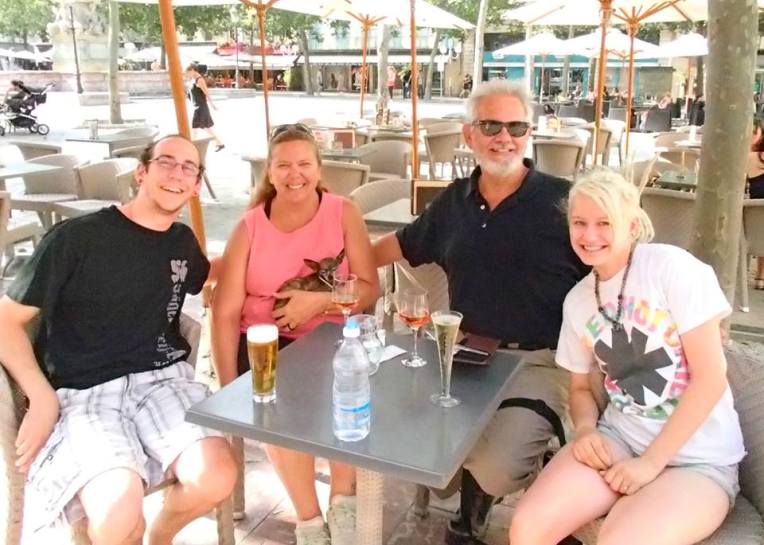
During our explorations there was always time to relax, talk, enjoy a meal, or have a cold beverage. Then on to exploring more of Carcassonne and France.
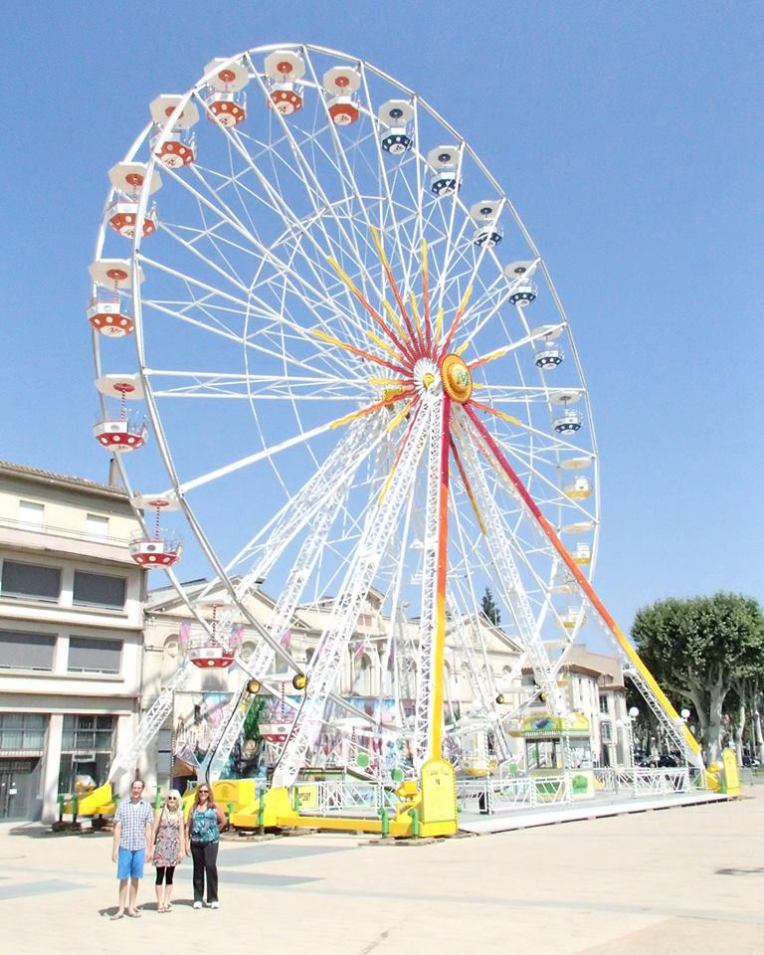
Adam, Tracy, Kiara, Alan, and Liz take a wine, beer, and champagne break in Place Carnot in the Bastide of CarcassonneAdam, Liz, and Tracy with the Ferris Wheel set up in Square Gambetta for Festival de Carcassonne.
With the temperatures reaching up into the 90s, we wanted to visit the Mediterranean with Adam and Liz. We tried to facilitate a SCUBA dive, but had difficulties getting connected to dive shops in Narbonne. So it was off to the beach for old-fashioned “sun and surf.”
The Narbonne Plage (Narbonne Beach) is one of several Mediterranean Sea beaches in the Languedoc-Roussillon region. Narbonne Plage is well west of the Côte d’Azur (known in English as the French Riviera) on the Mediterranean coastline in the southwest corner of France. The beach is 5 km of wide, fine sandy beach with a marina and restaurants. It is a public “locals’ beach,” or rather the “poor man’s” Riviera, with all the beauty of the Med without the extravagant cost of the Côte d’Azur.
We caught the regional TER (transport express régional) train from Carcassonne to Narbonne and then took one of the special summer buses to the beach. There were many other beach-goers on the bus with us. Surprisingly, Narbonne Plage is 25 minutes away from the train station, with a scenic view of central Narbonne and the Montagne de la Clape mountain range along the way.
Adam and Liz enjoying the Mediterranean Sea at Narbonne Plage
Fortifying ourselves with food and sangria (and a bit more sangria) we ventured out into the water. Beautiful sandy beach, very minimal crowds despite the full bus, warm water with a beautiful gradient of color from green to deep blue as the water gets deeper. There were lifeguard stations, lifeguards in Zodiac boats, and a police presence with swimsuit-wearing officers from the CRS Police (Direction Centrale des Compagnies Républicaines de Sécurité – Central Directorate of the Republican Security Companies; DCCRS).
While Tracy and I contented ourselves with wading, Adam and Liz splashed right into the sea for a swim. Wonderful day of water, walking the beach, investigating the marina, collecting shells, watching the surf fishermen, SCUBA divers (we knew there had to be divers there), and sailboats.
This slideshow requires JavaScript.
We took a different bus back toward the train station that normally stops several blocks away from the station. However, our driver very kindly drove us all the way to the bus stop at the train station.
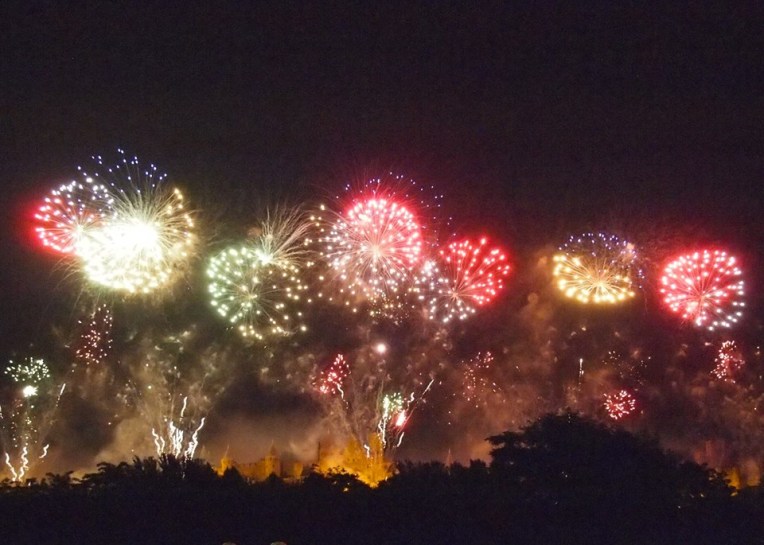
The La Fête Nationale (Bastille Day) fireworks in Carcassonne are famous throughout the world. In a beautiful medieval setting, the fireworks are lit among the ramparts and, as they shoot into the sky, they light the city below. The display has become extremely popular since its inception in 1898, with more than 700,000 people attending the festivities each year. It is the largest fireworks display in France with a full 25 minutes of pyrotechnics including “Burning the Cite,” immersing the medieval city of la Cité de Carcassonne in a red glow like the city is under siege and on fire.
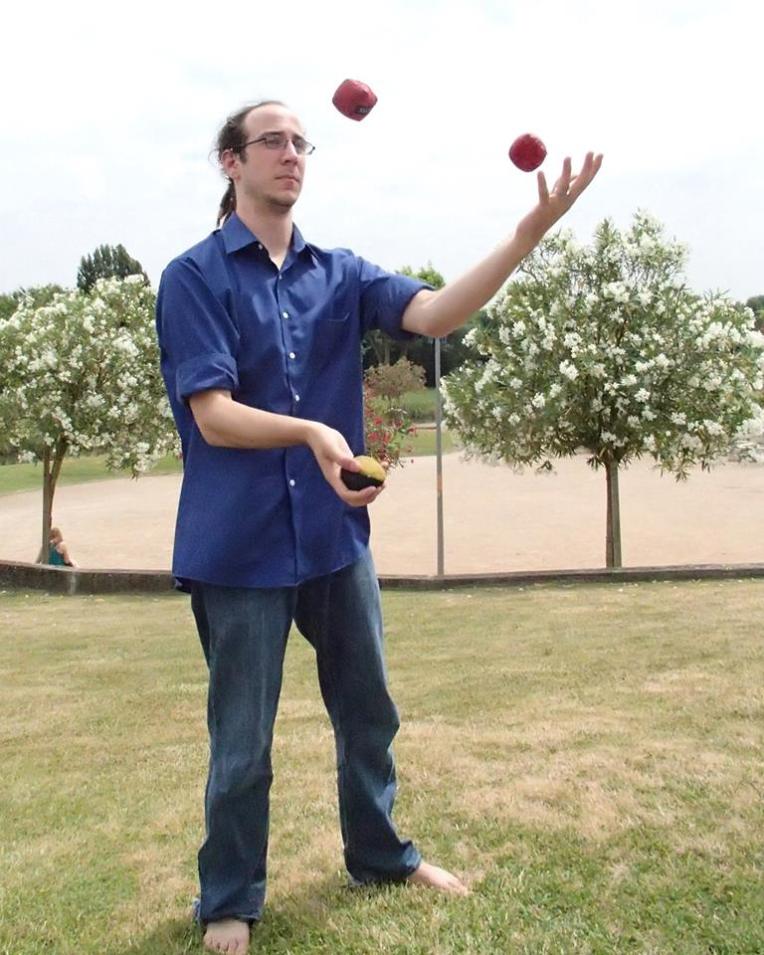
Tracy, Adam, Liz, Kiara, and I watched from the banks of the river Aube along Quai Bellevue. We arrived early and enjoy a picnic, Adam Juggled for the crowd, watch people play petanque, Kiara was doted on, drank wine, and we chatted with our neighbors while waiting for the fireworks to start. A festive and friendly atmosphere.
La Fête Nationale (Bastille Day) is the French national holiday commemorating the storming of the Bastille on July 14, 1789, a pivotal event the anti-monarchy revolution.
Liz, Adam, Tracy, and Kiara enjoying a picnic while we wait for the fireworks to start.Adam juggling for the crowd while waiting for the fireworksFireworks over the medieval city of la Cité de Carcassonne
Off and rolling to the Louvre with pre-paid tickets in hand. The Musée du Louvre (the Louvre Museum or simply The Louvre) is one of the world’s largest museums with nearly 35,000 objects from prehistory to the 21st century exhibited over 652,300 square feet. Located on the Right Bank of the River Seine in the 1st arrondissement, the Louvre receives more than 8 million visitors a year. The Louvre is the world’s most visited museum.
Like the Smithsonian Institute, it would take days to see everything in the Louvre, we elected to see specific galleries in order to see more of the rest of Paris. That makes a good reason to return to the Louvre again (and again . . . and again.)
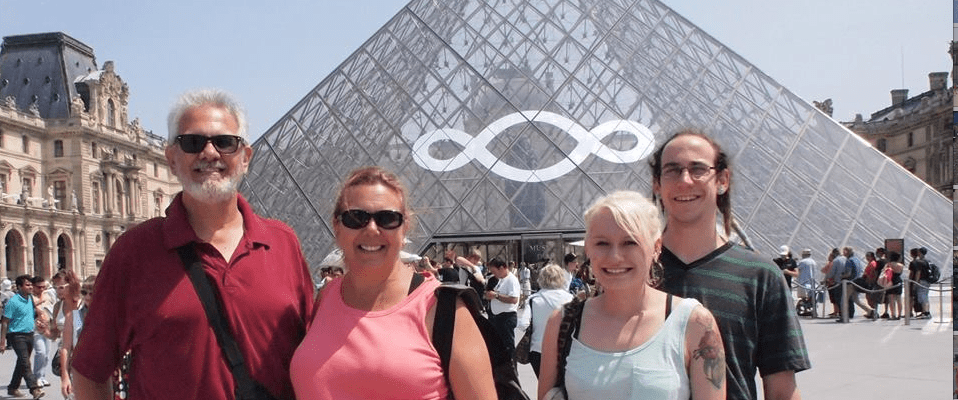
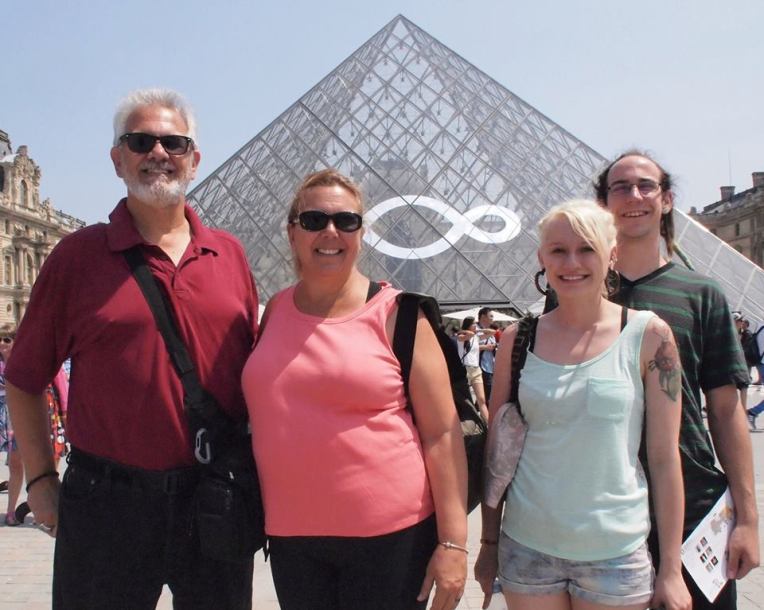
Alan, Tracy, Liz, and Adam in front of the Louvre pyramid.
What hasn’t been said about one of the world’s seminal museums that is located in a former royal palace and holds many of the world’s iconic pieces of art? The Louvre is amazing in its depth of art, artists, media, and history.
After accessing the Louvre’s entrance through the underground Carousel du Louvre shopping mall (with a minor delay when security screening were briefly bewildered by Adam’s juggling balls), Adam was our guide through the Louvre. So hard to narrow down choices, but included in our visit was (of course) the Mona Lisa, the Winged Victory of Samothrace, the Venus de Milo, and the Code of Hammurabi. We visited the art of Ancient Greece, Mesopotamia, and the Renaissance.
This slideshow requires JavaScript.
Adam and his fiancée Liz participated in Europe’s growing “Love Lock” phenomenon. Spreading across Europe is the new tradition of leave a padlock, often engraved or marked with lovers’ names to a famous landmark. On the Pont des Arts bridge across the River Seine, Adam left a lock to commemorate his and Liz’s visit to the “City of Lights.”
Adam putting a lock on the Pont des Arts bridge to memorialize his and Liz’s trip to Paris.
This slideshow requires JavaScript.
Now the Métro to the Avenue des Champs-Élysées, Paris’ most famous street. A cross between Rodeo Drive, Fifth Avenue, Regent Street, and Saville Row; lined with chestnut trees leading west to the Arc de Triomphe de l’Étoile. The Arc de Triomphe (Triumphal Arch) is dedicated to those who fought and died for France in the French Revolution and Napoleonic Wars with the names of all French victories and generals inscribed on its surfaces. Beneath the Arch is the Tomb of the Unknown Soldier from World War I. Access to the Arc de Triomphe is by underground passage under the traffic circle surrounding Place Charles De Gaulle.
Tracy, Liz, and Adam under the Arc de Triomphe and in Front of the Tomb of the Unknown Soldier
This slideshow requires JavaScript.
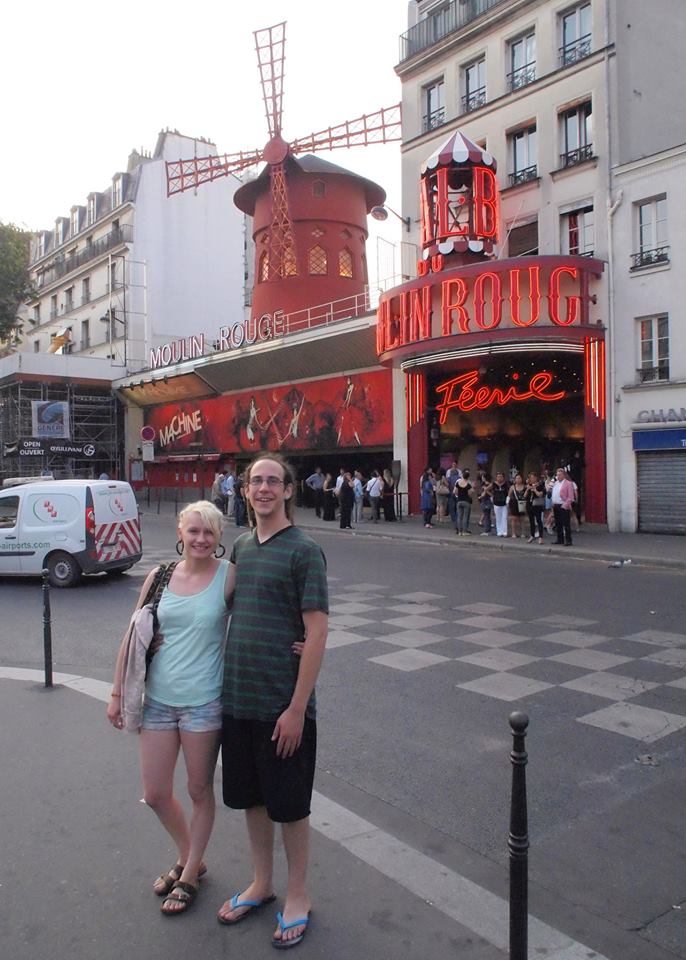
End of a long day and back to the Montmartre district for dinner. We tour down the Boulevard de Clichy and see both elegant and dive establishments along the lane. We have dinner across the street from the famous Moulin Rouge (Red Windmill) cabaret, famous for the Can-Can, Toulouse-Lautrec, and the 2001 Academy Award winning movie of the same name.
Liz and Adam in front of the Moulin Rouge
This slideshow requires JavaScript.
After dinner it was off to see the view of Paris from Sacré-Cœur Basilica at the top of Butte Montmartre . All in all a great day for everyone with frequent stops along the way to sample some of the wonderful Parisian wines at local bistros throughout the city.
We needed to pick up Adam and Liz from Aéroport Paris–Charles de Gaulle (Charles de Gaulle – Paris Airport – CDG). We were off on the Métro de Paris (subway) to the RER (Réseau Express Régional – Regional Express Network) “B” line to its final stop at the International Terminal at CDG. The airport is a city unto itself, it is the seventh busiest airport in the world, the second busiest in Europe, and handles in excess of 61 million passengers annually. Our fear was that we had never met anyone arriving at CDG before and had visions of Adam and Liz wandering in “airport limbo” for hours until we could locate them. However the airport staff was very helpful and we simply waited at the arrival gate for Delta for Adam and Liz to clear Customs and Passport control. Thirty minutes after their plane set down we saw their happy, jet-lagged faces.
Liz and Adam on the Paris MétroMétro de Paris (Subway) Sign
There are many approaches to dealing with jet-lag. Adam and Liz wanted to power through the day. So back on the RER and Métro to the hotel to drop off bags and then back on the Métro to Île de la Cité, the island the River Seine, to explore Cathédrale Notre-Dame de Paris (Notre-Dame Cathedral).
This slideshow requires JavaScript.
Notre-Dame is celebrating its 850 year anniversary. Cathédrale Notre-Dame de Paris (French for “Our Lady of Paris” – Notre-Dame Cathedral) is a historic Roman Catholic Marian cathedral located on the Île de la Cité. The cathedral is widely considered to be one of the finest examples of French Gothic architecture and is among the largest and well-known churches in the world. The cathedral’s treasury is notable for its reliquary which houses some of Catholicism’s most important relics including the purported Crown of Thorns, a fragment of the True Cross, and one of the Holy Nails.
This slideshow requires JavaScript.
The Cathedral’s stained glass windows were amazing and the quality of the colors has to be experienced to be believed. The Flying Buttresses on the exterior walls were graceful and added to the beauty of the exterior. We could have spent days exploring the architecture and art inside Cathédrale Notre-Dame de Paris.
After a quick lunch and several glasses of wine to fortify ourselves, we started walking along the Left Bank of the Seine heading toward Les Invalides. In retrospect the Métro would have been faster and easier on our feet, but every block held amazing architecture or public art.
This slideshow requires JavaScript.
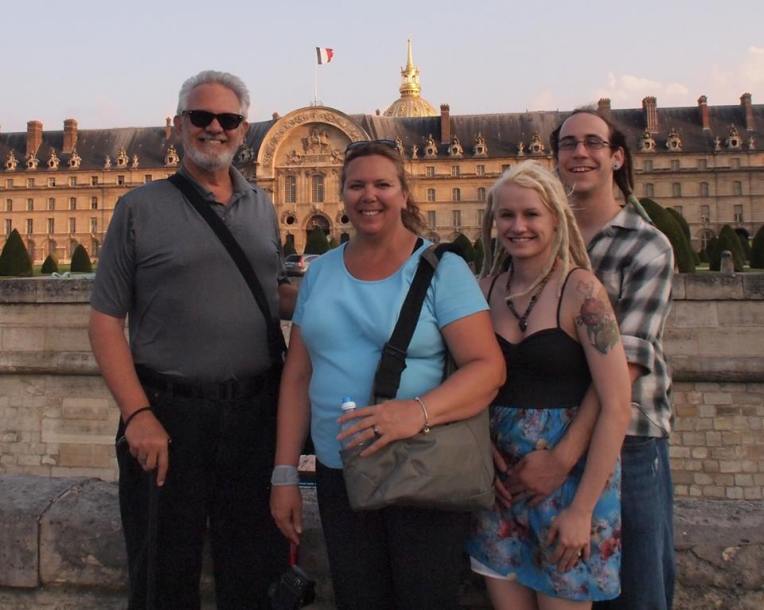
Finally reaching L’Hôtel National des Invalides (The National Residence of the Invalids), informally known simply as Les Invalides, we find a large park and series of buildings dedicated to French Military history and veteran. The complex’s name comes from its original purpose as a hospital and retirement home for war veterans. There are three museums on the grounds, the Musée de l’Armée (Army Museum), Musée des Plans-Reliefs (museum with three-dimensional models of battles), and the Musée d’Histoire Contemporaine (Museum of Contemporary History which started as the Library-Museum of the War.) Located on the site are the graves for many of France’s war heroes, including Napoleon Bonaparte.
Alan, Tracy, Liz, and Adam in front of L’Hôtel National des Invalides
This slideshow requires JavaScript.
From Les Invalides we could see La Tour Eiffel (the Eiffel Tower) through the surrounding buildings, our next stop. We had made reservations to go up into the tower for this evening as it was the only time available. Reservations fill very quickly to go to up to the observation areas.
Eiffel Tower seen from the 7th arrondissement
The wrought iron Eiffel Tower is named for engineer Gustave Eiffel who built the tower as an attraction to the 1889 World’s Fair. Originally intended to be a temporary attraction, but it quickly became the iconic symbol of France and Paris that remains today. The Tower is the tallest structure in Paris and the second tallest in France. At 1,063 feet it is taller that the Washington Monument (555 feet) and Space Needle (605 feet) and was the tallest structure in the world for 41 years until the Chrysler Building was completed in New York in 1930. (With its current communication antenna the Eiffel Tower is currently 17 feet taller than the Chrysler Building.) “Impressive” and “awe-inspiring” are perfect descriptions as the tower is much larger than we expected. We arrived at twilight to be able to watch night fall over the “City of Light” from the observation platform. At 11 pm we were also treated with light show of lights sparkling all over the Eiffel Tower.
This slideshow requires JavaScript.
Adam and Liz had by now been awake about 48 hours straight, so it was now time to head to the Métro to get them some well deserved rest. Passing dozens of unlicensed souvenir hawkers, each offering the same wonderfully cheesy, glowing, blinking Eiffel Tower models, we finally made it back to our hotel in the Montmartre district. The “last chance to get a blinking Eiffel Tower” had already become the humorous theme to the kids’ trip. It would continue until they left, with a comment about maybe being able to get one of the most desired souvenirs in Paris before they got on the plane to return home.












 An Italian Point Of View