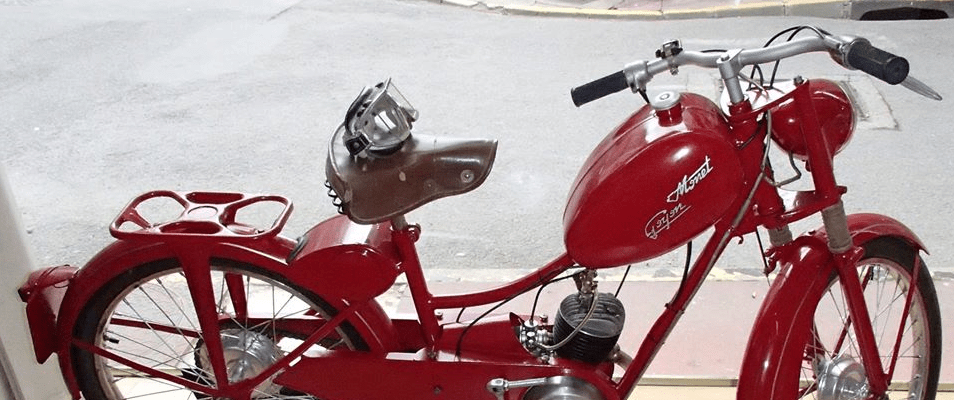
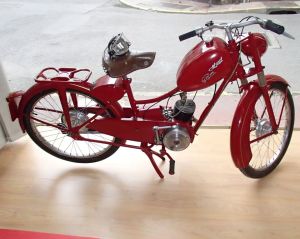
There I was “walking around the neighborhood” when I spotted this vintage Monet-Goyon motorcycle in the window of an insurance agency. I knew I had to get photos for my brother, Gary, who has always been a motorcycle enthusiast. After a bit of a struggle getting the proprietor to understand my inadequate French, he was happy to let me take some photos of this beautifully restored classic motorcycle. The insurance agency apparently is also a sponsor of the Circuit des Remparts, a race for classic Grand Prix and Formula 2 cars in Angoulême. The annual event also hosts a Concours d’Élégance gathering of vintage and prestigious cars, a “Hot August Nights” event for classic French and European cars.
Monet-Goyon 100 cc Motorcycle, circa 1954
Monet-Goyon motorcycles were made in France from about 1917 to 1959. The factory was located in Mâcon, in the department of Saône-et-Loire in the region of Burgundy.
After researching online and getting information from Gary, I learned that Monet-Goyon motorcycles were widely used in France. The Mâcon factory (which also built Koehler Escoffier motorcycles) produced numerous Villiers (British brand 2 stroke engines) and MAG (Swiss brand 4 stroke engines) powered motorcycles up until 1939. After the end of World War II, Monet-Goyon resumed production of small displacement motorcycles and scooters until finally closing its doors at the end of the 1950’s.
I believe this model is a Monet-Goyon 100cc S2G-1954G. Fun little discovery and I’ve added the Circuit des Remparts and its Concours d’Élégance to my list of “Events to Attend” in France.
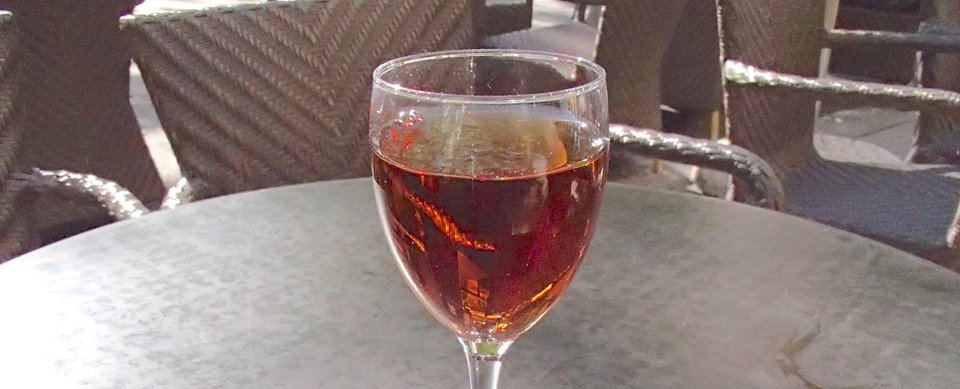
One of the iconic French cocktails is Kir (pronounced “keer”.)
Light and refreshing, it is considered the perfect summer aperitif.
The back story to the drink was that the mayor of Dijon, Felix Kir (a Catholic priest and hero in the French resistance during WWII), wanted to promote Dijon’s local products during the post-World War II economic recovery. But the Nazis had previously confiscated the entire production of Burgundy wine for which Dijon is well-known and there was left a surplus of the then-unknown Aligoté dry white wine. In a marketing coup, Mayor Kir invited delegations from around the country to receptions in Dijon and served them a cocktail he created using the Aligoté wine and Crème de Cassis, a sweet, dark blackcurrant liqueur that was also produced locally. The Crème de Cassis‘ sweetness offset and balances the acidity and dryness of the Aligoté wine. Mayor Kir’s cocktail was a big hit and resulted in huge sales of both Aligoté wine and Crème de Cassis liqueur.
Kir Cocktail
Today you may order the classic Kir with Crème de Cassis (blackcurrant), Kir de Mûre (blackberry), Kir de Framboise (raspberry), Kir de Pêche (peach), or you can “up the ante” to a Kir Royal made with champagne.
Most Kir cocktails today will be made using a local dry white wine and mixed one part Crème de Cassis to four parts wine-producing a deep blush color. Kir is served in a white wine glass and Kir Royal is presented in a champagne flute.
What do I think? I like it. It’s very refreshing on a sunny afternoon, but it’s a little too reminiscent of a wine cooler to me. It might be a nice change of pace, but I think I’d rather just have a good glass of wine (or a carafe of wine) to enjoy the afternoon.
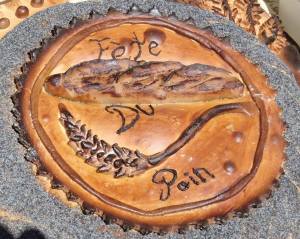
Carcassonne seems to have special events every week. This week was la Fête du Pain (the Bread Festival) sponsored by a local professional baking college, Saint Honoré Academy. (Saint Honoré is the patron saint of bakers.) All the events in Carcassonne reminds us of all the special event we used to experience in Reno, Nevada. French people really do take fresh baked bread seriously and we have found that in France, “Bread is king.”
The school set up both wood-fired and electric ovens in event tents on the perimeter of Square Gambetta We could smell freshly baked bread and hear the DJ’s music as we walked the block from our apartment to the Square. A dozen artisan bakers and apprentices were busy baking baguettes, breads, croissants, cakes, bread sculptures, and pies for exhibition and sale to the public. Many of the breads were created using the French twice-baked technique that makes that especially crusty bread that France is well-known for serving.
Fête du PainFête du PainFête du Pain – Baker working the wood fired oven
Tracy and I tried the pain au chocolat (chocolate croissant), a favorite of ours, and watched the bakers perform for the crowds. There was an area for children to decorate cookies and an inflatable “bounce house” with multiple food and craft vendors along the Square to visit as well.
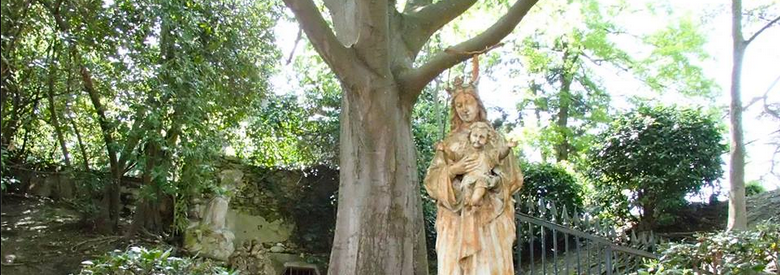
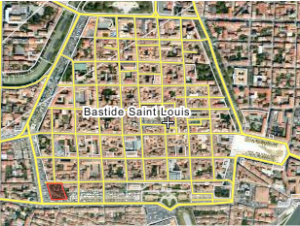
We discovered Jardin du Calvaire (Calvary Garden) located inside one of Carcassonne’s three remaining bastions. The “Big Tower” (also called the Bastion les Moulins [Tower of the Mills]) was built after 1359 and was part of the walls and fortifications that used to surround the Bastide Saint-Louis (Ville Basse) of Carcassonne. Located on the Southwest corner of the city, the bastion was later covered with windmills in 1599 to power mills grinding grain into flour for bakeries that would supply the city with “300 breads everyday for the poor.”
Location of the Jardin du Calvaire within Carcassonne’s Ville Basse
In 1825 a group formed to create the Jardin du Calvaire within the bastion. The leader of the group was Canon Cazaintre who is now buried on the site. The garden’s design was created by architect Jean-François Champagne. Jardin du Calvaire is circled with “Station of the Cross” shrines on its perimeter, has cypress and olive trees and laurels, and impressive sculptures reenacting the crucifixion on Calvary Hill. The crucifixion tableau is shielded by trees and cannot been seen from the regular garden; the sculptures can only be viewed after climbing to the top of the small hill in the garden. There is a small chapel built into the hill that represents the Holy Sepulcher and is illuminated with natural light from the crucifixion scene above.
Chapel within the Jardin du CalvaireWithin the Chapel in the Jardin du Calvaire
This urban garden is very peaceful with many benches along its paths. The restful quiet can make you forget that Jardin du Calvaire is situated alongside the major avenue of Boulevard Barbès.
One of Tracy’s favorite things about the garden are its numerous feral, but friendly cats cruising the garden and serving as unofficial “guardians” for the garden.
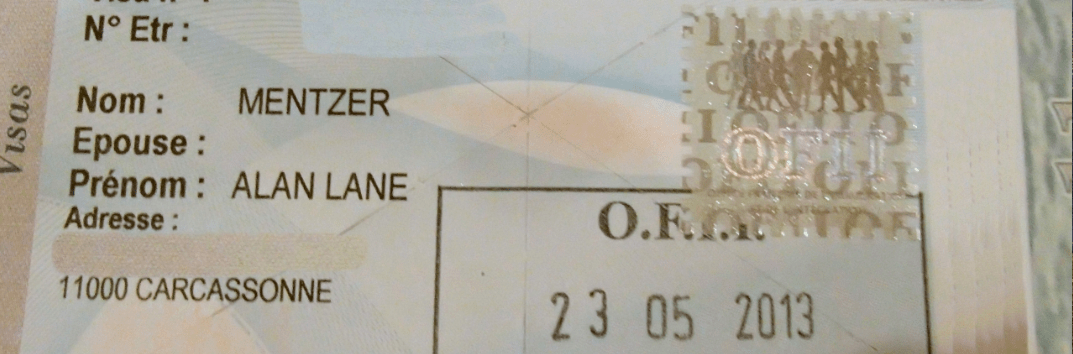
xamTracy and I are extremely excited that we have successfully completed our process for obtaining our Titre de Sejour (resident permits) at the OFII (L’Office Français de l’Immigration et de l’Intégration)office in Montpellier yesterday.
Titre de Sejour
The detailed process started in January 2013 when we first applied for our initial visa application at the French Consulate in San Francisco. After our visa request was accepted, the consulate gave us each a form, Demande d’Attestation OFII, that we would need to mail to the regional OFII office having jurisdiction over our new residence after our arrival in France. We added the Demande d’Attestation forms to our growing dossier of documents which we carefully hand carried on our flight to France.
During the first week in Carcassonne, we ventured to the post office to mail the Demande d’Attestation forms and supporting photocopies (passport page showing personal information with identification numbers, stamp from French immigration showing the date and point of entry, and the visa that was issued by the Consulate.) This involved using of our very limited French to mail a certified letter with receipt showing proof of posting. Titre de Sejour process is time sensitive and has to be completed within 90 days, so not knowing how long the French bureaucracy might take, we wanted to get it started as quickly as possible.
Surprisingly, we received back a confirmation letter back from OFII in a week’s time with an appointment set for May 23 for our medical exam and interview in Montpellier. At least that is what we discovered after a lengthy translation session with the five pages of correspondence enclosed. Thank goodness for Google Translate and a French-English dictionary. The medical exam appeared to be centered around a chest x-ray so we assumed the biggest concern for OFII was immigrants from developing countries with possible tuberculosis.
This past week was busy as we double-checked that we had all the additional supporting documents to bring for the appointment in our dossier. We needed proof of our address in the form of a rental agreement and rent receipts, our passports with our original visa, extra passport photos, and payment in the form of 241€ each in tax stamps.
The confirmation letter from OFII said that we could obtain the tax stamps at specially designated tabacs, tobacco stores, (basically your neighborhood “7-11” store.) That put me on the hunt for finding a “specially designated” tabac, again using my very limited French. Off to the friendly corner tabac at the end of our block, “Etes-vous en mesure de me timbre vendre pour montant de 241€?” “No,” but the very helpful woman escorted me out the door to point into town and give me a lengthy explanation of who could help me. I, of course, understood one word out of every four. So I smiled politely, said merci, and wandered into town to try my luck at another tabac. And another tabac, and another tabac, and still another tabac without success.
I thought I should take another tack and visit the Tourist Information office, mainly to speak with a bilingual person who might have an idea of which tabac might be able to help me. The three people at the Tourist Office conferred and, since this was a government issue, sent me to the Prefect office down the block. Unfortunately the Prefect closed at 4:00 so I went to the only government office that was open, the post office. La Poste does nearly everything in France, including having its own national banking service, so I hoped they might even have tax stamps along with their postage stamps. A very nice young woman with fairly good English explained that La Poste doesn’t issue tax stamps, but suggested the tabac/bar in front of the post office. Score! The proprietor was only too happy to sell me a four 90€, four 30€, and two 1€ tax stamps.
OFII
The day before the appointment we went to the train station for the seemingly simple task was getting train tickets to Montpellier, 90 miles east of Carcassonne. We had been to Montpellier a couple of times by train with no problems. However, the day of our appointment we learned that there was going to be a rail strike starting that evening when we needed to return home. Just when I was considering trying to telephone OFII and reschedule the appointment, the ticket agent nonchalantly scheduled us for a bus ride back to Carcassonne. Problem solved.
The morning of the appointment Tracy and I had a pleasant train ride to Montpellier and walked a block from the train station to the very conveniently located OFII office in a nondescript office business. We joined a diverse group of OFII clients waiting for our appointment at 1:30. The group included people from Asia, the Middle East, Africa, us from the US, and an older Australian couple that would play into this story. Once the office open the OFII staff systematically and efficiently processed the people in our group. The staff was very good about working with immigrants who may have limited skills speaking French.
We were kind of thrown for a loop when Tracy was called for her x-ray as “Tracy White,” her maiden name with a French pronunciation. But the confusion was temporary and Tracy was up and gone getting her chest x-ray. I later got confused where to go after my name was called for my x-ray and joined the wrong group. The staff patiently redirected my path and the x-ray process was quick and easy followed by an interview with a nurse on health issues, an eye exam, and height and weight measurements. Apparently a change in diet and walking everyday has very good for us since we’ve lost about 30 pounds since our arrival in France.
Next we were seen by the doctor who read our x-rays, reviewed our medical histories, and signed off on our medical clearances. We were given our x-ray films to take home ( “. . . lovely parting gifts”) which appears to be the norm for x-rays in France.
Chest X-ray
Now back to the Aussie couple. While we were waiting for our final interview, the Australian couple went in ahead of us for their final interview. I previously discussed how in this part of France any “generic English speaker” is assumed to be British. Well, apparently we also “all look alike” too. Granted that the Aussie man and I are “of an age” with grey hair, but by no stretch of the imagination could Tracy be confused with the Aussie’s rather dowdy wife who is about 20 years older than Tracy. However, the woman performing the Aussies’ final interview initially put our Titre de Sejour stickers into their passports. Once we walked in and she saw our paperwork, she realized she confused us with the only other English-speaking couple in the group; she sprinted to the elevator to catch the Aussies before that left the building. She and another OFII staff member carefully removed our Titre de Sejour stickers from the Aussies’ passports before the adhesive “set” and then re-applied our Titre de Sejour into our passports. For a while there Tracy and I would have been living in France under assumed identities and nationalities.
Our staff member kept apologizing for the mix up as she processed our tax stamps and final paper work. That was only “snag” in our entire residency process, so we were very pleased with how smooth the French bureaucracy had treated us. There were a few more final signatures and the use of a rubber stamp and we were then official residents of France. Our appointment at the OFII office lasted an hour and forty-five minutes from start to finish, I’ve spent more time than that waiting at DMV to register a car.
Nothing more to worry about with our residency until we start our renewal process in January. Hopefully by then the new four-year renewal period will be approved rather than the current annual renewal.
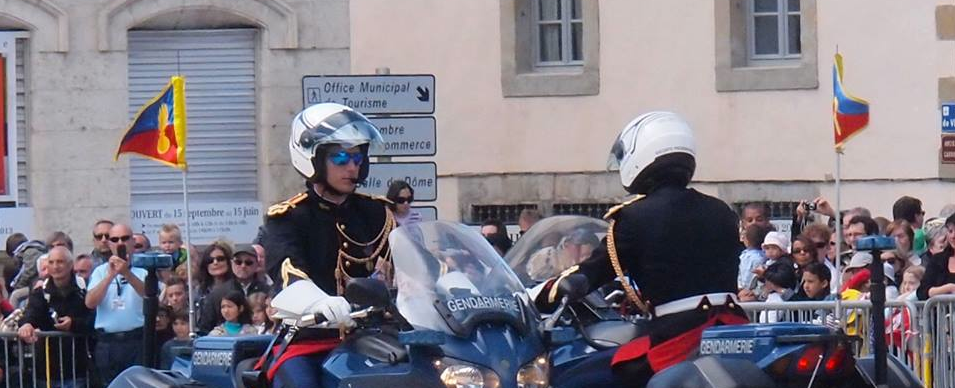
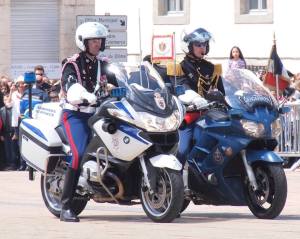
We attended the “Rallye Motocycliste Organis Par la Gendarmerie de l’Aude,” the Second Annual Motorcyclist Rally Sponsored by the Gendarmerie of Aude.
The free event in Square Gambetta included fast paced precision drills by motorcycle officers from the Republican Guard unit (presidential escort unit) of Gendarmerie Nationale of France and the Compagnie des Carabiniers du Prince of Monaco (royal family escort unit), amazing motorcycle stunts by the Republican Guard, music from a French Naval pipes and drums band, and a dramatic helicopter hoist delivery of a gendarme and his canine followed by a canine demonstration. There were also driving safety exhibits, vendor displays, and recruiting by the Gendarmerie Nationale.
In addition to the local dignitaries, Prince Pierre of Monaco attended the event to observe his royal motorcycle escorts perform with the Gendarmerie Nationale Republican Guard.
Tracy and I both had to shake our heads at the French Naval pipe and drum band playing “Scotland the Brave” and the Disney symphony type music to entertain the crowd before the rally began, but especially at the segment when cowboy hat wearing country line dancers joined in and danced to the bagpipes and drums!
Monégasque Carabiniers on white bike and French Gendarmerie on blue bikeGendarmerie Nationale Republican Guard Stunt Team
In my younger days I was generally known as one of the only three cops in America that didn’t drink coffee. That didn’t change in my academic career. It took visiting Italy and France and their excellent espresso to convert me into a dedicated coffee drinker.
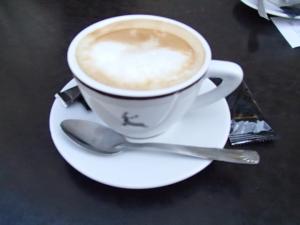
For breakfast in Carcassonne Tracy and I enjoyCafé Crème(Ca-fay Khrem), like an Italian cappuccino, a large steaming cup of espresso with steamed milk and a topping of foamed milk. Unlike Italian cappuccino or cafe latte there is no artistic patterns on top, just rich creamy coffee with a dollop of foam. In France the norm is not having a big breakfasts so Café Crème is often a meal unto itself or maybe with a croissant or a pain au chocolat (a flakey chocolate-filled viennoiserie pastry that is a favorite here in Southwest France.)
Café crème
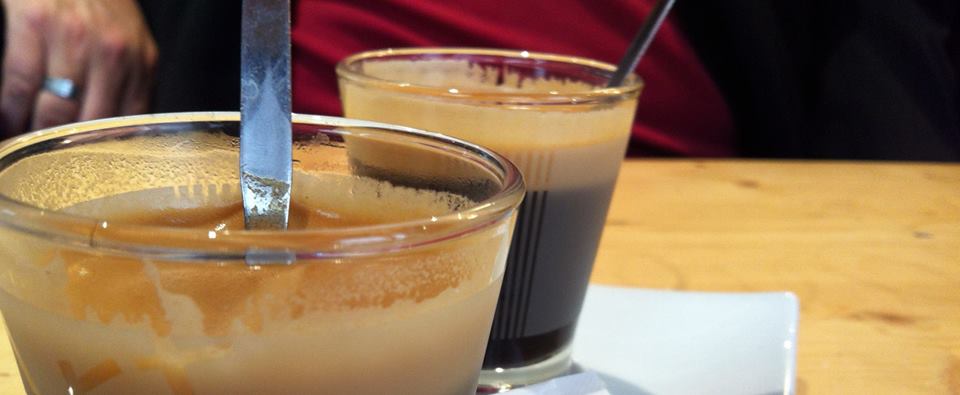
After 10:00 or 11:00 in the morning there is Café (Ca-fay) to enjoy (although many will enjoy Café for breakfast.) Café (also called Café Noir or Café Express)is drawn from an espresso machine just like an Italian espresso and rich with dark reddish-brown foam called “crema,” and served in a demitasse cup or small glass. In France and Italy milky coffee drinks like Café Crème are only consumed in the early morning, Café can be enjoyed all day long.
CaféCafé
Coffee in France is always served with sugar (sucre(Coo-khruh), real sugar, either granulated or sugar cubes. (Although a person could also request artificial sweetener, edulcorant [Ay-doohl-co-hrahn].) There is frequently a small ginger cookie or small chocolate to accompany your coffee in our part of France.
There are many cultural expectations to having coffee in France. Like I previously said, Café Crème, is not ordered after breakfast time. There are seldom paper “go cups” available, coffee is meant to be savored slowly, not to be drunk on the run. Coffee is not served during a meal (there is wine for that); coffee is reserved for after the meal is finished as a capstone to the event. If you enter a restaurant only for coffee, either sit at a table without place settings or stand at the counter. Drinking coffee while standing normally cost less than coffee while sitting at a table.
While our coffee drinking normally includes just Café Crème andCafé there are some other coffee choices.
Noisette(Nwah-zett) is an Café with a dash a cream. Noisette is French for “hazelnut” and refers to the color of the coffee. A noisette is similar to a small Italian Macchiato coffee.
Café au Lait (Ca-fay a lay), coffee with cream. Depending who you talk to, this either this is an acceptable synonym for Café Crème or is a phrase only used in a restaurant by tourists. I’ve also been told Café au Lait is a term only used by a French person in their own kitchen.
Café Allongé(ah-lohn-zhay), “extended coffee,” is espresso with additional hot water to make a more traditional American-style cup of coffee.
There is an option to order your Café as déca (Day-kah)or décaféiné (Day-kah-fay-uhn-ay)for a decaffeinated coffee. This is something Tracy strongly believes cancels a major reason for coffee in the first place and is perhaps is even a venial sin.
And for non-coffee drinkers there is Chocolat chaud (Shah-ko-lah show), hot chocolate that is normally made with rich, top-quality chocolate and is often served in demitasse cup.
France is definitely a “coffee culture” where few activities are as relaxing as sitting in the town square, sipping your café, and watching the world go by. “Un autre café, s’il vous plaît.” Another coffee, please.
“You know, every glass of wine here is French wine.” Me sharing the extremely obvious with Tracy.
The Languedoc-Roussillon region in Southwest France, where we are living, is the largest area in France in terms of vineyard acreage. The region is known for its Blanquette de Limoux, the world’s oldest sparkling wine, and many high quality red wines like Corbières, Cotaeux du Languedoc, Côtes du Roussillon, Fitou, Minervois, Saint Chinian, and Costières de Nimes.
Languedoc-Roussillon (Wikimedia Commons)
Languedoc-Roussillon is also known as the “Wine Lake” of France where the majority of inexpensive wines in France are produced. So much wine is produced in Languedoc-Roussillon that France worries the “Wine Lake’s” surplus drives down the export price of French table wine. More than 1/3 of all grapes grown in France are grown in the Languedoc-Roussillon region.
The everyday wines are called Vin de France,(previously called “Vin de Table“) the lowest level of the three tiers in the current wine classification system in France. But don’t let the term “lowest level” deceive you, these are flavorful wines that enhance any meal or are enjoyable simply by the glass. Any wine in France is all about its terroir: the environment, climate, soil, geography, and weather that makes up the intangibles that combined with the variety of grapes and the skill of the winemaker creates the final taste of the wine.
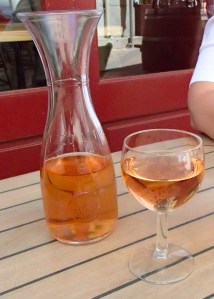
Pichet de Vin
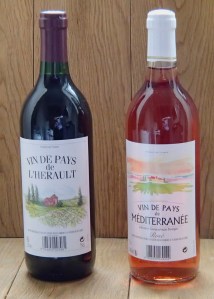
The mid-level category of French wines are Indication Géographique Protégée wines (IGP), an intermediate category basically replacing the former Vin de Pays (“country wine”) category. These IGP/Vin de Pays wines are simple varietal French wines that include Vin de Pays d’Oc from Languedoc-Roussillon. Vin de Pays d’Oc is the largest portion of all Vin de Pays wines produced in France.
Vin de Pays
Appellation d’Origine Protégée(AOP) is the highest category of French wine replacing the previously used category of Appellation d’Origine Contrôlée (AOC) wines. We look forward to touring some of the local vineyards in the near future and tasting some of these top-tier AOP wines. Restaurants in Carcassonne offer high quality AOC wine lists in addition to their basic house wines.
AOP Seal (Wikimedia Commons)
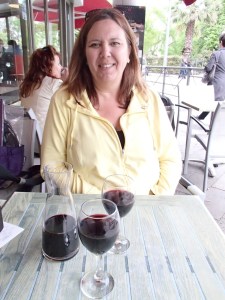
Most of Tracy and my wine consumption has been Vin de France and Vin de Pays. These inexpensive reds, white, and rosé wines have proven to be delicious. “Un demi-pichet de vin,” (a half litre carafe of a restaurant’s vin de France) has never been a bad experience. Restaurants carefully choose even the house wine with their reputations in mind. Rosé wines are a respected wine choice and hold a prominent place in many of France’s major wine regions, including Languedoc-Roussillon.
Tracy enjoying “un pichet of vin rouge.”
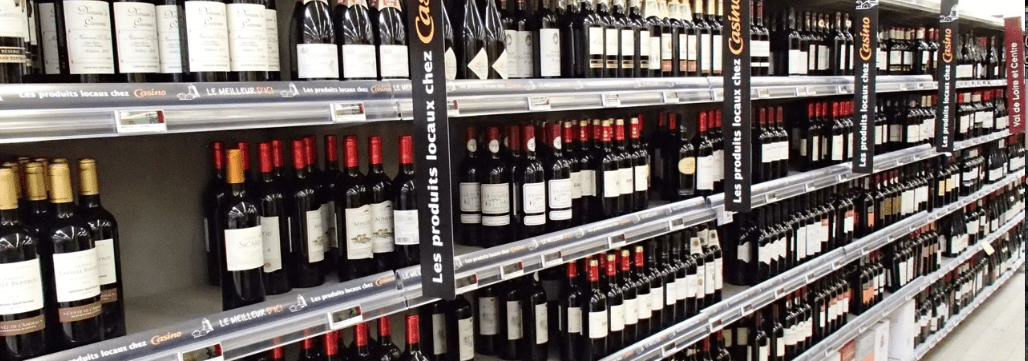
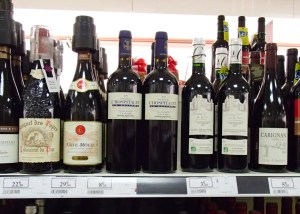
Shopping for wine is an embarrassment of riches. The wine section in every store offers a huge range of quality, varieties, and price points. It is difficult to narrow down your choices from so many offerings. I was stunned to even see “boxed” vin de France meant for inexpensive table wine. Two of our most recent purchases, a red and a rosé, were both under 2 Euro and they were delicious!
Shelves of WinesShelves of WinesShelves of WinesVaried wines and prices
Tracy and I greatly enjoy our new tradition of a glass of wine with lunch and dinner. And there is nothing like a leisurely afternoon, sitting in the town square of Place Carnot, and lingering with a carafe of wine as Tracy and I just enjoy the view, conversation, and people watching.
Pastis is an anise-flavored liqueur and popular aperitif in France.
Ricard is the number one pastis beverage in the world, its recipe unaltered since its creation by Paul Ricard in 1932. A refreshing apperitif, Ricard is a long-time favorite in France, especially in the southern regions of the country. Over 130 million liters of pastis is sold each year in France, more than two liters per inhabitant. The name “pastis” originally comes from the regional dialect occitan’s word, pastís, meaning “mash-up.”
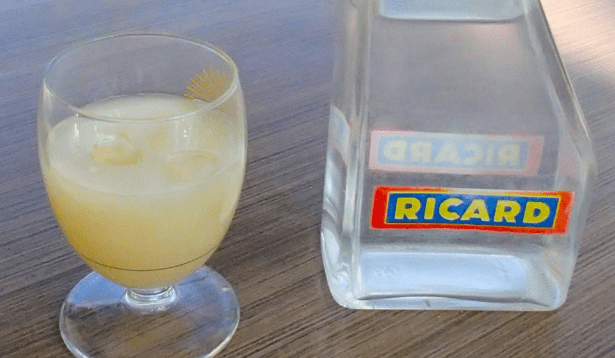
Ricard Pastis
Pastis’ popularity grew following the French ban on absinth. One reason for the popularity of pastis can be attributable to the demand for anise flavored drinks created by absinthe decades earlier. There is also an old tradition in the Mediterranean of anise-based liquors like Sambuca, Ouzo, Arak, and Mastika.
The principal ingredients of Ricard is star anise, a rare spice that grows in southern Chinese and in the north of Vietnam, licorice from Syria, and aromatic herbs from Provence. Pastis is not absinthe and does not does not contain grand wormwood (artemisia absinthium),the herb from which absinthe gets its name. Absinthe obtains its base flavor from green anise, not the star anise which Ricard uses. Pastis’ flavor comes from licorice root which is not used in absinthe. Also, absinthes are normally bottled at 45 to 74% ABV, while pastis is typically bottled at 40 to 50% ABV. Finally, unlike absinthe, pastis is classified as a liqueur because it contains sugar.
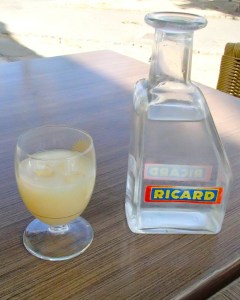
Pastis is normally served with the liqueur presented in one glass and accompanied by carafe of cold water.
The liqueur is diluted with the water according to the drinker’s preference, traditionally about 5 parts water to 1 part Ricard. Diluting the liqueur creates the “French Milk” effect as the water is added. The combination of liqueur and water ‘louches,’ and turns the diluted beverage cloudy and white in appearance. The drink is then consumed cold and is considered a refreshing beverage for hot days. Ice cubes may be added after diluting the pastis.
Pastis before dilution with waterPastis after dilution with water and ‘louching’ starting

















 An Italian Point Of View