Surviving Two National Transportation Strikes – While Traveling France With Visitors.

“Life is what happens to you while you’re busy making other plans.” ~John Lennon

So after all of Tracy’s meticulous travel planning in anticipation of son Casey and his fiancée Megan’s arrival in France; after our pre-purchase of train, flight, and venue tickets; and after our pre-paying for hotel reservation, we were surprised with a sudden rail strike which turned out to be the longest since 2010.  While “industrial actions” are always a possibility in France, this one took us totally unprepared.

A high-speed train TGV Duplex from SNCF. Wikimedia Commons

Casey and Megan arrived in Paris in early June and while exploring the “City of Lights” together, Tracy and I checked the English-language online news (The Local and France 24) and learned that two of SNCF’s (the French national rail service) four unions, CGT and Sud-Rail had started what will eventually turn out to be a 10 day strike.  Most strikes in France in recent years are 24 hour “rolling strikes” with prior public notice that cause a minimum of inconvenience.   But this rail strike was called on short notice because of major rail system reform legislation scheduled in the French Parliament that week and the strike would uncharacteristically drag on day after day after day.

So when the time came for the next leg of our trip, traveling from Paris to Marseille, we took the RER commuter train from Paris to the Gare de Marne-la-Vallée – Chessy train station to catch our previously assigned seats on the Ouigo high-speed train to Marseille.  (The Ouigo in SNCF’s alternative to discount airlines with re-liveried TGV trains with cost-saving online booking and the absence of a cafe car but with very comfortable deluxe seats with fares starting at €10.)  Unfortunately, once we arrived at the train station we learned our train (along with two others of the day’s previous trains which were also headed south) had been canceled.  But, we were told by the SNCF staff that there was one southbound TGV train still scheduled in two hours. The SNCF official told us that if we managed to “get on that train and the doors are able to close” we could ride that TGV as an alternative to our canceled train. Space on the train was “first come, first serve,” for passengers without assigned seating like us.

So we embraced the “lifeboat rules” of traveling during a major train strike in France.  We played cards and waited for the alternative train, keeping a close eye the electronic status board, and hoping that train didn’t get cancelled at the last-minute.  Casey and Megan became “Platinum level” participants in the “French National Sport” of surviving strikes. Both maintained absolute positive attitudes and great humor while waiting for our alternative train.  We talked and played cards to wile away the hours as we waited.  When the train arrived, we were waiting at the front of the queue with the regular passengers and a good portion of extra passengers from the three cancelled trains.  As we searched for space, the four of us ended up with many others passengers in a first class car standing in the entryway like commuters in a crowded subway car during rush hour.
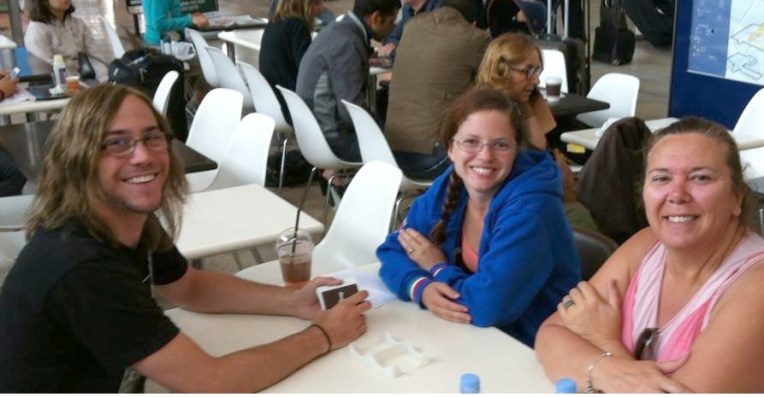
Casey, Megan. and Tracy playing cards and waiting for the train.
Megan and Casey waiting.

The train’s doors managed to close, it started rolling southbound, and we all sighed with relief that we made the train.  Now it was time to get comfortable (or as comfortable as possible) for the 3 hour + trip to Marseille.  Casey and Megan were kind enough to give me a spot on some steps entering a first class cabin (my old leg injury makes being stationary while standing painful.)  They both found a seat on the floor of the entryway way.  Tracy stood in the first class cabin doorway for the first two hours of the trip (and diverting air conditioning into the entryway.)  During the trip our fellow surplus passengers also found seats sitting on their bags, the floor, and one person sitting in the car’s restroom commode.  We were envious of our ticketed first-class companions in their assigned seats, but the overall mood of all the passengers was friendly and helpful.  Casey used his high school and college French to speak with a French father with his wife and two sons. Tracy helped support an older woman standing next to her in the cabin doorway.

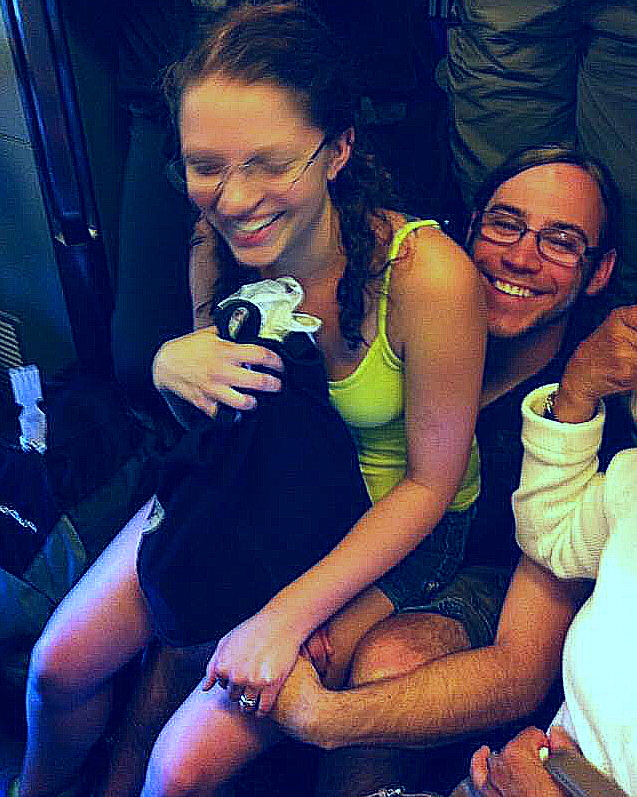
Casey, Megan, and Tracy standing in the entryway on the train to Marseille
Megan and Casey sitting on the train floor.

About two hours into the trip at the stop at Avignon, the first-class cabin that Tracy was standing near had four seats open up as those passengers disembarked.  The four of us luxuriated in the first-class seats for the remainder of the trip to Marseille.  We had a pleasant conversation with the other foursome in the cabin, a group of slightly older Parisians on their way to their condo on Côte d’Azur (the French Riviera).  One of the Parisians was a French engineer who spoke excellent English.  He and Casey, a newly graduated engineer, discussed their shared profession.

When we arrived in the Gare Saint-Charles (Marseille) train station and we congratulated ourselves on remaining calm and successfully working around the rail strike on that leg of the trip.

Casey and Megan at the Marseille marina.

While the rail strike dragged on, day after day, we toured Marseille and then got ready for our next leg to Rome.  We made use of the shuttle bus – rather than the train – out to Aéroport de Marseille Provence (Marseille Provence Airport) and later used the same bus upon our return to Marseille from Rome.

After our return from Rome, our next leg was scheduled to be Marseille to Carcassonne by the Bordeaux-Nice Intercités train in assigned seating.  Although the train strike was still on, this train was one of the 60% of routes still running. SNCF had hired additional station workers during the strike to help confused and stranded passengers in the train stations.  All of our questions about our train were answered quickly: our train was still running and would run straight to Carcassonne with no changes or delays.

We were expecting another over-crowded train like what we previously experienced from Gare de Marne-la-Vallée – Chessy to Marseille, but we were pleasantly surprised to have a cabin to ourselves with no overcrowding at all.  We assumed that this late into the strike, local commuters were choosing to postpone or finding alternative transportation for their travel.  We enjoyed the scenery of the southern French from Gare Saint-Charles (Marseille) through Nimes, Montpellier, Sète, Béziers, Narbonne, and finally home to Carcassonne.  While Casey and Megan were staying with us in Carcassonne, the rail strike finally ended after ten days.  We were thrilled that we had “dodged the bullet” with the train strike because Casey and Megan had to eventually return to Paris by train.  The ten-day rail strike was the longest since 2010.

SNCF Departure Board
Megan and Casey on train

As the end of Casey and Megan’s visit in Carcassonne approached, we learned that we took the “all clear” on transportation strikes for granted too soon.  Two French air traffic controller unions had voted for a six-day strike with the threat of impacting air passengers with 14,000 hours of delays, hundreds of cancelled flights, and a reduction overall of 20% of the air traffic through France. The air strike was scheduled to begin the day before Casey and Megan’s departure back to the US.

Tracy and I monitored Casey and Megan’s return flight to the US on British Airways.  It looked promising with their flight appearing to be one of the non-impacted ones. But the British Airways website had the caveat that we needed to confirm the flight 24 hours prior to departure because the strike situation was volatile and flights were subject to change.  Luckily, the first air traffic controller union almost immediately settled their strike and the second air traffic controller union called off their strike the Wednesday prior to Casey and Megan’s departure on Thursday.

So in the end, Casey and Megan caught the Intercités train with assigned seating to Montpellier where they took the Ouigo TGV train to the Gare de Marne-la-Vallée – Chessy just outside Disneyland-Paris.  Casey and Megan spent a day at Disneyland-Paris before flying home to Reno, Nevada the next day from Aéroport de Paris-Charles-de-Gaulle (Paris Charles de Gaulle Airport.)

Both Casey and Megan left France with metaphorical Gold Medals that we all earned in beating the French transportation strikes of June 2014.

Megan and Casey at the Disneyland-Paris entrance.


Barcelona: Parc del Laberint, Passeig de Gràcia, Plaça de Catalunya, and La Rambla

One reason we wanted to retire to Europe was to have a central place from which to “springboard” to explore many different cities in Europe.  With Adam and Liz visiting we decided to do just that and spent a few days in Barcelona, Spain.  We found that Adam and Liz share our interest the work of Antoni Gaudí so it was time to make some hotel and train reservations and head to Barcelona. It is only about a three-hour train ride to Barcelona from Carcassonne.  The TER (Transport Express Régional) to Narbonne, the high-speed TVG (Train à Grande Vitesse) to the Figueres Vilafant train station (just inside the Spanish border) to switch into a RENFE (ReNacional de los Ferrocarriles Españoles – Spanish National Railway Network) high-speed AVE (Alta Velocidad Española – Spanish High Speed) train.  The RENFE train was beautiful and we enjoyed the use of the club car for ice-cold Spanish beer.

Adam and Liz on the TER train out of Carcassonne.
Tracy, Alan, and Kiara on the TGV enroute to Spain.
A Spanish RENFE AVE Siemens Velaro (left) and a French SNCF TGV Duplex (right) at Figueres-Vilafant Station (Wikimedia Commons)
A Spanish RENFE AVE Siemens Velaro (left) and a French SNCF TGV Duplex (right) at Figueres-Vilafant Station
(Wikimedia Commons)

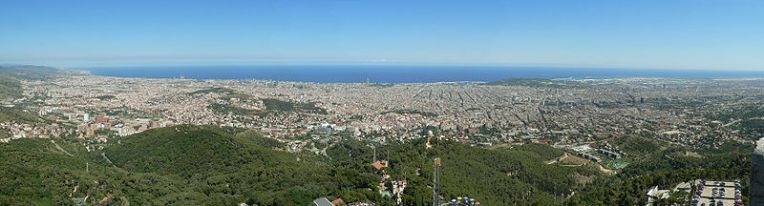
In very little time we were in Barcelona, sharing a pitcher (or two) of sangria.  Sitting on the Mediterranean Sea with about five million residents, Barcelona is the second largest city in Spain, the sixth most populated urban area in the European Union.

A panoramic view of Barcelona (Wikimedia Commons)
A panoramic view of Barcelona
(Wikimedia Commons)

We decided that while Paris is beautiful, Barcelona is gorgeous.  Stunningly gorgeous.

This slideshow requires JavaScript.

Adam led us to Parc del Laberint d’Horta (Labyrinth Park of Horta) in the Horta-Guinardó district in Barcelona.  The park is the oldest of its kind in the city. Located in the former estate of the Desvalls family, next to the Serra de Collserola ridge, the park combines an 18th century neoclassical garden and a 19th century romantic garden.  In 1967 the Desvalls family donated the park to the city of Barcelona, who opened to the public in 1971.  Liz had always wanted to explore a maze and was looking forward to exploring the labyrinth, so we lined up behind her and had her lead the way.

This slideshow requires JavaScript.

Returning to our hotel room and realizing that it wasn’t cooling off very quickly, we decided to take an evening walk through Passeig de Gràcia, Plaça de Catalunya, and La Rambla.  Passeig de Gràcia is one of the major avenues in Barcelona, it is compared to the Champs-Élysées, Fifth Avenue, and Rodeo Drive and is one of  the most important shopping and business areas of Barcelona containing many of the city’s most celebrated pieces of architecture. Passeig de Gràcia is regarded as the most expensive street in Barcelona and in Spain.

Plaça de Catalunya (Catalonia Square) is Barcelona’s large city square and is considered to be the city center and the place where the old city and the modern city meet.

La Rambla is located off Plaça de Catalunya.  The tree-lined pedestrian mall stretches for 1.2 kilometers between Barri Gòtic and El Raval, connecting Plaça de Catalunya with the Monumento a Colón (Christopher Columbus Monument) at Port Vell (the Old Harbor.)  Even in the middle of the week there is tremendous energy and activity in the “Heart of Barcelona.”

This slideshow requires JavaScript.

The following day was all about exploring Gaudi’s art and architecture and his contributions to Barcelona.

Narbonne Plage: Swimming in the Mediterranean Sea

With the temperatures reaching up into the 90s, we wanted to visit the Mediterranean with Adam and Liz.  We tried to facilitate a SCUBA dive, but had difficulties getting connected to dive shops in Narbonne.  So it was off to the beach for old-fashioned “sun and surf.”

The Narbonne Plage (Narbonne Beach) is one of several Mediterranean Sea beaches in the Languedoc-Roussillon region.  Narbonne Plage is well west of the Côte d’Azur (known in English as the French Riviera) on the Mediterranean coastline in the southwest corner of France.  The beach is 5 km of wide, fine sandy beach with a marina and restaurants.  It is a public “locals’ beach,” or rather the “poor man’s” Riviera, with all the beauty of the Med without the extravagant cost of the Côte d’Azur.  

We caught the regional TER (transport express régionaltrain from Carcassonne to Narbonne and then took one of the special summer buses to the beach. There were many other beach-goers on the bus with us.  Surprisingly, Narbonne Plage is 25 minutes away from the train station, with a scenic view of central Narbonne and the Montagne de la Clape mountain range along the way.

Adam and Liz enjoying the Mediterranean Sea at Narbonne Plage

Fortifying ourselves with food and sangria (and a bit more sangria) we ventured out into the water.  Beautiful sandy beach, very minimal crowds despite the full bus, warm water with a beautiful gradient of color from green to deep blue as the water gets deeper.  There were lifeguard stations, lifeguards in Zodiac boats, and a police presence with swimsuit-wearing officers from the CRS Police (Direction Centrale des Compagnies Républicaines de Sécurité – Central Directorate of the Republican Security Companies; DCCRS).

While Tracy and I contented ourselves with wading, Adam and Liz splashed right into the sea for a swim.  Wonderful day of water, walking the beach, investigating the marina, collecting shells, watching the surf fishermen, SCUBA divers (we knew there had to be divers there), and sailboats.

This slideshow requires JavaScript.

We took a different bus back toward the train station that normally stops several blocks away from the station.  However, our driver very kindly drove us all the way to the bus stop at the train station.

Paris: CDG, Notre-Dame, Les Invalides, and Eiffel Tower

We needed to pick up Adam and Liz from Aéroport Paris–Charles de Gaulle (Charles de Gaulle – Paris Airport – CDG).  We  were off on the Métro de Paris (subway) to the RER (Réseau Express Régional – Regional Express Network) “B” line to its final stop at the International Terminal at CDG.  The airport is a city unto itself,  it is the seventh busiest airport in the world, the second busiest in Europe, and handles in excess of  61 million passengers annually.  Our fear was that we had never met anyone arriving at CDG before and had visions of Adam and Liz wandering in “airport limbo” for hours until we could locate them.  However the airport staff was very helpful and we simply waited at the arrival gate for Delta for Adam and Liz to clear Customs and Passport control.  Thirty minutes after their plane set down we saw their happy, jet-lagged faces.

Liz and Adam on the Paris Métro
Métro de Paris (Subway) Sign

There are many approaches to dealing with jet-lag.  Adam and Liz wanted to power through the day.  So back on the RER and Métro to the hotel to drop off bags and then back on the Métro to Île de la Cité, the island the River Seine, to explore Cathédrale Notre-Dame de Paris (Notre-Dame Cathedral).

This slideshow requires JavaScript.

Notre-Dame is celebrating its 850 year anniversary.  Cathédrale Notre-Dame de Paris (French for “Our Lady of Paris” – Notre-Dame Cathedral) is a historic Roman Catholic Marian cathedral located on the Île de la Cité.  The cathedral is widely considered to be one of the finest examples of French Gothic architecture and is among the largest and well-known churches in the world.  The cathedral’s treasury is notable for its reliquary which houses some of Catholicism’s most important relics including the purported Crown of Thorns, a fragment of the True Cross, and one of the Holy Nails.

This slideshow requires JavaScript.

The Cathedral’s stained glass windows were amazing and the quality of the colors has to be experienced to be believed.  The Flying Buttresses on the exterior walls were graceful and added to the beauty of the exterior.  We could have spent days exploring the architecture and art inside Cathédrale Notre-Dame de Paris.

After a quick lunch and several glasses of wine to fortify ourselves, we started walking along the Left Bank of the Seine heading toward Les Invalides.  In retrospect the Métro would have been faster and easier on our feet, but every block held amazing architecture or public art.

This slideshow requires JavaScript.

Finally reaching L’Hôtel National des Invalides (The National Residence of the Invalids), informally known simply as Les Invalides,  we find a large park and series of buildings dedicated to French Military history and veteran.  The complex’s name comes from its original purpose as a hospital and retirement home for war veterans.  There are three museums on the grounds, the Musée de l’Armée (Army Museum), Musée des Plans-Reliefs (museum with three-dimensional models of battles), and the Musée d’Histoire Contemporaine (Museum of Contemporary History which started as the Library-Museum of the War.)  Located on the site are the graves for many of France’s war heroes, including Napoleon Bonaparte.

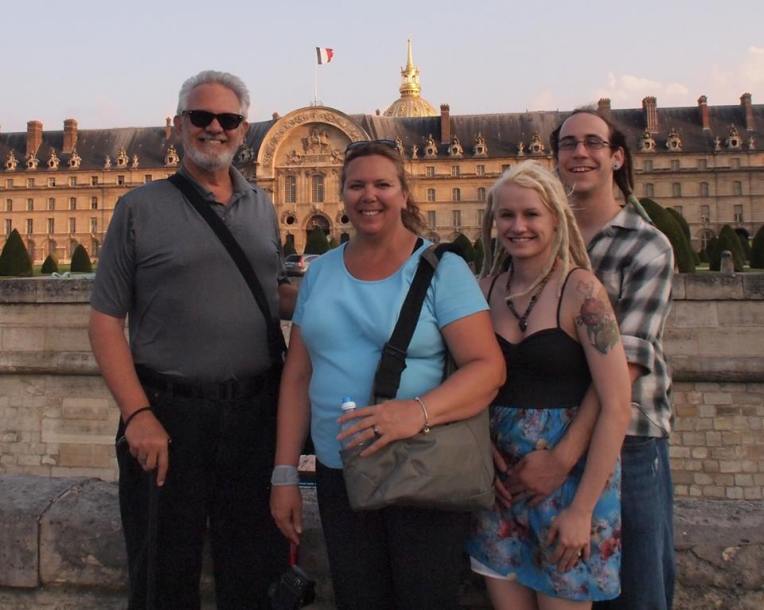
Alan, Tracy, Liz, and Adam in front of L'Hôtel National des Invalides
Alan, Tracy, Liz, and Adam in front of L’Hôtel National des Invalides

This slideshow requires JavaScript.

From Les Invalides we could see La Tour Eiffel (the Eiffel Tower) through the surrounding buildings, our next stop.  We had made reservations to go up into the tower for this evening as it was the only time available.  Reservations fill very quickly to go to up to the observation areas.

Eiffel Tower seen from the 7th arrondissement

The wrought iron Eiffel Tower is named for engineer Gustave Eiffel who built the tower as an attraction to the 1889 World’s Fair.  Originally intended to be a temporary attraction, but it quickly became the iconic symbol of France and Paris that remains today.  The Tower is the tallest structure in Paris and the second tallest in France.  At 1,063 feet it is taller that the Washington Monument (555 feet) and Space Needle (605 feet) and was the tallest structure in the world for 41 years until the Chrysler Building was completed in New York in 1930.   (With its current communication antenna the Eiffel Tower is currently 17 feet taller than the Chrysler Building.)  “Impressive” and “awe-inspiring” are perfect descriptions as the tower is much larger than we expected.  We arrived at twilight to be able to watch night fall over the “City of Light” from the observation platform.  At 11 pm we were also treated with light show of lights sparkling all over the Eiffel Tower.

This slideshow requires JavaScript.

Adam and Liz had by now been awake about 48 hours straight, so it was now time to head to the Métro to get them some well deserved rest.  Passing dozens of unlicensed souvenir hawkers, each offering the same wonderfully cheesy, glowing, blinking Eiffel Tower models, we finally made it back to our hotel in the Montmartre district. The “last chance to get a blinking Eiffel Tower” had already become the humorous theme to the kids’ trip. It would continue until they left, with a comment about maybe being able to get one of the most desired souvenirs in Paris before they got on the plane to return home.

Paris: Travel and Sacré-Cœur Basilica

Adam and Liz were flying into Aéroport Paris–Charles de Gaulle (Charles De Gaulle Airport – Paris) so we needed to travel to the other side of France to meet them.  Tracy and I elected to not get a car when we moved to France and because we were traveling with Kiara the Chihuahua using RyanAir or EasyJet (the discount airlines) was not an option.  So we made use of SNCF’s (Société Nationale des Chemins de fer Français – French National Railroad Company) regional trains and the newly available Ouigo high-speed train.  The Ouigo is a subsidiary of SNCF and is basically a stripped TGV (Train à Grande Vitesse) high-speed train without a club car designed to compete with the discount airlines.  The trains happily accept Kiara which made her and us very happy.  The Ouigo was comfortable and quiet and we enjoyed a very rural view of France that reminded us of Kansas and Nebraska with lots of grain fields and vineyards.

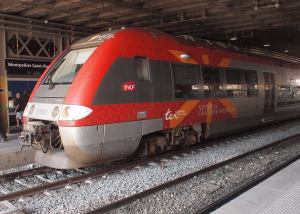
SNCF Train
SNCF Train
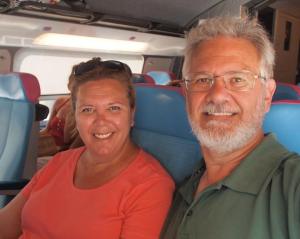
Tracy and Alan traveling by rail
Tracy and Kiara waiting for the train

Another reason for the Ouigo’s discount fare is its use of secondary train stations.  We arrived at the train station at Marne-la-Vallée – Chessy outside Paris only to realize that Marne-la-Vallée is the station for Disneyland-Paris.  We hadn’t realized that walking out the station door would put us immediately at the entrance to Disneyland.  We caught the RER (Réseau Express Régional – Regional Express Network) commuter train from Marne-la-Vallée to Paris and then the famous Paris Métropolitain (subway) to our hotel in the Montmartre district of Paris in the 18th arrondissement, a Right Bank arts neighborhood.

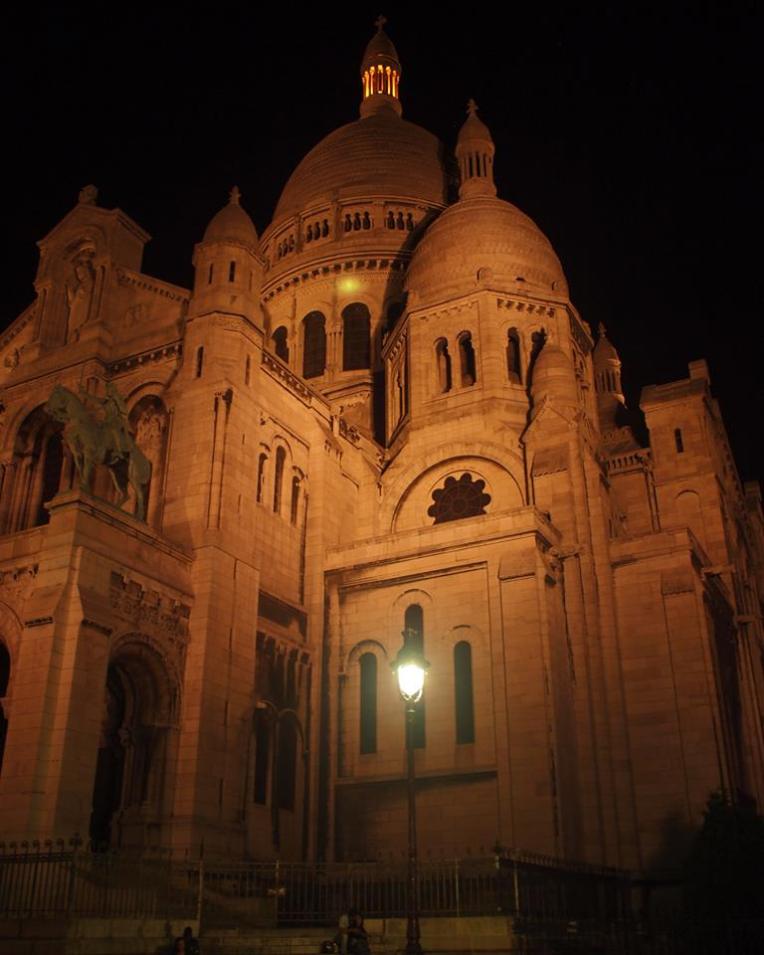
We arrived a day earlier than Adam and Liz’s arrival, so we did an evening stroll to visit Sacré-Cœur Basilica.  Located at the summit of the Butte Montmartre, the highest point in the Paris, the Basilica of the Sacred Heart of Paris, more commonly called Sacré-Cœur Basilica, is a Roman Catholic church and minor basilica, dedicated to the Sacred Heart of Jesus.  Built of white travertine stone, the Basilica is brilliantly illuminated and stunning at night.

Sacré-Cœur Basilica
Sacré-Cœur Basilica
Sacré-Cœur Basilica
Sacré-Cœur Basilica

The Basilica complex has a large garden area and  a fountain. There is an amazing panoramic view overlooking Paris from the Basilica and garden.  The Basilica complex is a favorite meeting place for young people with more than a hundred on the grounds socializing as we explored. To reach the top of Butte Montmartre there is a steep series of stairs with over 300 steps or a funicular railway.  The funicular has two parallel tracks with one car on each: one car going up counter-balancing the other car coming down.  In a minute and a half the funicular travels 354 horizontal feet and climbs the 35% gradient 118 vertical feet to the top of Butte Montmartre.  It is well worth the cost of one Métro ticket to enjoy a ride to the top.  The funicular transports about two million passengers each year.

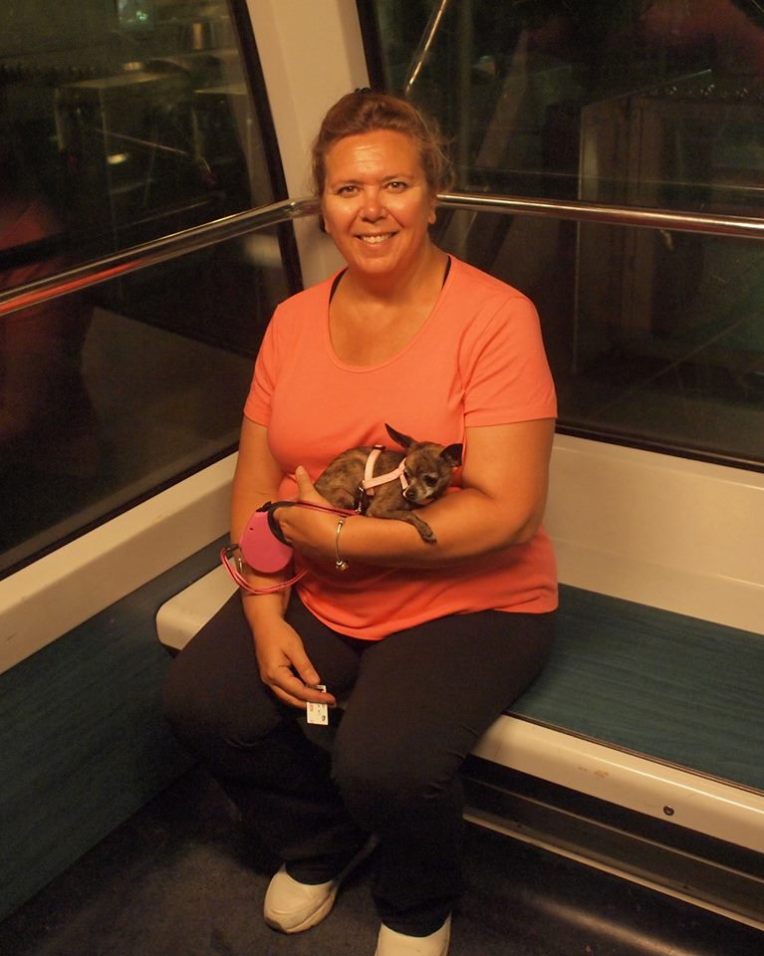
Tracy and Kiara on the Montmartre Funicular
Montmartre Funicular

With Sacré-Cœur Basilica around the corner from our hotel enjoyed the beauty of the Basilica on the hill above us and we later returned to share the sight with Adam and Liz.

View of Paris from Sacré-Cœur Basilica (Wikimedia Commons)
View of Paris from Sacré-Cœur Basilica
(Wikimedia Commons)

Bus Riding 101 and a Shark Face

Yesterday we rode the bus for the first time here in Carcassonne.

We are not the world’s most experienced travelers, but we have used public transportation before in San Francisco, Washington, D.C. and Rome while traveling. It isn’t that hard to figure out how a bus, trolley, metro works but there are some differences in each place . . . we learned about some of those differences on our travels yesterday.

We woke up and decided today is the day we will try riding the bus. Where to go? The grocery store, of course. In many places and even in Reno/Sparks the buses always have stops near grocery stores and we wanted to look for better grocery prices than those in the tourist areas, which we know are higher priced with minimal selection. We had visited a Geant Casino supermarket in Montpellier and Alan did a little online research and found there are two here in Carcassonne. So we got ready and headed out to ride the bus to a grocery store.

Which bus to take? There are 11 bus routes around Carcassonne, there is no printed route map that has all of the routes listed. Cathy, our new friend at the tourist office had told us that one street over from ours is one of the main offices of the bus system Agglo’transport. So we headed to the bus system office.

Alan talked to the nice elderly gentleman behind the counter and asked if he spoke English. He said with a surprisingly Italian accent, “a little.” Alan said we wanted to go to Geant Casino, the man asked “which one?” Alan replied “either one.” The little man, circling the times on the route 1 brochure, said “that’s your bus out there, go, I call and let him know you come.”

So without any fanfare, we raced over to hop on a bus. Alan had thoughtfully scooped up the brochure before leaving the bus office.

We board the bus and the driver said, “Geant Casino” we smiled and said “Oui.” We paid him 2 Euro and found a seat.

15 minutes later we arrive at Geant Casino and get off the bus. TaDa! Bus trip number 1 accomplished!! We congratulated each other and entered the store to have our first “supermarket” experience in Carcassonne.

We went inside, found that it is like a mini-mall, and there was a coffee bar so Cafe Creme it is! A nice way to celebrate our successful bus riding affair.

Fortified with caffeine, we go to the corral of shopping carts only to realize that they are all chained together. We look around and see that other people have shopping carts and realize that there must be a way to get one unlocked. We look at the mechanism, there are no directions. Alan notices a slot and realizes that something must fit in it to remove the hook from the cart. We assume a coin of some sort, but there are lots of coins and we’re not sure which and don’t want to jam the mechanism.

Thankfully, a little girl about 10 years old comes by to get the cart for her mom and Alan notices that she got the cart unlocked, then scooped out a handful of coins and asked, “which one?” She grabbed a 2 Euro coin and showed him it was too big. He scooped out another handful of coins and she selected the 1 Euro coin and showed him how to unlock the cart.

So we’ve now been inside the building for 45 minutes and we’ve managed to drink a cup of coffee and unlock the grocery cart. Feeling a bit deflated after our earlier high, we head into the store and spend the next two hours walking up and down every aisle trying to familiarize ourselves with the grocery store.

As some of you have already read, I had issues over the potato chips. Realizing that this supermarket has much better prices than the ones downtown in the tourist area we select a few purchases for the upcoming week and head to the checkout.

And voila! Bus ride and grocery shopping, done. We even figured out how to get the 1 Euro coin back out of the cart lock mechanism – score!

We walk back to the bus stop where we got off the bus and headed across the street believing that the return trip would start there. We only had to wait about 10 minutes before the driver arrived with the bus.

Yippee! Bus ride number 2, commenced!

The bus didn’t use the same route on the return and we unknowingly figured that it would get to where it was going, circle back and repeat the route. It’s how it works most everywhere we’ve been before. So we stay on the bus and when we reach the far side of town, enjoying the sightseeing, in the opposite direction of where we got on, the driver stops and as we are the only ones still on the bus says “Terminus – you must got off!”

A little shocked and wary, we gather our two bags of goodies from the grocery store and hop off the bus. Alan asks the driver “Is another bus coming?” the driver says “Oui” and leaves. We look at each other and realize we haven’t the slightest clue where we are. I told Alan ‘I think we’re near the other Geant Casino, I think I recognized the logo a couple of stops before this one.” He says, “then we’re on the other side of  town.”

Okay then, but we want to be on OUR side of town. Where we got on the bus, near the apartment, not here with bags of groceries and no bus.

We had spotted a KFC across the roundabout and decide to take a moment to regroup, eat something, get something cold to drink and then look at the bus schedule. Alan spotted the bus schedule kiosk so we noted the time for the next bus would arrive and headed over to KFC to grab some lunch. We pulled out the bus route brochure Alan had thoughtfully scooped up at the bus office, look at it after we eat and realize that there are little tiny, hard to see without your glasses, arrows showing the direction the bus travels and realize that the next bus would take us back to our original starting point.

We finish our drinks, walk back to the stop where the driver left us and waited until the bus returned. A different driver thankfully, one that hadn’t been witness to our “tourist” moment earlier.

We hopped on paid the driver and found a seat, rode until we reached our original starting point and felt pretty pleased that we didn’t let the whole extra two hour experience totally ruin the day.

This morning we decide to purposefully ride to the “other” Geant Casino and check their selection and prices and to determine which of the two will make for an easier trip with bags of groceries. Yesterdays experience has made us wary.

We walked to the bus stop near the train station since we now know that we need to be on that part of the route to go where we want to go. The driver, same guy who dropped us at the “terminus” yesterday recognizes us and asks “Geant Casino” to which I stupidly reply, “Yes!” The driver tells us to take the other bus, #2, which had just pulled up behind him thinking that I wanted to go to same Geant Casino as I did yesterday. Confused we walk to bus #2 and ask Geant Casino, the driver shakes his head and points back to bus #1. We walk back to bus #1 and the driver shakes his head. The poor man is probably thinking we’re stupid tourists who like to be lost, but we pay him the fare and find a seat.

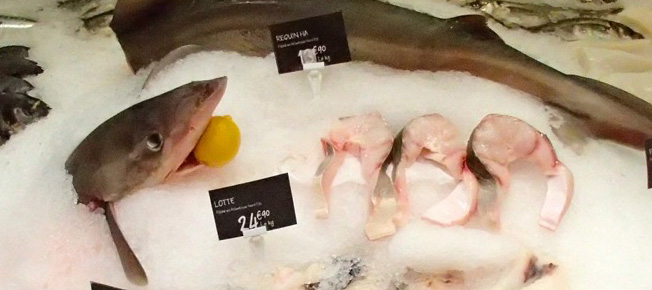
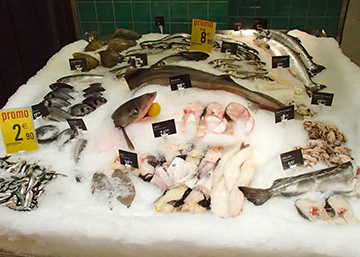
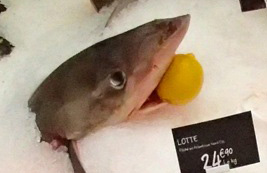
We did end up at Geant Casino #2, and did our shopping. Today’s Geant Casino had really, really fresh fish — including a small shark displayed with the head removed and set to the side with a lemon in its mouth! We opted for pork instead. This store had the same deplorable selection of potato chips, in case anyone was wondering. Then managed to catch the right bus to the stop a  block from the apartment. We have decided that Geant #2 is the better route, a longer walk to catch the bus but a shorter walk with bags of groceries.

Now I’m wondering if the driver works that route all the time as I fear that every time he sees us from now on he may think we are his weirdo riders who fly all the way to France to get lost on a bus looking for grocery stores. Can’t image what he told his family about us today!

bus1

Agglo’transport Bus #1 (with our favorite driver!)

morechips

Once again, we found chicken flavoring on chips. But I really love the “bursting with flavor” on the ketchup flavored chips!!

freshfish

Today’s fresh catch.

 sharkface

Lemon Shark??