February 2014 brought the traveling photography exhibition, Le Transporteur d’Images (“Carrier of Pictures”), to Carcassonne. The Transporteur d’Images is a mobile art gallery based in a converted river barge that is sailing on the Canal du Midi. The 150 mile long (241 km) Canal du Midi was built in the 17th century and connects with other rivers and canals to create a continuous waterway from Mediterranean to the Atlantic Ocean. The Canal du Midi, has been designated a UNESCO World Heritage site since 1996.
Map of Canal du Midi. (Image courtesy of Wikimedia Commons)
Captain Frédéric Journo with crewman/artist Gauthier Fleuri uses the traveling art exhibition as a method of creating awareness that historic trees lining the canal have been destroyed. Many trees along the route have had to be removed due to a spread of canker disease. Since setting sail from Sète in late July 2012, the Transporteur d’Images has raised €10,000 in donations for re-planting trees along this waterway with the sale of pictures, books, and posters.
Le Transporteur d’Images was one those unusual surprises that makes living in Carcassonne such a pleasure.
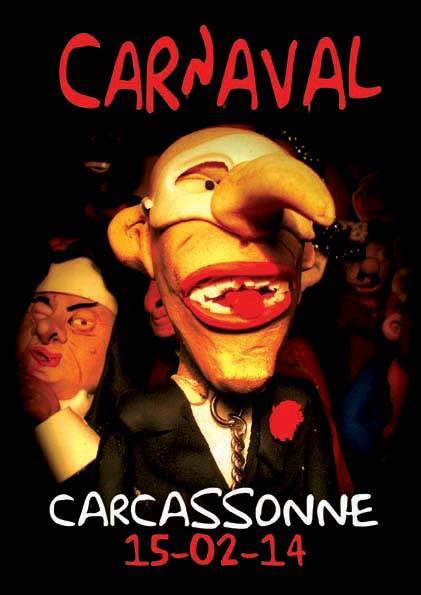
Our local version of Mardi Gras, the Carnaval de Carcassonne occurred over the weekend of February 15 (a few weeks early from the traditional Fat Tuesday – Shrove Tuesday start of Lent.) It was a wonderful combination of Burning Man, Carnival, and a Disney Parade starting at the town square of Place Carnot, through the streets of La Bastide, down the Rue de Verdun, acrossSquare Gambetta, down Boulevard Camille Pelletan to a final bonfire with masked ball under the stars starring five different bands at Le Dome. There were an amazing variety of costumes (ranging from medieval traditional, outrageous, risqué, modern, and child friendly), music, singing, dancing, with lots and lots of confetti along the way. (Tracy is still finding confetti that made it home.)
Carnaval de Carcassonne Poster
While not nearly as big as Mardi Gras in New Orleans, Carnival in Venice, or Carnival in Rio; the celebration had a “home town” flavor (like “Jack’s Carnival” or “Hometown Christmas” in Sparks, Nevada) and was major fun enjoyed by children and adults alike. The expected crowd was in excess of 16,000 people.
This slideshow requires JavaScript.
While the Carnival in Nice, Rio, New Orleans, and Venice are world-renowned, this was an exceptional event to attend especially because of the intimacy of a being a local celebration in a smaller city.
Alan and a traditional Masquerader at Carnaval de Carcassonne, 2014
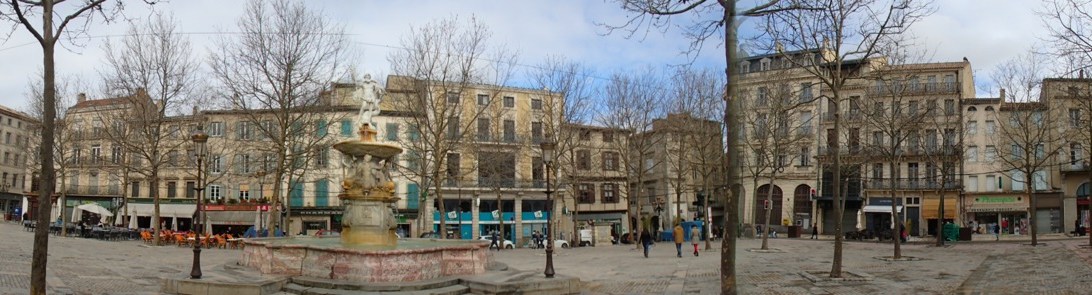
One of our favorite places in Carcassonne to spent time is in Place Carnot, the central town square near the middle of the Bastide Saint Louis (also called the Ville Basse – lower city), the modern city of Carcassonne that lays below the medieval citadel of la Cité de Carcassonne. (Google Earth: 43°12’48.39″ N 2°21’06.21″ E)
Bastide map indicating Place Carnot’s location.
“Place” is French for “square.” Place Carnot, while one of many squares scattered throughout town, is the “heart” of the city, the central square since medieval times that has been the main meeting place and market for the lower town. Place Carnot is where the open-air vegetable, fruit, and flower market is held every Tuesday, Thursday, and Saturday. This is the place to sit and enjoy a morning café creme or afternoon Pastis at one of the many cafés’ outdoor tables and watch people walk past. Place Carnot is where you can enjoy watching children chase pigeons past the Fountain of Neptune or skate on the seasonal skating rink that is assembled during the Christmas season. This is where many free musical events and an occasional wine tasting are hosted during the year. If you have an image in your mind of leisurely South of France town life, this is where that image would play out.
This slideshow requires JavaScript.
The history of the square is very rich. “At the junction of (the main streets of rue de Verdun andrue Georges Clemenceau) . . . , royal surveyors marked out a large square. After 1355, the square was reduced to the size we see today. By doing so, Rue Pinel and Rue de l’Aigle d’Or were created. After the fire in 1622 which destroyed more than 150 houses and the arcades filled with shops round the square, a new corn market (now the covered market) was built on the site of the Officiality. This cleared the square. On 27th December 1792, during the French Revolution, Jeanne Establet, or Joan the Black, was guillotined here with two of her accomplices. Two years later, Father Henri Beille, Vicar of Alet, a non-juring priest became the only victim of the Reign of Terror when he was executed. During the Napoleonic Empire, the square was renamed Place Impériale. It became Place Royale during the Restoration of the Monarchy, then Place Dauphine, Place de la Liberté and Place de la Révolution, Place aux Herbes (1852) and, finally, Place Carnot (1894).” From “Our French Retreat”
My understanding is that the square is named in honor of Nicolas Léonard Sadi Carnot, French military engineer and physicist, known as the father of thermodynamics. However I have had difficulties confirming that fact.
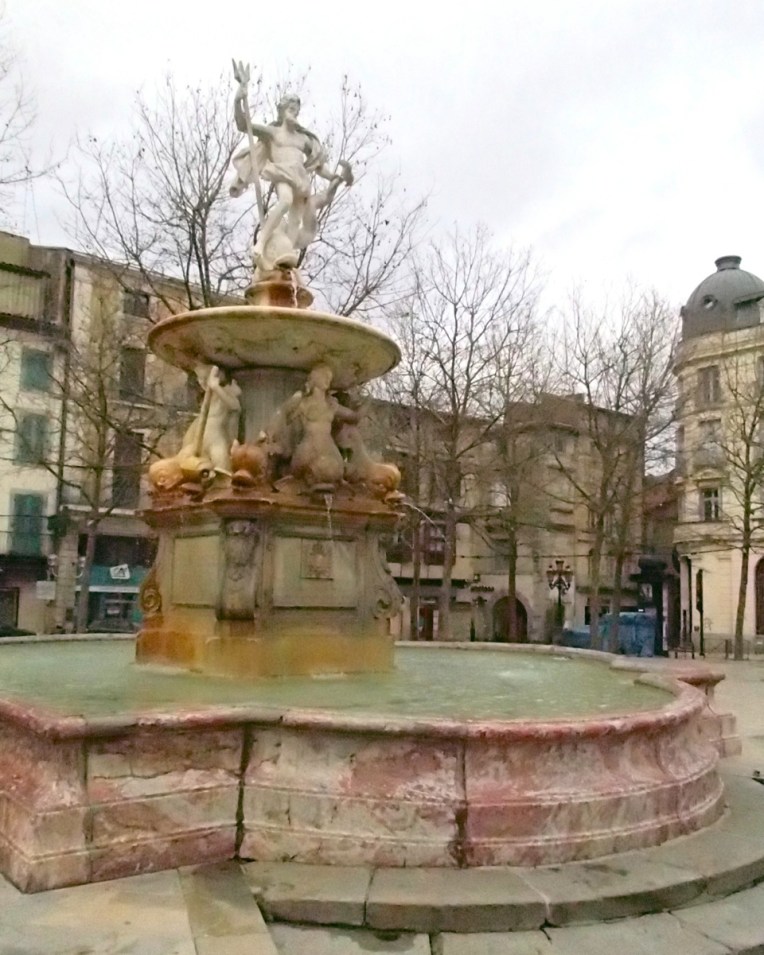
The surface is a mix of paving stones inset into square or spiral patterns. At the center of Place Carnot is the marble Fountain of Neptune (La Fontaine de Neptune). The fountain is surrounded by a rose-colored marble basin from the village of Caunes-Minervois which has been producing marble since Roman times. Neptune was sculpted by Italian artist Barata and his son and finished around 1771. Beneath Neptune are marble figures of dolphins and naiads. Tracy and I joke that after seeing the stunning sculptures in Florentine and Roman fountains, Place Carnot’s somewhat anorexic Neptune appears to have been created by a “junior varsity” sculptor. Our research into the additional works by Barata has yielded nothing. We wonder if he was a “one hit wonder” in his day.
Fountain of Neptune (La Fontaine de Neptune), Place Carnot, Carcassonne
This slideshow requires JavaScript.
The perimeter of the square is lined with trees and at each of the four corners is a small lion-headed fountain in the base of a candelabra of street lights with copper shades. Around the outer perimeter are numerous cafés and restaurants with their outdoor tables, chairs, umbrellas and awnings; clothing, cosmetics, tobacco, and food shops; four banks (including ours); and a pharmacy.
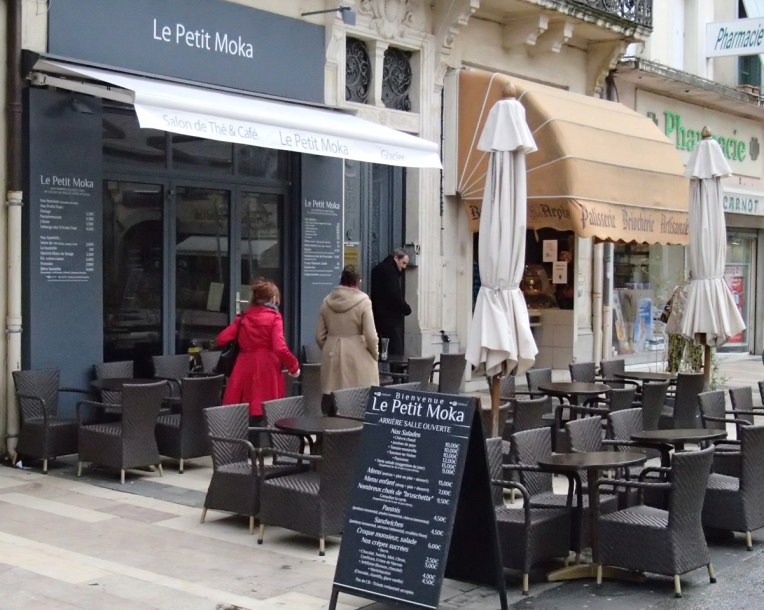
Place Carnot is great location to stop and sit, have a café-espresso, and enjoy the sun on your face (especially at La Petit Moka, our current favorite café.) Or you may order another Pastis and silently toast Joan the Black who met her final fate in the square by guillotine.
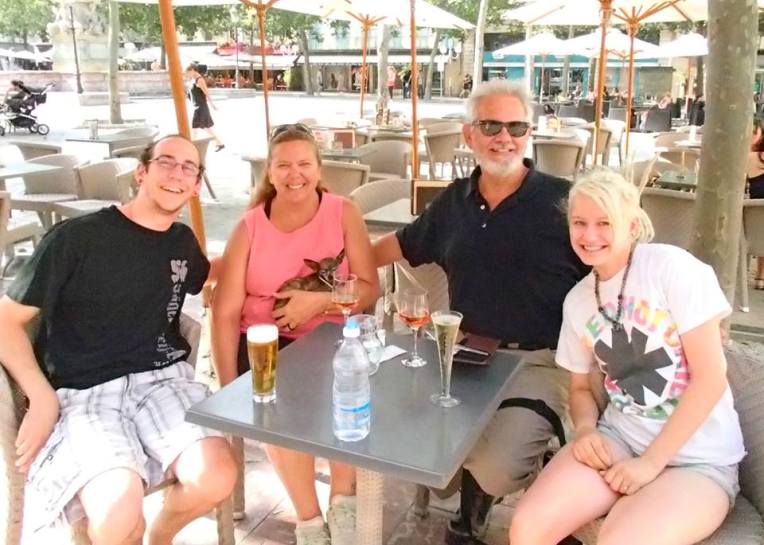
La Petit Moka Café, Place Carnot, CarcassonneAdam, Tracy, Kiara, Alan, and Liz take a wine, beer, and champagne break in Place Carnot in the Bastide of Carcassonne
While walking Sami the MinPin around the Bastide Saint Louis in Carcassonne during the holiday season, Sami insisted several times that I stop and enjoy a Affligem de Noël Christmas beer. I was very appreciative of her encouragement.
Affligem is not actually a French brand, it’s Belgian from the Op-Ale Brewery in the Flemish village of Opwijk and made under license for the 11th century Benedictine Abbey (monastery) in Affligem. But Affligem de Noël was the most commonly seen seasonal Christmas beer in Carcassonne with signs advertising its availability in many café and bar windows. http://www.affligembeer.be/
Affligem de Noël
While I was expecting a noticeably spiced Christmas beer (like the Red Nose Holiday Wassail Beer, a favorite of mine at Great Basin Brewery in Reno, Nevada), the Affligem de Noël had a very subtle taste of spices, fruits, and honey. This draft beer has a translucent, auburn color and a great aroma. The Affligem de Noël was refreshing and surprisingly would also make a good summer beer. Like most Christmas beers, this one had a slightly higher percentage of alcohol at 6.2% ABV.
If I understand the tradition correctly, there is a different Affligem de Noël beer brewed for the Christmas season every year. So after my positive experience with the 2013 beer, I am now looking forward to Affligem de Noël 2014.
“So . . . do you speak French?” A common question I was asked last year before we departed to France, the answer was, “Hardly a word.”
Our backstory explains how Tracy and I, through a convoluted process, came to retire in France. Prior to our retirement we did two years of Italian language study at Truckee Meadows Community College and using Italian Rosetta Stone computer software. (Our original retirement location was Italy.) My high school and college foreign language was German, Tracy’s was Latin.
Now approaching our first year anniversary in France there is still the question, “Do you speak French?” Tracy describes that I have an effective set of French “coping phrases” for life at the market, cafe, train station and my accent has gotten much better, but I’m still not to a conversational level. We haven’t found it to be true that with “total immersion you will pick up the language just like that” followed by snapping fingers. If anything, I am disappointed in my limited progress acquiring a good command of conversational French due to a lack of sufficient effort on my part.
While recently in Montpellier we met a delightful pair of five-year old French girls on the tram who chatted in English with Tracy and me. I decided that by the end of 2014 I wanted to speak basic conversational French as well as these five-year olds spoke English (I won’t even get in to the question, “Are you smarter than a Fifth Grader.) This seemed like a reasonable and obtainable goal. So I made a New Years resolution to stay on a comprehensive learning schedule for French language acquisition.
There are lots of methods for second-language acquisition. I know that I am more of a physical/aural learner so I selected audio learning systems. Tracy decided to stay with Rosetta Stone French because she found Rosetta Stone effective for her previously while learning Italian. (I also liked Rosetta Stone, but I wanted a system that starts with conversations and doesn’t require performing the learning in front of a computer.) We would have liked to attend a French language class in a traditional classroom, but there was no cost-effective classes in Carcassonne (but there are some really expensive one-on-one tutoring available.)
The programs I picked are certainly not the best and only options, but these are the learning programs I selected for my personal andragogy (adult self-learning) and learning style. The biggest success factors I think for any adult second-language learner is their motivation and perseverance. There is no “Magic Bullet” of the perfect learning program, no “learn French in just 10 days.” Learners must be consistent and actively involved in their self-education like any other pursuit – golf, cooking, knitting, playing a musical instrument – there is no passive approach to mastery.
I reverted back to my pre-retirement “Type A,” overachiever personality and selected three distinctly different learning programs to learn with rather than selecting just one system. My hope was that the different language programs would overlap subject matter, fill in holes, and reinforce the material in other programs. I wanted audio programs for use on my iPod that could be transportable and not require that I sit at a computer to work on my language studies. I wanted to listen and re-listen to a lesson while taking a walk, cooking, riding the bus, doing dishes, or shopping.
Pimsleur French
Pimsleur French
First, I selected Pimsleur French (http://www.pimsleur.com/Learn-French) which is a traditional audio learning program. The Pimsleur Method has been teaching millions of students since the 1960’s and is considered by many to be a solid, tried-and-true method that stresses active participation, not rote memorization. Although it emphasizes formal language and is somewhat dated with its lack of computer graphics, it is still frequently rated in the top 5 or higher of language learning programs. (http://learn-french-software-review.toptenreviews.com/pimsleur-french-unlimited-review.html) The Pimsleur system uses four principles in its teaching method: anticipation with “challenge and response” similar to having a conversation, graduated-interval recall to reinforce vocabulary, a core vocabulary of the most commonly used French words, and what Paul Pimsleur called organic learning, auditory learning similar to how children learn language by hearing examples and then repeating what is heard. The lessons are in 30 minute blocks that allows total effort without fatigue.
Amazon.com offers Pimsleur French levels I, II, & III for approximately $350.00 (in January 2014).
Coffee Break French
CoffeeBreak French
Secondly, I picked Coffee Break French (http://radiolingua.com/shows/french/coffee-break-french/) as a second-language acquisition tool. The audio lessons are available as a free iTunes download and from the Radio Lingua Network website (http://radiolingua.com/). (There is also Coffee Break Spanish and Coffee Break German available as well as a series of brief audio lessons in 24 languages ranging from Arabic to Zulu.) The original concept was to make language training conveniently available “during a daily coffee break.” These well produced audio lessons use the fun learning device of the instructor, Mark Pentleton (an experienced French and Spanish teacher), working with a college-aged student. This Socratic technique makes the lessons fun and upbeat while allowing the student to act as a proxy for me in a classroom. Most lessons are in 20 minute blocks, with approximately 100 lessons currently available and new lessons being frequently added. Part of the charm of Coffee Break French is that the instructor Mark Pentleton is Scottish. Although his English instruction has a distinctive Scottish burr, his French pronunciation is properly accented. While there is paid supplemental content available from the Radio Lingua Network, I only needed the professional lesson guides to accompany the audio lessons. Well worth the extra cost as I the lesson guides have helped me with my reading of printed French, building my vocabulary, and to better understand the conjugation of French verbs.
Coffee Break French has emphasis on proper French grammar as part of the lessons, something the Pimsleur program does not dwell upon. Like the Pimsleur method, the lessons revolve around conversations based on real-life daily activities.
I selected the Bronze membership, which provides a set of 40 lesson guides for £27.00 (in January 2014), although there are periodic discounts and I was able to purchase the lesson guides for just £21.60.
FrenchPod 101
FrenchPod 101
Finally, I selected FrenchPod 101. (http://www.frenchpod101.com/) A popular audio language program with free audio lessons, but I haven’t found FrenchPod 101 as well-organized or structured as the Pimsleur or Coffee Break French. What I do like is that the FrenchPod 101 offers lots of cultural insights, daily life in France, and casual French phrases. The cultural insights was one thing I greatly enjoyed in our TMCC Italian class with our professor, Carlo, who described his growing up and living in Italy. The lessons are usually less than 10 minutes with an energetic native French speaker and an American who is fluent in French. The discussions sound like two college-aged people talking about speaking French or living in France. The lessons include the use of casual and informal French language along with proper formal French. The lesson guides are helpful, but frequently do not exactly match the lessons’ dialog. There are about 300 lessons, but it is difficult to organize the lessons into a well structured schedule of study. It seems that the parent company, LanguagePod 101, (http://www.languagepod101.com/) provides the free audio lessons as a device to market paid subscriptions its to online training platform. I used my initial seven-day free trial to download the audio lessons and lesson guides that I was actually interested in using. Another learner who wants to work from their computer might like to join the “FrenchPod 101 Learning Community” and use its additional tools.
I use FrenchPod 101 as a supplement for its cultural insights and expanding my knowledge of informal French. I wouldn’t use this for my primary learning tool.
I do one lesson each from Pimsleur French, Coffee Break French, and FrenchPod 101 everyday, Monday through Friday. I leave the weekend free to rest or catch up on any overdue work.
Supplements
Duolingo
Duolingo
I use the free language-learning site Duolingo on my Kindle as educational entertainment. Its graphics are very similar to Rosetta Stone learners’ interface. It is a very worthwhile learning platform that I should consider working with more often. Amazing quality for a free service. It’s pretty fun too.
Flashcards
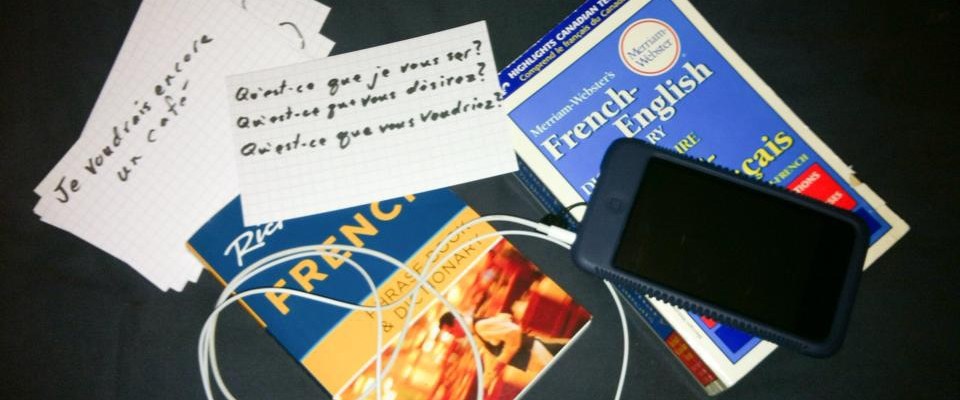
Being a physical learner, I find creating my own flashcards has the dual purpose of physically writing words down that I can later use to quiz myself. The audio learning programs do need supplements to assist me in learning to read French better.
Readings: French Newspapers, Menus, Grocery Items
I do my best to read the local newspaper online and physical newspapers while in cafes, as well as review menus, and read the names describing items in the store. The newspapers and menus challenge my reading comprehension. I find shopping reinforces my vocabulary when I see a physical object (apples, shoes) next to a sign (pommes, chaussures.) This is part of that “total immersion” experience to learning French.
Notebook
I keep a pen and notebook in the camera bag that I always carry. I find new words while I am out in the community that I am unable to define and make a note, then check on the word once I return home. Interesting how those words stick in my growing vocabulary.
Talk and Listen
I try to push myself to speak and to carefully listen to the local French people around me. It makes me practice, increases my confidence, and forces me to try to “think in French” not “translate English into French.”
DELF Challenge
DELF
I wanted to set up some tangible goals to work toward with my French studies. There is what is called the Common European Framework of Reference (CEFR) which is the guideline used in Europe to describe a person’s fluency in other languages.
The CEFR classifies learners into six levels:
A Basic User
A1 Breakthrough or beginner
A2 Waystage or elementary
B Independent User
B1 Threshold or intermediate
B2 Vantage or upper intermediate
C Proficient User
C1 Effective Operational Proficiency or advanced
C2 Mastery or proficiency
The French National Ministry of Education (Ministre de l’Éducation Nationale) provides testing for diplomas of achievement (Diplôme d’études en Langue Française – DELF) at each level of proficiency. (I believe this is similar to the United States’ Test of English as a Foreign Language exams – TOEFL.) There is a DELF exam for each of the six levels that test for four different language skills: listening, speaking, writing, and reading.
So, if I am understanding this certification process correctly, I want to test my second-language acquisition progress with the DELF testing. My goal is to earn at least the DELF A1 diploma in 2014.
So, with no “Magic Bullet,” I had better stay on track with my learning schedule for 2014. Someday soon I may be speaking as well as a five-year-old.
Bonne année et bonne santé! Happy New Year and Good Health!
This last year for Thanksgiving and Christmas, Tracy cooked our holiday meal, and extremely well done they were!
So for New Year Eve, le Réveillon de Saint-Sylvestre, I tried to make my lovely bride, Tracy, as close to a traditional French New Year’s Eve dinner as I could manage.
So after some research and shopping I felt I was prepared:
Seared foie gras: this time of year foie gras is everywhere. It’s a major menu selection for Christmas and New Year Eve dinners. Foie gras is incredibly delicious, I had no idea. I seared it about 30 second on each side. The good news: it was melt in your mouth perfect. The bad news: the high heat searing caused the smoke alarm to trigger.
Blinis with smoked salmon and caviar: smoked salmon appeared to be another favorite for the season. I also obtained a nice black caviar (not the wonderful and endangered Black Sea or Caspian sturgeon caviar you hear about. My pockets are not that deep.) The blinis, tiny buckwheat pancakes, were obtained from a store as we still struggle with baking in France. Tracy enjoyed both the salmon and caviar.
Polenta with black truffles. Truffles are a big deal in France. The polenta had shaved flecks of truffles throughout the pan-fried polenta.
A cheese plate with chèvre, camembert , and roquefort cheeses. It’s France, there MUST be a cheese plate. Tracy (and I) love chèvre (goat) cheese. I also included Camembert de Normandie (A.O.C.) and roquefort (A.O.C.) blue cheese both of which are “Contraband cheeses” that cannot be imported into the US since they are unpasteurized.
Additionally, I made meatballs, sausages, and sliced meats. We used to do this for hosting the kids during New Year Eve. It ended up that I had way too much food, but we enjoyed it over the next week.
Champagne. What is the point of living in France if you don’t enjoy real champagne for special event? Of course there was Champagne with dinner. (Although Tracy and I both love Italian Prosecco sparkling wine.)
Dessert: Chocolate and café éclairs from our favorite pâtisserie and boules de noël’ chocolat from the Christmas market in Square Gambetta.
It made a fun dinner with a new tradition to welcome in the new year.
DELAYED POST, I am catching up our blog after our blogging hiatus while recovering from walking the Camino de Santiago.
December 24 and 25, 2013
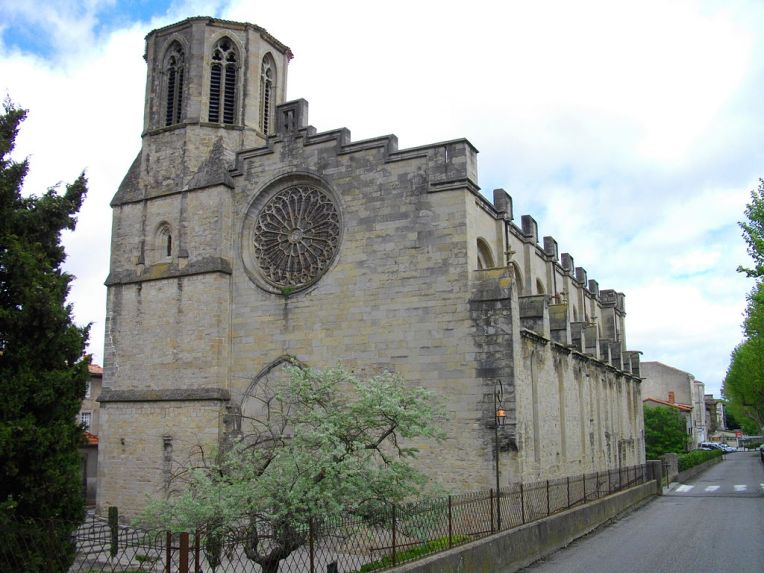
A quiet Christmas eve for us. Tradition in France is to attend la Messe de Minuit evening mass followed by a large family meal, le Réveillon. Tracy and I had planned to go to midnight mass at Cathédrale Saint-Michel de Carcassonne, but Sami, the min-pin puppy, was having terrible separation anxiety when we would leave her alone in the apartment. Rather than impose Sami’s whining on our neighbors, we spent the evening dining in and then took a midnight walk with Sami through the Bastide. Beautiful night walking through the quiet lanes, enjoying the lights.
Cathédrale Saint-Michel (Wikimedia Commons)
Père Noël (Father Christmas) was good to Sami Christmas morning. Sami scammed all sort of treats and toys from Père Noël . Tracy had previously knitted Sami her own Christmas stocking.
Sami opening her Christmas presents.
Christmas evening Tracy made a delicious Christmas dinner. Turkey roast, mashed potatoes, gravy, sautéed mushrooms, corn, green beans, toasted chèvre cheese on baguette, champagne, and religieuse pastries for dessert. Sami even got a small portion for her dinner. The nice thing about living in France is that if you want French champagne for dinner it only requires a walk to the end of the block.
We had a nice visit with some of Tracy’s family as they gathered for dinner, via FaceTime on her sister’s iPhone.
Wonderful Christmas, but we are missing our kids over the holiday.
DELAYED POST, I am catching up our blog after our blogging hiatus while recovering from walking the Camino de Santiago.
December 6, 2013
La Magie de Noël (The Magic of Christmas) Festival is a month-long (December 6, 2013 to January 5, 2014) celebration throughout Carcassonne.
There was a Christmas market in Square Gambetta with a Ferris wheel, carousel, and two children’s carnival rides.
In Place Carnot (the town square) the city had erected an ice skating rink. The rink had live and recorded music, food booths, and later at night “ice go karts” were available for the adventurous.
At Place d’Armes and Port Jacobin (Jacobin Gate) there was a large roller coaster and a children’s roller coaster and spin rides.
Jardin Andre Chenier (Andre Chenier Garden) had a simulated sled run, mild for children and steep for the more bold with several more children’s rides and food booths.
The final venue was up in the medieval la Cité de Carcassonne was a christmas crafts market behind the Basilique Saint-Nazaire-et-Saint-Celse.
During the month there was all kinds of live music scheduled at the different venues. The city businesses all had Christmas trees decorated with ribbons outside their front doors and there were Christmas lights hung over the streets. In short, the Christmas spirit was everywhere we walked. Square Gambetta is only a block away from our apartment and there were several special trips for seasonal specialties and stops for vin chaud (hot spiced wine.)
Tracy and Sami walking in the medieval la Cité de Carcassonne after visiting the Christmas craft fair.Alan and Sami walking in the medieval la Cité de Carcassonne after visiting the Christmas craft fair.
DELAYED POST, I am catching up our blog after our blogging hiatus while recovering from walking the Camino de Santiago.
December 8, 2013
To celebrate Carcassonne’s Fête de la Saint-Nicolas (Feast day of Saint Nicholas) there is the Marche aux Flambeaux (Torch Parade), an amazing parade from the medieval city of la Cité de Carcassonne across the Pont Vieux (Old Bridge) through Gambetta Square’s Christmas Market, the Bastide (the traditional town) to reach Place Carnot (the town square and marketplace).
Lead by Saint Nicholas, marchers in traditional medieval costumes, families, bands, and visitors all with flaming torches happily walk the route talking, laughing, and singing along the way. It is a wonderful start to the Christmas season in Carcassonne and one of the first events in the month-long La Magie de Noël (The Magic of Christmas) Festival.
We had a wonderful time joining in with the marchers, although Sami, the min-pin, was far less impressed with the volume of the music, especially the marching band’s drummers.
Tracy and Sami on the Pont Vieux (Old Bridge) waiting for the Marche aux Flambeaux (Torch March) to arrive. La Cité de Carcassonne in the background.Alan and Sami on the Pont Vieux (Old Bridge) waiting for the Marche aux Flambeaux (Torch March) to arrive. La Cité de Carcassonne in the background.












 An Italian Point Of View