Learning to Speak French in France, Part II

I recently had a friend ask how speaking French was going for me.  He had assumed that with nearly two years in France I would be near fluent with French. It has been about a year after my first post on this topic (Learning to Speak French in France) and I have to admit to coming up extremely short on my goal to “speak French as well as a five year old child” by the end of 2014.

While Tracy tells me I have made some good progress speaking French, that progress is not nearly the fluency of a five year old French child. An honest self-assessment is that I was not consistent enough in my language studies over the past year.  Like many “New Years Resolutions” I began to slip in my studies about April and was “hot and cold” for the rest of the year with my language work.

I have friends who were foreign exchange students who after six months were on their way to speaking their new languages well.  I think the biggest difference was that those friends really were “totally immersed” with a host family that often didn’t speak English and the “sink or swim” daily survival motivation greatly helped.  With Tracy and I as a couple of living abroad, the majority of my conversations are in English with her.

The start of 2015 is a good time to reassess, consider changes to my learning strategies, and re-commit to learning to speak French well.

Part of this re-motivation is reminding myself why I want to learn French.  If I have managed to function in France for nearly two years without a good proficiency in French, why bother?

The first reason is to really develop meaningful friendships and to really understand people in our new home, I need to be able to communicate beyond the “Me Tarzan, you Jane” or the set formula (“Je voudrais un . . . ” I would like  . . . ) levels of “getting by.”  Even only being able to speak and understand concrete concepts in French would greatly broadens our interaction with French people.  Some of our expat neighbors have developed wonderful relationships with local French people.  This is denied to us because of the communication barrier.

The second reason is that,“(t)he French have the lowest level of English proficiency out of all the nationalities in the European Union.”  Only about 39% of residents in France can hold a conversation in English with the greatest English proficiency being found in major cities. The number of English-speakers in France has slightly declined in recent years.  To function well in France I need a greater command of the French language.  While we have been able to locate an English-speaking doctor, ophthalmologist, veterinarian, and pharmacist, we have struggled with communications issues with our visa renewals, health insurance, and our banker.  We are living in France, we need to learn to speak French.

Finally, I am having “glimmers of a breakthrough” with learning French.  I like the challenge of learning to speak and understand the second-most spoken language in the world after English.  French and English are the only two languages spoken on all five continents with French being an official language in 29 countries and one of the six official languages of the United Nations.  I hope learning French will be a good tool for our future travel and helpful with better understanding other Romance languages like Spanish and Italian.

I just read an extremely motivating article in Time Magazine, “The Secret to Learning a Foreign Language as an Adult.”  The author, David Bailey, described his process which he claims allowed him to learn French to conversational fluency in 17 days.  I wanted to immediately dismiss the claim, but the author had prior fluency in another Romance language to build upon and he described a committed and intense regimen to achieve his goal. While I’m not Mr. Bailey, it is motivating to see what is possible in rapidly obtaining mastery of a new language with hard work.  My personal goals are not nearly as ambitious.

So what are my goals and how do I plan to achieve them in 2015?

GOALS:

1.  I am repeating my 2014 goal of being able to speak and understand French as well as a five year old by the end of 2015.  I want to be able to have basic conversation about concrete concepts with the correct use of elementary grammar and tenses.

2.  I will take and pass the Diplôme d’études en Langue Française (Diploma in French Studies – DELF) at the A1 level (beginning basic user) in 2015 and then prepare to take the A2 level (elementary basic user.)  This is a “hard” quantitative goal to add to my more subjective goal of being able to communicate as well as a five year old.

PROCESS FOR 2015:

There is a lot of research into second-language acquisition and that the process for learning another language later in life is more difficult for adults than children due to the reduced “plasticity” of the mind with age.  (The Science of Learning a New Language (and How to Use It).

My approach is to continue to use different methodologies to involve different learning modes.

1.  I will study French language an hour a day, 20 days a month (Monday through Friday with make-up time on the weekend for any missed days.)  I often incorporate the audio lesson with walking Sami the MinPin in the park where I can freely repeat the lessons out loud.

Alan Listening to Audio Lessons

2. With the recommendation of a friend I met on the Camino de Santiago, I’ve added the Michel Thomas Method French audio program (http://www.michelthomas.com/how-it-works.php), to my learning process.  Both Tracy and I have been impressed with the methodology and the speed of acquisition with the Michel Thomas program. It’s a very enjoyable and engaging way to learn.  Its emphasis is on relaxed listening only and the use of a text and notes are discouraged.  In the “The Secret to Learning a Foreign Language as an Adult” article Mr. Bailey’s also described his use of the Michel Thomas program too.

Michel Thomas French

3.  I am continuing to use Coffee Break French (http://radiolingua.com/shows/french/coffee-break-french/).  I especially like its practical short scenario-based lessons and the PDF lesson notes that allows me to practice reading as well as speaking French.

CoffeeBreak French
CoffeeBreak French

4.  I will maintain using the Pimsleur French program (http://www.pimsleur.com/Learn-French) for its methodology of “spaced repetition” for building vocabulary.  Pimsleur is the most formal and traditional of these three audio second-language acquisition programs.  The Pimsleur program is the most demanding to maintain focus with throughout its 30 minute lessons.

Pimsleur French
Pimsleur French

5.  I’ve added a DELF A1 study guide, Reussir le Delf A1 book and CD.  The text is designed for students preparing for the DELF A1 examination.  The guide was developed with Centre International d’études Pédagogiques (International Centre for Studies in Education – CIEP) who administers the DELF proficiency level exams.  The downside is that the guide is completely in French and I have to figure out any questions myself.

Réussir le Delf A1
Réussir le Delf A1

There is also a language school in Argelès-sur-Mer, where we are moving in April 2015. That school offers a preparation workshop for taking the DELF A1 test.  I need to research, but the workshop may be worth the time and cost. I also intend to investigate the language schools in nearby Perpignan, but most of those schools are priced for tourists and not retirees’ budgets.

For supplemental learning I am making a point of reading and translating at least one article in a French newspaper daily and using “close-captioning” on television to both hear and see French simultaneously.  I haven’t been using the French TV previously, but I believe it will help me further “train my ear” to understanding French better and to speak with the correct pacing.

I wrote in my last year’s blog post about second-language acquisition, “The programs I picked are certainly not the . . . only options, but these are the learning programs I selected for my personal andragogy (adult self-learning) and learning style.  The biggest success factors I think for any adult second-language learner is their motivation and perseverance.  There is no “Magic Bullet” of the perfect learning program, no “learn French in just 10 days.” Learners must be consistent and actively involved in their self-education  like any other pursuit – golf, cooking, knitting, playing a musical instrument – there is no passive approach to mastery”

For 2015 I believe I need to follow my own advice about “motivation and perseverance” and maintain consistency in my study efforts.
Congés Annuels – Annual Leave in France

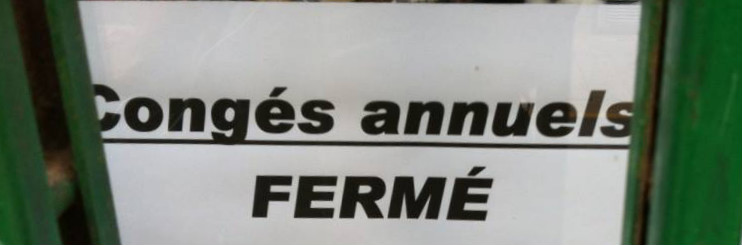
In the months of July and especially August, it is not unusual for Tracy and I to see a local French businesses closed with a sign on the door saying, “Congés Annuels -Fermé” (closed for annual leave).

This slideshow requires JavaScript.

I was recently visiting our local pet store buying dog food for Sami the MinPin and the proprietors made a point of reminding me that they would be closed for the month of August for their Congés Annuels.  So I purchased a second bag of dog food to get us through the month and wished them a bonnes vacances.

It is a norm for French people to take a month off in July or August for annual vacation with often entire businesses closing for the month.  Tracy and I are learning to plan our shopping and dining accordingly around Congés Annuels. Some French people identify themselves as “Julyists” (who take their month-long vacations in July)  and “Augustists,” (who take their vacation in August.)  Since we currently live in a tourist town where many French people visit during their holidays, some businesses and workers will take their Congés Annuels later in the year, often over the Christmas/New Years season. Coming from America, it’s a major culture shift to see these annual month-long holidays in France (and there are additional holidays throughout the year.)  The French have long cherished their vacation time with family and enjoying recreation prior to returning to their careers refreshed and rejuvenated.

France has a social culture that makes full use of holiday time, requires most businesses to be closed on Sundays, encourages turning off business cell phones after hours, and allowing office e-mails to wait for the following workday. France has a different tone toward vacation than we are used to in the US.  French people often see Americans as obsessed with work and unwilling to relax.  “Americans work 137 more hours per year than Japanese workers, 260 more hours per year than British workers, and 499 more hours per year than French workers.”

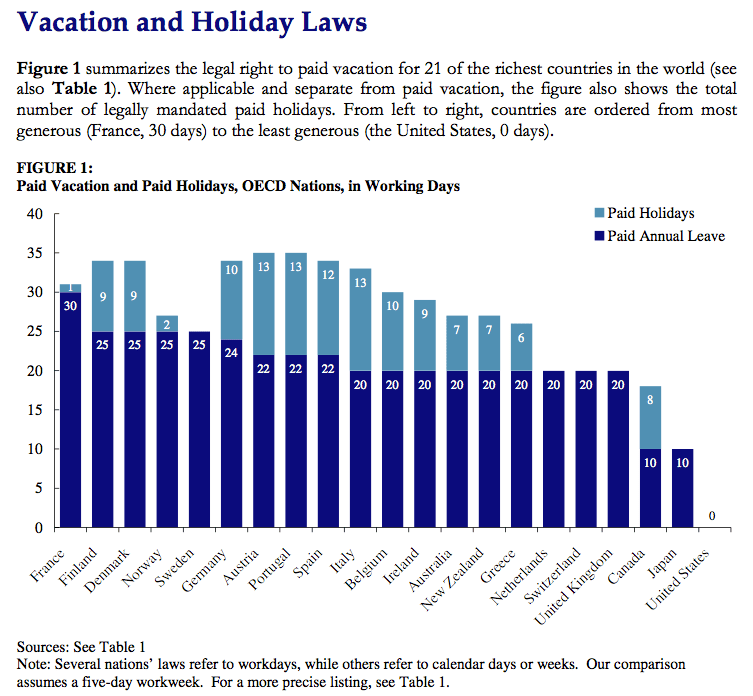
It was interesting to learn that there is no statutory requirement for paid vacation in the US.  The US  is the only advanced economy in the world that doesn’t require employers provide workers with paid vacation.  This is especially true of low-wage workers, part-time employees, and workers at small businesses.  The EU requires “at least 20 paid vacation days per year, with 25 and even 30 or more days in some countries.  Canada and Japan guarantee at least 10 days of paid vacation per year.”

Vacation laws by country CEPR http://www.cepr.net/index.php/press-releases/press-releases/us-only-advanced-economy-that-does-not-guarantee-workers-paid-vacation/
Vacation laws by country
CEPR
http://www.cepr.net/index.php/press-releases/press-releases/us-only-advanced-economy-that-does-not-guarantee-workers-paid-vacation/

Unlike 25% of American workers, I did have employer-paid vacation during my careers.  But I learned that in the US since “1976, (there has been) a huge decline in the share of workers taking vacations.  Some rough calculations show, in fact, that about 80 percent of workers once took an annual weeklong vacation — and now, just 56 percent do.”   “(In the US) 15% (of workers never) take any vacation at all.

The vacation company Expedia conducted a survey in the US and learned “that Americans are only using 10 of the 14 days they are given. That’s a whopping 577,212,000 vacation days left on the table.”  Glassdoor Survey say “61 percent (of) employees who have taken vacation/paid time off admit working at least some while on vacation. One in four (24 percent) report being contacted by a colleague about a work-related matter while taking time off, and one in five (20 percent) have been contacted by their boss.”  Tracy had a former boss (who was seriously lacking in managerial skills, but big into “letting people know where they are on the organizational chart”) who telephoned her twice about work matters during our honeymoon. (Yes, our cell phone was on in case of an emergency with one of the kids.)  Tracy was a graphic designer at the time and still jokes about the “urgent design emergencies” that necessitated interrupting our honeymoon; where she had no access to her work computer. And this was after having planned our wedding around the college’s publications schedule.

Why don’t Americans use their vacation time?  The Wall Street Journal says  “Workers pay a career penalty for vacation.” Although there are ” . .  ill effects of refusing to go on vacation, documented in research, include fatigue, poor morale, heart problems and reduced productivity,” according to Forbes magazine, people are afraid to take vacation time.   ” . . . (P)eople suffer from feeling like their employer really doesn’t want them to take time off.  In order to increase their sense of employment security, employees are trying harder every year to make themselves “indispensable.” This leads us to believe we really can’t be gone, or there will be a huge mountain of work facing us (and countless unpaid overtime hours spent digging out) when we return from a break.  Or worse, the job won’t be there when we come back.    . . . (C)all this the “work martyr complex.”  No matter how much we love family, we are martyrs to employers in order to keep that incredibly necessary, and fleeting paycheck. . . .  After 2 decades of CEOs who lead by “operational improvements,” causing round after round of cost cuts and layoffs, employees have learned that the day they take off could be the day their budget is slashed, or their job eliminated.”

While some businesses and organizations may believe they are enjoying short-term savings and productivity from unused vacation days, many other organizations are realizing the long-term costs of employee burn-out and increased attrition for their organizations.  Some US businesses and organizations are now trying to create a culture of encouraging employees to make full use of vacation time or even requiring its use.

Some workers are able to “roll over” vacation time to their advantage for planning an extended vacation or an extended maternity/paternity leave.  On retirement, Tracy had an exceptional option of having her remaining vacation days, along with her sick days, paid off at separation, an option she made full use of during our retirement planning. As faculty I had no vacation time or sick time at retirement (like many peoples’ excess annual vacation time) was “use it or lose it.”

In the mean time,  Tracy and I are enjoying the phenomenon of “Congés Annuels” in France and thinking how we would have greatly enjoyed the extra vacation time with our children when they were growing up.

No one ever said on their deathbed, ‘I wish I’d spent more time at the office.’ ” ~ Harold Kushner

No Permanent Address

I recently read a Buzzfeed humor article, 31 Important Things You Learn When You Move Across The World. The article had two lines that really struck a chord with me: “You learn that forms that ask for a “permanent address” are evil, and didn’t account for people like you” and “ Please provide a permanent address.’ *Cue Panic Attack*

There is a lot truth in those lines, with Tracy and my retirement lifestyle of selling our home, being expats living abroad, short-term renting, and changing our city of residence every year or two has made us – by some definitions – without a permanent address.

In my previous career in police work, “No Permanent Address” or “No Fixed Address” was a euphemism for a person being homeless. (Tracy and I commented about being “homeless” after selling our house and the lease running out on our apartment rental just prior to our departure to Europe. It was an unsettled feeling for us, but certainly not the same as the reality faced by real homeless people.)

Wikipedia defines ” ‘No Fixed Abode’ or ‘Without Fixed Abode’ (as) a legal term generally applied to those who do not have a fixed geographical location as their residence. This is applicable to several groups:

  • People who have a home, but which is not always in the same place:
    • Those whose occupation requires them to live permanently on boats, ships, or movable oil platforms, or to travel constantly (as showmen, for example).
    • Nomadic peoples (e.g. Indigenous Norwegian Travellers and Romanichal) and traveller groups (e.g. Irish Travellers, Scottish Gypsy and Traveller groups, New Age Travellers, Norwegian and Swedish Travellers); as well as individuals who adopt a mobile lifestyle, living in narrowboats, recreational vehicles, or the like.

While we do have friends who are full-time RV travelers in the US, almost all of them currently own a piece of real estate or physical home somewhere (even if it is currently rented to a tenant.)  Tracy are I are hardly vagabonds who are randomly camping in Roma settlements around France, but our process of moving frequently creates a necessity of updating our visa status, address, and other issues with French government agencies.  Our French visas actually classifies us as long-term “visiteurs” rather than as residents.

No longer owning a home in America and not physically living there has created a bit of a “grey area” with residency.  What is our “permanent address?”

The concept of “no permanent address” is a legitimate concern in today’s world.  In these modern times, if you want to vote, have a driver’s license, open a bank account, register a vehicle, have a credit card, or obtain health insurance, it isn’t just enough to have a U.S. passport, you need a permanent address.  In addition to American expatriates living abroad, this is a very common problem in the full-time RV community in the US. A post office box in many states is insufficient for a legal domicile. The demand for a “permanent address” has spawned companies (especially in Texas and South Dakota, Escapees RV Club being one example) who cater to full-time travelers by legally providing a permanent address.

Tracy and I, like many expats, have elected to use a family member’s address as our  permanent address in our former hometown of Reno, Nevada.  (When I was college-aged I used my parent’s address as my permanent address as I “hopscotched” between living arrangements and roommates.)  Because of Tracy and my decades-long connection to Reno and Sparks as residents, students, workers, taxpayers, homeowners, raising children and still having local family, and it being our last home, Reno serves as our official, permanent US residence.

This need for a permanent address isn’t  just an issue for RVers and expats. George H. W. Bush had a long career of public service as a congressman, ambassador to the UN, envoy to China, director of the CIA, vice president, and finally president of the US. That career frequently required that he lived in Washington D.C., New York, Virginia, Maryland, or overseas. From 1985 until his retirement in 1993 he used the Houstonian Hotel, Club & Spa in Houston, Texas as his legal domicile and official voting address (although he moved out of Houston in 1981, stayed at the Houstonian intermittently, paid rent only for days his rooms were actually occupied, and owned an actual residence in Kennebunkport, Maine.)  Former President Bush had signed an affidavit stating that he would build his retirement home in Houston and the “intent” stated in that document satisfied Texas that he was a bona fide resident of Texas (although Texas’ action did annoy some residents of Maine who, because of his home in Maine, felt former President Bush should have been considered a Maine resident and pay the Maine state income tax.)  After leaving public office former President Bush did make good on his promise and retired to Houston.

By no means do Tracy and I attempt to be “Perpetual Travelers” whose primary motive is to avoid becoming legal residents of any country with the ultimate goal of tax avoidance and evading any legal responsibilities of residency.  We contribute our fair share and fulfill our responsibilities to our countries of citizenship and occupancy.

While Tracy and I like to entertain a romantic fantasy of ourselves living a free-spirited, Bohemian, and unconventional expat life (cue images of Hemingways’s “Lost Generation” traveling from Paris to Pamplona in the 1920s or Montmartre’s diverse arts community from the movie, “Moulin Rouge!”), we are actually fairly orthodox, living within the many rules of “the system,” and we are definitely “on the grid” with a permanent address . . . but with an untraditional – and ever-changing – physical address.

Ernest Hemingway seated in 1925 with the persons depicted in the novel "The Sun Also Rises." The individuals depicted include Hemingway, Harold Loeb, Lady Duff Twysden; and Hadley Richardson, Ogden Stewart and Pat Guthrie. John F. Kennedy Presidential Library and Museum, Boston
Ernest Hemingway seated in 1925 with the persons depicted in the novel “The Sun Also Rises.” The individuals depicted include Hemingway, Harold Loeb, Lady Duff Twysden; and Hadley Richardson, Ogden Stewart and Pat Guthrie.
John F. Kennedy Presidential Library and Museum, Boston


Carcassonne with Casey and Megan: La Cité De Carcassonne, Château de Montségur, Mirepoix

“I thought to see fair Carcassonne, that lovely city—Carcassonne!” ~ Gustave Nadaud

Our return flight from Rome to Marseille via Ryanair went as smoothly as the initial flight.  However we did have some concerns since the French rail strike was still going on. But our train was one of the 60% still scheduled and running. At the “moment of truth” the train arrived and we had our assigned seats waiting for us with no overcrowding. All in all we had been extremely lucky working around the national rail strike.

This slideshow requires JavaScript.

We enjoyed the trip west along the Mediterranean coast and made it back to our current home in Carcassonne.

This slideshow requires JavaScript.

We took a day to hike to the top of Château de Montségur is a former fortress located about 80 kilometers (50 miles) southwest of Carcassonne near the Pyrénées mountains and the Spanish border. The ruins are the site of a razed stronghold of the Cathars. The fortress is referred to as one of the “Cathar castles” that gave shelter to Cathars during the Albigensian Crusades.

This slideshow requires JavaScript.

We also visited the nearby village of Mirepoix which has a substantial medieval ambience.

This slideshow requires JavaScript.

Casey and Megan were finally able to catch up on some much-needed rest in Carcassonne and enjoy the vacation part of their trip. And Casey discovered Ricard pastis as a traditional summer-time French beverage. At the end of their stay (with the rail strike finally over) Casey and Megan took the train back to Paris for a two-night stay with tickets for a day at Disneyland-Paris. Knowing he is a big fan of Mickey, it was our birthday present to him.

This slideshow requires JavaScript.

We waited until the last possible minute to warn them that there was talk of an air-traffic controller strike. Our silence paid off as at the last-minute the strike was culled down to only 10% of planes and limited to those going to other European countries. The kids made it to the airport and their British Airways flight without suffering through any more of France’s transportation worker strikes.

All in all it was a fantastic visit. We enjoyed meeting Megan and seeing Casey. We were overjoyed to finally being able to congratulate him in person for his university completion. The kids followed up their visit with a nice long Skype date so that we could meet their daughter, Izzy. The best thank you ever!


Part 1:  Paris with Casey and Megan: Notre Dame, Palace of Versaille, Eiffel Tower, Love Locks, and the Louvre

Part 2:  Marseille with Casey and Megan:  Train Strike, Chateau d’If, Vieux-Port, Phare de Sainte Marie, and Notre-Dame-de-la-Garde

Part 3:  Rome with Casey and Megan:  RyanAir, Pantheon, Colesseum, Roman Forum, and Trevi Fountain

Part 4:  Vatican City with Casey and Megan:  Vatican Museum, Sistine Chapel, Necropolis Tour, Saint Peter’s Basilica, and Saint Peter’s Square

Part 5:  Carcassonne with Casey and Megan: La Cité De Carcassonne, Château de Montségur, Mirepoix

Marseille with Casey and Megan: Train Strike, Chateau d’If, Vieux-Port, Phare de Sainte Marie, and Notre-Dame-de-la-Garde

“No, my dear Dantes. I know perfectly well that you are innocent. Why else would you be here? If you were truly guilty, there are a hundred prisons in France where they would lock you away. But Chateau d’If is where is they put the ones they’re ashamed of.” ~ Dorleac, The Count of Monte Cristo 

After arriving at Marne la Vallée-Chessy train station outside of Paris to catch our Ouigo high-speed train to Marseille we are told that a surprise rail worker strike has caused that train and two prior trains’ cancellation.  (The strike is eventually 10 days, the longest rail strike since 2008.)  Casey and Megan were getting a truly French experience of dealing with a large-scale rail strike.  We were told there was a chance of getting on high-speed TGV train still scheduled to depart in 2 1/2 hours.  IF it arrived we may be able to get on board.  IF we got inside and the doors were able to close we could go as far as the train continued to run. IF. We decided to “take the shot” at getting on that train.  In the mean time we “camped out” at the front of the line, talked, played cards, and worked on Soduku puzzles.

This slideshow requires JavaScript.

The train did arrive and we were able to squeeze into the hallway of a first-class carriage.  Other passengers were friendly with the “Life Boat” atmosphere and we stood or sat on the hallway floor for the first 2 1/2 hours of the nearly 900 kilometer trip.  About an hour out of Marseille departing passengers allowed us to finally get seats and we enjoyed the first-class luxury for the final hour of the trip, visiting with our neighbors in the cabin who were en route to the Côte d’Azur.  They were very friendly to their “refugee” seat-mates crashing first-class.  One gentleman was a French engineer who Casey had an animated discussion about their shared profession.  We would later read in the newspapers about people being stranded in rail stations for days and marvel that we were able to “pull off the impossible” and get one of the few remaining working trains to Marseille.

Marseille was completely unexpected.  I thought the city would be a gritty, slightly run-down port town.  Instead in was a clean, intriguing city that reminded me of San Francisco or Seattle. After wandering through the city I now understand why in 2013 it was awarded the title of Europe’s Capital of Culture.

This slideshow requires JavaScript.

Our literary adventure was taking the boat out to Chateau d’Id, the historic prison off the Vieux-Port (Old Port) of Marseille, to experience the setting of Dumas’ fictional “The Count of Monte Cristo” and “The man in the Iron Mask” in real life.  Reminiscent of visits to the former Alcatraz Federal Prison Museum off the coast of San Francisco.

This slideshow requires JavaScript.

Casey and Megan enjoyed taking the petit train up to Basilique de Notre Dame de la Garde located at the highest point in Marseille, about 150 meters (490 feet) above the south side of the Vieux-Port (Old Port), visiting the Musée Cantini with a collection including Picasso, Matisse, and Cézanne, and the strikingly unique Musée des Civilisations de l’Europe et de la Méditerranée [Museum of Civilisations from Europe and the Mediterranean (MuCEM).]

Notre-Dame de la Garde
Museum of European and Mediterranean Civilizations (MuCEM)

After a too-short visit and a sample of great seafood, we committing ourselves to returning in the near future and exploring more of Marseille at a future date.  We now headed by bus (the rail strike was still going on) to Aéroport de Marseille Provence (Marseille Provence Airport) to catch Ryanair for Rome.


Part 1:  Paris with Casey and Megan: Notre Dame, Palace of Versaille, Eiffel Tower, Love Locks, and the Louvre

Part 2:  Marseille with Casey and Megan:  Train Strike, Chateau d’If, Vieux-Port, Phare de Sainte Marie, and Notre-Dame-de-la-Garde

Part 3:  Rome with Casey and Megan:  RyanAir, Pantheon, Colesseum, Roman Forum, and Trevi Fountain

Part 4:  Vatican City with Casey and Megan:  Vatican Museum, Sistine Chapel, Necropolis Tour, Saint Peter’s Basilica, and Saint Peter’s Square

Part 5:  Carcassonne with Casey and Megan: La Cité De Carcassonne, Château de Montségur, Mirepoix

Paris with Casey and Megan: Notre Dame, Château de Versailles, Eiffel Tower, Love Locks, and the Louvre

“Paris is always a good idea.” ~ Audrey Hepburn

Our son Casey and his fiancée Megan became our second set of visitors to France.  The trip was to celebrate Casey’s graduation with his Chemical Engineering degree, his hiring as an engineer with the State of Nevada’s Chemical Accident Prevention Program, and his engagement to Megan.  So many important milestones to celebrate, but we were mainly looking forward to seeing Casey and meeting Megan for the first time.  Tracy had extensively pre-planned the trip in the attempt to try to visit everywhere Casey and Megan wanted to visit.  Tracy had the reservations made and confirmations organized to minimize the stress of traveling.  Tracy and I subscribed to the  “Fast and Light” school of travel with lightweight backpacks and making use of discount travel options as much as possible.

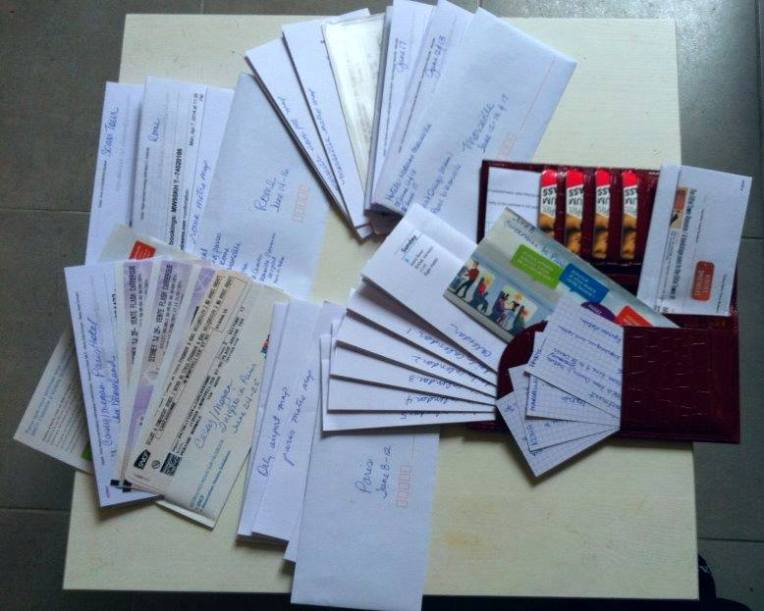
Tracy's collection of tickets, passes, reservations, and confirmations.
Tracy’s collection of tickets, passes, reservations, and confirmations.
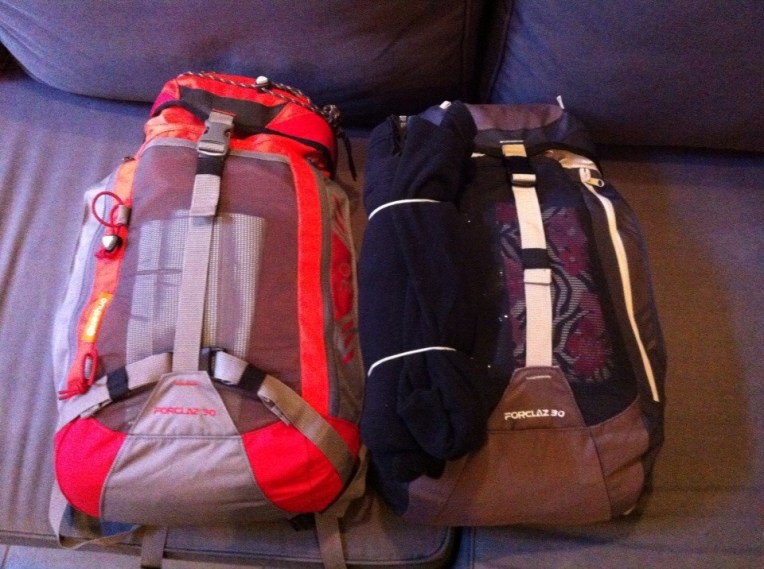
Tracy and my "Fast and Light" backpacks that are "Ryanair" size approved.
Tracy and my “Fast and Light” backpacks that are “Ryanair” size approved.

We left Carcassonne the day prior to Casey and Megan’s departure from the US to be able to meet them in Paris.  We took the SNCF train to Montpellier and transferred to the Ouigo TGV high-speed train to Paris.  We love the economy of the Ouigo where we can often get a trans-France train trip for as little as €10.

This slideshow requires JavaScript.

The Ouigo rolled into the Gare de Marne-la-Vallée – Chessy train station outside of Disneyland-Paris and caught the RER A (Réseau Express Régional) regional train into Paris proper where we used the Paris Métro system to picked up the key and settle into our apartment in the Belleville neighborhood of the 19th arrondissement.

This slideshow requires JavaScript.

The next morning Tracy and I walked about the Île de la Cité and Latin Quarter visiting the Panthéon to see the photo project that we took part in Carcassonne and hoping to spot our photos in the display used to disguise the scaffolds used to refurbish the monument. (Carcassonne – Au Panthéon Photo Project)  Then it was off to Aéroport de Paris-Orly to wait for Casey and Megan’s arrival.  It was our first time at the Orly Airport so we took the RER B line early in order to figure out international arrivals.

Aéroport de Paris-Orly

We were excited to see that Casey and Megan arrived without any problems.  We skipped the baggage claim area since they both joined us in our “Fast and Light” method of having a single backpack each for luggage and we were off to the RER for the ride to Paris talking all the way.  We headed back to the  Île de la Cité 


This slideshow requires JavaScript.

We “barnstormed” Paris trying to visit as many sites as we could squeeze in.  Megan had her first experiences with a subway with the very busy, but useful Paris Métro.  She was the only one of us not to be reversed and turned-around using the street and subway map.  We visited Notre-Dame de Paris (a must for Casey who  is a major fan of Hugo’s The Hunchback of Notre-Dame), explored the Renaissance and Egyptian sections the Louvre Museum, walked the Avenue des ChampsÉlysées from Place de la Concorde to the Arc de Triomphe de l’Étoile, Casey and Megan added a “Love Lock” to the Pont des Arts bridge, and enjoyed a chautauqua-type tour of the Eiffel Tower visiting the historic military radio room in the foundation and getting an “insider’s” view of the elevator system with a view paris from above the second level’s Restaurant le Jules Verne.  

Next venue on our itinerary:  Marseille.  A first for all of us.

Part 1:  Paris with Casey and Megan: Notre Dame, Palace of Versaille, Eiffel Tower, Love Locks, and the Louvre

Part 2:  Marseille with Casey and Megan:  Train Strike, Chateau d’If, Vieux-Port, Phare de Sainte Marie, and Notre-Dame-de-la-Garde

Part 3:  Rome with Casey and Megan:  RyanAir, Pantheon, Colesseum, Roman Forum, and Trevi Fountain

Part 4:  Vatican City with Casey and Megan:  Vatican Museum, Sistine Chapel, Necropolis Tour, Saint Peter’s Basilica, and Saint Peter’s Square

Part 5:  Carcassonne with Casey and Megan: La Cité De Carcassonne, Château de Montségur, Mirepoix


Carcassonne – Tour de France 2014

We were able to watch a part of the internationally renown Tour de France bicycle race. Leg 16 started in Carcassonne.

Tour de France Logo  (Wikimedia Commons)
Tour de France Logo
(Wikimedia Commons)

The 101th running of the Tour de France’s stage 16 raced through Carcassonne literally a half block from our apartment.  This stage was the longest of the 2014 race with 237.5 kilometers (148 miles) from Carcassonne traveling west up through the Pyrénées mountains and finishing in the village of Bagnères-de-Luchon near the Spanish border.

Tour de France 2014, Stage 16 (Reuters)
Tour de France 2014, Stage 16
(Reuters)

The Tour de France was actually two events for us.  The first was a parade of sponsor’s floats, called the Tour de France Caravan at 8:45.  Dozens of cleverly designed floats drove by throwing novelties, t-shirts, hats, and samples.

This slideshow requires JavaScript.

At 10:45 the racers (followed by their support vehicles) sprinted past as they circled the town and headed west.  We got to see the traditional yellow jersey on Italian bicyclist Vincenzo Nibali at the head of the pack of the 22 teams.  Although this was the mass start at the beginning of the race with careful riding through the narrow, twisting city streets, the entire pack of nearly 200 racers past us in less than 20 seconds.  We were cheering for US racer Tejay van Garderen who was in sixth place overall.  Thirty-four year old Australian Michael (‘Mick’) Rogers used his experience to climb the five peaks and power through the 237.5 kilometers (148 miles) to win this stage with a time of 6 hours, 7 minutes, 10 seconds.

This slideshow requires JavaScript.

After the chase cars, there were support trucks, motor coaches, and media mobile broadcast trucks.

We had a great morning experiencing in-person an event that has been exciting the world for over a hundred years.  We are also anxious to learn if Vincenzo Nibali will be the overall winner when the Tour de France’s concludes this weekend.

Tracy at the Tour de France 2014
Route of the 2014 Tour de France. (Wikimedia Commons)
Route of the 2014 Tour de France.
(Wikimedia Commons)

The Motif Of The US Flag In France

I find it interesting how often I see French people wearing clothing and or using advertising and decorating items based on the US flag’s iconic “stars and stripes.”

I’ve often wanted to take photos of French locals wearing interestingly designed US flag themed clothing.  Out of respect for their privacy (and not wanting to look like some kind of deranged stalker) I haven’t been photographing actual people. But with US Independence Day approaching, I thought I’d share a sampling of “stars and stripes” items I’ve seen in local stores.  Great Britain’s Union Jack flag designs and New York City items like New York Yankees ball caps and t-shirts are very popular too.

This slideshow requires JavaScript.

Surviving Two National Transportation Strikes – While Traveling France With Visitors.

“Life is what happens to you while you’re busy making other plans.” ~John Lennon

So after all of Tracy’s meticulous travel planning in anticipation of son Casey and his fiancée Megan’s arrival in France; after our pre-purchase of train, flight, and venue tickets; and after our pre-paying for hotel reservation, we were surprised with a sudden rail strike which turned out to be the longest since 2010.  While “industrial actions” are always a possibility in France, this one took us totally unprepared.

A high-speed train TGV Duplex from SNCF. Wikimedia Commons

Casey and Megan arrived in Paris in early June and while exploring the “City of Lights” together, Tracy and I checked the English-language online news (The Local and France 24) and learned that two of SNCF’s (the French national rail service) four unions, CGT and Sud-Rail had started what will eventually turn out to be a 10 day strike.  Most strikes in France in recent years are 24 hour “rolling strikes” with prior public notice that cause a minimum of inconvenience.   But this rail strike was called on short notice because of major rail system reform legislation scheduled in the French Parliament that week and the strike would uncharacteristically drag on day after day after day.

So when the time came for the next leg of our trip, traveling from Paris to Marseille, we took the RER commuter train from Paris to the Gare de Marne-la-Vallée – Chessy train station to catch our previously assigned seats on the Ouigo high-speed train to Marseille.  (The Ouigo in SNCF’s alternative to discount airlines with re-liveried TGV trains with cost-saving online booking and the absence of a cafe car but with very comfortable deluxe seats with fares starting at €10.)  Unfortunately, once we arrived at the train station we learned our train (along with two others of the day’s previous trains which were also headed south) had been canceled.  But, we were told by the SNCF staff that there was one southbound TGV train still scheduled in two hours. The SNCF official told us that if we managed to “get on that train and the doors are able to close” we could ride that TGV as an alternative to our canceled train. Space on the train was “first come, first serve,” for passengers without assigned seating like us.

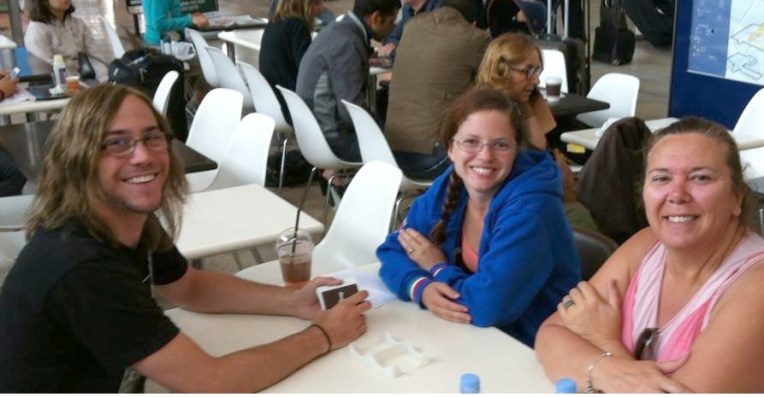
So we embraced the “lifeboat rules” of traveling during a major train strike in France.  We played cards and waited for the alternative train, keeping a close eye the electronic status board, and hoping that train didn’t get cancelled at the last-minute.  Casey and Megan became “Platinum level” participants in the “French National Sport” of surviving strikes. Both maintained absolute positive attitudes and great humor while waiting for our alternative train.  We talked and played cards to wile away the hours as we waited.  When the train arrived, we were waiting at the front of the queue with the regular passengers and a good portion of extra passengers from the three cancelled trains.  As we searched for space, the four of us ended up with many others passengers in a first class car standing in the entryway like commuters in a crowded subway car during rush hour.

Casey, Megan. and Tracy playing cards and waiting for the train.
Megan and Casey waiting.

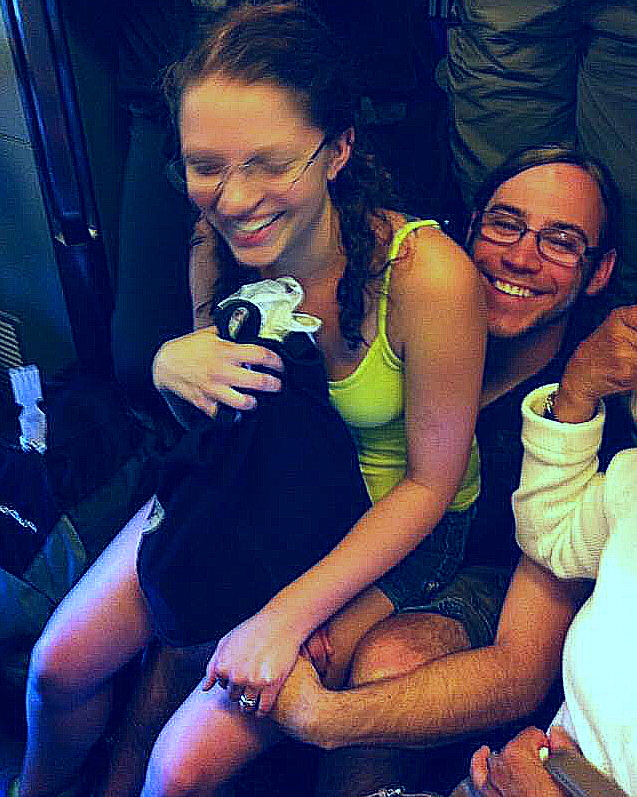
The train’s doors managed to close, it started rolling southbound, and we all sighed with relief that we made the train.  Now it was time to get comfortable (or as comfortable as possible) for the 3 hour + trip to Marseille.  Casey and Megan were kind enough to give me a spot on some steps entering a first class cabin (my old leg injury makes being stationary while standing painful.)  They both found a seat on the floor of the entryway way.  Tracy stood in the first class cabin doorway for the first two hours of the trip (and diverting air conditioning into the entryway.)  During the trip our fellow surplus passengers also found seats sitting on their bags, the floor, and one person sitting in the car’s restroom commode.  We were envious of our ticketed first-class companions in their assigned seats, but the overall mood of all the passengers was friendly and helpful.  Casey used his high school and college French to speak with a French father with his wife and two sons. Tracy helped support an older woman standing next to her in the cabin doorway.

Casey, Megan, and Tracy standing in the entryway on the train to Marseille
Megan and Casey sitting on the train floor.

About two hours into the trip at the stop at Avignon, the first-class cabin that Tracy was standing near had four seats open up as those passengers disembarked.  The four of us luxuriated in the first-class seats for the remainder of the trip to Marseille.  We had a pleasant conversation with the other foursome in the cabin, a group of slightly older Parisians on their way to their condo on Côte d’Azur (the French Riviera).  One of the Parisians was a French engineer who spoke excellent English.  He and Casey, a newly graduated engineer, discussed their shared profession.

When we arrived in the Gare Saint-Charles (Marseille) train station and we congratulated ourselves on remaining calm and successfully working around the rail strike on that leg of the trip.

Casey and Megan at the Marseille marina.

While the rail strike dragged on, day after day, we toured Marseille and then got ready for our next leg to Rome.  We made use of the shuttle bus – rather than the train – out to Aéroport de Marseille Provence (Marseille Provence Airport) and later used the same bus upon our return to Marseille from Rome.

After our return from Rome, our next leg was scheduled to be Marseille to Carcassonne by the Bordeaux-Nice Intercités train in assigned seating.  Although the train strike was still on, this train was one of the 60% of routes still running. SNCF had hired additional station workers during the strike to help confused and stranded passengers in the train stations.  All of our questions about our train were answered quickly: our train was still running and would run straight to Carcassonne with no changes or delays.

We were expecting another over-crowded train like what we previously experienced from Gare de Marne-la-Vallée – Chessy to Marseille, but we were pleasantly surprised to have a cabin to ourselves with no overcrowding at all.  We assumed that this late into the strike, local commuters were choosing to postpone or finding alternative transportation for their travel.  We enjoyed the scenery of the southern French from Gare Saint-Charles (Marseille) through Nimes, Montpellier, Sète, Béziers, Narbonne, and finally home to Carcassonne.  While Casey and Megan were staying with us in Carcassonne, the rail strike finally ended after ten days.  We were thrilled that we had “dodged the bullet” with the train strike because Casey and Megan had to eventually return to Paris by train.  The ten-day rail strike was the longest since 2010.

SNCF Departure Board
Megan and Casey on train

As the end of Casey and Megan’s visit in Carcassonne approached, we learned that we took the “all clear” on transportation strikes for granted too soon.  Two French air traffic controller unions had voted for a six-day strike with the threat of impacting air passengers with 14,000 hours of delays, hundreds of cancelled flights, and a reduction overall of 20% of the air traffic through France. The air strike was scheduled to begin the day before Casey and Megan’s departure back to the US.

Tracy and I monitored Casey and Megan’s return flight to the US on British Airways.  It looked promising with their flight appearing to be one of the non-impacted ones. But the British Airways website had the caveat that we needed to confirm the flight 24 hours prior to departure because the strike situation was volatile and flights were subject to change.  Luckily, the first air traffic controller union almost immediately settled their strike and the second air traffic controller union called off their strike the Wednesday prior to Casey and Megan’s departure on Thursday.

So in the end, Casey and Megan caught the Intercités train with assigned seating to Montpellier where they took the Ouigo TGV train to the Gare de Marne-la-Vallée – Chessy just outside Disneyland-Paris.  Casey and Megan spent a day at Disneyland-Paris before flying home to Reno, Nevada the next day from Aéroport de Paris-Charles-de-Gaulle (Paris Charles de Gaulle Airport.)

Both Casey and Megan left France with metaphorical Gold Medals that we all earned in beating the French transportation strikes of June 2014.

Megan and Casey at the Disneyland-Paris entrance.