No Permanent Address

I recently read a Buzzfeed humor article, 31 Important Things You Learn When You Move Across The World. The article had two lines that really struck a chord with me: “You learn that forms that ask for a “permanent address” are evil, and didn’t account for people like you” and “ Please provide a permanent address.’ *Cue Panic Attack*

There is a lot truth in those lines, with Tracy and my retirement lifestyle of selling our home, being expats living abroad, short-term renting, and changing our city of residence every year or two has made us – by some definitions – without a permanent address.

In my previous career in police work, “No Permanent Address” or “No Fixed Address” was a euphemism for a person being homeless. (Tracy and I commented about being “homeless” after selling our house and the lease running out on our apartment rental just prior to our departure to Europe. It was an unsettled feeling for us, but certainly not the same as the reality faced by real homeless people.)

Wikipedia defines ” ‘No Fixed Abode’ or ‘Without Fixed Abode’ (as) a legal term generally applied to those who do not have a fixed geographical location as their residence. This is applicable to several groups:

  • People who have a home, but which is not always in the same place:
    • Those whose occupation requires them to live permanently on boats, ships, or movable oil platforms, or to travel constantly (as showmen, for example).
    • Nomadic peoples (e.g. Indigenous Norwegian Travellers and Romanichal) and traveller groups (e.g. Irish Travellers, Scottish Gypsy and Traveller groups, New Age Travellers, Norwegian and Swedish Travellers); as well as individuals who adopt a mobile lifestyle, living in narrowboats, recreational vehicles, or the like.

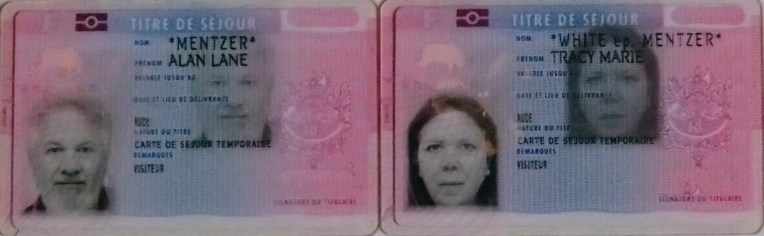
While we do have friends who are full-time RV travelers in the US, almost all of them currently own a piece of real estate or physical home somewhere (even if it is currently rented to a tenant.)  Tracy are I are hardly vagabonds who are randomly camping in Roma settlements around France, but our process of moving frequently creates a necessity of updating our visa status, address, and other issues with French government agencies.  Our French visas actually classifies us as long-term “visiteurs” rather than as residents.

No longer owning a home in America and not physically living there has created a bit of a “grey area” with residency.  What is our “permanent address?”

The concept of “no permanent address” is a legitimate concern in today’s world.  In these modern times, if you want to vote, have a driver’s license, open a bank account, register a vehicle, have a credit card, or obtain health insurance, it isn’t just enough to have a U.S. passport, you need a permanent address.  In addition to American expatriates living abroad, this is a very common problem in the full-time RV community in the US. A post office box in many states is insufficient for a legal domicile. The demand for a “permanent address” has spawned companies (especially in Texas and South Dakota, Escapees RV Club being one example) who cater to full-time travelers by legally providing a permanent address.

Tracy and I, like many expats, have elected to use a family member’s address as our  permanent address in our former hometown of Reno, Nevada.  (When I was college-aged I used my parent’s address as my permanent address as I “hopscotched” between living arrangements and roommates.)  Because of Tracy and my decades-long connection to Reno and Sparks as residents, students, workers, taxpayers, homeowners, raising children and still having local family, and it being our last home, Reno serves as our official, permanent US residence.

This need for a permanent address isn’t  just an issue for RVers and expats. George H. W. Bush had a long career of public service as a congressman, ambassador to the UN, envoy to China, director of the CIA, vice president, and finally president of the US. That career frequently required that he lived in Washington D.C., New York, Virginia, Maryland, or overseas. From 1985 until his retirement in 1993 he used the Houstonian Hotel, Club & Spa in Houston, Texas as his legal domicile and official voting address (although he moved out of Houston in 1981, stayed at the Houstonian intermittently, paid rent only for days his rooms were actually occupied, and owned an actual residence in Kennebunkport, Maine.)  Former President Bush had signed an affidavit stating that he would build his retirement home in Houston and the “intent” stated in that document satisfied Texas that he was a bona fide resident of Texas (although Texas’ action did annoy some residents of Maine who, because of his home in Maine, felt former President Bush should have been considered a Maine resident and pay the Maine state income tax.)  After leaving public office former President Bush did make good on his promise and retired to Houston.

By no means do Tracy and I attempt to be “Perpetual Travelers” whose primary motive is to avoid becoming legal residents of any country with the ultimate goal of tax avoidance and evading any legal responsibilities of residency.  We contribute our fair share and fulfill our responsibilities to our countries of citizenship and occupancy.

While Tracy and I like to entertain a romantic fantasy of ourselves living a free-spirited, Bohemian, and unconventional expat life (cue images of Hemingways’s “Lost Generation” traveling from Paris to Pamplona in the 1920s or Montmartre’s diverse arts community from the movie, “Moulin Rouge!”), we are actually fairly orthodox, living within the many rules of “the system,” and we are definitely “on the grid” with a permanent address . . . but with an untraditional – and ever-changing – physical address.

Ernest Hemingway seated in 1925 with the persons depicted in the novel "The Sun Also Rises." The individuals depicted include Hemingway, Harold Loeb, Lady Duff Twysden; and Hadley Richardson, Ogden Stewart and Pat Guthrie. John F. Kennedy Presidential Library and Museum, Boston
Ernest Hemingway seated in 1925 with the persons depicted in the novel “The Sun Also Rises.” The individuals depicted include Hemingway, Harold Loeb, Lady Duff Twysden; and Hadley Richardson, Ogden Stewart and Pat Guthrie.
John F. Kennedy Presidential Library and Museum, Boston


Rome with Casey and Megan: RyanAir, Pantheon, Colosseum, Roman Forum, and Trevi Fountain

“All roads indeed lead to Rome, but theirs also is a more mystical destination, some borne of which no traveller knows the name, some city, they all seem to hint, even more eternal.” ~ Richard Le Gallienne

Arriving at Aéroport de Marseille Provence (Marseille Provence Airport) we intend to fly Ryanair for the first time.  Tracy has seen several reality TV shows which featured Ryanair’s uncompromising rules which allows the airplane to offer its cut-rate fares.  When Casey and Megan were still in the US we had sent Ryanair’s strict carry-on baggage rules:  one carry-on bag no larger than 55 cm x 40 cm x 20 cm (21.6″ x 15.7″ x 7.8″) plus one small bag of up to 35 cm x 20 cm x 20 cm (13.7″ x 7.9″ x 7.9″). (Tracy and I purchased new backpacks specifically to meet Ryanair’s requirements.)  But even this these notoriously small bag requirements, Ryanair does not guarantee that your bag will be allowed in the cabin.  If there is no more room in the overhead bins bags are stored in the hold for free.  Oversized luggage will be charged at substantial additional fees.  The reality show Tracy watched had numerous incidents of displeased passengers with oversized bags being billed additional fees or denied boarding and some passengers missing flights due to Ryanair’s strict check-in policy.  Ryanair has a 98% on-time departure record that comes with a requirement to have passport visas verified, passing through security screening, and admission to the boarding area at least 45 minutes before departure.

We were pleasantly surprised.  Although we showed up substantially early (concerned about an overflowing airport due to the train strike) we passed through easily and were treated very professionally by the Ryanair staff.  Horror stories aside, we were pleased with traveling Ryanair and decided to make use of their discount flights in the future.

This slideshow requires JavaScript.

It was a quick flight to Ciampino–Aeroporto Internazionale (Rome Ciampino Airport) [about 12 kilometer (7.5 mi) south of Rome] we took the bus to the tram into Termini Station and a street car out to our hotel.  Tracy found a wonderful hotel in a suburb of Rome, while it was about a 30 minute ride outside central Rome, we had large comfortable rooms, a breakfast buffet, and paid “locals” prices at wonderful family trattorias in the hotel’s neighborhood.  We were treated wonderfully, paid a quarter of the cost for meals in Paris, and we kept wanting to return to try different dishes on the menu.  All that and the carafes of vino della casa (house wines) were inexpensive and delicious.

Roman Street Car
Roman Street Car

The Metropolitana di Roma (Rome subway) with only two “crossed” lines are not nearly as comprehensive as Paris, but most of the major sights are accessible off the subway.  Although Tracy and I have used the Rome bus system, we didn’t use it this trip.

We had a great time exploring the Roman Forum and the Colosseum. Although the rain would start and stop during the day, it helped to minimize the crowds.  It really is a “small world,” our friends Ron and Cyndy Coscuna just happen to be in Rome and we met them near the Fontana del Pantheon for lunch and later watched the rain fall through the oculus in the ceiling of the Pantheon.

We did get caught in a torrential downpour after leaving the Pantheon. Megan stopped at a little store to pick up a sweatshirt, Tracy and I headed next door to the bar to find refuge from the storm. When Casey and Megan joined us they found seats next to a couple from South Africa and had a nice chat while the bartender and owner tried to mix up a White Russian for Megan. With nearly four times the alcohol content, they finally succeeded. Megan stayed fairly warm afterwards. The owner didn’t quite believe that Megan was old enough to have the drink. Tracy reassured him that she was indeed old enough to order alcohol and though still a bit doubtful, he delivered her drink to the table. He did, however, need reassurance an additional six times. Yes, she really does look that young!


This slideshow requires JavaScript.

Casey and Megan stopped to throw coins in the Trevi Fountain to observe the tradition that throwing coins with ensure you will return to Rome.  Unfortunately the fountain was largely covered with scaffolding for refurbishing.  But that gave Casey and Megan another reason to return to Rome in the future, to see the fountain flowing in it’s full glory.

After exploring Roma, it was time to visit the smallest country in the world, Vatican City.


Part 1:  Paris with Casey and Megan: Notre Dame, Palace of Versaille, Eiffel Tower, Love Locks, and the Louvre

Part 2:  Marseille with Casey and Megan:  Train Strike, Chateau d’If, Vieux-Port, Phare de Sainte Marie, and Notre-Dame-de-la-Garde

Part 3:  Rome with Casey and Megan:  RyanAir, Pantheon, Colesseum, Roman Forum, and Trevi Fountain

Part 4:  Vatican City with Casey and Megan:  Vatican Museum, Sistine Chapel, Necropolis Tour, Saint Peter’s Basilica, and Saint Peter’s Square

Part 5:  Carcassonne with Casey and Megan: La Cité De Carcassonne, Château de Montségur, Mirepoix


Surviving Two National Transportation Strikes – While Traveling France With Visitors.

“Life is what happens to you while you’re busy making other plans.” ~John Lennon

So after all of Tracy’s meticulous travel planning in anticipation of son Casey and his fiancée Megan’s arrival in France; after our pre-purchase of train, flight, and venue tickets; and after our pre-paying for hotel reservation, we were surprised with a sudden rail strike which turned out to be the longest since 2010.  While “industrial actions” are always a possibility in France, this one took us totally unprepared.

A high-speed train TGV Duplex from SNCF. Wikimedia Commons

Casey and Megan arrived in Paris in early June and while exploring the “City of Lights” together, Tracy and I checked the English-language online news (The Local and France 24) and learned that two of SNCF’s (the French national rail service) four unions, CGT and Sud-Rail had started what will eventually turn out to be a 10 day strike.  Most strikes in France in recent years are 24 hour “rolling strikes” with prior public notice that cause a minimum of inconvenience.   But this rail strike was called on short notice because of major rail system reform legislation scheduled in the French Parliament that week and the strike would uncharacteristically drag on day after day after day.

So when the time came for the next leg of our trip, traveling from Paris to Marseille, we took the RER commuter train from Paris to the Gare de Marne-la-Vallée – Chessy train station to catch our previously assigned seats on the Ouigo high-speed train to Marseille.  (The Ouigo in SNCF’s alternative to discount airlines with re-liveried TGV trains with cost-saving online booking and the absence of a cafe car but with very comfortable deluxe seats with fares starting at €10.)  Unfortunately, once we arrived at the train station we learned our train (along with two others of the day’s previous trains which were also headed south) had been canceled.  But, we were told by the SNCF staff that there was one southbound TGV train still scheduled in two hours. The SNCF official told us that if we managed to “get on that train and the doors are able to close” we could ride that TGV as an alternative to our canceled train. Space on the train was “first come, first serve,” for passengers without assigned seating like us.

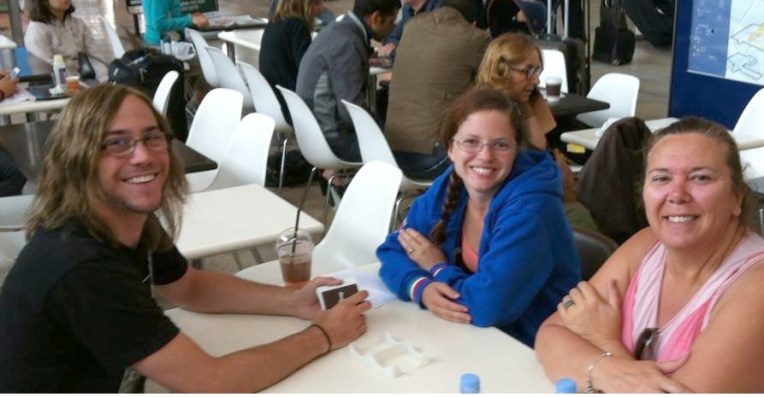
So we embraced the “lifeboat rules” of traveling during a major train strike in France.  We played cards and waited for the alternative train, keeping a close eye the electronic status board, and hoping that train didn’t get cancelled at the last-minute.  Casey and Megan became “Platinum level” participants in the “French National Sport” of surviving strikes. Both maintained absolute positive attitudes and great humor while waiting for our alternative train.  We talked and played cards to wile away the hours as we waited.  When the train arrived, we were waiting at the front of the queue with the regular passengers and a good portion of extra passengers from the three cancelled trains.  As we searched for space, the four of us ended up with many others passengers in a first class car standing in the entryway like commuters in a crowded subway car during rush hour.

Casey, Megan. and Tracy playing cards and waiting for the train.
Megan and Casey waiting.

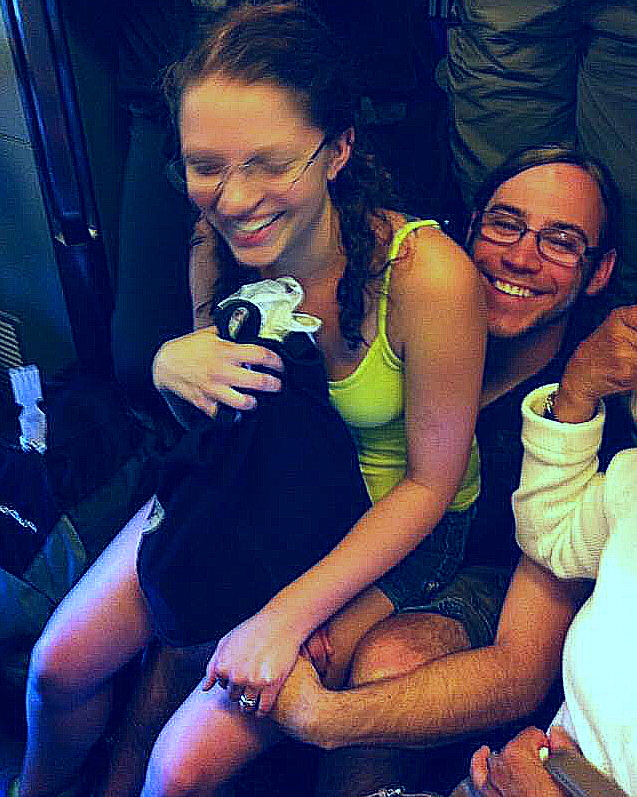
The train’s doors managed to close, it started rolling southbound, and we all sighed with relief that we made the train.  Now it was time to get comfortable (or as comfortable as possible) for the 3 hour + trip to Marseille.  Casey and Megan were kind enough to give me a spot on some steps entering a first class cabin (my old leg injury makes being stationary while standing painful.)  They both found a seat on the floor of the entryway way.  Tracy stood in the first class cabin doorway for the first two hours of the trip (and diverting air conditioning into the entryway.)  During the trip our fellow surplus passengers also found seats sitting on their bags, the floor, and one person sitting in the car’s restroom commode.  We were envious of our ticketed first-class companions in their assigned seats, but the overall mood of all the passengers was friendly and helpful.  Casey used his high school and college French to speak with a French father with his wife and two sons. Tracy helped support an older woman standing next to her in the cabin doorway.

Casey, Megan, and Tracy standing in the entryway on the train to Marseille
Megan and Casey sitting on the train floor.

About two hours into the trip at the stop at Avignon, the first-class cabin that Tracy was standing near had four seats open up as those passengers disembarked.  The four of us luxuriated in the first-class seats for the remainder of the trip to Marseille.  We had a pleasant conversation with the other foursome in the cabin, a group of slightly older Parisians on their way to their condo on Côte d’Azur (the French Riviera).  One of the Parisians was a French engineer who spoke excellent English.  He and Casey, a newly graduated engineer, discussed their shared profession.

When we arrived in the Gare Saint-Charles (Marseille) train station and we congratulated ourselves on remaining calm and successfully working around the rail strike on that leg of the trip.

Casey and Megan at the Marseille marina.

While the rail strike dragged on, day after day, we toured Marseille and then got ready for our next leg to Rome.  We made use of the shuttle bus – rather than the train – out to Aéroport de Marseille Provence (Marseille Provence Airport) and later used the same bus upon our return to Marseille from Rome.

After our return from Rome, our next leg was scheduled to be Marseille to Carcassonne by the Bordeaux-Nice Intercités train in assigned seating.  Although the train strike was still on, this train was one of the 60% of routes still running. SNCF had hired additional station workers during the strike to help confused and stranded passengers in the train stations.  All of our questions about our train were answered quickly: our train was still running and would run straight to Carcassonne with no changes or delays.

We were expecting another over-crowded train like what we previously experienced from Gare de Marne-la-Vallée – Chessy to Marseille, but we were pleasantly surprised to have a cabin to ourselves with no overcrowding at all.  We assumed that this late into the strike, local commuters were choosing to postpone or finding alternative transportation for their travel.  We enjoyed the scenery of the southern French from Gare Saint-Charles (Marseille) through Nimes, Montpellier, Sète, Béziers, Narbonne, and finally home to Carcassonne.  While Casey and Megan were staying with us in Carcassonne, the rail strike finally ended after ten days.  We were thrilled that we had “dodged the bullet” with the train strike because Casey and Megan had to eventually return to Paris by train.  The ten-day rail strike was the longest since 2010.

SNCF Departure Board
Megan and Casey on train

As the end of Casey and Megan’s visit in Carcassonne approached, we learned that we took the “all clear” on transportation strikes for granted too soon.  Two French air traffic controller unions had voted for a six-day strike with the threat of impacting air passengers with 14,000 hours of delays, hundreds of cancelled flights, and a reduction overall of 20% of the air traffic through France. The air strike was scheduled to begin the day before Casey and Megan’s departure back to the US.

Tracy and I monitored Casey and Megan’s return flight to the US on British Airways.  It looked promising with their flight appearing to be one of the non-impacted ones. But the British Airways website had the caveat that we needed to confirm the flight 24 hours prior to departure because the strike situation was volatile and flights were subject to change.  Luckily, the first air traffic controller union almost immediately settled their strike and the second air traffic controller union called off their strike the Wednesday prior to Casey and Megan’s departure on Thursday.

So in the end, Casey and Megan caught the Intercités train with assigned seating to Montpellier where they took the Ouigo TGV train to the Gare de Marne-la-Vallée – Chessy just outside Disneyland-Paris.  Casey and Megan spent a day at Disneyland-Paris before flying home to Reno, Nevada the next day from Aéroport de Paris-Charles-de-Gaulle (Paris Charles de Gaulle Airport.)

Both Casey and Megan left France with metaphorical Gold Medals that we all earned in beating the French transportation strikes of June 2014.

Megan and Casey at the Disneyland-Paris entrance.


Writing A Check In France

Although we’ve had a French checking account for about a year, we’ve been exclusively using the account’s credit/debit card, the Carte Bleue, for in-person and online shopping. We have never bothered to obtain an actual checkbook from our bank in France.  We very seldom used checks in the US because of the prevalence of online payments.

But, we recently had a need for a chèque issued on a French bank, so I set about acquiring a French checkbook called a Chéquier or a Carnet de chèques. I went online to BNP Paribas, our French bank, and searched for the link to order a Carnet de chèques.  Of course, the website is in French and after stumbling around web pages for a good while using with my limited French language skills, I decided I needed some help locating the correct link.  

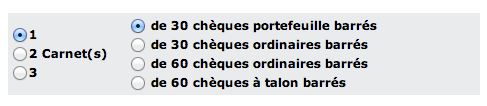
I “clicked in” to the BNP website’s “chat” function to “speak” with a bank representative who was extremely helpful.  Totally embracing technology, I had one computer window open to the BNP website, a second window open to chat with the bank representative, and a third window opened to Google Translate to expedite the conversation with the French speaking bank rep.   I worked through the  online conversation and finally located the right web page to order chèques.  However after reaching the correct webpage, I was offered the somewhat confusing options of:

Cheques Options
Cheques Options

While I understood the options of  ordering 1, 2, or 3 carnets (books) of chèques with either 30 or 60 chèques each, I had to do some additional online research to figure out exactly what the differences were between chèques portefeuille barréschèques ordinaires barrés, and chèques à talon barrés.  After visiting several online Expat forums I learned that: 

Chèque portefeuille: has checks that are attached and tear away from the top like the majority of US checkbooks.
Chèque ordinaire:  has checks that are attached to the left side like a book and tear away from the left side.
Chèque à talon:  checks that are attached and tear away from the top, but with a”stub”(à souche) that gets left in the checkbook with a space for a personal memo.

Now understanding the options better, I selected the chèques portefeuille barrés (the choice most similar to what we have for our US checkbook) and “clicked” to have the Carnet de chèques mailed to us rather than the option of having the checkbook sent to our local bank branch for pick-up.

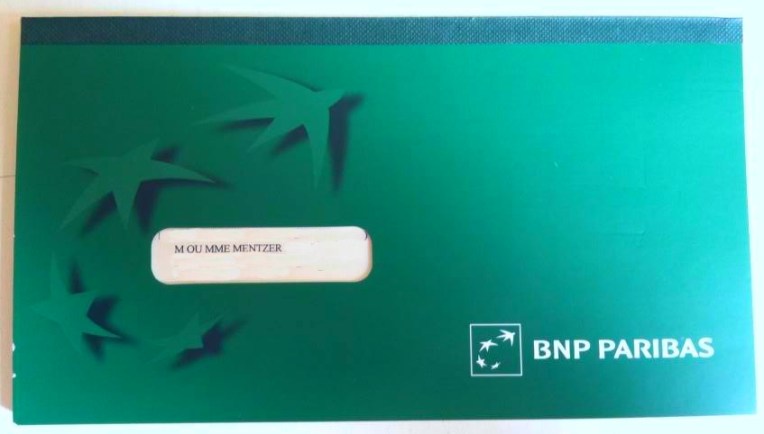
Carnet de chèques
Carnet de chèques

A week later, the Carnet de chèques arrived in the mail.  First thing I saw was that French chèques are noticeably larger than US checks.

Size Comparison: An US Check On Top Of A French Chèque
Size Comparison: A US Check On Top Of A French Chèque

Also different from the US was a receipt included which had to be signed and returned to the bank acknowledging that the checkbook had arrived, there are no missing checks, and that the checks are printed correctly.  Apparently the checks are not valid until the return receipt has been received at the bank.

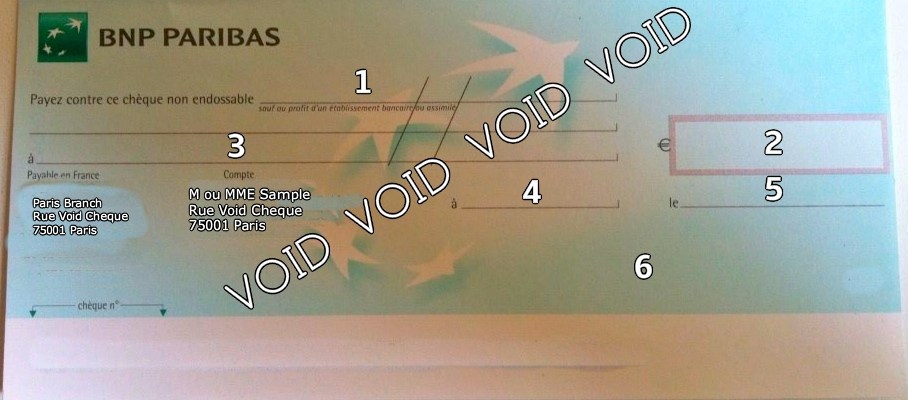
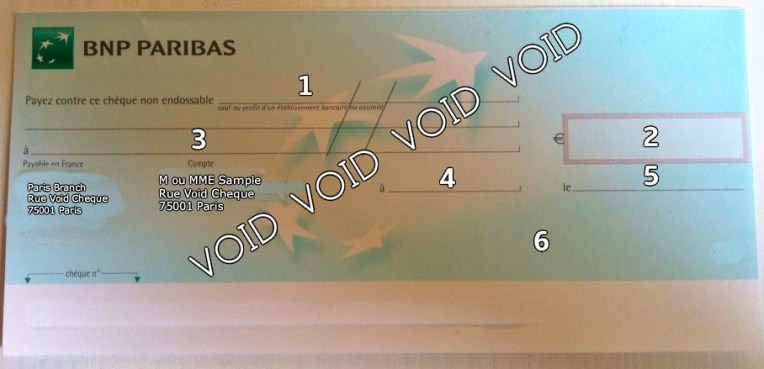
There is a very specific formula to writing French checks.  While US checks and French chèques look similar, there are several differences in their formats.  The most obvious difference that a chèque written on a French bank is required to be written in French.

Sample French Chèque

Line 1.Payez contre cheque,” “Payez contre ce chèque‘,” or “Payez contre cheque non endossable.”  The top line on US checks is where the payee’s name usually goes, so it’s important to know that Payez contre cheque means “Pay against this cheque (this amount)” not “Pay to the order of” like is found on an US check.  On the top line of the chèque you spell out the amount to be paid using French words.  For example €87,50 needs to be spelled out as “Quatre-vingt-sept Euros et cinquante centimes” or “Quatre-vingt-sept Euros et 50/100 c.”  I still struggle with understanding French numbers, but there are many “How to write a check in France” websites with “Numbers to French Words Converters” that look very helpful.

Line 2. “” On this line the amount for the check is written in numbers.  Remember that in France the comma (virgule) and the period (point) are used in writing amounts are reversed from the way the comma and the period are used in the US. For example: Two thousand eighty-seven Euros and 50 centimes is correctly written as €2.087,50 and not as €2,087.50.

Line 3. “A” This is the payee space that you write in the name of the person, company, or organization to whom the amount is being paid.  A chèque for Mr. Dubois is written as M Dubois (for Monsieur Dubois),  Mrs. Dubois as Mme Dubois (for Madam Dubois), or Miss Dubois as Mlle Dubois (for Mademoiselle Dubois.)

Line 4. “Fait à” or “A“.  A departure from how checks are written in the US, on this line you write the name of the city of where the chèque is being written, for example “Fait à Carcassonne” or “a Paris.”

Line 5. “Le”  This is the date line where today’s date is written.  Remember that the European standard for writing a date is “day-month-year” (like the US military standard of writing dates.)  A chèque written on Christmas day would be correctly written as 25-12-2014, not as 12-25-2014.  Christmas day could also be correctly written as 25 décembre 2014.  (The French do not capitalize the first letter of a month.)

janvier = January
février = February
mars = March
avril = April
mai = May
juin = June
juillet = July
août = August
septembre = September
octobre = October
novembre = November
décembre = December

Line 6. Beneath lines 4 and 5 reading “Fait à Carcassonne le 25-12-2014″ is the space for a signature.  There is often no actual “line” provided on French chèques for a signature like is usually found on US checks.

So now, with a Carnet de chèques in hand and understanding the format for writing a French chèque, we are finally ready to write that check.


Absentee/Overseas Voting From France

Tracy and I believe that it is essential to participate in the privilege and right of voting in the US.

One major issue we have read in the many expat forums is Americans who say that they have had difficulties voting while living abroad. But so far our voting experience has been very positive.  I wonder with the ease we have navigated the process if some of those voting complaints are from the distance past or because of a person living overseas misunderstanding of the process to obtain a ballot.

Since 1986 there has been the “Uniformed and Overseas Citizens Absentee Voting Act (UOCAVA)” that requires that all overseas citizens be allowed to register and vote in federal elections. For Nevada, the Secretary of State web site explains the absentee/overseas process on its “Military/ Overseas Voting” page.  The web page also supplies links to individual Nevada counties’ Registrars of Voters and to the Federal Voting Assistance Program that assists both military and civilian overseas voters.

Our Washoe County Registrar of Voter’s web site is also very helpful with a form request page that carefully explains the absentee/overseas process:

“ABSENT BALLOT REQUEST

An absent ballot request form can be filled out and processed at the beginning of each election year.  Your absent ballot request is only valid for the calendar year in which we receive it.  It is important that you specify which election(s) you are requesting a ballot for.

THE DEADLINE TO SUBMIT A REQUEST FOR AN ABSENT BALLOT IS THE TUESDAY PRIOR TO ANY ELECTION, AT 5 PM.  WE STRONGLY URGE YOU TO SEND IN YOUR REQUEST AS SOON AS POSSIBLE.  REMEMBER, YOUR VOTED BALLOT MUST BE IN OUR OFFICE BY 7 PM ON ELECTION DAY IN ORDER TO BE COUNTED.

BALLOTS WILL BE MAILED TO OVERSEAS AND MILITARY VOTERS 45 DAYS PRIOR TO ANY ELECTION. BALLOTS WITH OUT-OF-STATE MAILING ADDRESSES WILL BE MAILED 40 DAYS PRIOR TO ANY ELECTION AND BALLOTS WITH IN-STATE ADDRESSES WILL BE MAILED AT THE 30-DAY MARK.
 IT IS IMPORTANT THAT YOU PLAN ACCORDINGLY. 

You can print, fill out and mail or fax the Absent Ballot Request form below to us.  (Remember, your signature is required.)  If you find that the address you have listed for the Primary Election will not be valid for the General Election, please submit an updated request.  We cannot accept changes by phone.  Please call us if you have any questions.  (775) 328-3670″

We downloaded a “Absent Ballot Request Form” for each of us, completed the form, attached copies of our Nevada driver licenses, and mailed the form to the Washoe County Registrar of Voters.  The form gave us the option to request an absentee ballot for a specific election or for every election during the calendar year (which was our choice.)

Washoe County Absent Ballot Request

There is obviously some personal responsibility and pre-planning of deadlines required by an American living overseas to be able to vote. It is not an automatic process. A new request needs to be submitted every year.

Our absentee/overseas ballots for the primary election arrived in France on May 5 for the primary election scheduled June 10.

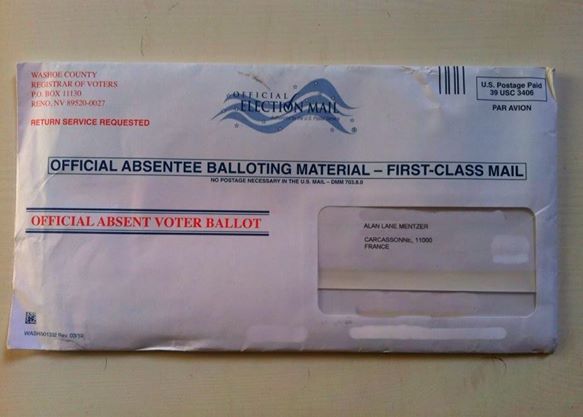
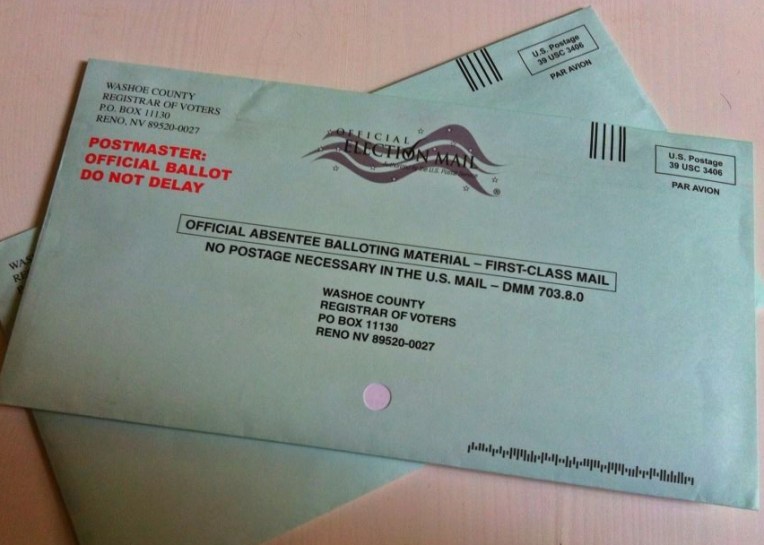
Absentee Ballot Envelop
Absentee Ballot Envelope

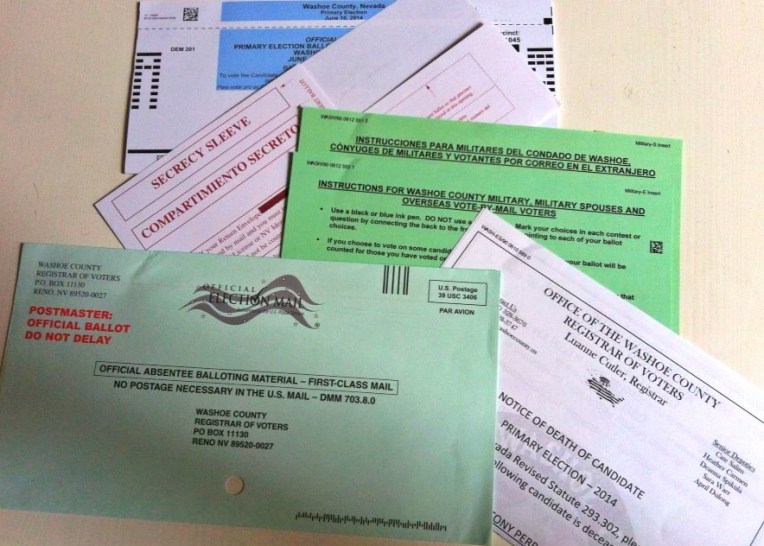
Inside the envelope is the primary ballot for my political party, “Instructions For Washoe County Military, Military Spouses And Overseas Vote-By-Mail Voters” in both English and Spanish, a notice that a candidate for office has died but remains on the previously printed ballot (also in English and Spanish), a “Secrecy Sleeve” to protect privacy, and a special return envelope.

Absentee Ballot Materials

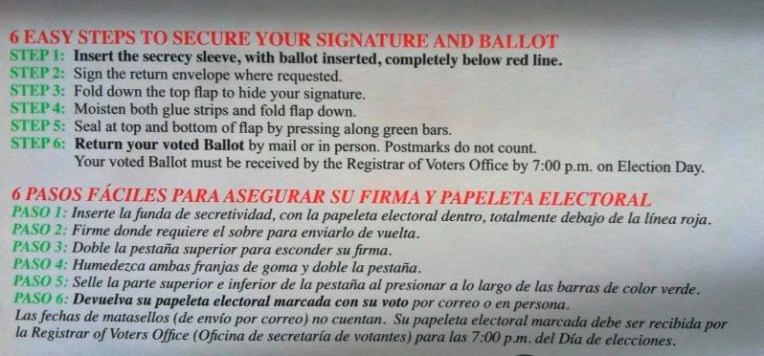
After marking our selections of candidates on the ballot (in black or blue ink only, to be read by an electronic scanner), there is an elaborate six-step process to protect our privacy while ensuring the integrity of the absentee voting process.

Ballot Mailing Directions

Once our Byzantine directions for signing and sealing the envelopes are accomplished, all that is left is a quick trip to la Poste (the post office) to add an €1,78 international stamp to each envelope (about $4.90 total) and give the ballots plenty of time to make it back to Reno by 7 p.m. June 10.

We also have the ability to confirm our ballots arrived at the Washoe County Registrar of Voters by visiting myvoterfile at the Nevada Secretary of State’s web site.

Our patriotic duty to vote is done until the general election on November 4.

Ballot Envelopes
Ballot Envelopes
 

Filing Our First Déclaration des Revenus (French Taxes)

Every May full-time residents of France are required to file la Déclaration des Revenus (Declaration of Earnings), the annual tax declaration equivalent to filing your 1040 tax form in the US.  Since France is our principal residence and we have lived here longer than a year, we are required to file a Déclaration des Revenus for the first time since moving to France.

So, how did we — with our rudimentary skills in speaking French — figure out how to file our Déclaration des Revenus?

In this case the Internet, Google Translate, expat discussion forums, and numerous professional websites were all major tools.  I’m often thankful that we have so much information available from the Internet. Neither of us can imagine the struggle of expats living abroad before such tools were readily available.  One key source for collecting information was the online English language newspaper, “The Local, France’s News in English” that reminded readers in April that a Déclaration des Revenus would be due in May.  The article listed the forms required, had advice from an expat tax expert, and listed links to La Direction Générale des Finances Publiquesthe French version of the US Treasury’s Internal Revenue Service.  The Finances Publiques’ web site allows you to download forms and even file your Déclaration des Revenus online.  (There are also expat tax preparation services in France, but ours was pretty straight forward.)

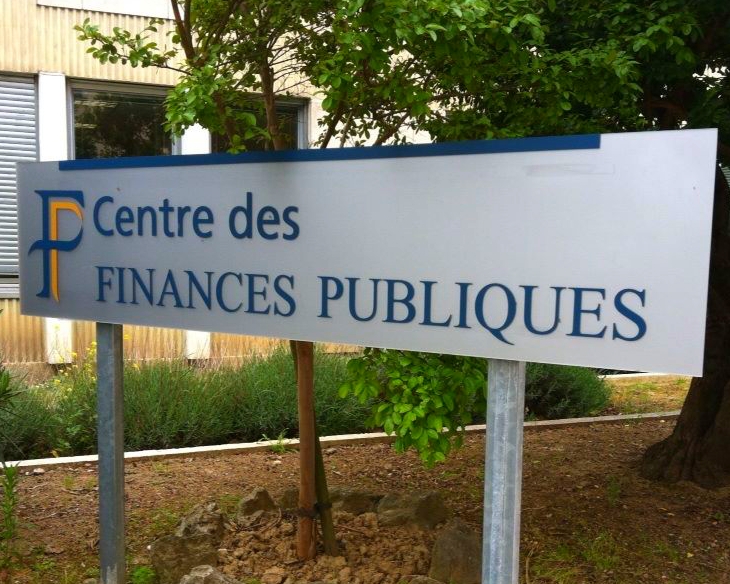
Center of Finances Publiques

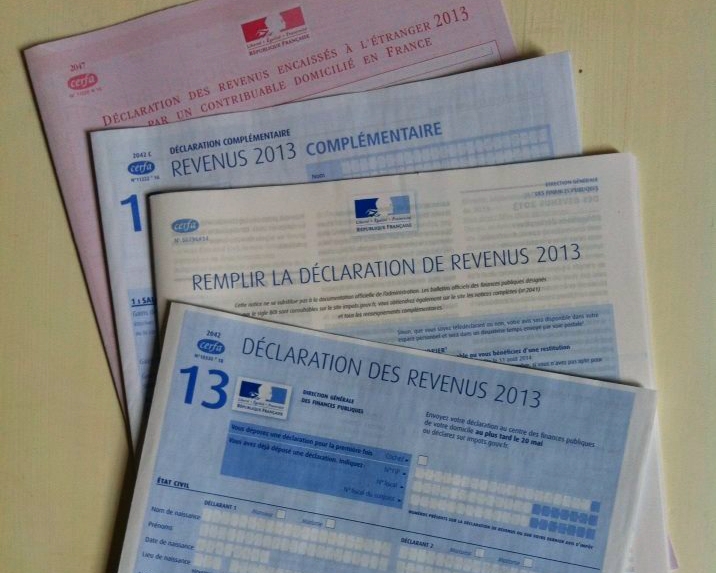
Due to my lack of confidence with online filing the Déclaration des Revenus in French, I elected to visit the local Centre de Finances Publiques (tax office) to pick up the needed forms.  Between my “shopping list” of forms, my very basic French, the helpful Finances Publiques’ representative’s basic English, I managed to pick-up the required forms.  Like our US Tax Return, the Déclaration des Revenus consists of several forms.  For us, we needed:

Formulaire 2042
The main tax form (like the US tax form 1040) listing our name, address, and global income.

Formulaire 2047
This form is for listing any income earned outside of France.  Our pensions are considered foreign income that must be declared on this form, as well as the total noted on the Formulaire 2042.

Formulaire 3916
On this form we list all bank accounts that are located outside of France.

Declaration  des Revenus Forms and Directions
Declaration des Revenus Forms and Directions

Filling out these three forms was actually simpler than completing many of my past US Tax Returns; but, of course, these forms and directions are written in French and I had to struggle with the language barrier.  Yes, French tax forms share with US tax forms the ability to create stress and give the preparer a total feeling of confusion and inadequacy.

Using an English-French dictionary, Google Translate, and a tax help guide from “The Connexion:  France’s English-Language Newspaper” written for British expats, it took about two days to (hopefully) correctly complete the documents.  Tracy double-checked the translations, Dollar-to-Euro conversions, directions, math, documents, and finally concurred that we had now had all the forms ready to submit.

The next big question was:  to whom or where do we submit Déclaration des Revenus?  Unlike US tax forms, there was no mailing address on any on the forms, nor directions for how to file.  So we gathered up all the completed forms and visited the local tax office again.  Tracy spotted a large mail box outside the office door with a sign marked for Déclaration des Revenus.  But first I visited with the Finances Publiques’ representative again and asked her to double-check that our Déclaration was complete.  (Thankfully the representative spoke some English, which was extremely helpful to me.) She asked me to include a copy of our 2013 rental contract with our Déclaration des Revenus and then the package would be complete.

We had a quick round trip back to the apartment, made a copy of our lease, and returned to speak with the same Finances Publiques’ representative for one last final review. The representative believed the package was complete now and officially accepted the Déclaration des Revenus. Yet another milestone first with living in France.

So what happens next?

Unlike the US, no payment is ever sent with the Déclaration des Revenus.  The Finances Publiques reviews the financial situation on the forms and later sends an Avis d’Imposition (a tax bill) or an Avis de Non-imposition (certificate of non-taxable income) usually around mid to late August for the amount of taxes due. Since it is our first filing, we are told that we could receive a response from the Finances Publique as late as November or December 

Now for the complexity.  The United States is one of the few countries that taxes on the basis of citizenship rather than residence.  The United States requires that US citizens file a yearly tax return with the US Internal Revenue Service as long as their income (earned in the US or earned abroad) is over $9,000. Americans working abroad are generally exempt from paying tax on their first $97,600 in foreign earned income, but they are still required to file a return. 

Tracy and I do not earn income in France and we previously filed our US tax return in April.  

To avoid double taxation for citizens living abroad, there is a tax treaty between the US and France, the “Convention Between the Government of the United States of America and the Government of the French Republic for the Avoidance of Double Taxation and the Prevention of Fiscal Evasion with Respect to Taxes on Income and Capital (1994).”  The biggest issue for us addressed in the treaty is that pensions from a US source is taxed only by the United States and not by France.  So, in theory, we are only required to pay our US taxes, however, in actually application we may still receive a tax bill.  

This is our first time filing a Déclaration des Revenus with Franceso we are interested to see exactly how this will work out for us.  Every expat’s tax situation is unique unto itself.  So we may have no French Impôts sur le Revenu (income tax) liability, a small French income tax bill (for non-pension interest or dividends), or no income tax liability but a bill for social service fees (if you call it a “fee” it doesn’t fall under the “tax” exemption.)

We will tell you about the outcome sometime between August and November when we hear from La Direction Générale des Finances Publiques.  Keep your fingers crossed that we only get a Avis de Non-imposition (certificate of non-taxable income).


Cartes de Séjour Arrived To Help Celebrate Our First Year In France

Following the Prefect Office’s instructions that we received after we submitted our applications to renew our Titres de Séjour (residency permits) [First Renewal of Our Residency Permit (Titre de Séjour)], we e-mailed the prefecture after 30 days to inquire whether our application has been approved and Cartes de Séjour (residency cards) issued.

So after an anxious 30 days (we expected the approval to be pro forma with the initial request in the US for a long-term visa being the most challenging, but it’s never good to make such a broad assumption of an automatic approval when immigration law and bureaucracy are involved) I translated an inquiry into French and e-mailed the Préfecture de l’Aude here in Carcassonne.  I immediately received an auto-response advising me that the message was received by the Prefecture and to expect an answer within 5 working days.  I put my “Type A” personality back in retirement mode and told myself, five more days to wait was not unreasonable.

However, I received back within two hours an e-mail response from an actual person telling me our request was in the hands of a real person and requested our 10 digit identification number from our Récépissés de Demande de Carte de Séjour (receipts of application for residency permit.)  I referred to our  Récépissés, located the ID numbers in the upper right corners where the e-mail said the numbers would be found, and e-mailed the information back to the Prefecture.

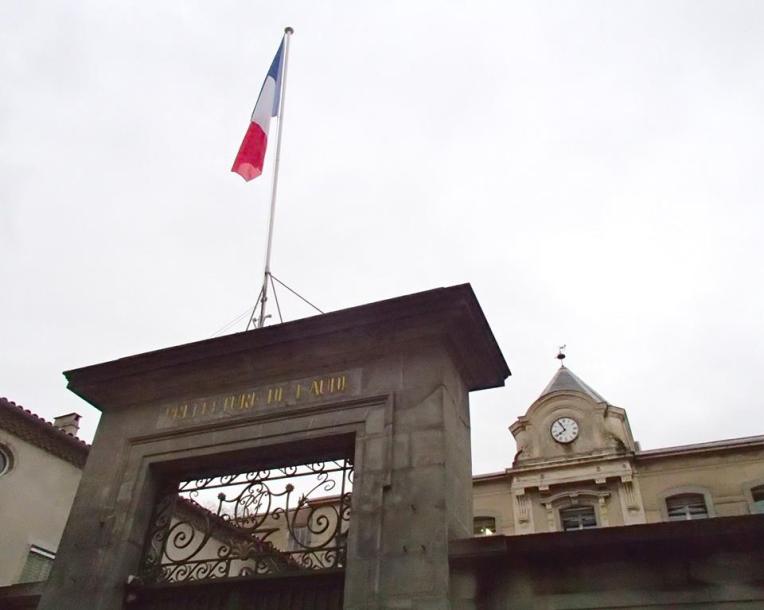
La Préfecture de l'Aude à Carcassonne
La Préfecture de l’Aude à Carcassonne

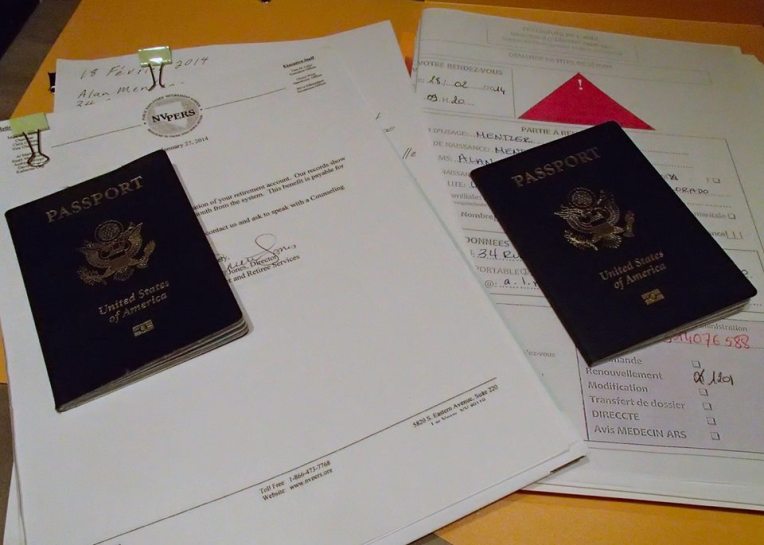
The following morning before 9:30 a.m. there was an e-mail from the Prefecture telling me that our application is approved, our new Cartes de Séjour are at the Prefecture, and to come and pick the cards up April 1. We were asked to bring with us our Récépissés de Demande de Carte de Séjour and current Titres de Séjour (residency permits) which are “sticker” documents affixed inside our US passports.

So April 1, Tracy and I were up early to be at the Prefecture at 9 a.m. when the doors open to the residency permit office. After a little bit confusion and language difficulties at the reception area we received a yellow “Post-It” note with the number “4” written on it and sent to the waiting area outside the residency permit office.  This was unusual because on previous visits at the prefecture, like at the DMV back in the States, we received a printed number tab to match the electronic number display next to the office door.  After waiting a couple of minutes the electronic display turned on and showed “500.”  That didn’t look right.  Having a number “4” in our hands we decided we misunderstood something in the French.  After checking back at the reception desk, the receptionist took us into the Estranger Passeport (foreign passport) office and created an informal line with us and other visitors also holding “Post-It” note numbers. We quickly moved up in the line short line and met with the friendly Prefect representative who accepted our Récépissés de Demande de Carte de Séjour and passports. The representative very efficiently had us sign a form accepting our new Cartes de Séjour and handed us our cards and a receipt for our records. We were in and out of the Prefecture in 20 minutes.

Cartes de Séjour
Cartes de Séjour

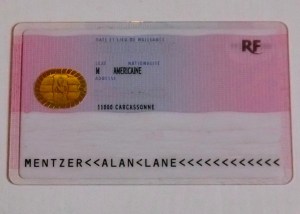
The Carte de Séjour is rather “High-Tech” with security features like a microchip with biometric information, a “watermark photo” that matches the subject’s photo, hologram, shifting colors, micro-printing, République Française watermarks on the laminate, the subject’s signature, and check digits.  It’s a very professional looking document, although a rather unattractive pastel pink and blue in color.  The card lists our French ID number, expiration date, nationality, place and date of birth, gender, and current address in France.

Reverse of Carte de Séjour

So we are starting our second year in France feeling fairly accomplished with successfully navigating French bureaucracy and obtaining our Cartes de Séjour without any snags. For our renewal next year we are planning the same strategy of starting early and being well prepared with all the documents required.


First Renewal of Our Residency Permit (Titre de Séjour)

Tracy and I are fast approaching our first anniversary of living in France.  This anniversary requires that we renew our Residency Permit, our Titre de Séjour.  Although the French government has been considering creating long-stay visa with a 4 year expiration date, those have not been approved yet.  So for at least the first five years of residency, a Titre de Séjour must be renewed annually. (France Mulls Longer Visas for Expats.)

Titre de Sejour
Titre de Sejour

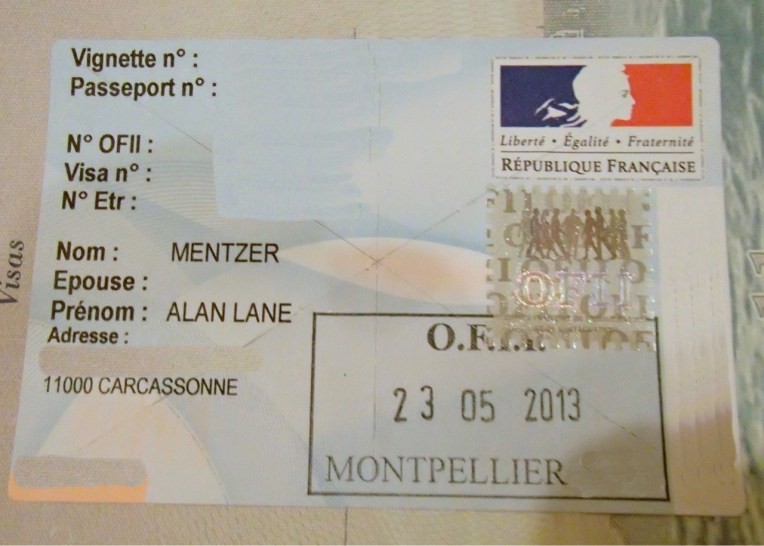
When we first arrived in France, we needed to immediately make appointments with the Immigration Office, OFII (L’Office Français de l’Immigration et de l’Intégration, in Montpellier for a review of our paperwork and a medical check up. (See our previous blog post OFII Medical and Titre de Sejour.)  But our renewal needs to be submitted to the local Prefect Office having jurisdiction over the district in which we live rather than at the OFII .  A Prefect Office is the representative of the French national government and Ministry of the Interior at the local level.  Visiting the Prefect Office is like visiting a local “Federal Building” in the US.  There are 101 districts in France, each with its own Prefecture.   Since the city of Carcassonne resides within the District of Aude, our Prefect Office is the Préfecture de l’Aude.   No train ride is required to another city like when we had to visit OFII in Montpellier.  Conveniently  for us, the Préfecture is located walking distance from our apartment at 52 Rue Jean Bringer in the historical Bastide of Carcassonne.

Préfets de l'Aude
Préfets de l’Aude

The Préfect de l’Aude is located within the former Bishopric Palace of Carcassonne’s Catholic Diocese that was originally built in 1760.  The Prefecture Office was moved into the building after the establishment of the French Consulate system of government after 1799.

PRÉFECTURE DE L'AUDE À CARCASSONNE
PRÉFECTURE DE L’AUDE À CARCASSONNE

Although Tracy and I haven’t yet had any difficulties with the legendary French bureaucracy (in fact government offices have been surprisingly helpful and efficient to date) I wanted to get started early to hopefully “head off” any potential problems.

In January 2014, three months before our Titre de Séjour’s expiration date, I went to the Prefect Office to pick up a renewal form and make an appointment. I wanted enough time to allow for requesting documents from the US and their mailing time.   It’s a pretty building, but “government offices” are “government offices” around the world with the feel of waiting at the DMV or Social Security office.  I was given a number and directed to the waiting area.  While sitting in the waiting room I had a nice conversation in English with an Italian expat and his Australian girlfriend.  He was helping her renew her residency.  Sadly, they were called in by their representative before I could learn many details of their immigration experiences.  But I was also quickly called in to see my representative.  She did not speak English, but between my pre-translated request letter and fledgling French I was able to pick up the application and make a return appointment for February 28.

The renewal application was a single page asking for our name and address in France and a list of supporting documents with only nine items. The application asked us to bring the original documents for the Prefect to inspect and photocopies to submit with the application form .  Of the nine items on the supporting documents list, 0ne item doesn’t apply, two overlap, and two are “stationery” items.  It appears to be a simple process.  In addition to the application form we also needed to produce:

Applications and supporting documents

1.  The current  Titre de Séjour, residency permitto be renewed.  Our initial Titre de Séjour is actually a “sticker” that OFII attached to a page in each of our passports (which are required as Item 2.)

2.   US passport valid through the end of the visa.

3.   Any documents of changes in civil status (marriage, divorce, widowed).  This does not apply as there had obviously been no changes in status for either of us.

4.  Proof of financial independence.  Documents that prove we are financially stable and independent.  We have bank statements, letters of recommendations, and pension statements.

5.  Statement of honor (Attestation sur l’Honneur) in our handwriting that we will “not to exercise any professional activities” in France without prior authorization.  Basically a statement that we will not be working or seek ing employment in France.  We located an online a sample letter of the correct format to use and translated our letters into French.

6.  Proof of domicile by evidence of a recent electricity bill.   Jason, our landlord, provides utilities as part of our rent so we do not have an electricity bill.  Jason was kind enough to provide the apartment’s power bill, his identification information, and his own  Attestation sur l’Honneur to verify our residency as his tenants.

7.  Four passport photos taken at the convenient photo booth at the local Monoprix supermarket.

8.  Stamped, self-addressed envelope.

9.  Tax Stamps (timbres fiscaux) for payment in the amount of €106 each.  The timbres fiscaux were purchased at a local convenience store, a tabac, designated to sell tax stamps.

 Tax Stamps (timbres fiscaux)
Tax Stamps (timbres fiscaux)

Tracy, the queen of organization, prepared our individual dossiers of application forms and supporting documents that follows the list right down the line.

We arrived at the Préfect about 10 minutes early for our appointment and were given slips with numbers, but escorted directly to the Residency Permit office.  There was a young couple completing their appointment ahead of us.  It was obvious from the discussion and body language that they had apparently came to their appointment without all their necessary documents and were sadly leaving empty-handed.

Tracy and I were invited into a cubicle and our Préfect representative very professionally went through our application and dossiers of supporting documents.  It was obviously she was very pleased with Tracy’s organization and efficiency with the presentation.  Our representative did require “proof of civil status” which we wrongly assumed we didn’t need  since there had been no change.  However we also brought to the appointment our “mobile file cabinet” binder/briefcase with originals of all our essential documents and we were able to produce the marriage certificate that our representative required.  She allowed me to make a quick photocopy and add it to our applications.

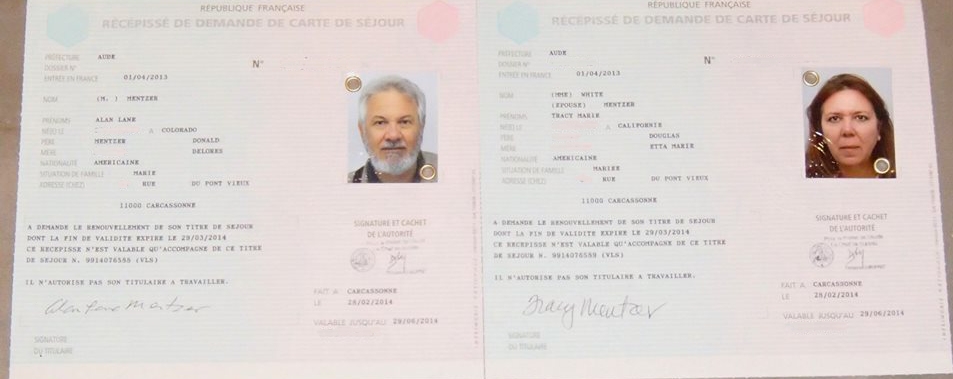
At the conclusion of our appointment the representative gave us each an elaborate Récépissé de Demande de Carte de Séjour, a receipt that allows us to continue to live in France until final disposition of our applications by the Préfect.

The representative also gave us an e-mail address at the Préfect to contact after 30 days to inquire if our  Cartes de Séjour have arrived for pick-up at the Préfect.  My understanding is that the renewal (if granted) that will replace our initial Titre de Séjour, residency permits “stickers” and would be issued in the form of an identification card, a Carte de Séjour Think of the Carte de Séjour as the French equivalent of an US Citizenship and Immigration Services’ (USCIS)  “Green Card,” although a “Green Card” represents permanent residency in the US and this Carte de Séjour will need to be renewed again in another year after issue.

From beginning to end the entire appointment took 30 minutes.  Our representative was friendly, helpful, and very efficient.  Overall it was as good of an experience as possible aided, I believe, by our efforts to be well prepared and organized to help make our representative’s job as easy as possible.  Now we wait for the next 30 days and hope for a positive answer to our requests.

Récépissé de Demande de Carte de Séjour

Learning to Speak French in France

“So . . .  do you speak French?”  A common question I was asked last year before we departed to France,  the answer was, “Hardly a word.”

Our backstory explains how Tracy and I, through a convoluted process, came to retire in France.  Prior to our retirement we did two years of Italian language study at Truckee Meadows Community College and using Italian Rosetta Stone computer software. (Our original retirement location was Italy.)  My high school and college foreign language was German, Tracy’s was Latin.

Now approaching our first year anniversary in France there is still the question, “Do you speak French?”  Tracy describes that I have an effective set of French “coping phrases” for life at the market, cafe, train station and my accent has gotten much better, but I’m still not to a conversational level.  We haven’t found it to be true that with “total immersion you will pick up the language just like that” followed by snapping fingers.  If anything, I am disappointed in my limited progress acquiring a good command of conversational French due to a lack of sufficient effort on my part.

While recently in Montpellier we met a delightful pair of five-year old French girls on the tram who chatted in English with Tracy and me.  I decided that by the end of 2014 I wanted to speak basic conversational French as well as these five-year olds spoke English (I won’t even get in to the question, “Are you smarter than a Fifth Grader.)   This seemed like a reasonable and obtainable goal.  So I made a New Years resolution to stay on a comprehensive learning schedule for French language acquisition.

There are lots of methods for second-language acquisition.  I know that I am more of a physical/aural learner so I selected audio learning systems.  Tracy decided to stay with Rosetta Stone French because she found Rosetta Stone effective for her previously while learning Italian.  (I also liked Rosetta Stone, but I wanted a system that starts with conversations and doesn’t require performing the learning in front of a computer.)  We would have liked to attend a French language class in a traditional classroom, but there was no cost-effective classes in Carcassonne (but there are some really expensive one-on-one tutoring available.)

The programs I picked are certainly not the best and only options, but these are the learning programs I selected for my personal andragogy (adult self-learning) and learning style.  The biggest success factors I think for any adult second-language learner is their motivation and perseverance.  There is no “Magic Bullet” of the perfect learning program, no “learn French in just 10 days.” Learners must be consistent and actively involved in their self-education  like any other pursuit – golf, cooking, knitting, playing a musical instrument – there is no passive approach to mastery.

I reverted back to my pre-retirement “Type A,” overachiever personality and selected three distinctly different learning programs to learn with rather than selecting just one system.  My hope was that the different language programs would overlap subject matter, fill in holes, and reinforce the material in other programs.  I wanted audio programs for use on my iPod that could be transportable and not require that I sit at a computer to work on my language studies.  I wanted to listen and re-listen to a lesson while taking a walk, cooking, riding the bus, doing dishes, or shopping.

Pimsleur French

Pimsleur French
Pimsleur French

First, I selected Pimsleur French (http://www.pimsleur.com/Learn-French)  which is a traditional audio learning program.  The Pimsleur Method has been teaching millions of students since the 1960’s and is considered by many to be a solid, tried-and-true method that stresses active participation, not rote memorization.  Although it emphasizes formal language and is somewhat dated with its lack of computer graphics, it is still frequently rated in the top 5 or higher of language learning programs.  (http://learn-french-software-review.toptenreviews.com/pimsleur-french-unlimited-review.html)   The Pimsleur system uses four principles in its teaching method:  anticipation with “challenge and response” similar to having a conversation, graduated-interval recall to reinforce vocabulary, a core vocabulary of the most commonly used French words, and what Paul Pimsleur called organic learning, auditory learning similar to how children learn language by hearing examples and then repeating what is heard.  The lessons are in 30 minute blocks that allows total effort without fatigue.

Amazon.com offers Pimsleur French levels I, II, & III for approximately $350.00 (in January 2014).

Coffee Break French

CoffeeBreak French
CoffeeBreak French

Secondly, I picked Coffee Break French (http://radiolingua.com/shows/french/coffee-break-french/) as a second-language acquisition tool.  The audio lessons are available as a free iTunes download and from the Radio Lingua Network website (http://radiolingua.com/).  (There is also Coffee Break Spanish and Coffee Break German available as well as a series of brief audio lessons in 24 languages ranging from Arabic to Zulu.)   The original concept was to make language training conveniently available “during a daily coffee break.”  These well produced audio lessons use the fun learning device of the instructor, Mark Pentleton (an experienced French and Spanish teacher), working with a college-aged student.  This Socratic technique makes the lessons fun and upbeat while allowing the student to act as a proxy for me in a classroom.  Most lessons are in 20 minute blocks, with approximately 100 lessons currently available and new lessons being frequently added.  Part of the charm of Coffee Break French is that the instructor Mark Pentleton is Scottish.  Although his English instruction has a distinctive Scottish burr, his French pronunciation is properly accented.  While there is paid supplemental content available from the Radio Lingua Network,  I only needed the professional lesson guides to accompany the audio lessons. Well worth the extra cost as I the lesson guides have helped me with my reading of printed French, building my vocabulary, and to better understand the conjugation of French verbs.
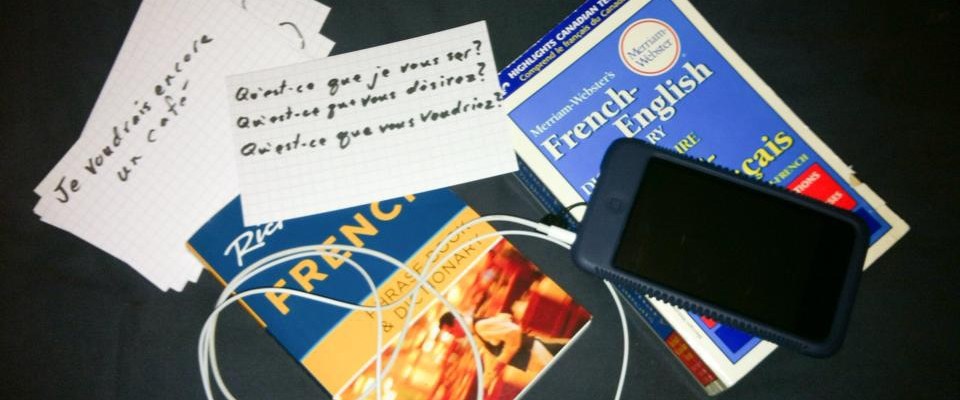

Coffee Break French has emphasis on proper French grammar as part of the lessons, something the Pimsleur program does not dwell upon.  Like the Pimsleur method, the lessons revolve around conversations based on real-life daily activities.

I selected the Bronze membership, which provides a set of 40 lesson guides for £27.00 (in January 2014), although there are periodic discounts and I was able to purchase the lesson guides for just £21.60.

FrenchPod 101

FrenchPod 101
FrenchPod 101

Finally, I selected FrenchPod 101. (http://www.frenchpod101.com/) A popular audio language program with free audio lessons, but I haven’t found FrenchPod 101 as well-organized or structured as the Pimsleur or Coffee Break French.  What I do like is that the FrenchPod 101 offers lots of cultural insights, daily life in France, and casual French phrases.  The cultural insights was one thing I greatly enjoyed in our TMCC Italian class with our professor, Carlo, who described his growing up and living in Italy.  The lessons are usually less than 10 minutes with an energetic native French speaker and an American who is fluent in French.  The discussions sound like two college-aged people talking about speaking French or living in France.  The lessons include the use of casual and informal French language along with proper formal French.  The lesson guides are helpful, but frequently do not exactly match the lessons’ dialog.  There are about 300 lessons, but it is difficult to organize the lessons into a well structured schedule of study.  It seems that the parent company, LanguagePod 101, (http://www.languagepod101.com/) provides the free audio lessons as a device to market paid subscriptions its to online training platform.  I  used my initial seven-day free trial to download the audio lessons and lesson guides that I was actually interested in using.   Another learner who wants to work from their computer might like to join the “FrenchPod 101 Learning Community” and use its additional tools.

I use FrenchPod 101 as a supplement for its cultural insights and expanding my knowledge of informal French.  I wouldn’t use this for my primary learning tool.  

I do one lesson each from Pimsleur French, Coffee Break French, and FrenchPod 101 everyday, Monday through Friday.  I leave the weekend free to rest or catch up on any overdue work.

Supplements

Duolingo
Duolingo

Duolingo

I use the free language-learning site Duolingo on my Kindle as educational entertainment.  Its graphics are very similar to Rosetta Stone learners’ interface. It is a very worthwhile learning platform that I should consider working with more often.  Amazing quality for a free service.  It’s pretty fun too.

Flashcards

Being a physical learner, I find creating my own flashcards has the dual purpose of physically writing words down that I can later use to quiz myself.  The audio learning programs do need supplements to assist me in learning to read French better.

Readings: French Newspapers, Menus, Grocery Items

I do my best to read the local newspaper online and physical newspapers while in cafes, as well as review menus, and read the names describing items in the store.  The newspapers and menus challenge my reading comprehension.  I find shopping reinforces my vocabulary when I see a physical object (apples, shoes) next to a sign (pommes, chaussures.)  This is part of that “total immersion” experience to learning French.

Notebook

I keep a pen and notebook in the camera bag that I always carry.  I find new words while I am out in the community that I am unable to define and make a note, then check on the word once I return home.  Interesting how those words stick in my growing vocabulary.

Talk and Listen

I try to push myself to speak and to carefully listen to the local French people around me.  It makes me practice, increases my confidence, and forces me to try to “think in French” not “translate English into French.”

DELF Challenge

DELF
DELF

I wanted to set up some tangible goals to work toward with my French studies.  There is what is called the Common European Framework of Reference (CEFR) which is the guideline used in Europe to describe a person’s fluency in other languages.

The CEFR classifies learners into six levels:

A Basic User

A1 Breakthrough or beginner
A2 Waystage or elementary

B Independent User

B1 Threshold or intermediate
B2 Vantage or upper intermediate

C Proficient User

C1 Effective Operational Proficiency or advanced
C2 Mastery or proficiency

The French National Ministry of Education (Ministre de l’Éducation Nationale) provides testing for diplomas of achievement (Diplôme d’études en Langue Française – DELF) at each level of proficiency.  (I believe this is similar to the United States’  Test of English as a Foreign Language exams – TOEFL.)  There is a DELF exam for each of the six levels that test for four different language skills:  listening, speaking, writing, and reading.

So, if I am understanding this certification process correctly, I want to test my second-language acquisition progress with the DELF testing.  My goal is to earn at least the DELF A1 diploma in 2014.

So, with no “Magic Bullet,” I had better stay on track with my learning schedule for 2014. Someday soon I may be speaking as well as a five-year-old.