Marseille with Casey and Megan: Train Strike, Chateau d’If, Vieux-Port, Phare de Sainte Marie, and Notre-Dame-de-la-Garde

“No, my dear Dantes. I know perfectly well that you are innocent. Why else would you be here? If you were truly guilty, there are a hundred prisons in France where they would lock you away. But Chateau d’If is where is they put the ones they’re ashamed of.” ~ Dorleac, The Count of Monte Cristo 

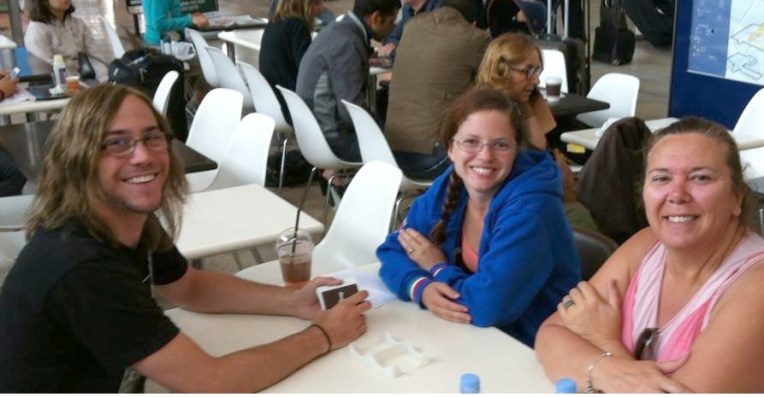
After arriving at Marne la Vallée-Chessy train station outside of Paris to catch our Ouigo high-speed train to Marseille we are told that a surprise rail worker strike has caused that train and two prior trains’ cancellation.  (The strike is eventually 10 days, the longest rail strike since 2008.)  Casey and Megan were getting a truly French experience of dealing with a large-scale rail strike.  We were told there was a chance of getting on high-speed TGV train still scheduled to depart in 2 1/2 hours.  IF it arrived we may be able to get on board.  IF we got inside and the doors were able to close we could go as far as the train continued to run. IF. We decided to “take the shot” at getting on that train.  In the mean time we “camped out” at the front of the line, talked, played cards, and worked on Soduku puzzles.

This slideshow requires JavaScript.

The train did arrive and we were able to squeeze into the hallway of a first-class carriage.  Other passengers were friendly with the “Life Boat” atmosphere and we stood or sat on the hallway floor for the first 2 1/2 hours of the nearly 900 kilometer trip.  About an hour out of Marseille departing passengers allowed us to finally get seats and we enjoyed the first-class luxury for the final hour of the trip, visiting with our neighbors in the cabin who were en route to the Côte d’Azur.  They were very friendly to their “refugee” seat-mates crashing first-class.  One gentleman was a French engineer who Casey had an animated discussion about their shared profession.  We would later read in the newspapers about people being stranded in rail stations for days and marvel that we were able to “pull off the impossible” and get one of the few remaining working trains to Marseille.

Marseille was completely unexpected.  I thought the city would be a gritty, slightly run-down port town.  Instead in was a clean, intriguing city that reminded me of San Francisco or Seattle. After wandering through the city I now understand why in 2013 it was awarded the title of Europe’s Capital of Culture.

This slideshow requires JavaScript.

Our literary adventure was taking the boat out to Chateau d’Id, the historic prison off the Vieux-Port (Old Port) of Marseille, to experience the setting of Dumas’ fictional “The Count of Monte Cristo” and “The man in the Iron Mask” in real life.  Reminiscent of visits to the former Alcatraz Federal Prison Museum off the coast of San Francisco.

This slideshow requires JavaScript.

Casey and Megan enjoyed taking the petit train up to Basilique de Notre Dame de la Garde located at the highest point in Marseille, about 150 meters (490 feet) above the south side of the Vieux-Port (Old Port), visiting the Musée Cantini with a collection including Picasso, Matisse, and Cézanne, and the strikingly unique Musée des Civilisations de l’Europe et de la Méditerranée [Museum of Civilisations from Europe and the Mediterranean (MuCEM).]

Notre-Dame de la Garde
Museum of European and Mediterranean Civilizations (MuCEM)

After a too-short visit and a sample of great seafood, we committing ourselves to returning in the near future and exploring more of Marseille at a future date.  We now headed by bus (the rail strike was still going on) to Aéroport de Marseille Provence (Marseille Provence Airport) to catch Ryanair for Rome.


Part 1:  Paris with Casey and Megan: Notre Dame, Palace of Versaille, Eiffel Tower, Love Locks, and the Louvre

Part 2:  Marseille with Casey and Megan:  Train Strike, Chateau d’If, Vieux-Port, Phare de Sainte Marie, and Notre-Dame-de-la-Garde

Part 3:  Rome with Casey and Megan:  RyanAir, Pantheon, Colesseum, Roman Forum, and Trevi Fountain

Part 4:  Vatican City with Casey and Megan:  Vatican Museum, Sistine Chapel, Necropolis Tour, Saint Peter’s Basilica, and Saint Peter’s Square

Part 5:  Carcassonne with Casey and Megan: La Cité De Carcassonne, Château de Montségur, Mirepoix

Paris with Casey and Megan: Notre Dame, Château de Versailles, Eiffel Tower, Love Locks, and the Louvre

“Paris is always a good idea.” ~ Audrey Hepburn

Our son Casey and his fiancée Megan became our second set of visitors to France.  The trip was to celebrate Casey’s graduation with his Chemical Engineering degree, his hiring as an engineer with the State of Nevada’s Chemical Accident Prevention Program, and his engagement to Megan.  So many important milestones to celebrate, but we were mainly looking forward to seeing Casey and meeting Megan for the first time.  Tracy had extensively pre-planned the trip in the attempt to try to visit everywhere Casey and Megan wanted to visit.  Tracy had the reservations made and confirmations organized to minimize the stress of traveling.  Tracy and I subscribed to the  “Fast and Light” school of travel with lightweight backpacks and making use of discount travel options as much as possible.

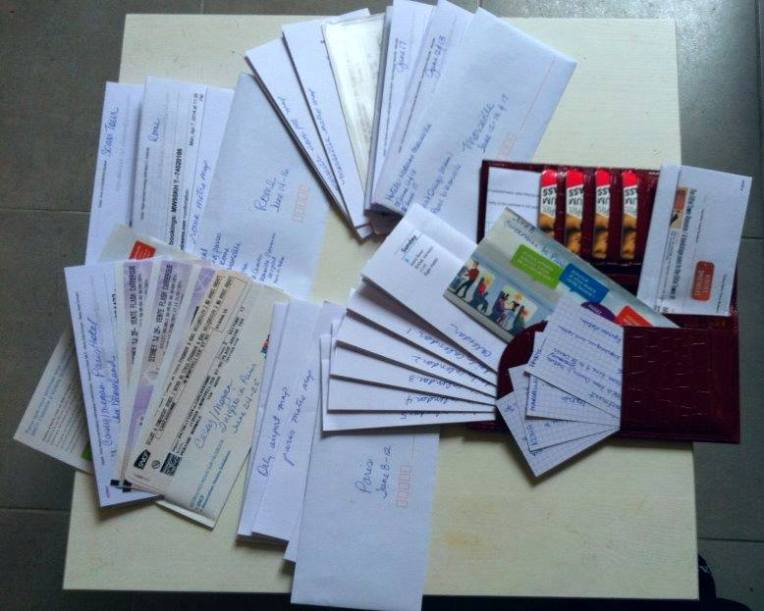
Tracy's collection of tickets, passes, reservations, and confirmations.
Tracy’s collection of tickets, passes, reservations, and confirmations.
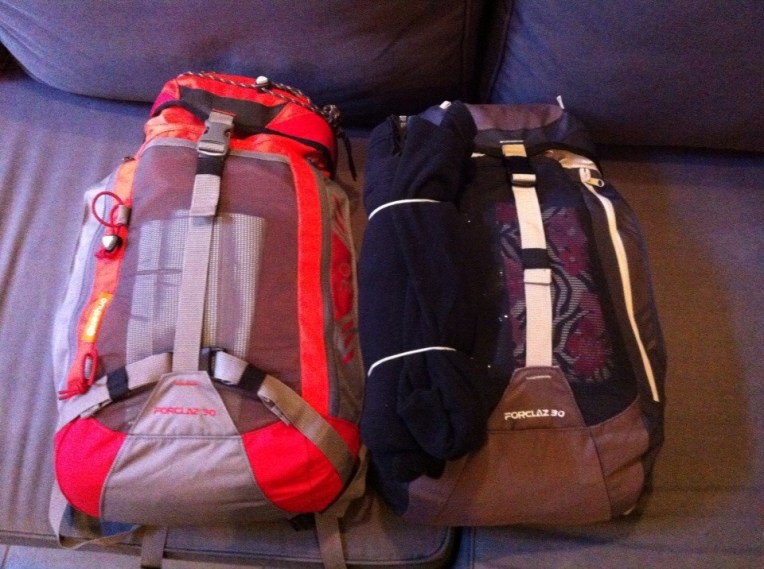
Tracy and my "Fast and Light" backpacks that are "Ryanair" size approved.
Tracy and my “Fast and Light” backpacks that are “Ryanair” size approved.

We left Carcassonne the day prior to Casey and Megan’s departure from the US to be able to meet them in Paris.  We took the SNCF train to Montpellier and transferred to the Ouigo TGV high-speed train to Paris.  We love the economy of the Ouigo where we can often get a trans-France train trip for as little as €10.

This slideshow requires JavaScript.

The Ouigo rolled into the Gare de Marne-la-Vallée – Chessy train station outside of Disneyland-Paris and caught the RER A (Réseau Express Régional) regional train into Paris proper where we used the Paris Métro system to picked up the key and settle into our apartment in the Belleville neighborhood of the 19th arrondissement.

This slideshow requires JavaScript.

The next morning Tracy and I walked about the Île de la Cité and Latin Quarter visiting the Panthéon to see the photo project that we took part in Carcassonne and hoping to spot our photos in the display used to disguise the scaffolds used to refurbish the monument. (Carcassonne – Au Panthéon Photo Project)  Then it was off to Aéroport de Paris-Orly to wait for Casey and Megan’s arrival.  It was our first time at the Orly Airport so we took the RER B line early in order to figure out international arrivals.

Aéroport de Paris-Orly

We were excited to see that Casey and Megan arrived without any problems.  We skipped the baggage claim area since they both joined us in our “Fast and Light” method of having a single backpack each for luggage and we were off to the RER for the ride to Paris talking all the way.  We headed back to the  Île de la Cité 


This slideshow requires JavaScript.

We “barnstormed” Paris trying to visit as many sites as we could squeeze in.  Megan had her first experiences with a subway with the very busy, but useful Paris Métro.  She was the only one of us not to be reversed and turned-around using the street and subway map.  We visited Notre-Dame de Paris (a must for Casey who  is a major fan of Hugo’s The Hunchback of Notre-Dame), explored the Renaissance and Egyptian sections the Louvre Museum, walked the Avenue des ChampsÉlysées from Place de la Concorde to the Arc de Triomphe de l’Étoile, Casey and Megan added a “Love Lock” to the Pont des Arts bridge, and enjoyed a chautauqua-type tour of the Eiffel Tower visiting the historic military radio room in the foundation and getting an “insider’s” view of the elevator system with a view paris from above the second level’s Restaurant le Jules Verne.  

Next venue on our itinerary:  Marseille.  A first for all of us.

Part 1:  Paris with Casey and Megan: Notre Dame, Palace of Versaille, Eiffel Tower, Love Locks, and the Louvre

Part 2:  Marseille with Casey and Megan:  Train Strike, Chateau d’If, Vieux-Port, Phare de Sainte Marie, and Notre-Dame-de-la-Garde

Part 3:  Rome with Casey and Megan:  RyanAir, Pantheon, Colesseum, Roman Forum, and Trevi Fountain

Part 4:  Vatican City with Casey and Megan:  Vatican Museum, Sistine Chapel, Necropolis Tour, Saint Peter’s Basilica, and Saint Peter’s Square

Part 5:  Carcassonne with Casey and Megan: La Cité De Carcassonne, Château de Montségur, Mirepoix
 

Carcassonne – Tour de France 2014

We were able to watch a part of the internationally renown Tour de France bicycle race. Leg 16 started in Carcassonne.

Tour de France Logo  (Wikimedia Commons)
Tour de France Logo
(Wikimedia Commons)

The 101th running of the Tour de France’s stage 16 raced through Carcassonne literally a half block from our apartment.  This stage was the longest of the 2014 race with 237.5 kilometers (148 miles) from Carcassonne traveling west up through the Pyrénées mountains and finishing in the village of Bagnères-de-Luchon near the Spanish border.

Tour de France 2014, Stage 16 (Reuters)
Tour de France 2014, Stage 16
(Reuters)

The Tour de France was actually two events for us.  The first was a parade of sponsor’s floats, called the Tour de France Caravan at 8:45.  Dozens of cleverly designed floats drove by throwing novelties, t-shirts, hats, and samples.

This slideshow requires JavaScript.

At 10:45 the racers (followed by their support vehicles) sprinted past as they circled the town and headed west.  We got to see the traditional yellow jersey on Italian bicyclist Vincenzo Nibali at the head of the pack of the 22 teams.  Although this was the mass start at the beginning of the race with careful riding through the narrow, twisting city streets, the entire pack of nearly 200 racers past us in less than 20 seconds.  We were cheering for US racer Tejay van Garderen who was in sixth place overall.  Thirty-four year old Australian Michael (‘Mick’) Rogers used his experience to climb the five peaks and power through the 237.5 kilometers (148 miles) to win this stage with a time of 6 hours, 7 minutes, 10 seconds.

This slideshow requires JavaScript.

After the chase cars, there were support trucks, motor coaches, and media mobile broadcast trucks.

We had a great morning experiencing in-person an event that has been exciting the world for over a hundred years.  We are also anxious to learn if Vincenzo Nibali will be the overall winner when the Tour de France’s concludes this weekend.

Tracy at the Tour de France 2014
Route of the 2014 Tour de France. (Wikimedia Commons)
Route of the 2014 Tour de France.
(Wikimedia Commons)

The Motif Of The US Flag In France

I find it interesting how often I see French people wearing clothing and or using advertising and decorating items based on the US flag’s iconic “stars and stripes.”

I’ve often wanted to take photos of French locals wearing interestingly designed US flag themed clothing.  Out of respect for their privacy (and not wanting to look like some kind of deranged stalker) I haven’t been photographing actual people. But with US Independence Day approaching, I thought I’d share a sampling of “stars and stripes” items I’ve seen in local stores.  Great Britain’s Union Jack flag designs and New York City items like New York Yankees ball caps and t-shirts are very popular too.

This slideshow requires JavaScript.

Surviving Two National Transportation Strikes – While Traveling France With Visitors.

“Life is what happens to you while you’re busy making other plans.” ~John Lennon

So after all of Tracy’s meticulous travel planning in anticipation of son Casey and his fiancée Megan’s arrival in France; after our pre-purchase of train, flight, and venue tickets; and after our pre-paying for hotel reservation, we were surprised with a sudden rail strike which turned out to be the longest since 2010.  While “industrial actions” are always a possibility in France, this one took us totally unprepared.

A high-speed train TGV Duplex from SNCF. Wikimedia Commons

Casey and Megan arrived in Paris in early June and while exploring the “City of Lights” together, Tracy and I checked the English-language online news (The Local and France 24) and learned that two of SNCF’s (the French national rail service) four unions, CGT and Sud-Rail had started what will eventually turn out to be a 10 day strike.  Most strikes in France in recent years are 24 hour “rolling strikes” with prior public notice that cause a minimum of inconvenience.   But this rail strike was called on short notice because of major rail system reform legislation scheduled in the French Parliament that week and the strike would uncharacteristically drag on day after day after day.

So when the time came for the next leg of our trip, traveling from Paris to Marseille, we took the RER commuter train from Paris to the Gare de Marne-la-Vallée – Chessy train station to catch our previously assigned seats on the Ouigo high-speed train to Marseille.  (The Ouigo in SNCF’s alternative to discount airlines with re-liveried TGV trains with cost-saving online booking and the absence of a cafe car but with very comfortable deluxe seats with fares starting at €10.)  Unfortunately, once we arrived at the train station we learned our train (along with two others of the day’s previous trains which were also headed south) had been canceled.  But, we were told by the SNCF staff that there was one southbound TGV train still scheduled in two hours. The SNCF official told us that if we managed to “get on that train and the doors are able to close” we could ride that TGV as an alternative to our canceled train. Space on the train was “first come, first serve,” for passengers without assigned seating like us.

So we embraced the “lifeboat rules” of traveling during a major train strike in France.  We played cards and waited for the alternative train, keeping a close eye the electronic status board, and hoping that train didn’t get cancelled at the last-minute.  Casey and Megan became “Platinum level” participants in the “French National Sport” of surviving strikes. Both maintained absolute positive attitudes and great humor while waiting for our alternative train.  We talked and played cards to wile away the hours as we waited.  When the train arrived, we were waiting at the front of the queue with the regular passengers and a good portion of extra passengers from the three cancelled trains.  As we searched for space, the four of us ended up with many others passengers in a first class car standing in the entryway like commuters in a crowded subway car during rush hour.

Casey, Megan. and Tracy playing cards and waiting for the train.
Megan and Casey waiting.

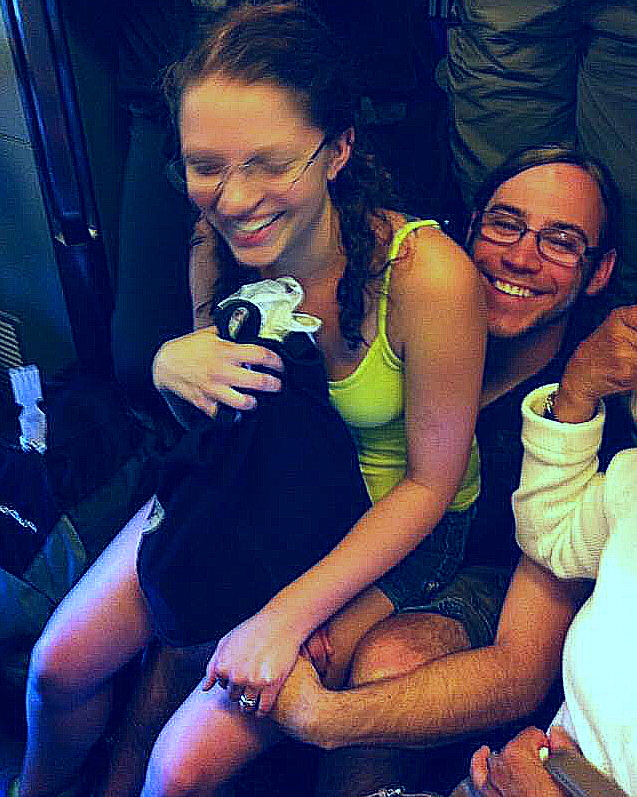
The train’s doors managed to close, it started rolling southbound, and we all sighed with relief that we made the train.  Now it was time to get comfortable (or as comfortable as possible) for the 3 hour + trip to Marseille.  Casey and Megan were kind enough to give me a spot on some steps entering a first class cabin (my old leg injury makes being stationary while standing painful.)  They both found a seat on the floor of the entryway way.  Tracy stood in the first class cabin doorway for the first two hours of the trip (and diverting air conditioning into the entryway.)  During the trip our fellow surplus passengers also found seats sitting on their bags, the floor, and one person sitting in the car’s restroom commode.  We were envious of our ticketed first-class companions in their assigned seats, but the overall mood of all the passengers was friendly and helpful.  Casey used his high school and college French to speak with a French father with his wife and two sons. Tracy helped support an older woman standing next to her in the cabin doorway.

Casey, Megan, and Tracy standing in the entryway on the train to Marseille
Megan and Casey sitting on the train floor.

About two hours into the trip at the stop at Avignon, the first-class cabin that Tracy was standing near had four seats open up as those passengers disembarked.  The four of us luxuriated in the first-class seats for the remainder of the trip to Marseille.  We had a pleasant conversation with the other foursome in the cabin, a group of slightly older Parisians on their way to their condo on Côte d’Azur (the French Riviera).  One of the Parisians was a French engineer who spoke excellent English.  He and Casey, a newly graduated engineer, discussed their shared profession.

When we arrived in the Gare Saint-Charles (Marseille) train station and we congratulated ourselves on remaining calm and successfully working around the rail strike on that leg of the trip.

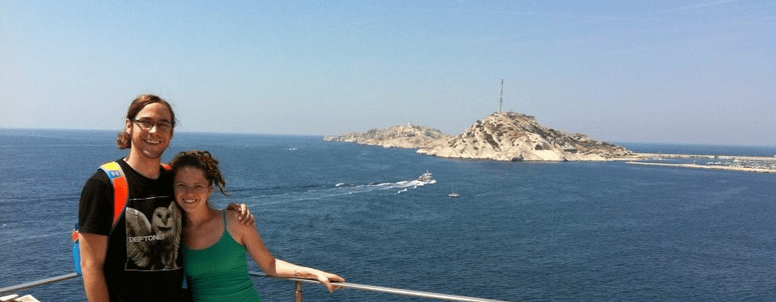
Casey and Megan at the Marseille marina.

While the rail strike dragged on, day after day, we toured Marseille and then got ready for our next leg to Rome.  We made use of the shuttle bus – rather than the train – out to Aéroport de Marseille Provence (Marseille Provence Airport) and later used the same bus upon our return to Marseille from Rome.

After our return from Rome, our next leg was scheduled to be Marseille to Carcassonne by the Bordeaux-Nice Intercités train in assigned seating.  Although the train strike was still on, this train was one of the 60% of routes still running. SNCF had hired additional station workers during the strike to help confused and stranded passengers in the train stations.  All of our questions about our train were answered quickly: our train was still running and would run straight to Carcassonne with no changes or delays.

We were expecting another over-crowded train like what we previously experienced from Gare de Marne-la-Vallée – Chessy to Marseille, but we were pleasantly surprised to have a cabin to ourselves with no overcrowding at all.  We assumed that this late into the strike, local commuters were choosing to postpone or finding alternative transportation for their travel.  We enjoyed the scenery of the southern French from Gare Saint-Charles (Marseille) through Nimes, Montpellier, Sète, Béziers, Narbonne, and finally home to Carcassonne.  While Casey and Megan were staying with us in Carcassonne, the rail strike finally ended after ten days.  We were thrilled that we had “dodged the bullet” with the train strike because Casey and Megan had to eventually return to Paris by train.  The ten-day rail strike was the longest since 2010.

SNCF Departure Board
Megan and Casey on train

As the end of Casey and Megan’s visit in Carcassonne approached, we learned that we took the “all clear” on transportation strikes for granted too soon.  Two French air traffic controller unions had voted for a six-day strike with the threat of impacting air passengers with 14,000 hours of delays, hundreds of cancelled flights, and a reduction overall of 20% of the air traffic through France. The air strike was scheduled to begin the day before Casey and Megan’s departure back to the US.

Tracy and I monitored Casey and Megan’s return flight to the US on British Airways.  It looked promising with their flight appearing to be one of the non-impacted ones. But the British Airways website had the caveat that we needed to confirm the flight 24 hours prior to departure because the strike situation was volatile and flights were subject to change.  Luckily, the first air traffic controller union almost immediately settled their strike and the second air traffic controller union called off their strike the Wednesday prior to Casey and Megan’s departure on Thursday.

So in the end, Casey and Megan caught the Intercités train with assigned seating to Montpellier where they took the Ouigo TGV train to the Gare de Marne-la-Vallée – Chessy just outside Disneyland-Paris.  Casey and Megan spent a day at Disneyland-Paris before flying home to Reno, Nevada the next day from Aéroport de Paris-Charles-de-Gaulle (Paris Charles de Gaulle Airport.)

Both Casey and Megan left France with metaphorical Gold Medals that we all earned in beating the French transportation strikes of June 2014.

Megan and Casey at the Disneyland-Paris entrance.


Writing A Check In France

Although we’ve had a French checking account for about a year, we’ve been exclusively using the account’s credit/debit card, the Carte Bleue, for in-person and online shopping. We have never bothered to obtain an actual checkbook from our bank in France.  We very seldom used checks in the US because of the prevalence of online payments.

But, we recently had a need for a chèque issued on a French bank, so I set about acquiring a French checkbook called a Chéquier or a Carnet de chèques. I went online to BNP Paribas, our French bank, and searched for the link to order a Carnet de chèques.  Of course, the website is in French and after stumbling around web pages for a good while using with my limited French language skills, I decided I needed some help locating the correct link.  

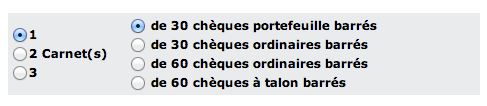
I “clicked in” to the BNP website’s “chat” function to “speak” with a bank representative who was extremely helpful.  Totally embracing technology, I had one computer window open to the BNP website, a second window open to chat with the bank representative, and a third window opened to Google Translate to expedite the conversation with the French speaking bank rep.   I worked through the  online conversation and finally located the right web page to order chèques.  However after reaching the correct webpage, I was offered the somewhat confusing options of:

Cheques Options
Cheques Options

While I understood the options of  ordering 1, 2, or 3 carnets (books) of chèques with either 30 or 60 chèques each, I had to do some additional online research to figure out exactly what the differences were between chèques portefeuille barréschèques ordinaires barrés, and chèques à talon barrés.  After visiting several online Expat forums I learned that: 

Chèque portefeuille: has checks that are attached and tear away from the top like the majority of US checkbooks.
Chèque ordinaire:  has checks that are attached to the left side like a book and tear away from the left side.
Chèque à talon:  checks that are attached and tear away from the top, but with a”stub”(à souche) that gets left in the checkbook with a space for a personal memo.

Now understanding the options better, I selected the chèques portefeuille barrés (the choice most similar to what we have for our US checkbook) and “clicked” to have the Carnet de chèques mailed to us rather than the option of having the checkbook sent to our local bank branch for pick-up.

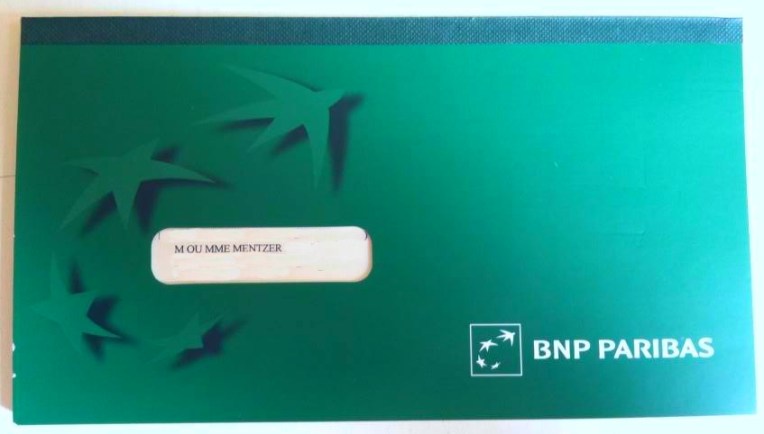
Carnet de chèques
Carnet de chèques

A week later, the Carnet de chèques arrived in the mail.  First thing I saw was that French chèques are noticeably larger than US checks.

Size Comparison: An US Check On Top Of A French Chèque
Size Comparison: A US Check On Top Of A French Chèque

Also different from the US was a receipt included which had to be signed and returned to the bank acknowledging that the checkbook had arrived, there are no missing checks, and that the checks are printed correctly.  Apparently the checks are not valid until the return receipt has been received at the bank.

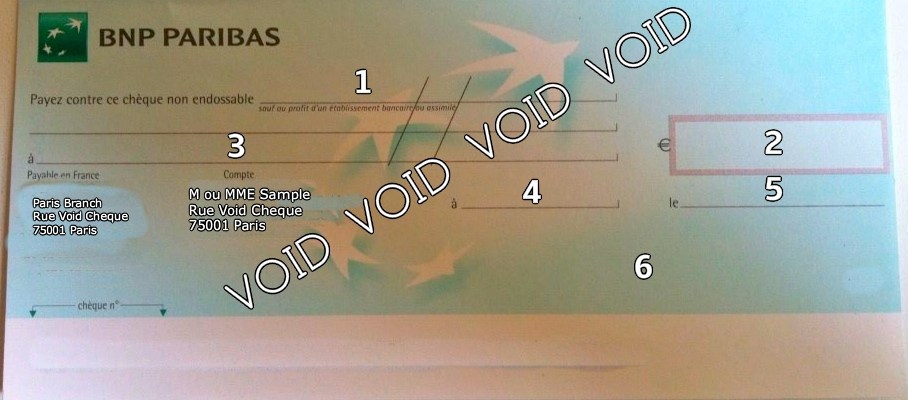
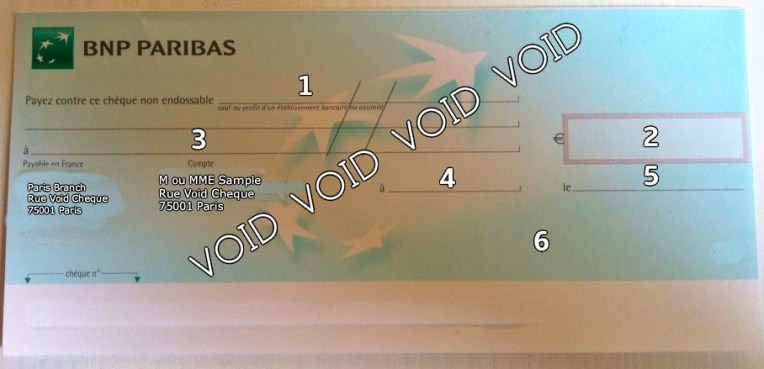
There is a very specific formula to writing French checks.  While US checks and French chèques look similar, there are several differences in their formats.  The most obvious difference that a chèque written on a French bank is required to be written in French.

Sample French Chèque

Line 1.Payez contre cheque,” “Payez contre ce chèque‘,” or “Payez contre cheque non endossable.”  The top line on US checks is where the payee’s name usually goes, so it’s important to know that Payez contre cheque means “Pay against this cheque (this amount)” not “Pay to the order of” like is found on an US check.  On the top line of the chèque you spell out the amount to be paid using French words.  For example €87,50 needs to be spelled out as “Quatre-vingt-sept Euros et cinquante centimes” or “Quatre-vingt-sept Euros et 50/100 c.”  I still struggle with understanding French numbers, but there are many “How to write a check in France” websites with “Numbers to French Words Converters” that look very helpful.

Line 2. “” On this line the amount for the check is written in numbers.  Remember that in France the comma (virgule) and the period (point) are used in writing amounts are reversed from the way the comma and the period are used in the US. For example: Two thousand eighty-seven Euros and 50 centimes is correctly written as €2.087,50 and not as €2,087.50.

Line 3. “A” This is the payee space that you write in the name of the person, company, or organization to whom the amount is being paid.  A chèque for Mr. Dubois is written as M Dubois (for Monsieur Dubois),  Mrs. Dubois as Mme Dubois (for Madam Dubois), or Miss Dubois as Mlle Dubois (for Mademoiselle Dubois.)

Line 4. “Fait à” or “A“.  A departure from how checks are written in the US, on this line you write the name of the city of where the chèque is being written, for example “Fait à Carcassonne” or “a Paris.”

Line 5. “Le”  This is the date line where today’s date is written.  Remember that the European standard for writing a date is “day-month-year” (like the US military standard of writing dates.)  A chèque written on Christmas day would be correctly written as 25-12-2014, not as 12-25-2014.  Christmas day could also be correctly written as 25 décembre 2014.  (The French do not capitalize the first letter of a month.)

janvier = January
février = February
mars = March
avril = April
mai = May
juin = June
juillet = July
août = August
septembre = September
octobre = October
novembre = November
décembre = December

Line 6. Beneath lines 4 and 5 reading “Fait à Carcassonne le 25-12-2014″ is the space for a signature.  There is often no actual “line” provided on French chèques for a signature like is usually found on US checks.

So now, with a Carnet de chèques in hand and understanding the format for writing a French chèque, we are finally ready to write that check.


Absentee/Overseas Voting From France

Tracy and I believe that it is essential to participate in the privilege and right of voting in the US.

One major issue we have read in the many expat forums is Americans who say that they have had difficulties voting while living abroad. But so far our voting experience has been very positive.  I wonder with the ease we have navigated the process if some of those voting complaints are from the distance past or because of a person living overseas misunderstanding of the process to obtain a ballot.

Since 1986 there has been the “Uniformed and Overseas Citizens Absentee Voting Act (UOCAVA)” that requires that all overseas citizens be allowed to register and vote in federal elections. For Nevada, the Secretary of State web site explains the absentee/overseas process on its “Military/ Overseas Voting” page.  The web page also supplies links to individual Nevada counties’ Registrars of Voters and to the Federal Voting Assistance Program that assists both military and civilian overseas voters.

Our Washoe County Registrar of Voter’s web site is also very helpful with a form request page that carefully explains the absentee/overseas process:

“ABSENT BALLOT REQUEST

An absent ballot request form can be filled out and processed at the beginning of each election year.  Your absent ballot request is only valid for the calendar year in which we receive it.  It is important that you specify which election(s) you are requesting a ballot for.

THE DEADLINE TO SUBMIT A REQUEST FOR AN ABSENT BALLOT IS THE TUESDAY PRIOR TO ANY ELECTION, AT 5 PM.  WE STRONGLY URGE YOU TO SEND IN YOUR REQUEST AS SOON AS POSSIBLE.  REMEMBER, YOUR VOTED BALLOT MUST BE IN OUR OFFICE BY 7 PM ON ELECTION DAY IN ORDER TO BE COUNTED.

BALLOTS WILL BE MAILED TO OVERSEAS AND MILITARY VOTERS 45 DAYS PRIOR TO ANY ELECTION. BALLOTS WITH OUT-OF-STATE MAILING ADDRESSES WILL BE MAILED 40 DAYS PRIOR TO ANY ELECTION AND BALLOTS WITH IN-STATE ADDRESSES WILL BE MAILED AT THE 30-DAY MARK.
 IT IS IMPORTANT THAT YOU PLAN ACCORDINGLY. 

You can print, fill out and mail or fax the Absent Ballot Request form below to us.  (Remember, your signature is required.)  If you find that the address you have listed for the Primary Election will not be valid for the General Election, please submit an updated request.  We cannot accept changes by phone.  Please call us if you have any questions.  (775) 328-3670″

We downloaded a “Absent Ballot Request Form” for each of us, completed the form, attached copies of our Nevada driver licenses, and mailed the form to the Washoe County Registrar of Voters.  The form gave us the option to request an absentee ballot for a specific election or for every election during the calendar year (which was our choice.)

Washoe County Absent Ballot Request

There is obviously some personal responsibility and pre-planning of deadlines required by an American living overseas to be able to vote. It is not an automatic process. A new request needs to be submitted every year.

Our absentee/overseas ballots for the primary election arrived in France on May 5 for the primary election scheduled June 10.

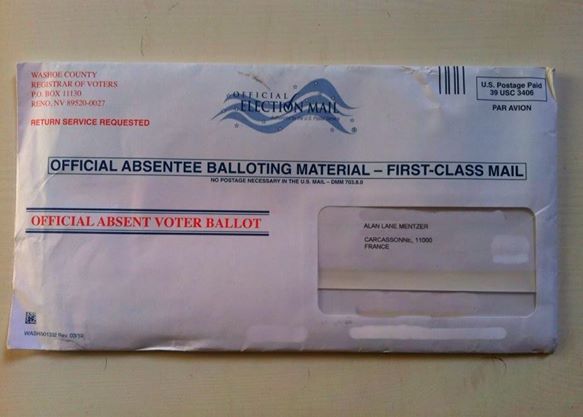
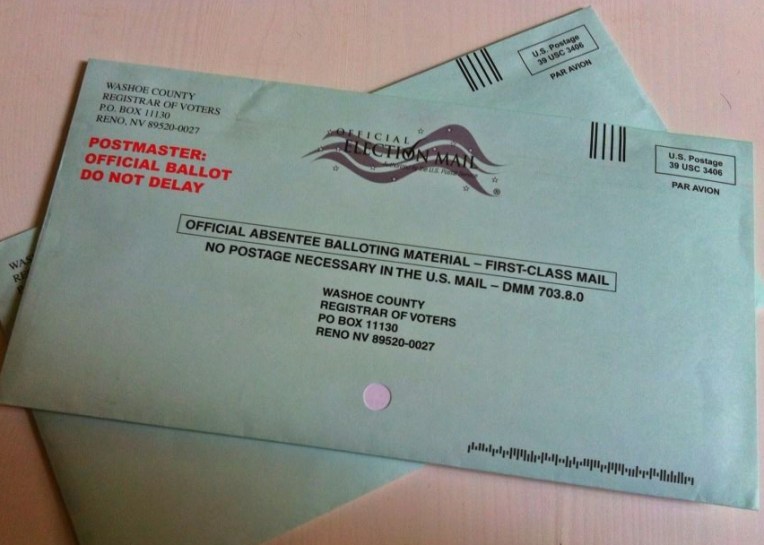
Absentee Ballot Envelop
Absentee Ballot Envelope

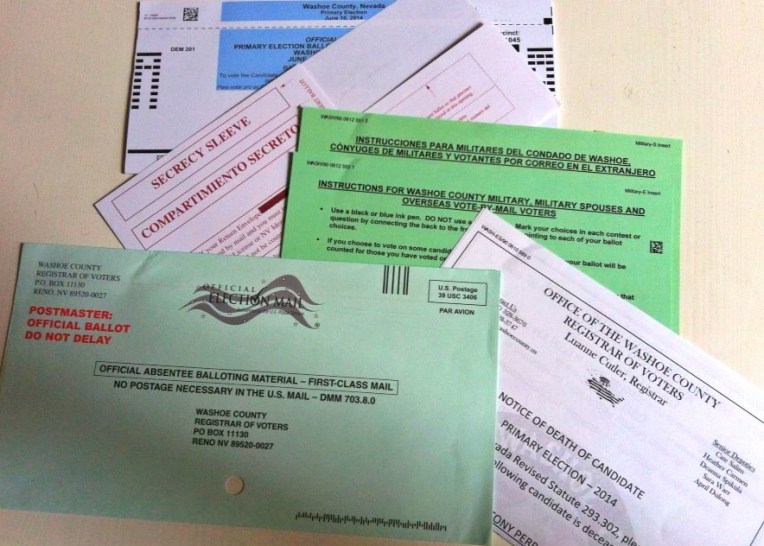
Inside the envelope is the primary ballot for my political party, “Instructions For Washoe County Military, Military Spouses And Overseas Vote-By-Mail Voters” in both English and Spanish, a notice that a candidate for office has died but remains on the previously printed ballot (also in English and Spanish), a “Secrecy Sleeve” to protect privacy, and a special return envelope.

Absentee Ballot Materials

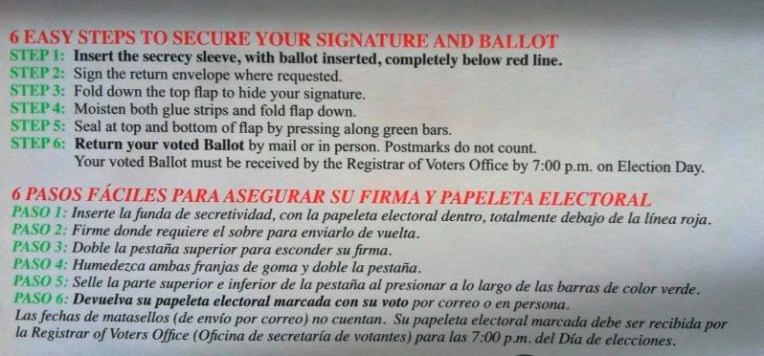
After marking our selections of candidates on the ballot (in black or blue ink only, to be read by an electronic scanner), there is an elaborate six-step process to protect our privacy while ensuring the integrity of the absentee voting process.

Ballot Mailing Directions

Once our Byzantine directions for signing and sealing the envelopes are accomplished, all that is left is a quick trip to la Poste (the post office) to add an €1,78 international stamp to each envelope (about $4.90 total) and give the ballots plenty of time to make it back to Reno by 7 p.m. June 10.

We also have the ability to confirm our ballots arrived at the Washoe County Registrar of Voters by visiting myvoterfile at the Nevada Secretary of State’s web site.

Our patriotic duty to vote is done until the general election on November 4.

Ballot Envelopes
Ballot Envelopes
 

Filing Our First Déclaration des Revenus (French Taxes)

Every May full-time residents of France are required to file la Déclaration des Revenus (Declaration of Earnings), the annual tax declaration equivalent to filing your 1040 tax form in the US.  Since France is our principal residence and we have lived here longer than a year, we are required to file a Déclaration des Revenus for the first time since moving to France.

So, how did we — with our rudimentary skills in speaking French — figure out how to file our Déclaration des Revenus?

In this case the Internet, Google Translate, expat discussion forums, and numerous professional websites were all major tools.  I’m often thankful that we have so much information available from the Internet. Neither of us can imagine the struggle of expats living abroad before such tools were readily available.  One key source for collecting information was the online English language newspaper, “The Local, France’s News in English” that reminded readers in April that a Déclaration des Revenus would be due in May.  The article listed the forms required, had advice from an expat tax expert, and listed links to La Direction Générale des Finances Publiquesthe French version of the US Treasury’s Internal Revenue Service.  The Finances Publiques’ web site allows you to download forms and even file your Déclaration des Revenus online.  (There are also expat tax preparation services in France, but ours was pretty straight forward.)

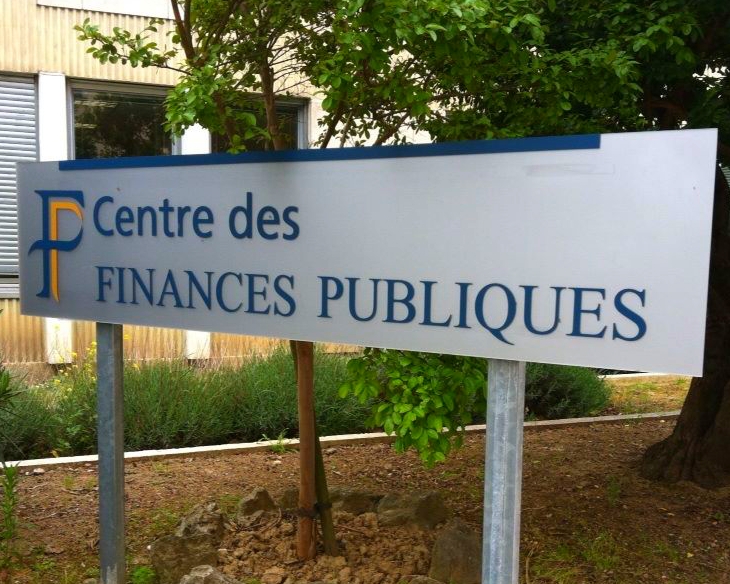
Center of Finances Publiques

Due to my lack of confidence with online filing the Déclaration des Revenus in French, I elected to visit the local Centre de Finances Publiques (tax office) to pick up the needed forms.  Between my “shopping list” of forms, my very basic French, the helpful Finances Publiques’ representative’s basic English, I managed to pick-up the required forms.  Like our US Tax Return, the Déclaration des Revenus consists of several forms.  For us, we needed:

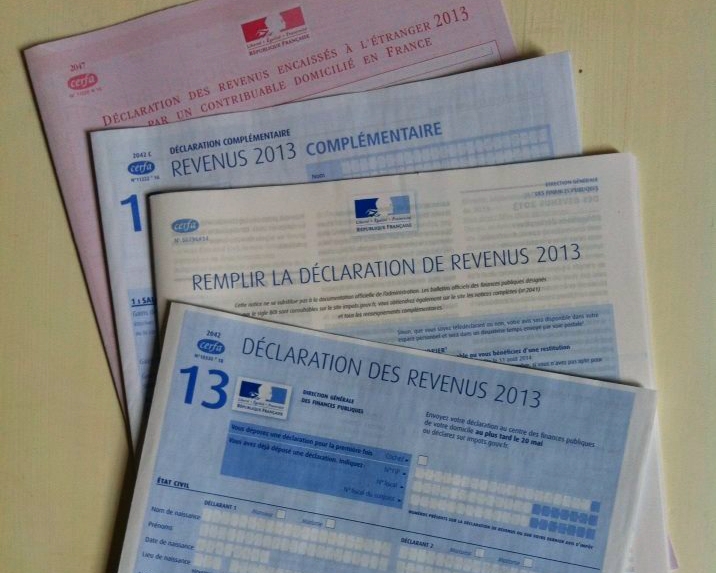
Formulaire 2042
The main tax form (like the US tax form 1040) listing our name, address, and global income.

Formulaire 2047
This form is for listing any income earned outside of France.  Our pensions are considered foreign income that must be declared on this form, as well as the total noted on the Formulaire 2042.

Formulaire 3916
On this form we list all bank accounts that are located outside of France.

Declaration  des Revenus Forms and Directions
Declaration des Revenus Forms and Directions

Filling out these three forms was actually simpler than completing many of my past US Tax Returns; but, of course, these forms and directions are written in French and I had to struggle with the language barrier.  Yes, French tax forms share with US tax forms the ability to create stress and give the preparer a total feeling of confusion and inadequacy.

Using an English-French dictionary, Google Translate, and a tax help guide from “The Connexion:  France’s English-Language Newspaper” written for British expats, it took about two days to (hopefully) correctly complete the documents.  Tracy double-checked the translations, Dollar-to-Euro conversions, directions, math, documents, and finally concurred that we had now had all the forms ready to submit.

The next big question was:  to whom or where do we submit Déclaration des Revenus?  Unlike US tax forms, there was no mailing address on any on the forms, nor directions for how to file.  So we gathered up all the completed forms and visited the local tax office again.  Tracy spotted a large mail box outside the office door with a sign marked for Déclaration des Revenus.  But first I visited with the Finances Publiques’ representative again and asked her to double-check that our Déclaration was complete.  (Thankfully the representative spoke some English, which was extremely helpful to me.) She asked me to include a copy of our 2013 rental contract with our Déclaration des Revenus and then the package would be complete.

We had a quick round trip back to the apartment, made a copy of our lease, and returned to speak with the same Finances Publiques’ representative for one last final review. The representative believed the package was complete now and officially accepted the Déclaration des Revenus. Yet another milestone first with living in France.

So what happens next?

Unlike the US, no payment is ever sent with the Déclaration des Revenus.  The Finances Publiques reviews the financial situation on the forms and later sends an Avis d’Imposition (a tax bill) or an Avis de Non-imposition (certificate of non-taxable income) usually around mid to late August for the amount of taxes due. Since it is our first filing, we are told that we could receive a response from the Finances Publique as late as November or December 

Now for the complexity.  The United States is one of the few countries that taxes on the basis of citizenship rather than residence.  The United States requires that US citizens file a yearly tax return with the US Internal Revenue Service as long as their income (earned in the US or earned abroad) is over $9,000. Americans working abroad are generally exempt from paying tax on their first $97,600 in foreign earned income, but they are still required to file a return. 

Tracy and I do not earn income in France and we previously filed our US tax return in April.  

To avoid double taxation for citizens living abroad, there is a tax treaty between the US and France, the “Convention Between the Government of the United States of America and the Government of the French Republic for the Avoidance of Double Taxation and the Prevention of Fiscal Evasion with Respect to Taxes on Income and Capital (1994).”  The biggest issue for us addressed in the treaty is that pensions from a US source is taxed only by the United States and not by France.  So, in theory, we are only required to pay our US taxes, however, in actually application we may still receive a tax bill.  

This is our first time filing a Déclaration des Revenus with Franceso we are interested to see exactly how this will work out for us.  Every expat’s tax situation is unique unto itself.  So we may have no French Impôts sur le Revenu (income tax) liability, a small French income tax bill (for non-pension interest or dividends), or no income tax liability but a bill for social service fees (if you call it a “fee” it doesn’t fall under the “tax” exemption.)

We will tell you about the outcome sometime between August and November when we hear from La Direction Générale des Finances Publiques.  Keep your fingers crossed that we only get a Avis de Non-imposition (certificate of non-taxable income).


Cartes de Séjour Arrived To Help Celebrate Our First Year In France

Following the Prefect Office’s instructions that we received after we submitted our applications to renew our Titres de Séjour (residency permits) [First Renewal of Our Residency Permit (Titre de Séjour)], we e-mailed the prefecture after 30 days to inquire whether our application has been approved and Cartes de Séjour (residency cards) issued.

So after an anxious 30 days (we expected the approval to be pro forma with the initial request in the US for a long-term visa being the most challenging, but it’s never good to make such a broad assumption of an automatic approval when immigration law and bureaucracy are involved) I translated an inquiry into French and e-mailed the Préfecture de l’Aude here in Carcassonne.  I immediately received an auto-response advising me that the message was received by the Prefecture and to expect an answer within 5 working days.  I put my “Type A” personality back in retirement mode and told myself, five more days to wait was not unreasonable.

However, I received back within two hours an e-mail response from an actual person telling me our request was in the hands of a real person and requested our 10 digit identification number from our Récépissés de Demande de Carte de Séjour (receipts of application for residency permit.)  I referred to our  Récépissés, located the ID numbers in the upper right corners where the e-mail said the numbers would be found, and e-mailed the information back to the Prefecture.

La Préfecture de l'Aude à Carcassonne
La Préfecture de l’Aude à Carcassonne

The following morning before 9:30 a.m. there was an e-mail from the Prefecture telling me that our application is approved, our new Cartes de Séjour are at the Prefecture, and to come and pick the cards up April 1. We were asked to bring with us our Récépissés de Demande de Carte de Séjour and current Titres de Séjour (residency permits) which are “sticker” documents affixed inside our US passports.

So April 1, Tracy and I were up early to be at the Prefecture at 9 a.m. when the doors open to the residency permit office. After a little bit confusion and language difficulties at the reception area we received a yellow “Post-It” note with the number “4” written on it and sent to the waiting area outside the residency permit office.  This was unusual because on previous visits at the prefecture, like at the DMV back in the States, we received a printed number tab to match the electronic number display next to the office door.  After waiting a couple of minutes the electronic display turned on and showed “500.”  That didn’t look right.  Having a number “4” in our hands we decided we misunderstood something in the French.  After checking back at the reception desk, the receptionist took us into the Estranger Passeport (foreign passport) office and created an informal line with us and other visitors also holding “Post-It” note numbers. We quickly moved up in the line short line and met with the friendly Prefect representative who accepted our Récépissés de Demande de Carte de Séjour and passports. The representative very efficiently had us sign a form accepting our new Cartes de Séjour and handed us our cards and a receipt for our records. We were in and out of the Prefecture in 20 minutes.

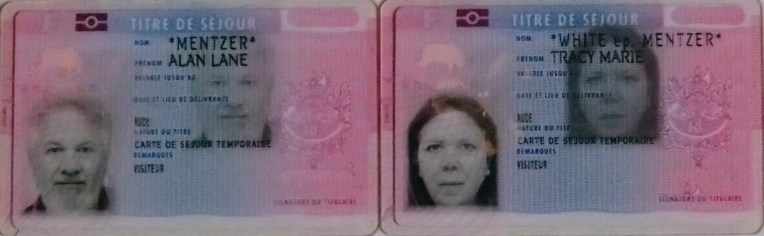
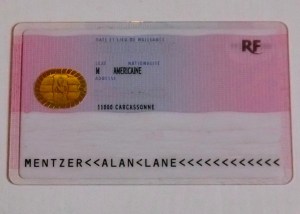
Cartes de Séjour
Cartes de Séjour

The Carte de Séjour is rather “High-Tech” with security features like a microchip with biometric information, a “watermark photo” that matches the subject’s photo, hologram, shifting colors, micro-printing, République Française watermarks on the laminate, the subject’s signature, and check digits.  It’s a very professional looking document, although a rather unattractive pastel pink and blue in color.  The card lists our French ID number, expiration date, nationality, place and date of birth, gender, and current address in France.

Reverse of Carte de Séjour

So we are starting our second year in France feeling fairly accomplished with successfully navigating French bureaucracy and obtaining our Cartes de Séjour without any snags. For our renewal next year we are planning the same strategy of starting early and being well prepared with all the documents required.