One of our goals with our new retired life is to eat healthier.
In the past it was always faster and often more convenient to swing by a “drive-up window” and pick up a quick meal. Even though I knew better about nutrition, it was quick and satisfying to grab Quarter Pounder with Cheese, a Baconator, or Extreme Sausage Sandwich. I love a good cheeseburger, et. al, but “everything in moderation” and sometimes I wasn’t moderate in my dining habits. (You would think that after documentaries like “Super Size Me” I would have long ago been avoiding fast foods.) Please don’t think Tracy and I raised the kids on fast food and that we didn’t use healthy foods to prepare meals, but we also took our fair share of “short-cuts” to the “drive-up.”
With a major change in environment and limited access to fast food, Tracy and I wanted to create new eating habits that actually follow the USDA Food Pyramid recommendations we previous ignored if it wasn’t convenient. (But still enjoy an occasional, emphasis on “occasional,” indulgence.)
Tracy and I both love to cook and try new recipes. Now we have a lot of brand new ingredients to explore with our cooking. We want to minimize meat and emphasize vegetables, fruits, and grains. We also wanted to use farm fresh, local foods as much as possible and avoid frozen, canned, and pre-packaged foods. There are no excuses as we now have the time with retirement to enjoy making our meals completely from scratch.
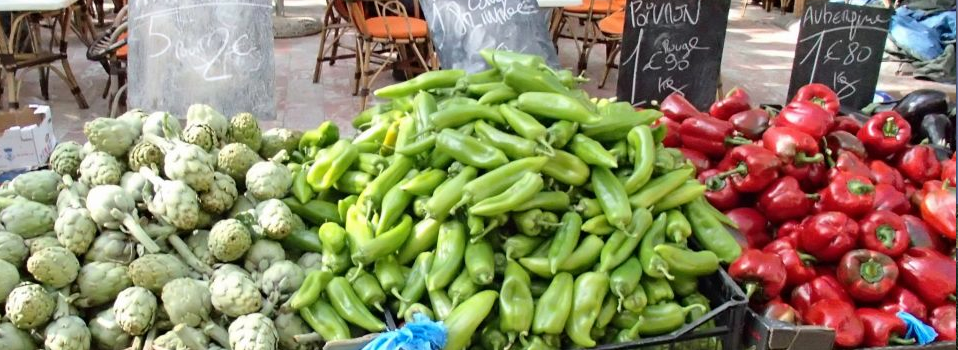
One pleasure has been shopping at the open air market in Place Carnot. Every Tuesday, Thursday, and Saturday is market day in Carcassonne. The town square in Place Carnot is full of tables with vegetables, fruits, honey, breads, meats, and flowers. We are now shopping for seasonal and fresh foods, usually directly from and sold by the farmers themselves. (There are also some imports from Spain, Italy, and North Africa also available. The country of origins on all foods are clearly identified.) Colors are often vivid with some shocking differences in foods’ colors that we only used to see in heirloom and heritage produce in the U.S.
I realize I am stating the obvious regarding the local food being is raised for its taste, rather than its ability to be trucked long distances and to last longer on store shelves. There are many new and different flavors to experience. (And new names for old favorites: mushroom are des champignons, potatoes are des pommes de terre, and strawberries as des fraises.) Yes, I already knew about the improved quality of local foods but it’s an evolution for me to experience it on a continuous basis. I never had or took the time to shop farmer’s markets or to garden at home. (I have a “black thumb” when plants are involved. There were only silk plants in my old office.) Previously tt was always a matter of running by the supermarket’s vegetable section or stocking frozen vegetables in the freezer.
The experience of shopping at the open air market is a theater upon itself: all different kinds of people coming and going, the various interactions between buyers and sellers, people looking for the best quality at the best value, friendly “bonjours” and “au revoirs,” and us standing in the middle of it. We are already choosing our favorite vendors. We have our farmer with the freshest and best tasting tomatoes. There is our “Melon Man” who insists we taste a slice of his cantaloupes first before he hand-picks the ripest melons for us. There are the vendors who are exceedingly patient with my limited French when they ask for, “Trois euros cinquante-cinq centimes” (3 euros 55 cents) and make a point to write the amount out on a pad of paper or show me the amount on the calculator.
And the best part is, of course, cooking and eating our bounty then returning to the market do it all again.
It’s hard to believe that we’ve been here a month already. Time has sure passed quickly as we worked on settling in to our new community.
So far in the last 30 days, we’ve made two train trips to Montpellier; had a sick computer and a sick puppy; rode the bus – mostly successfully; shopped at the open-air market, found a grocery store we like; selected a favorite coffee bar; visited a medieval citadel; taken lots of long walks along the river; have been to the tourist office, the post office, the bank, the veterinary office, the butcher, the pharmacy, the train station and one of the museums.
We’ve talked to people from France, Germany and England, taken hundreds of photos and studied zero French.
We’ve been able to keep in touch with the kids, our family and friends through social media sites and e-mail. Major plus as we miss the kids quite a bit.
We read from others that dealing with OFII would be time-consuming and difficult process but haven’t found that to be true. Within our first 30 days, we mailed our documents to them with the requested copies of our passport, visa and visa stamp. We received our notification that the materials were received within 10 days of our arrival. Ten days later we received our letters from OFII with the time and date of our meeting for our medical exam and general interviews. Definitely not the nail-biting situation we had expected.
Now that we are settled into our Carcassonne home and have completed our first month abroad we are creating a schedule for travel, adding French lessons into our daily routine and making plans for our OFII trip in May.
Living in Carcassonne is wonderful, but it still feels a little like being on vacation and Alan and I keep reminding each other that we don’t need to rush around trying to see everything possible each day. We have 11 more months to wander and explore, learn some French, do some out-of-town travel, visit a friend or two also living abroad and drink more wine.
So far, life is great. Alan and I are so grateful for the opportunity we’ve been given and the love and support of our kids, family and friends.
“Where in the world are . . . Tracy, Alan, and Kiara the micro-dog?”
“Where the heck is Carcassonne? I know France . . . a little. Paris . . . and the Normandy Beaches from WWII . . . and Provence from all those photos of fields of lavender . . . the French Riviera . . . the Canne Film Festival . . . and those wine places: Burgundy, Champaign, and Bordeaux. Alright, I really don’t know anything about France and never, ever heard of Carcassonne before.”
So, what about France?
France, the République Française, is the largest country in western Europe and the third largest in Europe overall. The “Hexagon” — the approximate shape of France — is a little smaller in area than Texas and basically located in the center of western Europe. To the north is the Atlantic Ocean and English Channel and to the south is the Mediterranean Sea, France is bordered by Spain, Andorra, Monaco, Italy, Switzerland, Germany, Luxembourg, and Belgium. France has overseas regions including French Guiana, Guadeloupe, Martinique, Reunion and Mayotte and additional territories like French Polynesia. This is similar to Alaska and Hawaii being U.S. states although not part of the contiguous United States and U.S. territories like Puerto Rico, Guam, and the U.S. Virgin Islands. France has about 1/5 the total population of the U.S. with 65 million citizens, compared to 316 million in the U.S. France has been the number one tourist destination in the world for the last 20 years. Geographically diverse with three major mountain ranges, major beaches, and scenic valleys, France is also ethnically diverse. France’s colonial past and tolerant culture has made it as much of a “melting pot” of peoples and cultures as the United States. Paris is the capitol to France’s semi-presidential constitutional republic that shares many aspects with the U.S. system of government. France is the fifth largest economy in the world and the second largest economy in Europe. And yes, the language in France is French.
France in the dark green (Wikipedia Commons)
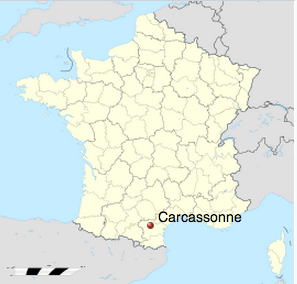
So, exactly where in France are we?
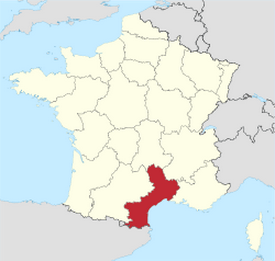
There are 22 regions in Metropolitan France and 5 regions overseas. The regions are roughly the same as states in the U.S. but with less autonomy. Each region has a capital (think state capital). We live in the Languedoc-Roussillon region and our regional capital is in Montpellier. It is the eighth largest city in France and its fastest growing for over 25 years — it’s also the size of Reno, Nevada with approximately 255,000 residents. The immigration office we work with is headquartered there. We live in the city of Carcassonne, about 90 miles from Montpellier.
Languedoc-Roussillon Region in red. (Wikipedia Commons)
Within the region of Languedoc-Roussillon there are five departments (think of the departments like a county): Aude, Gard, Hérault, Lozère, and Pyrénées-Orientales. Carcassonne is located within the Department of Aude and is its Prefecture (the “county seat”). With Languedoc-Roussillon being adjacent to Spain and the Pyrenees there is a Spanish Catalonian influence to food and culture here. There is also the local regional dialect of Occitan (a mix of French, Spanish and Italian) still spoken in the region although French is the official language.
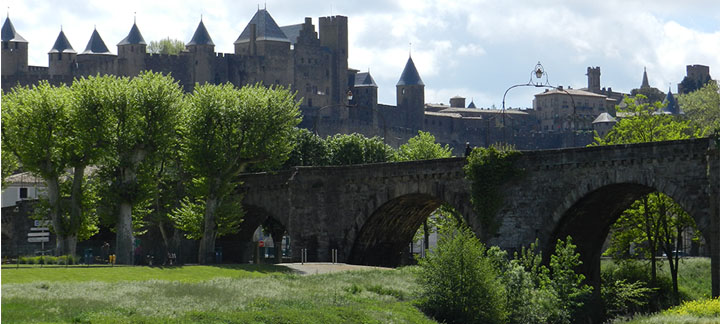
Carcassonne (Wikipedia Commons)
Carcassonne’s history as a settlement dates back to about 3500 BCE. There was the Roman colony Carsac on the same site in 100 BCE. Carcassonne has been occupied by Romans, Visigoths, Saracens, and Crusaders. The beginning of what was to become the largest existing walled city in Europe started in the 3rd Century with the Romans fortifying their outpost with walls. Through the centuries the fortifications continued to grow and expanded to today’s huge citadel with two massive outer walls three kilometers in length with 52 towers and barbicans. One of these towers housed the Inquisition in the 13th Century and is still known as ‘Inquisition Tower’. There are drawbridges, portcullis, arrow slits, and machicolations (murder holes – basically holes in the ceilings to drop rocks on people’s heads) to defend the fortress. Portions of the film “Robin Hood: Prince of Thieves” (1991) with Kevin Costner and Morgan Freeman were shot in and around Carcassonne. In 1997, le Cité de Carcassonne was added to UNESCO’s list of World Heritage sites.
Tracy, Alan, and Kiara in front of le Cité de Carcassonne
Carcassonne has a current population of about 48,000 residents (somewhat smaller than Carson City’s 55,000) and consists of three distinct areas.
1.) Le Cité de Carcassonne, the historic fortified citadel located at the top of the hill on the right bank of the River Aude. Le Cité is home to museums, restaurants, shops, and hotels.
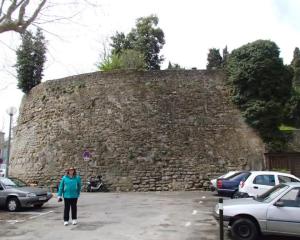
2.) The Ville Basse (the lower town) or le Bastide de Saint-Louis is located on the left bank of the River Aude. The Ville Basse, our current home, is an irregular hexagram with narrow streets in the typical grid layout of the 13th Century. The Ville Basse has historic reminders of it’s former walls with three of the town’s four original bastions at the town’s corners and the impressive medieval Jacobin Gate (Porte des Jacobin).
3.) The new town. The modern city and suburbs that has grown around the original medieval city .
Tracy in front of one of Carcassonne’s Ville Basse’s remaining bastions
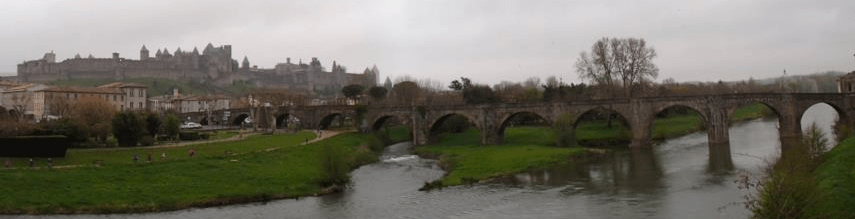
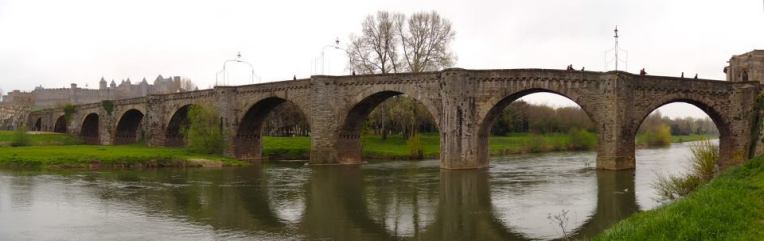
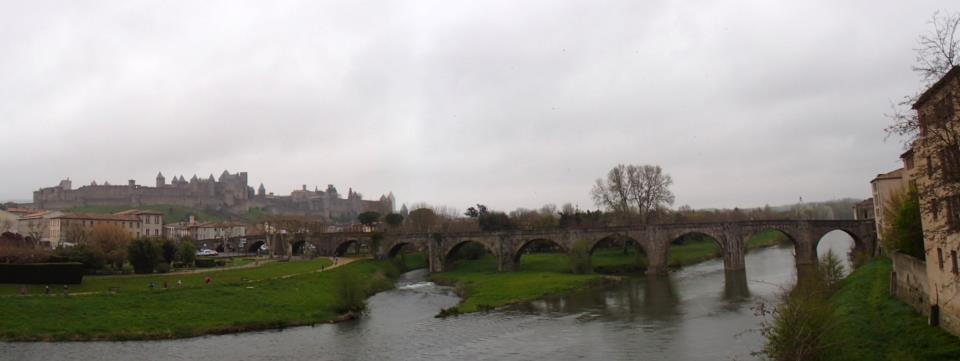
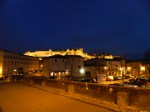
We are enjoying our new home in the Ville Basse. At the end of our block is Pont Vieux (the old bridge), the stone bridge built with its twelve semi-circular arches in the early 1300s. This pedestrian bridge crosses the River Aude and leads up to le Cité de Carcassonne. The parks on both the left and right banks of the Aude are Kiara’s favorite places to walk and play.
Du Pont Vieux
In Carcassonne’s Ville Basse we have been finding many new favorite spots, one of which is La Petit Moka with its outdoor seating and great coffee. Near our apartment is Square Gambetta, host to a rotating variety of special events including open air markets, new car shows, and flea markets. The Musée des Beaux Arts (Museum of Fine Arts) is at the west end of Square Gambetta inside an 18th century hôtel.
Carcassonne Map
The town square, Place Carnot, is home to the open air market on Tuesdays, Thursdays, and Saturdays, where we shop for fresh fruits and vegetables The square has a fountain of Neptune at the center and a grandstand at one end. Its perimeter is lined with cafes and shops. Place Carnot is a perfect location for people watching and a morning café creme, an afternoon café, or an evening pichet de vin (carafe of wine). Interesting historical note: during the French Revolution and Reign of Terror, four people were guillotined in the Place Carnot. Nowadays, our favorite coffee place La Petit Moka is there.
Place Carnot
At the north end of the Ville Basse is the Gare de Carcassonne (train station) and the section of the Canal du Midi thatflows through Carcassonne.The Canal du Midi, like Le Cité de Carcassonne isa UNESCO World Hertiage Site, it is a 225 mile long network of navigable waterways linking the Mediterranean to the Atlantic through 328 structures (locks, aqueducts, bridges, and tunnels.) Built between 1667 and 1694 ,the Canal du Midi paved the way for the Industrial Revolution in France. There are now recreational barge cruises on the canal.
Canal du Midi
To the south of the Ville Basse, is the Jacobins’ Gate, Porte des Jacobins, a remaining example of the four former gates when the Ville Basse was still surrounded by a wall. The Jacobins’ Gate is registered as a historical monument. Outside the gate are fountains and gardens.
Jacobins Gate
Our apartment is located one block west of Square Gambetta, approximately six blocks from Place Carnot and 1/2 block from Pont Vieux. A 20-minute walk from our front door will find you at either the train station (Gare de Carcassonne) or Le Cite (the citadel) depending on whether you head north or south. The Jacobins’ Gate is less than 5 minutes from our apartment.
How Carcassonne originally got its name is lost in antiquity.
However, there is a favorite local folk tale about how le Citéde Carcassonne got its name in the legend of Madam Carcas.
According to one version of the legend, in the 800’s Emperor Charlemagne’s troops surrounded le Cité in an attempt for the Frankish king to seize the city for his own. Knowing the fortress of le Cité was impenetrable, Charlemagne’s troops laid siege to starve the occupants out of le Cité. The siege continued for years and years with food stores in le Cité eventually running desperately low. Just when food supplies were nearly exhausted and it looked like a surrender of le Cité was the only option, Madam Carcas had the very last of the city’s grain force-fed into one of the remaining pigs. The pig was then thrown over the battlement down at the troops below. The pig hit the ground and burst open from being so over-stuffed with grain. Charlemagne’s troops despaired that even le Cité’s livestock was still being fed grain and the occupants had enough food that they could waste it by throwing surplus food at the troops. If after years of siege le Citéstill had those kinds of food reserves, there was no hope of starving the city’s occupants out of the fortress. Charlemagne withdrew his troops and Madam Carcas taunted the troops by yelling, “Carcas te sonne!” or “Carcas is calling you!” In appreciation for saving le Cité, the town people changed the name of the town to “le Citéde Carcassonne.”
None of this story is historically true, but never let the truth get in the way of a great tale. Around 100 BCE le Cité was a Roman colony already known as Carcasum.
But the legend of Madam Carcas is a great story and maybe the origin of the phrase, “When pigs fly?”
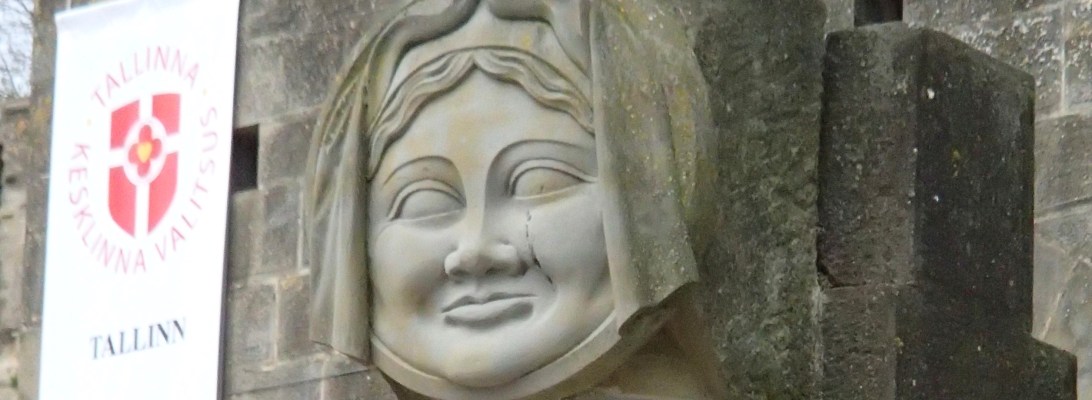
Regardless of facts, today there is a sculpture of Madam Carcas welcoming visitors at the entrance of le Cité de Carcassonne.
With a little more than a week in residence, there are a few observations I have made. It will be interesting to see if those observations remain true over time.
1. I can’t tell you how often I’ve been asked about French men wearing berets. Here in 2013 France I have only seen one older man, in Charles De Gaulle Airport, wearing a beret and I don’t know whether or not if he was actually French. The only other berets I have seen are the red military berets worn by members of the French 11th Parachute Brigade, 3rd Marine Infantry Parachute Regiment ( 3e Régiment de Parachutistes d’Infanterie de Marine, 3e RPIMa), a French Army paratrooper unit stationed here in Carcassonne. I did see two young French men in uniformed service with Kepi caps and train conductors wearing service caps. As a whole I would say most French men seldom wear hats at all during this time of year. If there was currently an iconic piece of French menswear during this time of year I woud say it is short scarfs tied with a Parisian knot.
2. Seldom do you see coffee in a “take-away” cup. Coffee culture here is such that you get your coffee in a ceramic or glass cup with the intent that you will savor it either sitting at a table or standing at the bar. Here coffee is a little harder to locate than in Italy were there were at least two coffee bars on every block.
3. However, in France it seems that there is at least two bakeries, boulangeries, on every block. The smell of fresh baked bread will make you detour to get a better whiff of the aroma. Bread appears to be king and you really do see people carrying their loaves of baguettes home. Bread is made without preservatives so it seldom lasts more than a couple days. And yes! The French pantries from the local pâtisserie really are as delicious as their reputation.
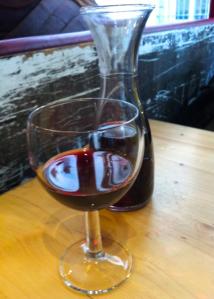
4. The local table wine by the carafe, un pichet de vin de maison, is always a good choice. Inexpensive and available by the quarter, half, or full liter carafe it can make a meal or just a break in the day more enjoyable. Blanc, rouge, rosé, surprisingly rose’ wine is a respected wine choice here.
5. It is true that French people are more reserved and formal. One will get an odd look if you wish a stranger a bonjour while walking down the street. But it is expected and polite to say bonjour and au revoir when entering or leaving a shop or restaurant. Please and thank you, s’il vous plaît and merci, are a necessary part of our vocabulary. But we have also found French people to be extremely friendly and helpful. Not as many people here speak English as we found in Italy, but all are patient with our broken French, pantomime, hand signals, and pre-translated notes. Attempting to speak French is normally greeted with a smile and an attempt to speak some words of English back.
6. The “reserved and formal” aspect of French behavior will often melt in the face of a two pound Chihuahua. Kiara is often greeted with smiles, praises, and even kisses. She is an amazing icebreaker in a sea of formality.
7. At least in this time and place we are frequently seen by French people as “generic English speakers” and most often mistaken as being from the United Kingdom. We assume the majority of English speaking visitors here are from the UK. We haven’t met any one that can differentiate a British from an American accent yet.
8. French people take great pride in their work. Baristas, wait staff, ticket agents, sales people, conductors, information desk staff all have a great work ethic and try to completely satisfy you. They often add personal touches above their basic job tasks. I was watching a window washer clean windows with a perfectionist’s attention. It seems the attitude was a job is required to be dome completely and right the first time. The éclairs that I picked up on the run today were exquisitely wrapped and in a precisely sized box, like a gift from Nordstrom’s at Christmas time.
9. Amazing the conventions you take for granted. Keyboards here are not the “QWERTY” style and surprisingly difficult to use after years of typing in the US. The hand sign for “one” is not the index finger, but the thumb. The French start counting with the thumb. Holding up an index finger will make a counter person assume “two.” Good table service is being left alone to enjoy your meal. Your coffee or meal “rents” you your table for as long as you want it. If you want your bill you need to request l’addition.
10. It is much quieter here. The volume is at a very genteel level in restaurants, stores, on the train, or walking down a city street. The volome of speaking is at a much quieter level. There is still the outburst of laughing, children playing, and public dispute between people, but in all the general tone of conversation is closer to what we expect in a library.
Some people learn by watching others, some people learn by reading and doing, some of us learn by trial and error. Here are today’s lessons:
Our daily routine has suffered a bit being nine hours off of a lifetime schedule. We have found over the last few days that naps help, but that we also get up at the ungodly hour of 3 a.m. when we have had one. That being said, this morning at 6:30 a.m. we found out several truths about making friends with our neighbors.
1: 3 a.m. is an unreasonable time for any living person, over the age of 30, to be wide-awake.
2: 6:30 a.m. is an unreasonable time for any living person, who is retired, to be wide-awake.
3: Being wide-awake for hours on end in the dead of night does not help one make good decisions.
4: Breakfast at 6:30 a.m. is a reasonable idea if:
a: one remembers that one is not alone in the building
b: one remembers to turn on the fan above the oven
c: one remembers to not burn anything when the fan is off
d: one has the slightest clue where the shut off switch is to the smoke alarm
Lesson 1: One does not make friends, in France or elsewhere, by waking them up at the horribly early hour of 6:30 a.m. with a screaming alarm for nearly 20 minutes. Suffice it to say that we are extremely blessed that no one called the fire department as we do not have the language skills to explain ourselves.
Lesson 2: When moving into a new apartment learn how to turn off things that make loud noises.
Lesson 3: Turning off the main power switch from the circuit breaker does not cut the power to a hard-wired smoke detector with a battery backup.
Lesson 4: A man of 6’4″ and a cane of 3’4″ does not equal enough height to remove the battery from the smoke detector of an apartment with 15 ft ceilings.
The award for French faux-pax #1 goes to the Husband. And I must add that even after 20 minutes of trying to silence the smoke detector my eggs were wonderful if just a bit chilled. Tomorrow we should try them again without the alarm!!
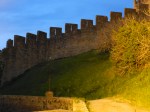
Our first visit to La Cite was quite an experience . . . and we still haven’t made it past the second wall! La Cite is a double-walled fortress here in Carcassonne and it is quite magnificent. It sits atop a hillside east of our apartment across the Pont Vieux (old bridge). The walls are well over three feet thick and dwarf anyone standing near them. It doesn’t take long for you to start imagining yourself as the leader of an army attempting to gain entry into this fortress.
La Cite has over 3 kilometers of outer wall, nearly 1.6 miles, and we wandered through approx. 500 yards in all on this first visit. We headed over from our apartment about 20 minutes before sunset and approached the avenue that goes up the hill to one of the entrances between the two outer walls. From our vantage point we could see seven of the 52 towers on the outer walls.
The wall was built over centuries and it is apparent even with this first visit that the architecture of the times changed throughout the building process. We noted both romanesque and gothic arches built within a space of a few feet of one another. Overall the outer wall appears very romanesque in design which makes sense since most of the walls were built over the original Roman foundations from approx. 100 BC.
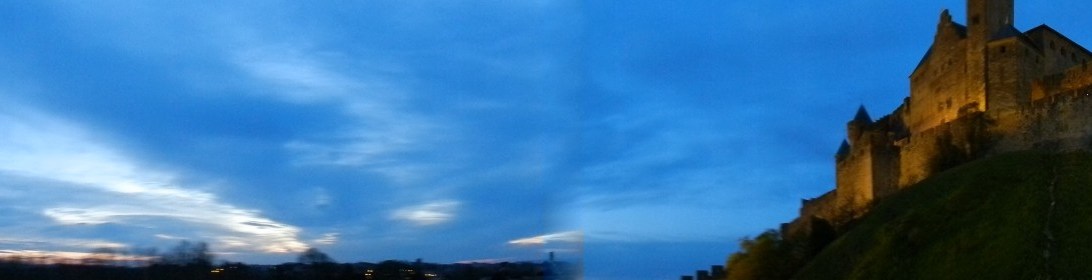
The colors are amazing in the early evening, the sky is very, very blue and the grassy hillside is very, very green which gives La Cite an almost cartoonish feel of color, especially in photographs.
While we were exploring we met a group of people on their way to the round tower to the left of area we were exploring and on our way back home, we noted there were flames and fire spinning and drumming happening in that open turret.
Not a bad first experience.
View of one of the towers through the Gothic arch.
Steep cobblestone path to the first outer wall.
Lower arm of the outer wall, part of the original entranceway into La Cite.










 An Italian Point Of View