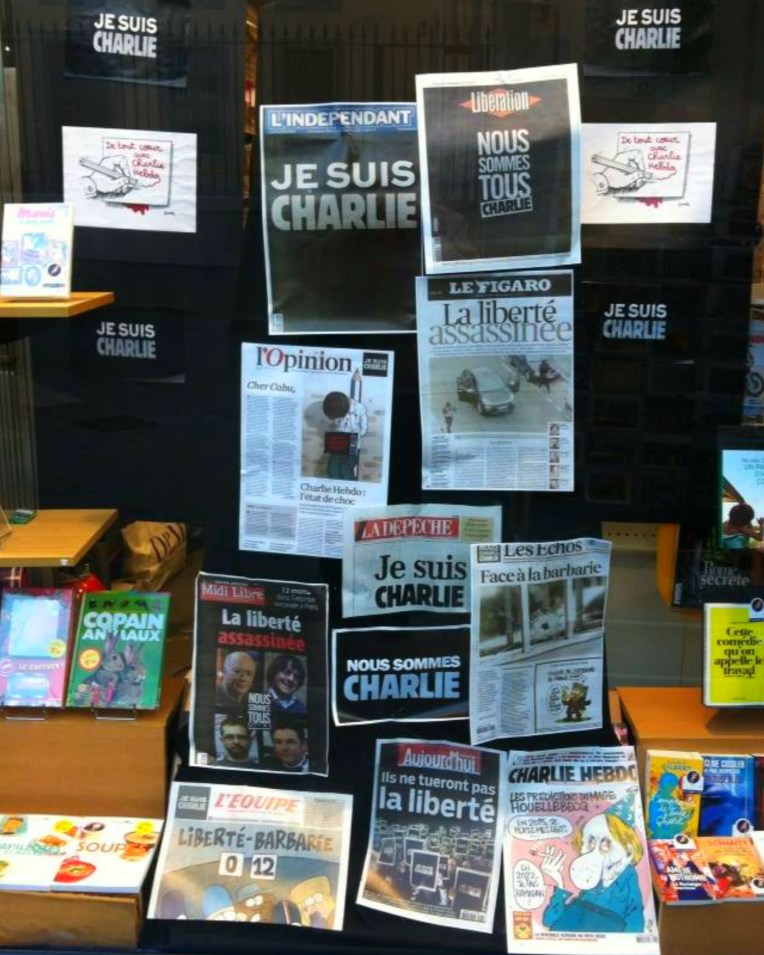
After the mass murder of 12 people at the Charlie Hebdo magazine office in Paris on January 7, 2015, there has been an outpouring of support for the Freedom of Expression and journalism, whether satire or straight news reporting, in France. It started as a hashtag on Twitter of #JeSuisCharlie (I am Charlie) to show support to the victims and survivors of this terrible act of terrorism. #JeSuisCharlie soon moved to the front page of newspapers around the country and to people and businesses posting “Je Suis Charlie” in their windows. We were pleased to see “Je Suis Charlie” posted around Carcassonne which has also hosted Unity Rallies advocating free expression and in memory of the victims.
#JeSuisCharlieNewspaper shop display for #JeSuisCharlie
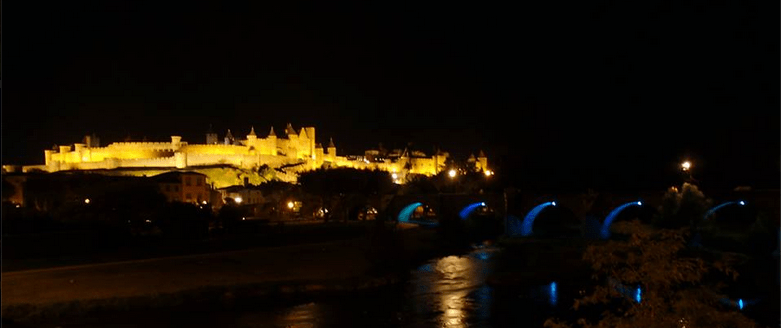
After visiting Paris and Normandy we finally had the opportunity to share with Deb and Gerry our home in Carcassonne and to walk up the hill from our apartment to explore the medieval double-walled city, la Cité de Carcassonne. We enjoyed the three kilometers walk around the walls of la Cité, viewed its 52 towers, saw the count’s château, and visited the many shops, restaurants, and hotels within. The citadel of la Cité is a UNESCO World Heritage Site.
For Tracy and I it is, “The view that never gets old.”
Deb, Gerry, Tracy, Alan, and Sami the MinPin at the Aude gate of la Cite de Carcassonne
This slideshow requires JavaScript.
We took advantage of having a car to see one of the many Cathar castles that are scattered throughout the region, the ruins of the Château de Montségur. It is a legacy of the Albigensian Crusade (1209–1229), a 20-year military campaign initiated by Pope Innocent III to purge the Cathar sect from the Languedoc region in the south of France. The ruins of Montségur are at the top of 1,200 metres (3,900 feet) pog (an Occitan word meaning “peak, hill, mountain”) near the start the Pyrenees Mountain range.
The trip had the double purpose of “warming up” Tracy and Deb for their upcoming trek on the Camino de Santiago across Spain.
After their climb to the top of Montségur, we headed over to the town of Mirepoix. The small village of Mirepoix has managed to retain the classic architecture and charm of its original town square but with updated shops and businesses. The city is known for its overhanging arcade which has 150 individually carved wooden heads. A quaint place for a relaxing afternoon.
This slideshow requires JavaScript.
The time had come to split up. We drove to St. Jean-Pied-de-Port to deliver Tracy and Deb at the traditional start of the Camino Francés of the Camino de Santiago, the 1200 year old pilgrimage route of the 800 kilometers (500 miles) long Camino de Santiag0 (The Way of Saint James). Deb was limited to only having two weeks to hike, so they planned to walk the first 164 kilometers (102 miles) over the Pyrenees Mountains and through the Basque country of Navarreto Logroño, Spain, then skip ahead by train to Sarria, and finish the last 107 kilometers (67 miles) hiking through the Galicia region to Compostela de Santiago.
Gerry and I (with a continuous “comedy of errors” of finding our way along the French highways) continued on to Paris (after a brief overnight stop in Limoges.) Gerry and I enjoyed a final evening in Paris with a “Steak frites” (Steak and French fried potatoes) in the Montmartre district in the 18th arrondissement. We admired the sight of the Basilique du Sacré-Cœur, watched the unruly crush of bicycles, scooters, motorcycles, cars, trucks, and buses work their way (miraculously without a single collision) through the intersection near the Avner Métro station, and had a final ice cream. The next morning Gerry took the RER B to Charles DeGaulle Airport for his flight back to California and I caught The RER A to Marne-la-Vallée – Chessy and my Ouigo TVG train home to Carcassone.
Deb and Tracy in St. Jean-Pied-de-Port at the start of the French route of the Camino de Santiago.
“I thought to see fair Carcassonne, that lovely city—Carcassonne!” ~ Gustave Nadaud
Our return flight from Rome to Marseille via Ryanair went as smoothly as the initial flight. However we did have some concerns since the French rail strike was still going on. But our train was one of the 60% still scheduled and running. At the “moment of truth” the train arrived and we had our assigned seats waiting for us with no overcrowding. All in all we had been extremely lucky working around the national rail strike.
This slideshow requires JavaScript.
We enjoyed the trip west along the Mediterranean coast and made it back to our current home in Carcassonne.
This slideshow requires JavaScript.
We took a day to hike to the top of Château de Montségur is a former fortress located about 80 kilometers (50 miles) southwest of Carcassonne near the Pyrénées mountains and the Spanish border. The ruins are the site of a razed stronghold of the Cathars. The fortress is referred to as one of the “Cathar castles” that gave shelter to Cathars during the Albigensian Crusades.
This slideshow requires JavaScript.
We also visited the nearby village of Mirepoix which has a substantial medieval ambience.
This slideshow requires JavaScript.
Casey and Megan were finally able to catch up on some much-needed rest in Carcassonne and enjoy the vacation part of their trip. And Casey discovered Ricard pastis as a traditional summer-time French beverage. At the end of their stay (with the rail strike finally over) Casey and Megan took the train back to Paris for a two-night stay with tickets for a day at Disneyland-Paris. Knowing he is a big fan of Mickey, it was our birthday present to him.
This slideshow requires JavaScript.
We waited until the last possible minute to warn them that there was talk of an air-traffic controller strike. Our silence paid off as at the last-minute the strike was culled down to only 10% of planes and limited to those going to other European countries. The kids made it to the airport and their British Airways flight without suffering through any more of France’s transportation worker strikes.
All in all it was a fantastic visit. We enjoyed meeting Megan and seeing Casey. We were overjoyed to finally being able to congratulate him in person for his university completion. The kids followed up their visit with a nice long Skype date so that we could meet their daughter, Izzy. The best thank you ever!
We were able to watch a part of the internationally renown Tour de France bicycle race. Leg 16 started in Carcassonne.
Tour de France Logo (Wikimedia Commons)
The 101th running of the Tour de France’s stage 16 raced through Carcassonne literally a half block from our apartment. This stage was the longest of the 2014 race with 237.5 kilometers (148 miles) from Carcassonne traveling west up through the Pyrénées mountains and finishing in the village of Bagnères-de-Luchon near the Spanish border.
Tour de France 2014, Stage 16 (Reuters)
The Tour de France was actually two events for us. The first was a parade of sponsor’s floats, called the Tour de France Caravan at 8:45. Dozens of cleverly designed floats drove by throwing novelties, t-shirts, hats, and samples.
This slideshow requires JavaScript.
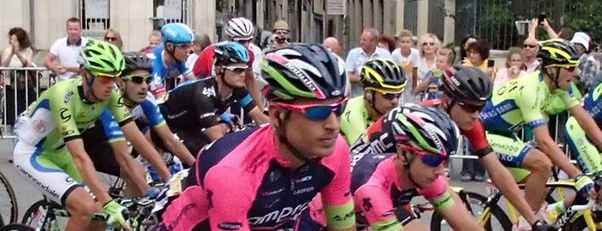
At 10:45 the racers (followed by their support vehicles) sprinted past as they circled the town and headed west. We got to see the traditional yellow jersey on Italian bicyclist Vincenzo Nibali at the head of the pack of the 22 teams. Although this was the mass start at the beginning of the race with careful riding through the narrow, twisting city streets, the entire pack of nearly 200 racers past us in less than 20 seconds. We were cheering for US racer Tejay van Garderen who was in sixth place overall. Thirty-four year old Australian Michael (‘Mick’) Rogers used his experience to climb the five peaks and power through the 237.5 kilometers (148 miles) to win this stage with a time of 6 hours, 7 minutes, 10 seconds.
This slideshow requires JavaScript.
After the chase cars, there were support trucks, motor coaches, and media mobile broadcast trucks.
We had a great morning experiencing in-person an event that has been exciting the world for over a hundred years. We are also anxious to learn if Vincenzo Nibali will be the overall winner when the Tour de France’s concludes this weekend.
Tracy at the Tour de France 2014Route of the 2014 Tour de France. (Wikimedia Commons)
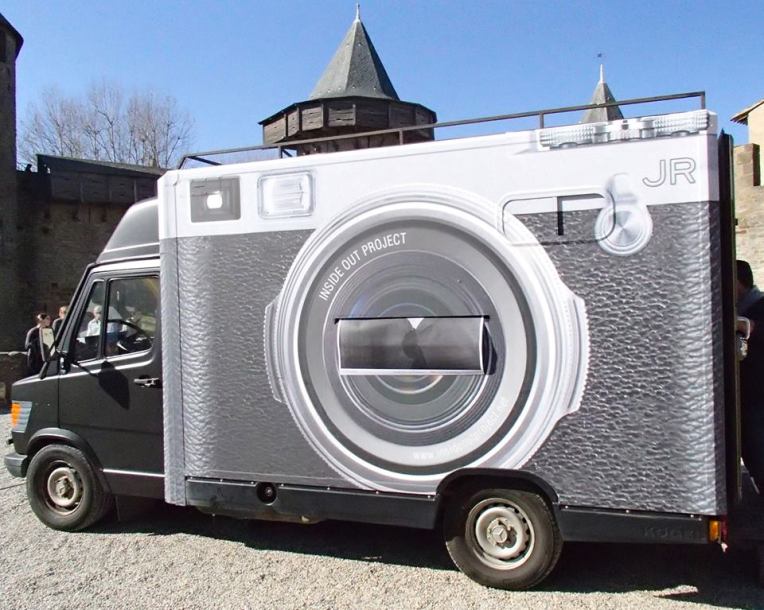
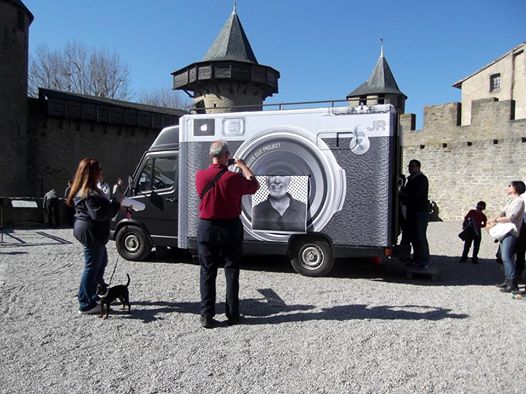
Tracy and I participated in the Au Panthéon Photo Project that is visiting 8 national monuments in France collecting portraits of visitors to later use as an art project of portraits covering the enormous scaffolding system that will be surrounding the Pantheon in Paris during its renovation this year. The Centre des Monuments Nationaux commissioned contemporary artist JR to create a participatory work inspired by his Inside Out projects, “encapsulating the humanistic and universal values embodied by the Pantheon.”
Mobile Photo Booth for Inside Out Project
From March 5 to 29, The Inside Out project’s unique mobile photo booth is visiting the Basilica Cathedral of Saint-Denis near Paris, home to the royal necropolis and its collection of 70 sculpted recumbent statues; the medieval city of la Cité de Carcassonne; Angers Castle, home of the Apocalypse tapestry, the largest known tapestry from the Middle Ages; the Carnac Megaliths near the Morbihan Gulf, the largest group of standing stones in the world, a key place in European prehistory; the three towers of La Rochelle, facing the Atlantic as some of the most important medieval maritime fortifications; the Palais du Tau in Reims, the royal and episcopal residence associated with the coronation of 32 French kings; the Savoye villa à Poissy and its modernist architecture by Le Corbusier; and returning to the Pantheon in Paris, the masterpiece of the architect Soufflot, located on the Montagne Sainte-Geneviève. People unable to come to one of these locations may still participate by taking a photo at home and uploading it to http://www.au-pantheon.fr/en/.
According to the Au Panthéon website, “The portraits that best represent the diversity of the contemporary world will be used to create a mosaic that will be visible around the drum beneath the dome, and on certain places within the monument. The aim is to use all of the portraits in the final work. It will be inaugurated on Tuesday 22 April 2014.”
During our visit the mobile photo both produced poster-sized prints of our images like a giant Polaroid camera. We added out photos to the temporary mosaic of photos on the sidewalk outside the barbacane surrounding the Château in La Cite De Carcassonne. Although there was a lengthy line to participate in the free process, we had a great time visiting with an American expats family from Oregon currently living outside Aix-en-Provence, our upstairs apartment neighbor and her friend also visiting from Oregon, and a French women recently returned from Miami where she was working for an US company. Sami the MinPin enjoyed the attention from the crowd as well.
Some of the 288 portraits taken in Carcassonne, including ours.Tracy, Sami, and Alan photographed by the local newspaper, Midi Libre, at the Au Panthéon event.
Since we have plans to be in Paris in June, we are looking forward to seeing the finished art project and possibly even our own images displayed at the Pantheon.
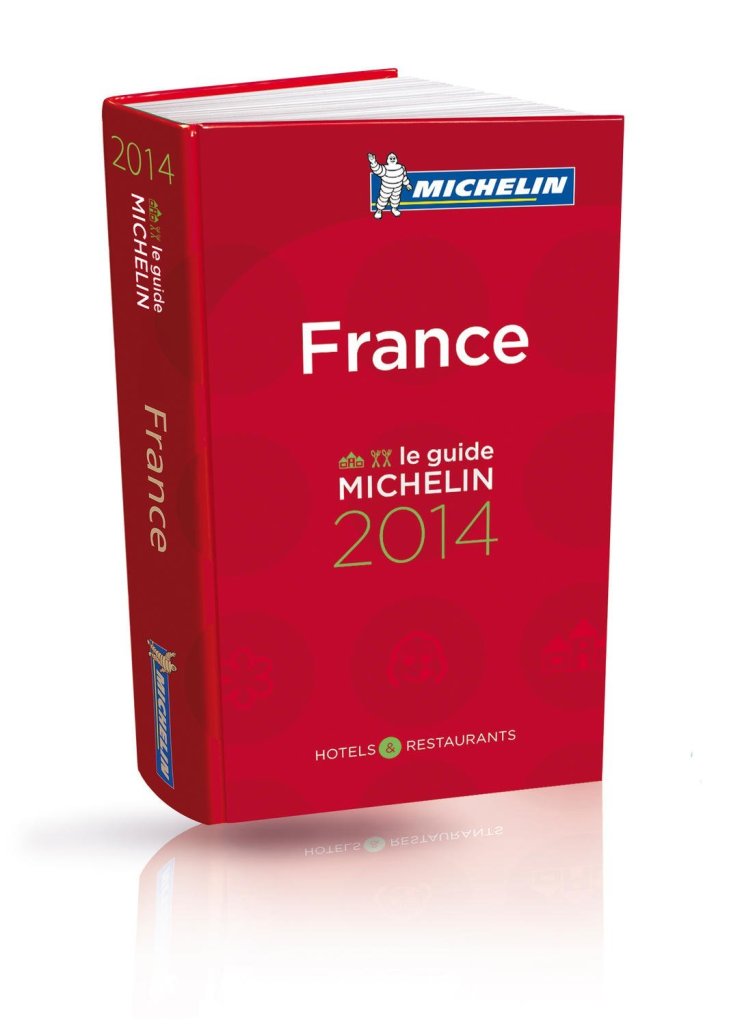
The 2014 Michelin Guide was just been released and that is big news in France. (Michelin Guide to Restaurants.) National and local newspapers have been publishing articles about the restaurants that have earned or lost stars, the process of Michelin’s restaurant inspectors, the inspectors’ unpublished criteria, the growing number of women chefs on the list, and the state of fine dining in the world. (Food Buzz: Michelin Guide France 2014.)
It has been said that France anticipates the annual gastronomic “red guide” with its ratings the way the US looks forward to the Academy Awards. World renowned French chef Paul Bocuse, who has been honored by the Culinary Institute of America as Chef of the Century, once said, “Michelin is the only guide that counts.” French Chef Bernard Loiseau in 2003 committed suicide in part because of rumors that his restaurant was to be demoted from three-stars to two.
Michelin Guide France 2014
France now has 27 three-stars restaurants (one new addition this year), 79 two-stars restaurants (six new additions), and with the addition of 57 new restaurants for 2014 there are 504 one-star restaurants. (A Complete List: France’s New Michelin Star Diners.) For comparison, there are 10 three-stars restaurants in the US: 7 in New York, 2, in San Francisco, and 1 in Chicago. There are another approximately 230 two and one-starred rated restaurants also in the US. (The Michelin Guide: Making Top Chefs Reach For The Stars.) Japan actually has more three-stars restaurants than France with 28, a matter causing indignation with the Michelin Guide for many French.
The “star” ratings means:
* * * Three stars reward exceptional cuisine where diners eat extremely well, often superbly. Distinctive dishes are precisely executed, using superlative ingredients. Worth a special journey.
* * Two stars denote excellent cuisine, skillfully and carefully crafted dishes of outstanding quality. Worth a detour.
* One star indicates a very good restaurant in its category, offering cuisine prepared to a consistently high standard. A good place to stop on your journey.
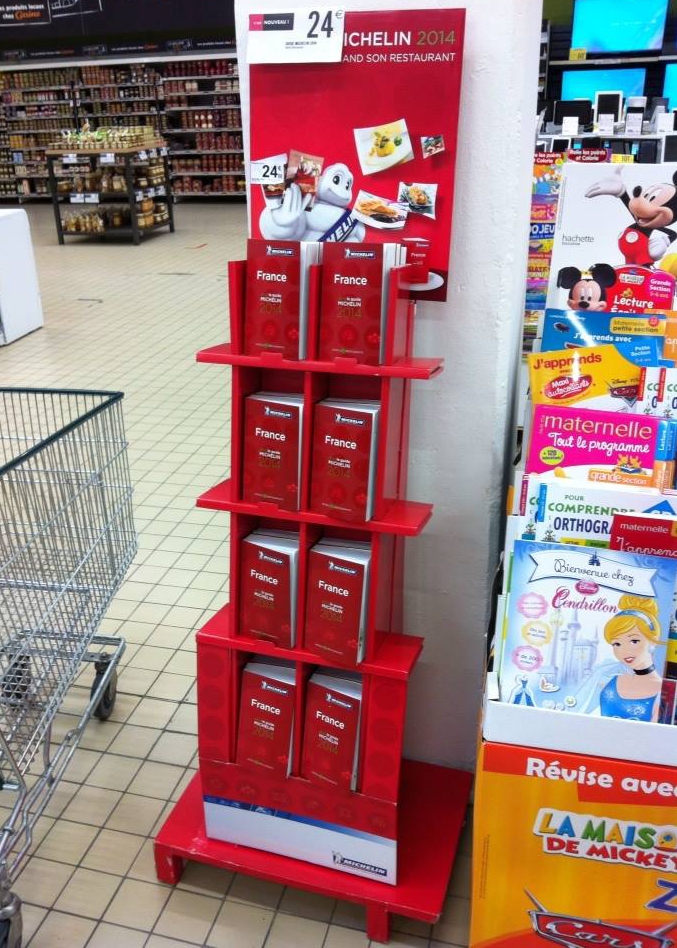
I was grocery shopping at the local supermarché and was surprised to see a display of the red-covered Michelin Guides. Apparently the Michelin Guide isn’t a specialty text for “foodies” and gourmands but a required best-selling reference for everyday people in France.
Michelin Guide Display
Our local Michelin “starred” restaurants near Carcassonne are:
Parc, Two-stars, Chef Franck Putelet, 80 Chemin des Anglais, at the base of hill below the medieval le Cité de Carcassonne.
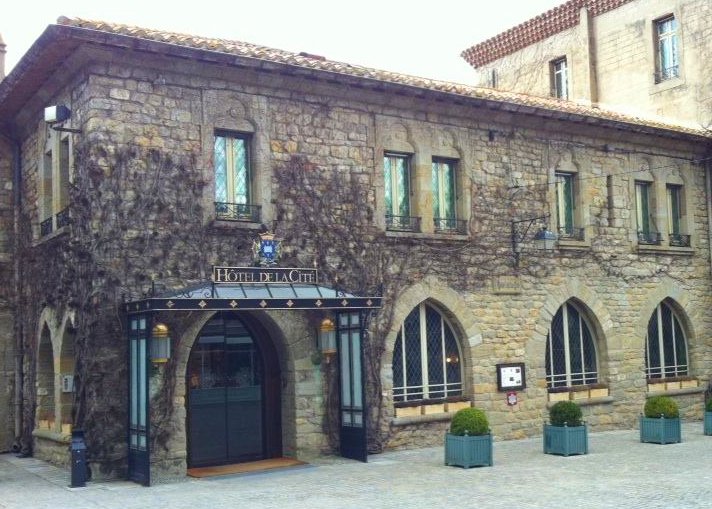
La Barbacane, One-star, Chef Jérôme Ryon, located in Hôtel de la Cité within the walls of the medieval citadel of le Cité de Carcassonne.
Hôtel de la CitéLa Barbacane
Le Domiane d”Auriac, One-star, Chef Philippe Deschamps, Route de Saint-Hilaire, at the edge of Carcassonne.
La Bergerie Aragon, One-star, Chef Fabien Galibert, 12 kilometers North of Carcassonne in the village of Aragon.
Le Puits du Trésor, One-star, Chef Jean-Marc Boyer, 12 kilometer north of Carcassonne in the village of Lastours. Above the village are of the few original Cathar castles left.
L’Ambrosia, One-star, Chef Daniel Minet, 8.5 kilometer north-west of Carcassonne.
So which Michelin rated restaurants have Tracy and I experienced in France? At this point none, although we are considering several for special occasions like our anniversary.
While lunches at many of these elite establishments are not outrageously expensive, dinners can have a substantial cost. La Barbacane’s lunch with wine and coffee is now priced at €36 each, about $100 total with today’s exchange rate. La Barbacane’s current seasonal dinner – Gnocchi Parisienne Gaude Mornay in Beaufort with cream and truffle stew Magnatum Pico; Black winter truffle salad, bread and truffle chicken jus; Scallops Jacques Breton with Mélanosporum truffle, potato Pays de Sault and cream leeks sauce “carbonara;” Veal shank confit and stuffed milk Orloff nuts, smoked ham and Comté old heart endive with truffle; Truffled cheese trolley; Pure Caribbean chocolate mousse and black truffles and light nuts nougat cream, and milk foam arlette – is €140 each, about $400 for the two of us. I’m not certain if beverages are included. Perhaps it’s like the old saying, “If you have to ask you can’t afford it.” A Michelin rated restaurant dinner is, for this retired couple on a fixed income, certainly a planned and carefully budgeted extravagance. In the mean time, we can admire culinary excellence from afar like admiring the latest model sports cars.
Good thing we love the take-out shawarma at the nearby Moroccan kebab restaurant while watching Anthony Bourdain and trying in the many small “holes-in-the-wall” cafes, brasseries, and bistros in Carcassonne.
Tracy and I are fast approaching our first anniversary of living in France. This anniversary requires that we renew our Residency Permit, our Titre de Séjour. Although the French government has been considering creating long-stay visa with a 4 year expiration date, those have not been approved yet. So for at least the first five years of residency, a Titre de Séjour must be renewed annually. (France Mulls Longer Visas for Expats.)
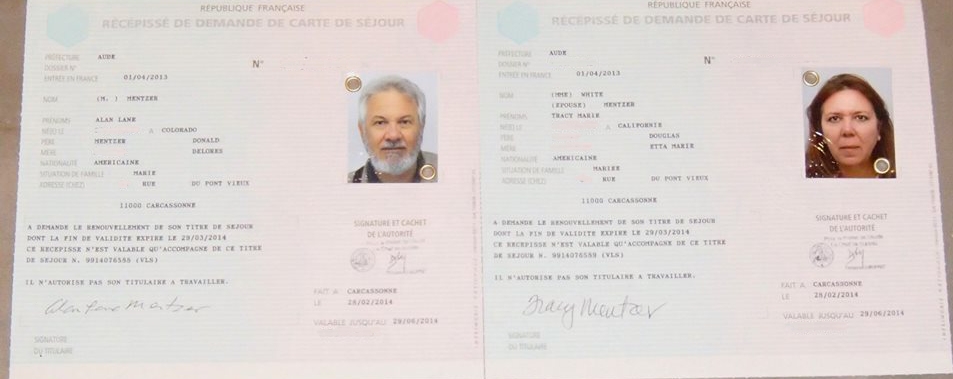
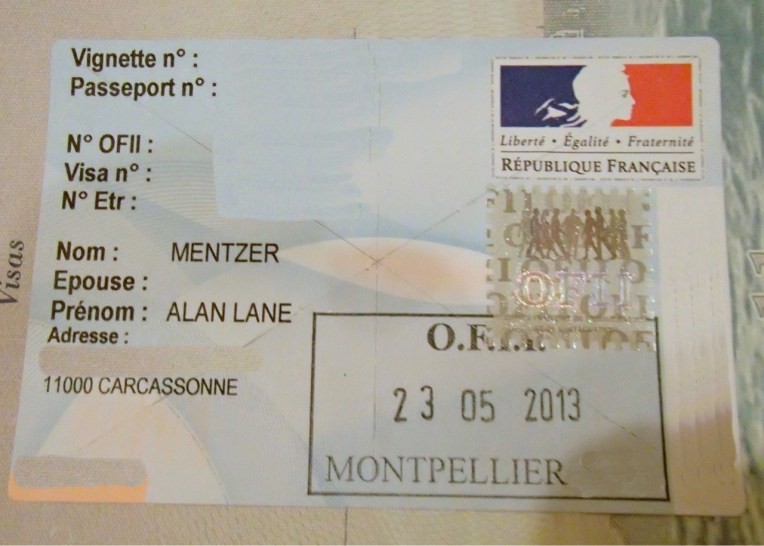
Titre de Sejour
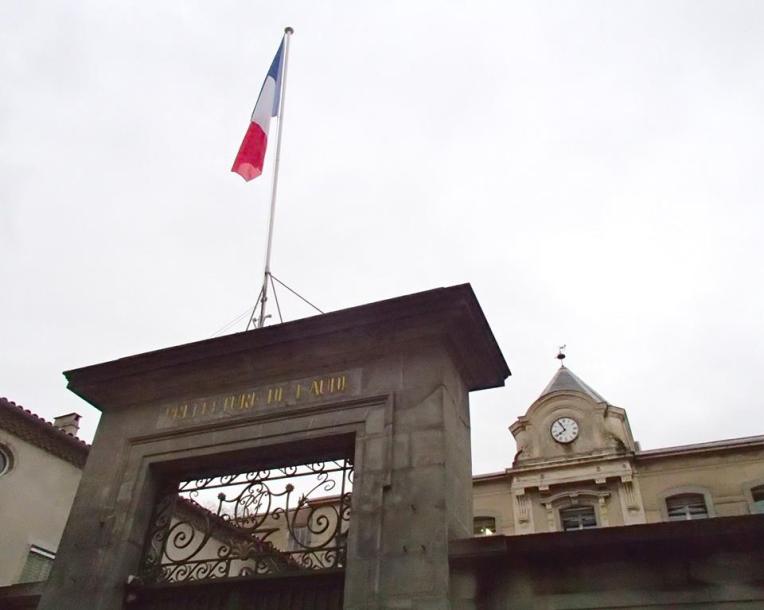
When we first arrived in France, we needed to immediately make appointments with the Immigration Office, OFII (L’Office Français de l’Immigration et de l’Intégration, in Montpellier for a review of our paperwork and a medical check up. (See our previous blog post OFII Medical and Titre de Sejour.) But our renewal needs to be submitted to the local Prefect Office having jurisdiction over the district in which we live rather than at the OFII . A Prefect Office is the representative of the French national government and Ministry of the Interior at the local level. Visiting the Prefect Office is like visiting a local “Federal Building” in the US. There are 101 districts in France, each with its own Prefecture. Since the city of Carcassonne resides within the District of Aude, our Prefect Office is the Préfecture de l’Aude. No train ride is required to another city like when we had to visit OFII in Montpellier. Conveniently for us, the Préfecture is located walking distance from our apartment at 52 Rue Jean Bringer in the historical Bastide of Carcassonne.
Préfets de l’Aude
The Préfect de l’Aude is located within the former Bishopric Palace of Carcassonne’s Catholic Diocese that was originally built in 1760. The Prefecture Office was moved into the building after the establishment of the French Consulate system of government after 1799.
PRÉFECTURE DE L’AUDE À CARCASSONNE
Although Tracy and I haven’t yet had any difficulties with the legendary French bureaucracy (in fact government offices have been surprisingly helpful and efficient to date) I wanted to get started early to hopefully “head off” any potential problems.
In January 2014, three months before our Titre de Séjour’s expiration date, I went to the Prefect Office to pick up a renewal form and make an appointment. I wanted enough time to allow for requesting documents from the US and their mailing time. It’s a pretty building, but “government offices” are “government offices” around the world with the feel of waiting at the DMV or Social Security office. I was given a number and directed to the waiting area. While sitting in the waiting room I had a nice conversation in English with an Italian expat and his Australian girlfriend. He was helping her renew her residency. Sadly, they were called in by their representative before I could learn many details of their immigration experiences. But I was also quickly called in to see my representative. She did not speak English, but between my pre-translated request letter and fledgling French I was able to pick up the application and make a return appointment for February 28.
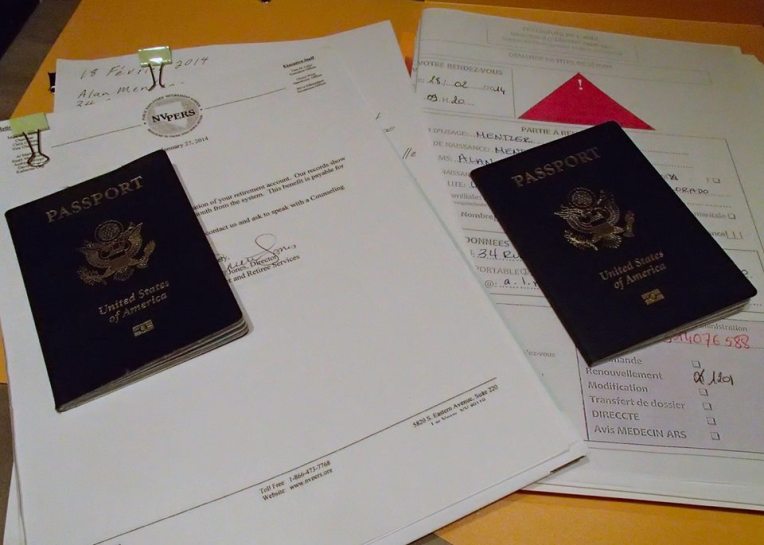
The renewal application was a single page asking for our name and address in France and a list of supporting documents with only nine items. The application asked us to bring the original documents for the Prefect to inspect and photocopies to submit with the application form . Of the nine items on the supporting documents list, 0ne item doesn’t apply, two overlap, and two are “stationery” items. It appears to be a simple process. In addition to the application form we also needed to produce:
Applications and supporting documents
1. The current Titre de Séjour, residency permit, to be renewed. Our initial Titre de Séjour is actually a “sticker” that OFII attached to a page in each of our passports (which are required as Item 2.)
2. US passport valid through the end of the visa.
3. Any documents of changes in civil status (marriage, divorce, widowed). This does not apply as there had obviously been no changes in status for either of us.
4. Proof of financial independence. Documents that prove we are financially stable and independent. We have bank statements, letters of recommendations, and pension statements.
5. Statement of honor (Attestation sur l’Honneur) in our handwriting that we will “not to exercise any professional activities” in France without prior authorization. Basically a statement that we will not be working or seek ing employment in France. We located an online a sample letter of the correct format to use and translated our letters into French.
6. Proof of domicile by evidence of a recent electricity bill. Jason, our landlord, provides utilities as part of our rent so we do not have an electricity bill. Jason was kind enough to provide the apartment’s power bill, his identification information, and his own Attestation sur l’Honneur to verify our residency as his tenants.
7. Four passport photos taken at the convenient photo booth at the local Monoprix supermarket.
8. Stamped, self-addressed envelope.
9. Tax Stamps (timbres fiscaux) for payment in the amount of €106 each. The timbres fiscaux were purchased at a local convenience store, a tabac, designated to sell tax stamps.
Tax Stamps (timbres fiscaux)
Tracy, the queen of organization, prepared our individual dossiers of application forms and supporting documents that follows the list right down the line.
We arrived at the Préfect about 10 minutes early for our appointment and were given slips with numbers, but escorted directly to the Residency Permit office. There was a young couple completing their appointment ahead of us. It was obvious from the discussion and body language that they had apparently came to their appointment without all their necessary documents and were sadly leaving empty-handed.
Tracy and I were invited into a cubicle and our Préfect representative very professionally went through our application and dossiers of supporting documents. It was obviously she was very pleased with Tracy’s organization and efficiency with the presentation. Our representative did require “proof of civil status” which we wrongly assumed we didn’t need since there had been no change. However we also brought to the appointment our “mobile file cabinet” binder/briefcase with originals of all our essential documents and we were able to produce the marriage certificate that our representative required. She allowed me to make a quick photocopy and add it to our applications.
At the conclusion of our appointment the representative gave us each an elaborate Récépissé de Demande de Carte de Séjour, a receipt that allows us to continue to live in France until final disposition of our applications by the Préfect.
The representative also gave us an e-mail address at the Préfect to contact after 30 days to inquire if our Cartes de Séjour have arrived for pick-up at the Préfect. My understanding is that the renewal (if granted) that will replace our initial Titre de Séjour, residency permits “stickers” and would be issued in the form of an identification card, a Carte de Séjour . Think of the Carte de Séjour as the French equivalent of an US Citizenship and Immigration Services’ (USCIS) “Green Card,” although a “Green Card” represents permanent residency in the US and this Carte de Séjour will need to be renewed again in another year after issue.
From beginning to end the entire appointment took 30 minutes. Our representative was friendly, helpful, and very efficient. Overall it was as good of an experience as possible aided, I believe, by our efforts to be well prepared and organized to help make our representative’s job as easy as possible. Now we wait for the next 30 days and hope for a positive answer to our requests.
February 2014 brought the traveling photography exhibition, Le Transporteur d’Images (“Carrier of Pictures”), to Carcassonne. The Transporteur d’Images is a mobile art gallery based in a converted river barge that is sailing on the Canal du Midi. The 150 mile long (241 km) Canal du Midi was built in the 17th century and connects with other rivers and canals to create a continuous waterway from Mediterranean to the Atlantic Ocean. The Canal du Midi, has been designated a UNESCO World Heritage site since 1996.
Map of Canal du Midi. (Image courtesy of Wikimedia Commons)
Captain Frédéric Journo with crewman/artist Gauthier Fleuri uses the traveling art exhibition as a method of creating awareness that historic trees lining the canal have been destroyed. Many trees along the route have had to be removed due to a spread of canker disease. Since setting sail from Sète in late July 2012, the Transporteur d’Images has raised €10,000 in donations for re-planting trees along this waterway with the sale of pictures, books, and posters.
Le Transporteur d’Images was one those unusual surprises that makes living in Carcassonne such a pleasure.
Our local version of Mardi Gras, the Carnaval de Carcassonne occurred over the weekend of February 15 (a few weeks early from the traditional Fat Tuesday – Shrove Tuesday start of Lent.) It was a wonderful combination of Burning Man, Carnival, and a Disney Parade starting at the town square of Place Carnot, through the streets of La Bastide, down the Rue de Verdun, acrossSquare Gambetta, down Boulevard Camille Pelletan to a final bonfire with masked ball under the stars starring five different bands at Le Dome. There were an amazing variety of costumes (ranging from medieval traditional, outrageous, risqué, modern, and child friendly), music, singing, dancing, with lots and lots of confetti along the way. (Tracy is still finding confetti that made it home.)
Carnaval de Carcassonne Poster
While not nearly as big as Mardi Gras in New Orleans, Carnival in Venice, or Carnival in Rio; the celebration had a “home town” flavor (like “Jack’s Carnival” or “Hometown Christmas” in Sparks, Nevada) and was major fun enjoyed by children and adults alike. The expected crowd was in excess of 16,000 people.
This slideshow requires JavaScript.
While the Carnival in Nice, Rio, New Orleans, and Venice are world-renowned, this was an exceptional event to attend especially because of the intimacy of a being a local celebration in a smaller city.
Alan and a traditional Masquerader at Carnaval de Carcassonne, 2014












 An Italian Point Of View