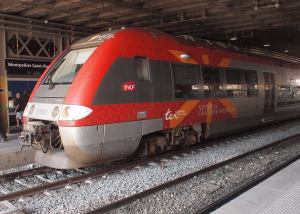
One reason we wanted to retire to Europe was to have a central place from which to “springboard” to explore many different cities in Europe. With Adam and Liz visiting we decided to do just that and spent a few days in Barcelona, Spain. We found that Adam and Liz share our interest the work of Antoni Gaudí so it was time to make some hotel and train reservations and head to Barcelona. It is only about a three-hour train ride to Barcelona from Carcassonne. The TER (Transport Express Régional) to Narbonne, the high-speed TVG (Train à Grande Vitesse) to the Figueres Vilafant train station (just inside the Spanish border) to switch into a RENFE (Red Nacional de los Ferrocarriles Españoles – Spanish National Railway Network) high-speed AVE (Alta Velocidad Española – Spanish High Speed) train. The RENFE train was beautiful and we enjoyed the use of the club car for ice-cold Spanish beer.
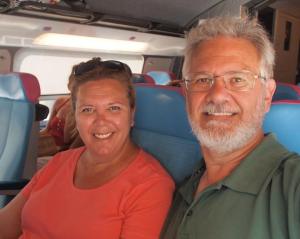
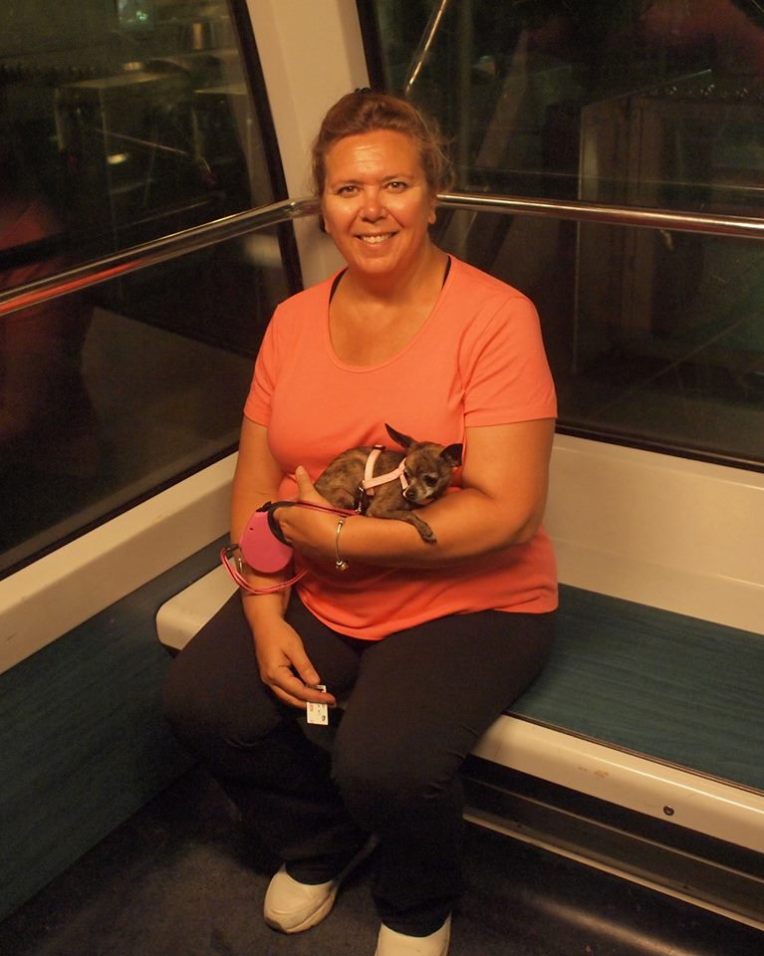
Adam and Liz on the TER train out of Carcassonne.Tracy, Alan, and Kiara on the TGV enroute to Spain.A Spanish RENFE AVE Siemens Velaro (left) and a French SNCF TGV Duplex (right) at Figueres-Vilafant Station (Wikimedia Commons)
In very little time we were in Barcelona, sharing a pitcher (or two) of sangria. Sitting on the Mediterranean Sea with about five million residents, Barcelona is the second largest city in Spain, the sixth most populated urban area in the European Union.
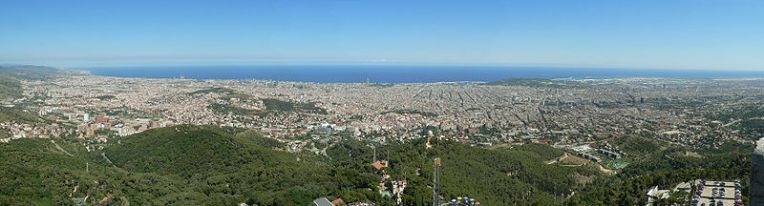
A panoramic view of Barcelona (Wikimedia Commons)
We decided that while Paris is beautiful, Barcelona is gorgeous. Stunningly gorgeous.
This slideshow requires JavaScript.
Adam led us to Parc del Laberint d’Horta (Labyrinth Park of Horta) in the Horta-Guinardó district in Barcelona. The park is the oldest of its kind in the city. Located in the former estate of the Desvalls family, next to the Serra de Collserola ridge, the park combines an 18th century neoclassical garden and a 19th century romantic garden. In 1967 the Desvalls family donated the park to the city of Barcelona, who opened to the public in 1971. Liz had always wanted to explore a maze and was looking forward to exploring the labyrinth, so we lined up behind her and had her lead the way.
This slideshow requires JavaScript.
Returning to our hotel room and realizing that it wasn’t cooling off very quickly, we decided to take an evening walk through Passeig de Gràcia, Plaça de Catalunya, and La Rambla. Passeig de Gràcia is one of the major avenues in Barcelona, it is compared to the Champs-Élysées, Fifth Avenue, and Rodeo Drive and is one of the most important shopping and business areas of Barcelona containing many of the city’s most celebrated pieces of architecture. Passeig de Gràcia is regarded as the most expensive street in Barcelona and in Spain.
Plaça de Catalunya (Catalonia Square) is Barcelona’s large city square and is considered to be the city center and the place where the old city and the modern city meet.
La Rambla is located off Plaça de Catalunya. The tree-lined pedestrian mall stretches for 1.2 kilometers between Barri Gòtic and El Raval, connecting Plaça de Catalunya with the Monumento a Colón (Christopher Columbus Monument) at Port Vell (the Old Harbor.) Even in the middle of the week there is tremendous energy and activity in the “Heart of Barcelona.”
This slideshow requires JavaScript.
The following day was all about exploring Gaudi’s art and architecture and his contributions to Barcelona.
With the temperatures reaching up into the 90s, we wanted to visit the Mediterranean with Adam and Liz. We tried to facilitate a SCUBA dive, but had difficulties getting connected to dive shops in Narbonne. So it was off to the beach for old-fashioned “sun and surf.”
The Narbonne Plage (Narbonne Beach) is one of several Mediterranean Sea beaches in the Languedoc-Roussillon region. Narbonne Plage is well west of the Côte d’Azur (known in English as the French Riviera) on the Mediterranean coastline in the southwest corner of France. The beach is 5 km of wide, fine sandy beach with a marina and restaurants. It is a public “locals’ beach,” or rather the “poor man’s” Riviera, with all the beauty of the Med without the extravagant cost of the Côte d’Azur.
We caught the regional TER (transport express régional) train from Carcassonne to Narbonne and then took one of the special summer buses to the beach. There were many other beach-goers on the bus with us. Surprisingly, Narbonne Plage is 25 minutes away from the train station, with a scenic view of central Narbonne and the Montagne de la Clape mountain range along the way.
Adam and Liz enjoying the Mediterranean Sea at Narbonne Plage
Fortifying ourselves with food and sangria (and a bit more sangria) we ventured out into the water. Beautiful sandy beach, very minimal crowds despite the full bus, warm water with a beautiful gradient of color from green to deep blue as the water gets deeper. There were lifeguard stations, lifeguards in Zodiac boats, and a police presence with swimsuit-wearing officers from the CRS Police (Direction Centrale des Compagnies Républicaines de Sécurité – Central Directorate of the Republican Security Companies; DCCRS).
While Tracy and I contented ourselves with wading, Adam and Liz splashed right into the sea for a swim. Wonderful day of water, walking the beach, investigating the marina, collecting shells, watching the surf fishermen, SCUBA divers (we knew there had to be divers there), and sailboats.
This slideshow requires JavaScript.
We took a different bus back toward the train station that normally stops several blocks away from the station. However, our driver very kindly drove us all the way to the bus stop at the train station.
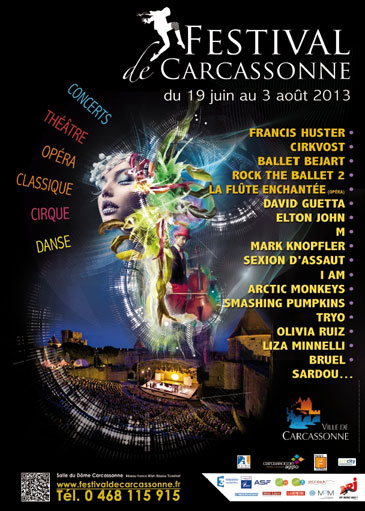
The Festival de Carcassonne (Carcassonne Festival) is one of the major cultural events for the South of France and is now one of France’s largest festivals with nearly 120 shows ranging from opera, dance, theatre, classical music, cirque, French and international popular music. More than 80 of the 120 shows have free admission. It’s Carcassonne’s version of Arttown with an emphasis on the performing arts. From the end of June to August, artists perform at 10 different venues, including the Roman theatre in the medieval fortress of la Cité de Carcassonne.
Festival de Carcassonne
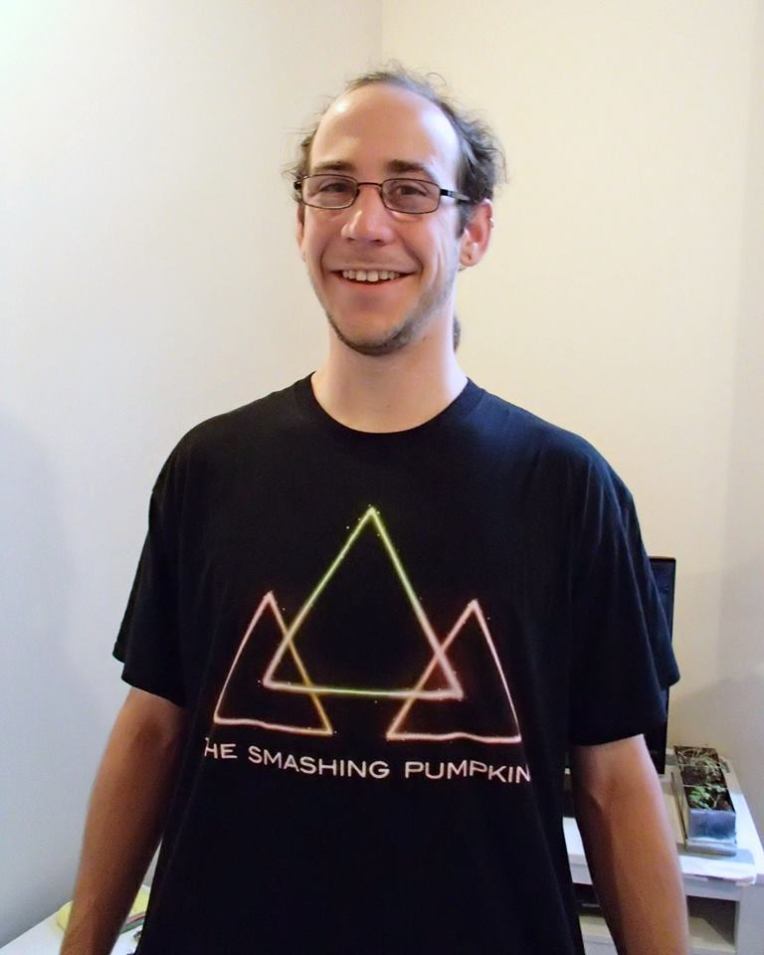
Adam and Liz just happened to be visiting us over Adam’s birthday. As Karma would have it, one of Adam’s favorite bands, Smashing Pumpkins, was performing in Théâtre Jean-Deschamps insidela Cité de Carcassonne for Festival de Carcassonne on Adam’s birthday. The only “band shirt” Adam brought on this trip just happened to be from Smashing Pumpkins’ “Zero” tour.
Adam wearing his Smashing Pumpkins’ Zero shirt
Smashing Pumpkins was performing at the Festival de Carcassonne as part of their European “Shamrocks and Shenanigans 2013” tour. The universe had spoken and Adam and Liz were going to spend the evening of Adam’s 22nd birthday watching Smashing Pumpkins perform in the former Roman amphitheater of la Cité’s Théâtre Jean-Deschamps within the citadel’s fortified walls and in the shadow of the Basilique Saint-Nazaire-et-Saint-Celse de Carcassonne (Basilica of St. Nazaire and St. Celse.)
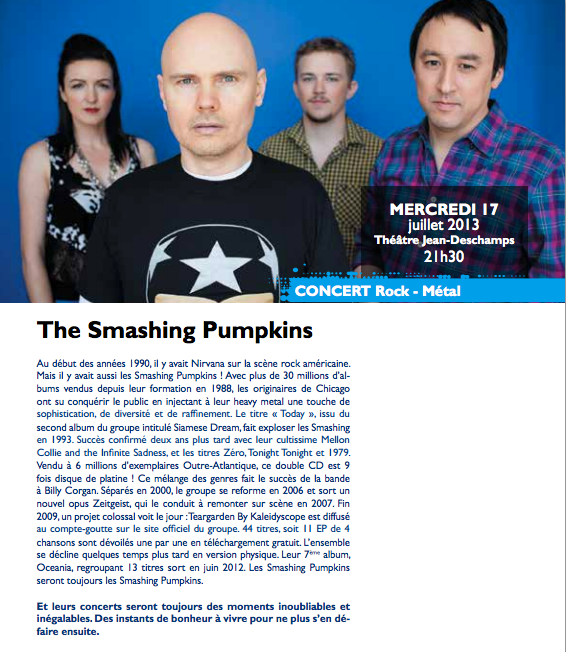
Smashing Pumpkins’ program page for Festival de Carcassonne
Adam and Liz arrived early at the theater to wait in line and were rewarded with seats in the second row from the stage. While standing in line they had a long discussion with an English-speaking French couple from Toulouse about the music scene in Europe.
Liz and Adam pointing out a Smashing Pumpkins sign in Place Carnot
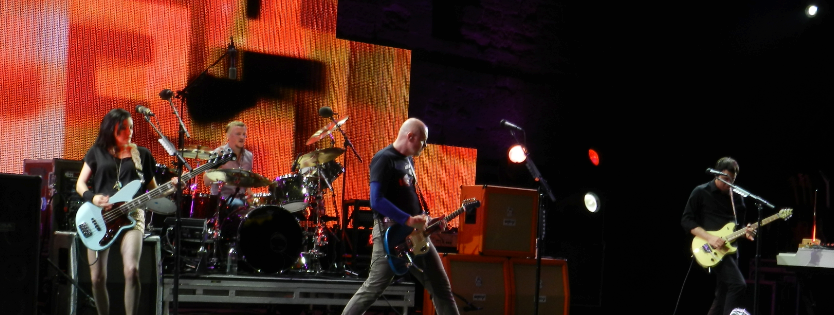
Adam and Liz had a great time at the concert, right up front to the stage, and they captured some great photos of the performance.
This slideshow requires JavaScript.
And, of course, afterwards Liz got Adam a “Shamrocks and Shenanigans 2013” concert tour shirt for his birthday.
Adam in a Smashing Pumpkins’ “Shamrocks and Shenanigans” tour shirtAdam in a Smashing Pumpkins’ “Shamrocks and Shenanigans” tour shirt
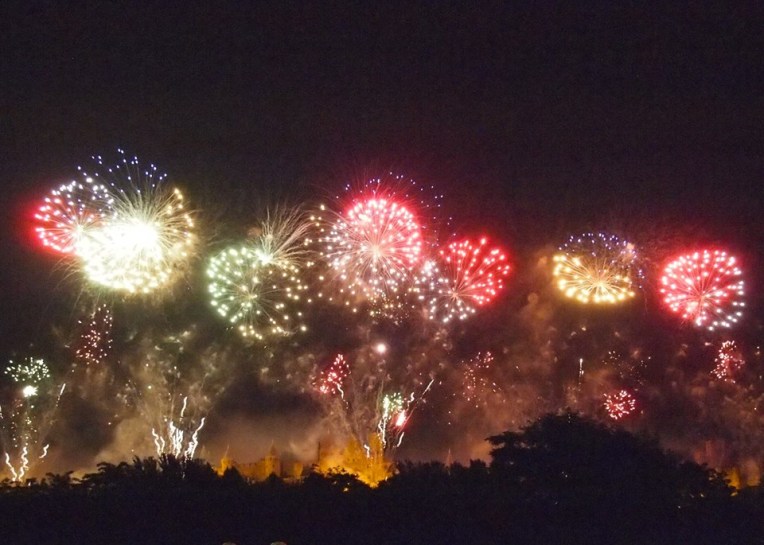
The La Fête Nationale (Bastille Day) fireworks in Carcassonne are famous throughout the world. In a beautiful medieval setting, the fireworks are lit among the ramparts and, as they shoot into the sky, they light the city below. The display has become extremely popular since its inception in 1898, with more than 700,000 people attending the festivities each year. It is the largest fireworks display in France with a full 25 minutes of pyrotechnics including “Burning the Cite,” immersing the medieval city of la Cité de Carcassonne in a red glow like the city is under siege and on fire.
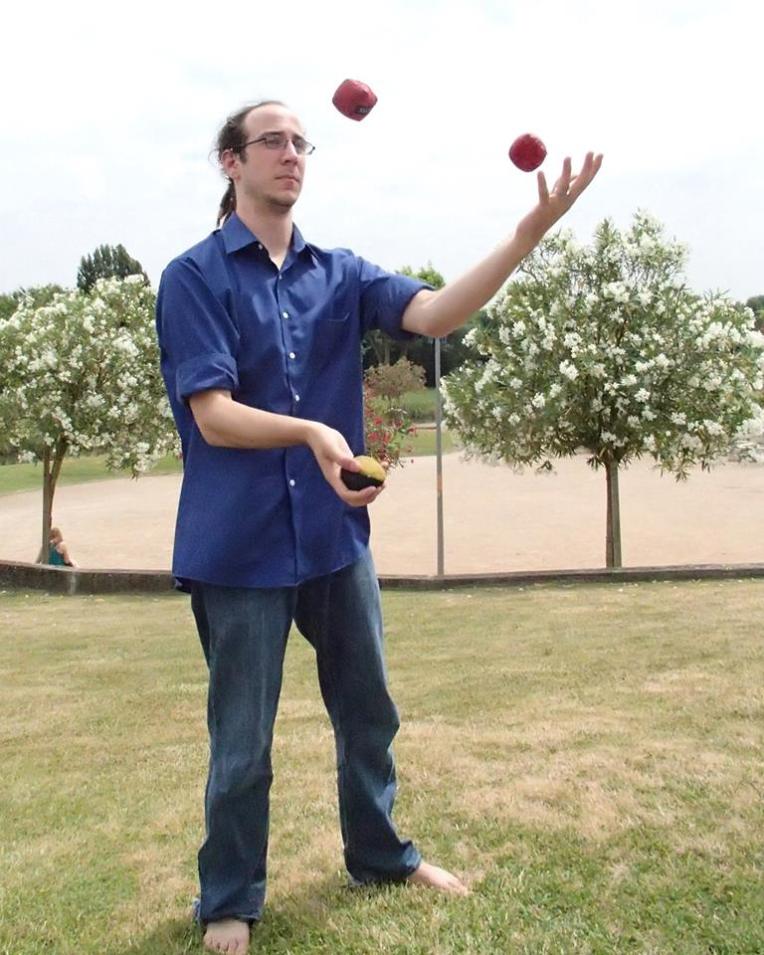
Tracy, Adam, Liz, Kiara, and I watched from the banks of the river Aube along Quai Bellevue. We arrived early and enjoy a picnic, Adam Juggled for the crowd, watch people play petanque, Kiara was doted on, drank wine, and we chatted with our neighbors while waiting for the fireworks to start. A festive and friendly atmosphere.
La Fête Nationale (Bastille Day) is the French national holiday commemorating the storming of the Bastille on July 14, 1789, a pivotal event the anti-monarchy revolution.
Liz, Adam, Tracy, and Kiara enjoying a picnic while we wait for the fireworks to start.Adam juggling for the crowd while waiting for the fireworksFireworks over the medieval city of la Cité de Carcassonne
With Adam and Liz newly arrived in Carcassonne, they had an opportunity to attend one of the many events that seem to be happening all year-long. Their first event was at the medieval city of la Cité de Carcassonne: the 25ème Tour de l’Aude des Voitures Anciennes en Pays Cathare (25th Annual Tour de l’Aude Vintage Car Rally through Cathare Country.) Eighty plus cars from 1914 to 1945 of the most prestigious brands (Delage, Delahaye, Rolls Royce, Talbot, Bugatti …) from all over Europe. Like “Hot August Nights” for vintage European cars (plus a few US cars like a classic Mustang and Cadillac.)
Tracy, Liz, and Adam at the 25ème Tour de l’Aude des Voitures Anciennes en Pays Cathare (25th Annual Tour de l’Aude Vintage Car Rally.)Liz and Adam at the Narbonne gate of the medieval city of la Cité de Carcassonne
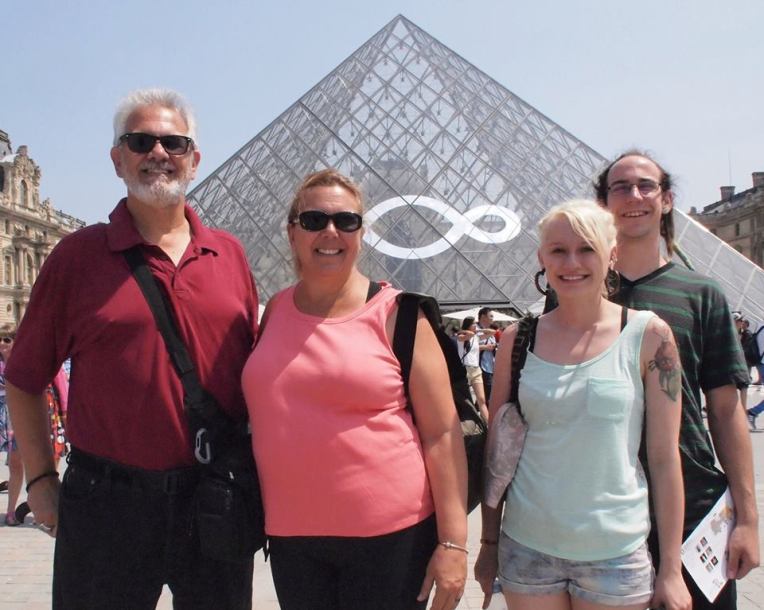
Off and rolling to the Louvre with pre-paid tickets in hand. The Musée du Louvre (the Louvre Museum or simply The Louvre) is one of the world’s largest museums with nearly 35,000 objects from prehistory to the 21st century exhibited over 652,300 square feet. Located on the Right Bank of the River Seine in the 1st arrondissement, the Louvre receives more than 8 million visitors a year. The Louvre is the world’s most visited museum.
Like the Smithsonian Institute, it would take days to see everything in the Louvre, we elected to see specific galleries in order to see more of the rest of Paris. That makes a good reason to return to the Louvre again (and again . . . and again.)
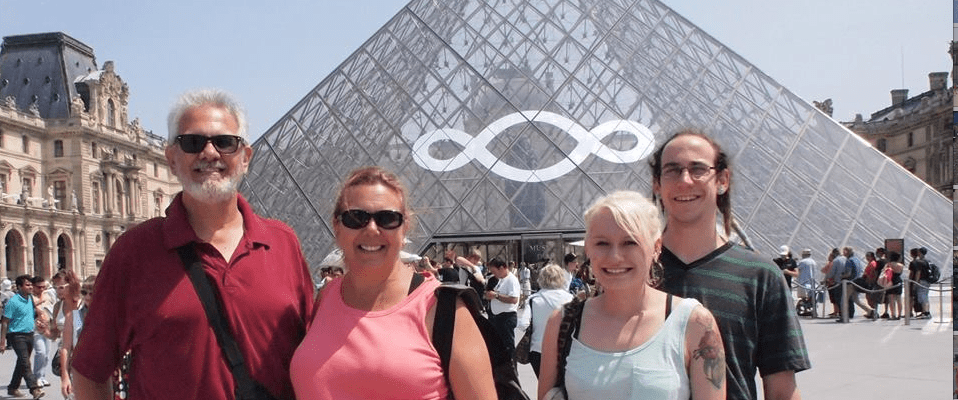
Alan, Tracy, Liz, and Adam in front of the Louvre pyramid.
What hasn’t been said about one of the world’s seminal museums that is located in a former royal palace and holds many of the world’s iconic pieces of art? The Louvre is amazing in its depth of art, artists, media, and history.
After accessing the Louvre’s entrance through the underground Carousel du Louvre shopping mall (with a minor delay when security screening were briefly bewildered by Adam’s juggling balls), Adam was our guide through the Louvre. So hard to narrow down choices, but included in our visit was (of course) the Mona Lisa, the Winged Victory of Samothrace, the Venus de Milo, and the Code of Hammurabi. We visited the art of Ancient Greece, Mesopotamia, and the Renaissance.
This slideshow requires JavaScript.
Adam and his fiancée Liz participated in Europe’s growing “Love Lock” phenomenon. Spreading across Europe is the new tradition of leave a padlock, often engraved or marked with lovers’ names to a famous landmark. On the Pont des Arts bridge across the River Seine, Adam left a lock to commemorate his and Liz’s visit to the “City of Lights.”
Adam putting a lock on the Pont des Arts bridge to memorialize his and Liz’s trip to Paris.
This slideshow requires JavaScript.
Now the Métro to the Avenue des Champs-Élysées, Paris’ most famous street. A cross between Rodeo Drive, Fifth Avenue, Regent Street, and Saville Row; lined with chestnut trees leading west to the Arc de Triomphe de l’Étoile. The Arc de Triomphe (Triumphal Arch) is dedicated to those who fought and died for France in the French Revolution and Napoleonic Wars with the names of all French victories and generals inscribed on its surfaces. Beneath the Arch is the Tomb of the Unknown Soldier from World War I. Access to the Arc de Triomphe is by underground passage under the traffic circle surrounding Place Charles De Gaulle.
Tracy, Liz, and Adam under the Arc de Triomphe and in Front of the Tomb of the Unknown Soldier
This slideshow requires JavaScript.
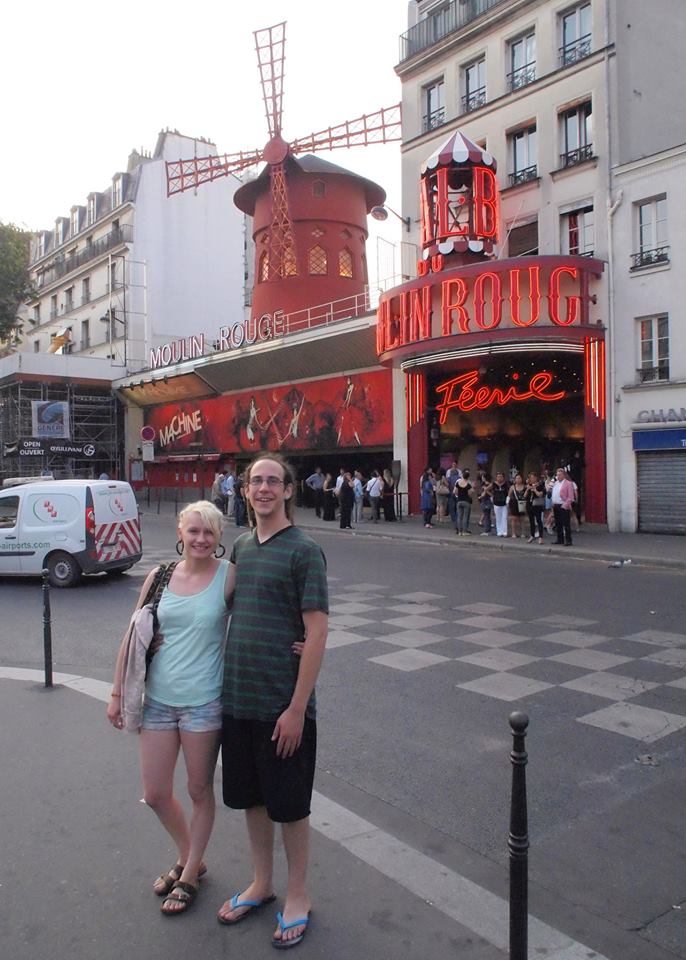
End of a long day and back to the Montmartre district for dinner. We tour down the Boulevard de Clichy and see both elegant and dive establishments along the lane. We have dinner across the street from the famous Moulin Rouge (Red Windmill) cabaret, famous for the Can-Can, Toulouse-Lautrec, and the 2001 Academy Award winning movie of the same name.
Liz and Adam in front of the Moulin Rouge
This slideshow requires JavaScript.
After dinner it was off to see the view of Paris from Sacré-Cœur Basilica at the top of Butte Montmartre . All in all a great day for everyone with frequent stops along the way to sample some of the wonderful Parisian wines at local bistros throughout the city.
A project I started in the first few weeks after we arrived in Carcassonne was setting up a French bank account. This wasn’t the same as those people you read about in the news with numbered foreign bank accounts in Switzerland, the Cayman Islands, Bermuda, or Luxembourg as a tax dodge. Our intentions is to follow the financial rules and to stay under the $10,000 maximum balance in a foreign account that would require a FBAR, or “Report of Foreign Bank and Financial Accounts,” Treasury Form TD F 90-22.1 be filed with the US IRS.
We wanted a French bank account for three common sense reasons.
The first reason was that to minimize foreign transaction and conversion fees from our US bank. An international wire transfer currently has a flat $35.00 fee compared to being “nickel and dimed” with withdrawals and conversion fees every time we patronize French ATMs and businesses with our US bank cards. Being on a fixed income we want to minimize the monthly fees that we can control. It would be less expensive for us to transfer one larger amount of cash into a French bank account and use a local debit card for purchases.
Secondly is that France was one of the innovators of the “Chip and Pin” style, EMV credit/debit card. (EMV is Europay – Mastercard – Visa, a global standard for integrated circuit cards and “IC” card capable “point of sale terminals” and ATMs used to authenticate credit and debit card transactions.) While a traditional US style cards will work in many ATMs and at some businesses in France, many businesses will only accept the “Chip and PIN” style card or not understand how to “swipe” a traditional US card. We wanted greater flexibility in our day-to-day life and our US bank is not issuing “Chip and PIN” cards yet. Regular US cards (with some exceptions) are not scheduled to transition to “Chip and PIN” EMV technology until 2015-2017. On their recent visit to France, Adam and Liz found their US cards worked at the ATM but not in restaurants or clubs.
Finally, there are times when technology fails and an ATM or business does not get a response back from international data lines and computers with US-based cards. We wanted a back-up in the event of sunspots, earthquakes, satellite outages, volcanos, undersea cable breaks, or the “Blue Screen of Death.” I like “belt and suspender” redundancy. We also wanted a backup in case our US card is lost or stolen.
The process of setting up a French bank account took about 12 weeks for us to complete from beginning to end. Because our US bank is Bank of America, we selected French bank BNP Paribas (the fourth largest bank in the world) who is Bank of America’s foreign partner in France. Because of this affiliation, Bank of America will waive some fees.
We made an appointment at the local BNP and met with a very helpful bilingual bank officer. The only snag was that she was bilingual in French and Spanish. (We are very close to Spain in Carcassonne.) Between our rudimentary French, my old police Spanish, basic Italian, Google Translate, and our bank officer’s very basic English we started the process for a bank account with the “Chip and PIN” style debit cards referred to as Carte Bleue. We left the meeting with the paperwork started, but we needed to return with additional documentation of our residency.
Between our first and second appointment to the bank we had our meeting with OFII (L’Office Français de l’Immigration et de l’Intégration – French Immigration) which (after a medical exam, chest x-ray, and application review) granted us our Titre de Sejour (resident permits) to upgrade our original visas.
Titre de Sejour
On our second appointment at the bank we brought photocopies of our Titre de Sejour and a detailed copy of our lease with rent receipts to prove our residency in Carcassonne. What our bank officer normally needed by bank policy was also a utility bill (gas, electricity, a land-line telephone) as further proof of residency at the address. We explained (often using pantomime, Italian, and pidgin French) that all the utilities were in our landlord’s name and without a local bank account we could not start a utility account. After conferring with her bank manager the solution was found to send us a registered letter at our address to sign and return as final proof of residency. A very elegant and helpful solution. We appreciated that the bank’s management could “think outside the box” and work with our odd circumstances. In anticipation of the final approval by the bank manager, our bank officer finished the paperwork, assigned us an account number, and told us to return once the registered letter was signed to pick up the bank cards.
The registered letter arrived three days later which we signed and had the receipt sent back to the bank. Soon after claim tickets for our Carte Bleue debit cards arrived in the mail along with “Welcome Customer” letters from BNP.
Now for the confusing part. We went to the back to pick up the cards and were told that they hadn’t arrived from the manufacturer yet and to come back in a week. A week later we were told the same thing. The third week we were getting worried that with our inadequate French, we had missed a step in the process. Should we have made an initial deposit into the account before the bank would release the cards? The fourth week later we spoke with our Bank Officer who was able to convey that because of the internal electronics it takes the manufacturer four to six weeks to make the cards and asked us to be patient and the bank would call us when the cards arrived.
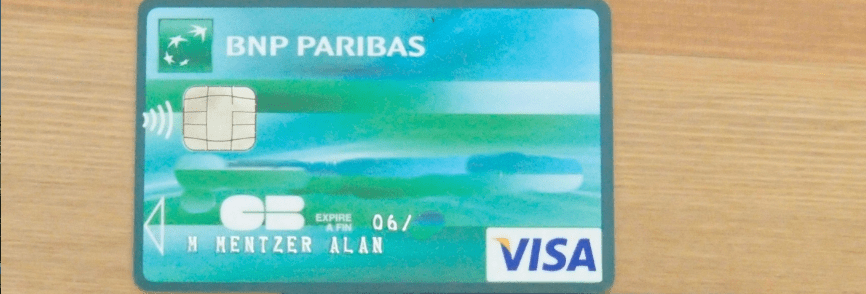
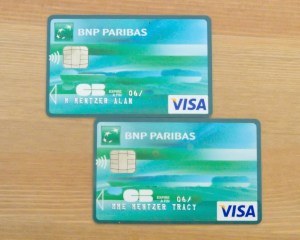
In the mean time our son Adam and his fiancée Liz arrived for a visit and we put the bank cards concerns on hold and had a great visit with them. The day after Adam and Liz left, we received a call from the bank (I stumbled through the telephone conversation in French) that our cards had arrived. After a short walk to the bank (with lunch on the way) we were proud owners of our Cartes Bleue and had officially established a functioning bank account in France. It took two appointments over six weeks and six weeks of waiting for the cards to be manufacturer and arrive at the bank.
Another small step in establishing our expat life in Europe. Now we will work on the online International Transfer process with Bank of America. We expect to have everything set up, validated, and our first wire transfer completed by the middle of August – just in time for our Camino trip!
We needed to pick up Adam and Liz from Aéroport Paris–Charles de Gaulle (Charles de Gaulle – Paris Airport – CDG). We were off on the Métro de Paris (subway) to the RER (Réseau Express Régional – Regional Express Network) “B” line to its final stop at the International Terminal at CDG. The airport is a city unto itself, it is the seventh busiest airport in the world, the second busiest in Europe, and handles in excess of 61 million passengers annually. Our fear was that we had never met anyone arriving at CDG before and had visions of Adam and Liz wandering in “airport limbo” for hours until we could locate them. However the airport staff was very helpful and we simply waited at the arrival gate for Delta for Adam and Liz to clear Customs and Passport control. Thirty minutes after their plane set down we saw their happy, jet-lagged faces.
Liz and Adam on the Paris MétroMétro de Paris (Subway) Sign
There are many approaches to dealing with jet-lag. Adam and Liz wanted to power through the day. So back on the RER and Métro to the hotel to drop off bags and then back on the Métro to Île de la Cité, the island the River Seine, to explore Cathédrale Notre-Dame de Paris (Notre-Dame Cathedral).
This slideshow requires JavaScript.
Notre-Dame is celebrating its 850 year anniversary. Cathédrale Notre-Dame de Paris (French for “Our Lady of Paris” – Notre-Dame Cathedral) is a historic Roman Catholic Marian cathedral located on the Île de la Cité. The cathedral is widely considered to be one of the finest examples of French Gothic architecture and is among the largest and well-known churches in the world. The cathedral’s treasury is notable for its reliquary which houses some of Catholicism’s most important relics including the purported Crown of Thorns, a fragment of the True Cross, and one of the Holy Nails.
This slideshow requires JavaScript.
The Cathedral’s stained glass windows were amazing and the quality of the colors has to be experienced to be believed. The Flying Buttresses on the exterior walls were graceful and added to the beauty of the exterior. We could have spent days exploring the architecture and art inside Cathédrale Notre-Dame de Paris.
After a quick lunch and several glasses of wine to fortify ourselves, we started walking along the Left Bank of the Seine heading toward Les Invalides. In retrospect the Métro would have been faster and easier on our feet, but every block held amazing architecture or public art.
This slideshow requires JavaScript.
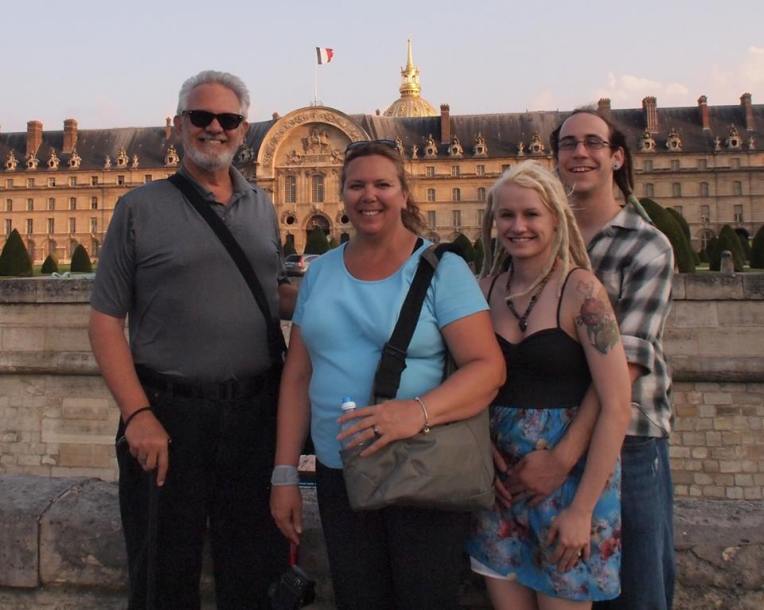
Finally reaching L’Hôtel National des Invalides (The National Residence of the Invalids), informally known simply as Les Invalides, we find a large park and series of buildings dedicated to French Military history and veteran. The complex’s name comes from its original purpose as a hospital and retirement home for war veterans. There are three museums on the grounds, the Musée de l’Armée (Army Museum), Musée des Plans-Reliefs (museum with three-dimensional models of battles), and the Musée d’Histoire Contemporaine (Museum of Contemporary History which started as the Library-Museum of the War.) Located on the site are the graves for many of France’s war heroes, including Napoleon Bonaparte.
Alan, Tracy, Liz, and Adam in front of L’Hôtel National des Invalides
This slideshow requires JavaScript.
From Les Invalides we could see La Tour Eiffel (the Eiffel Tower) through the surrounding buildings, our next stop. We had made reservations to go up into the tower for this evening as it was the only time available. Reservations fill very quickly to go to up to the observation areas.
Eiffel Tower seen from the 7th arrondissement
The wrought iron Eiffel Tower is named for engineer Gustave Eiffel who built the tower as an attraction to the 1889 World’s Fair. Originally intended to be a temporary attraction, but it quickly became the iconic symbol of France and Paris that remains today. The Tower is the tallest structure in Paris and the second tallest in France. At 1,063 feet it is taller that the Washington Monument (555 feet) and Space Needle (605 feet) and was the tallest structure in the world for 41 years until the Chrysler Building was completed in New York in 1930. (With its current communication antenna the Eiffel Tower is currently 17 feet taller than the Chrysler Building.) “Impressive” and “awe-inspiring” are perfect descriptions as the tower is much larger than we expected. We arrived at twilight to be able to watch night fall over the “City of Light” from the observation platform. At 11 pm we were also treated with light show of lights sparkling all over the Eiffel Tower.
This slideshow requires JavaScript.
Adam and Liz had by now been awake about 48 hours straight, so it was now time to head to the Métro to get them some well deserved rest. Passing dozens of unlicensed souvenir hawkers, each offering the same wonderfully cheesy, glowing, blinking Eiffel Tower models, we finally made it back to our hotel in the Montmartre district. The “last chance to get a blinking Eiffel Tower” had already become the humorous theme to the kids’ trip. It would continue until they left, with a comment about maybe being able to get one of the most desired souvenirs in Paris before they got on the plane to return home.
Adam and Liz were flying into Aéroport Paris–Charles de Gaulle (Charles De Gaulle Airport – Paris) so we needed to travel to the other side of France to meet them. Tracy and I elected to not get a car when we moved to France and because we were traveling with Kiara the Chihuahua using RyanAir or EasyJet (the discount airlines) was not an option. So we made use of SNCF’s (Société Nationale des Chemins de fer Français – French National Railroad Company) regional trains and the newly available Ouigo high-speed train. The Ouigo is a subsidiary of SNCF and is basically a stripped TGV (Train à Grande Vitesse) high-speed train without a club car designed to compete with the discount airlines. The trains happily accept Kiara which made her and us very happy. The Ouigo was comfortable and quiet and we enjoyed a very rural view of France that reminded us of Kansas and Nebraska with lots of grain fields and vineyards.
SNCF TrainTracy and Alan traveling by railTracy and Kiara waiting for the train
Another reason for the Ouigo’s discount fare is its use of secondary train stations. We arrived at the train station at Marne-la-Vallée – Chessy outside Paris only to realize that Marne-la-Vallée is the station for Disneyland-Paris. We hadn’t realized that walking out the station door would put us immediately at the entrance to Disneyland. We caught the RER (Réseau Express Régional – Regional Express Network) commuter train from Marne-la-Vallée to Paris and then the famous Paris Métropolitain (subway) to our hotel in the Montmartre district of Paris in the 18th arrondissement, a Right Bank arts neighborhood.
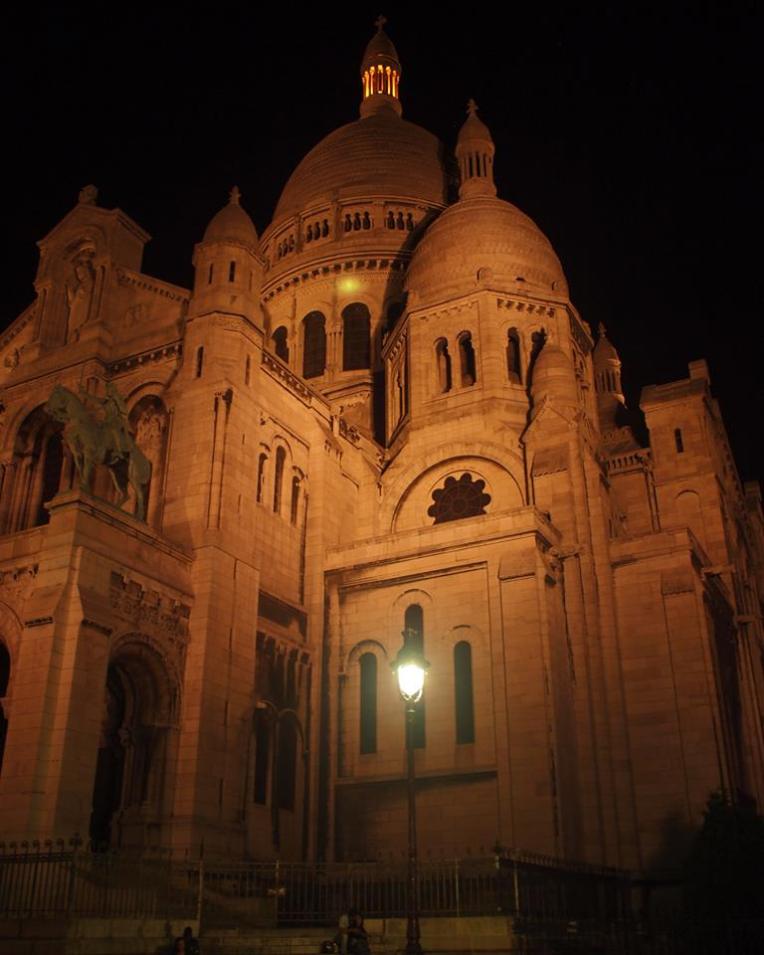
We arrived a day earlier than Adam and Liz’s arrival, so we did an evening stroll to visit Sacré-Cœur Basilica. Located at the summit of the Butte Montmartre, the highest point in the Paris, the Basilica of the Sacred Heart of Paris, more commonly called Sacré-Cœur Basilica, is a Roman Catholic church and minor basilica, dedicated to the Sacred Heart of Jesus. Built of white travertine stone, the Basilica is brilliantly illuminated and stunning at night.
Sacré-Cœur BasilicaSacré-Cœur Basilica
The Basilica complex has a large garden area and a fountain. There is an amazing panoramic view overlooking Paris from the Basilica and garden. The Basilica complex is a favorite meeting place for young people with more than a hundred on the grounds socializing as we explored. To reach the top of Butte Montmartre there is a steep series of stairs with over 300 steps or a funicular railway. The funicular has two parallel tracks with one car on each: one car going up counter-balancing the other car coming down. In a minute and a half the funicular travels 354 horizontal feet and climbs the 35% gradient 118 vertical feet to the top of Butte Montmartre. It is well worth the cost of one Métro ticket to enjoy a ride to the top. The funicular transports about two million passengers each year.
Tracy and Kiara on the Montmartre FunicularMontmartre Funicular
With Sacré-Cœur Basilica around the corner from our hotel enjoyed the beauty of the Basilica on the hill above us and we later returned to share the sight with Adam and Liz.
View of Paris from Sacré-Cœur Basilica (Wikimedia Commons)





















 An Italian Point Of View