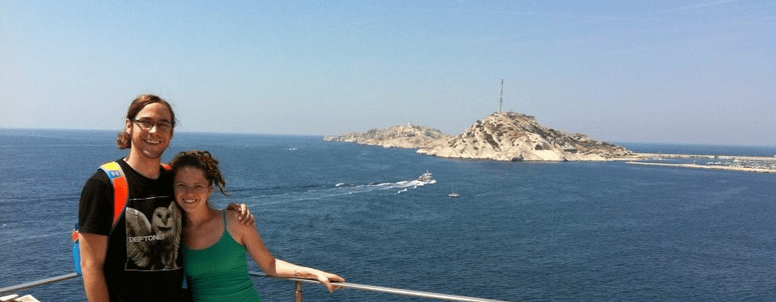
France with Deb and Gerry: Omaha Beach, Normandy American Cemetery and Memorial

It is the 70th anniversary of the D-Day Invasion this year, and we wanted to visit the sites of the Normandy landings from June 6, 1944 during Deb and Gerry’s visit with us.  After seeing Mont Saint-Michel, we drove to Saint Laurent-sur-Mer to see Omaha Beach and Colleville-sur-Mer to see the Normandy American Cemetery and Memorial.

Signs to Omaha Beach

It was a beautiful day on Omaha Beach, the weather was perfect.  The ocean looking toward the English Channel was also perfect, not like on D-Day 70 years ago with 5 to 6 foot swells, 59 degree temperature, and force 4 winds. The day we were there we saw swimmers in the water, kitesurfers working the waves, and people walking the beach barefoot.  I kept looking at how exposed WWII troops would have been on the beach, thinking about the books I’ve read describing the D-Day landings, and seeing in my mind that horrific 25-minute opening scene to the film “Saving Private Ryan.”  Massive sacrifice and history was made at that location. Tracy said it was like seeing an old photo overlaid atop a recent one, an odd sense of realism and history merged together in your mind – both compelling and disconcerting at the same time.

We did get the opportunity to chat for a while with an author who had a display highlighting veterans of WWII whom he interviewed both for the display near the beach and his current book. He shared stories of the battle, some of which we knew and some we had never heard. Though we didn’t buy his book, we did enjoy talking with him for a while and appreciated his insight and suggestions.
This slideshow requires JavaScript.

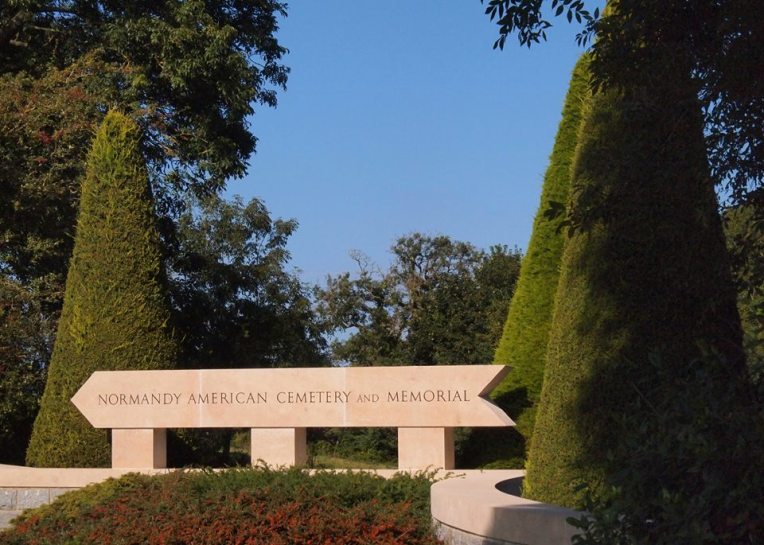
Normandy American Cemetery and Memorial

The Normandy American Cemetery and Memorial is located on a bluff overlooking Omaha Beach. It covers 172 acres (70 hectare) and commemorates the remains of 9,387 American military dead, most of whom were killed during the invasion of Normandy and the ensuing military operations in World War II. The names of 1,557 Americans who lost their lives in the Normandy campaign but could not be located or identified are inscribed on the walls of a semicircular garden at the east side of the memorial. There is also a 22 foot tall bronze sculpture, The Spirit of American Youth Rising from the Waves.

Like all other overseas American cemeteries in France for World War I and II, France has granted the United States a special, perpetual concession to the land occupied by the cemetery, free of any charge or any tax. This cemetery is managed by the American government by the American Battle Monuments Commission.  The US Flag flies over the cemetery.

Deb and Tracy were able to locate the markers for the Niland brothers, whose story was part of the inspiration for the movie “Saving Private Ryan.” Though they did have to wait for a bit while a group of French tourists finished visiting, they did get the opportunity for a few photos of the brothers’ markers which are side-by-side in the cemetery. There are 45 sets of brothers buried here, only 33 of them are buried side-by-side. In addition there are 3 medal of honor recipients, a father and son (also buried side-by-side), 307 unknown burials and four women.

The Normandy American Cemetery and Memorial is the American Battle Monuments Commission’s most visited cemetery, receiving about a million visitors each year.

This slideshow requires JavaScript.

Part 1:  Paris with Deb and Gerry: Eiffel Tower, Notre Dame, Love Locks, Arc de Triomphe, and the Luxembourg Garden

Part 2:  France with Deb and Gerry: Mont Saint-Michel, Normandy

Part 4:  Carcassonne with Deb and Gerry: Le Cité de Carcassonne, Château de Montségur, Mirepoix

France with Deb and Gerry: Mont Saint-Michel, Normandy

After visiting Paris, we picked up our rental car in Versailles and drove to Normandy to see Mont Saint-Michel, the ‘Wonder of the West.’

The car rental process was slightly more complicated than it sounds.  Prior to Deb and Gerry’s arrival, Tracy tried to reserve a rental car with the standard unlimited mileage option that is available from the US websites. However, the results she kept getting was a low mileage, not unlimited mileage quote. Tracy asked Deb to try making a reservation from the US and Deb was able to get a quote with unlimited mileage for the same car from the same rental agency.  Tracy wasn’t sure why there was a difference depending which country a rental inquiry originates from. Perhaps the rental agencies’ websites track the potential client IP addresses. In the end, Deb had to reserve the car while she was still in the US so that we could get the unlimited mileage package we wanted. Another oddity of life in France.

Mont Saint-Michel is a small tidal island with a Gothic-style Benedictine abbey, monastery, and city surrounded by fortifications dating back to the 8th century. The Abbey was built between the 11th and 16th centuries. It is located approximately 600 metres (0.6 miles) off the coast of Normandy, at the mouth of the Couesnon River. This island is about 100 hectares (247 acres) in size. One of France’s best known landmarks, it is a UNESCO World Heritage Site. Over 3 million people visit Mont Saint-Michel annually.

Located between the regions of Brittany and Normandy, Mont Saint-Michel’s unique location created a tidal causeway (a path uncovered only at low tide) that allowed early pilgrims to walk to the island’s abbey during low tide.  However, high tide made the island extremely defensible with the possibility of drowning or stranding attackers caught on the causeway when the tide would come in and fully surround the island. There is an impressive 14 metres (46 feet) difference between the high and low water marks. Mont Saint-Michel was unconquered during the Hundred Year War. In 1433 a small garrison was able to defend the island from an England assault.  The island, like Alcatraz in San Francisco Bay, was also used as a prison in the 1600-1700’s.

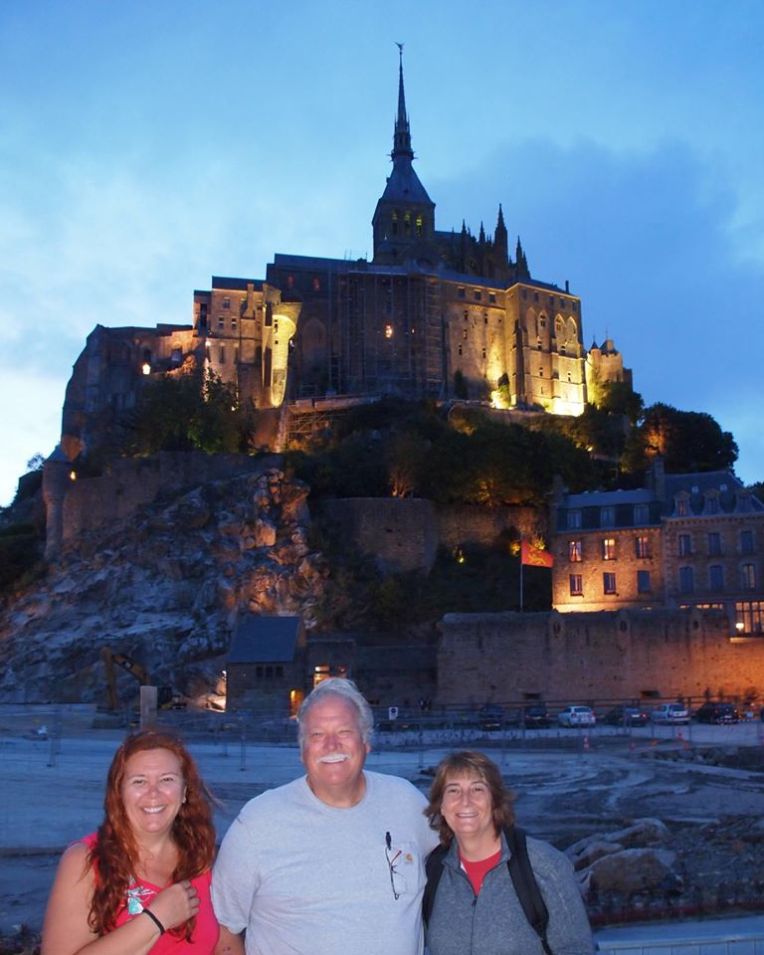
Tracy, Gerry, and Deb at Mont Saint-Michel, Normandy, France

We stayed in a cabin at the beautiful Camping Haliotis in Pontorson. The cabin was only 9 km from Mont Saint-Michele, we liked the facility and its amenities so much we decided to stay an extra night. We were lucky to be visiting on the last night that Mont Saint-Michele was open in the evening, so we explored the island as it transitioned from daylight to night time.  We drove to the parking area and took the shuttle bus out the raised causeway to Mont Saint-Michele.  We had a great time exploring the Abbey, the town, the fortifications, and watching the resident nuns use a hoist to transfer groceries and supplies up a cable into the upper Abbey.

The sunset was absolutely beautiful over Mont Saint-Michele.  It really is a “wonder.”

This slideshow requires JavaScript.

Part 1:  Paris with Deb and Gerry: Eiffel Tower, Notre Dame, Love Locks, Arc de Triomphe, and the Luxembourg Garden

Part 3:  France with Deb and Gerry: Omaha Beach, Normandy American Cemetery and Memorial

Part 4:  Carcassonne with Deb and Gerry: Le Cité de Carcassonne, Château de Montségur, Mirepoix
Paris with Deb and Gerry: Eiffel Tower, Notre Dame, Love Locks, Arc de Triomphe, and the Luxembourg Garden

The end of August and into September we were lucky to have Tracy’s Aunt Deb and Uncle Gerry come and visit us in France.  Deb had come to Paris before, but always on business trips that limited her opportunity to tour the city.  This was Gerry’s first travel outside the United States except as a guest of Uncle Sam and the US Army with an all-expense paid trip to Southeast Asia in 1969 where the locals were  hostile.

Gerry, Deb, and Tracy in front of the Cathédrale Notre Dame de Paris
Gerry, Deb, and Tracy in front of the Cathédrale Notre Dame de Paris.

En route to Paris, Tracy and I stopped for a short layover in Montpellier.  We enjoyed a coffee and a walked through the Place de la Comédie while waiting for the OUIGO TGV to arrive and take us to Paris.  We have become big fans of the French national rail system’s, SNCF, discount high-speed train.  The train gets us from Montpellier to Paris (465 miles [750 km]) in 3 hours and the cost is only €10 if you book your tickets early.

This slideshow requires JavaScript.

When we arrived in Paris, we found that there was a problem with apartment that Tracy had reserved.  Since the apartment was unavailable we received an upgrade to a much larger apartment in the Trocadéro district in the 16th arrondissement.  The apartment was located behind the Palais de Chaillot in easy walking distance to the Eiffel Tower.  Great serendipity for our stay in Paris.  Tracy and I are getting to know Paris, its sights, its Métro (the second busiest subway system in Europe after Moscow), and the RER (Réseau Express Régional) system better with each visit.

This slideshow requires JavaScript.

We met Deb and Gerry at Paris’ Charles de Gaulle Airport (Aéroport de Paris-Charles-de-Gaulle) and zipped into town on the RER and the Métro to drop their bags off. Then is was out into Paris to see the city.  While in Paris we enjoyed the Eiffel Tower Romance tour and had a private view of Paris from above the Jules Verne Restaurant on the second level of the Eiffel Tower.  We enjoyed the daytime and nighttime views of Eiffel Tower and the city of Paris from the Palais de Chaillot near our apartment.  The Palais de Chaillot and its grounds over looks the Eiffel Tower and was built as part of the Exposition International of 1937.

We walked along the River Seine to the Île de la Cité (one of the two islands on the Seine at the city’ center) to visit the Cathédrale NotreDame de Paris.  It is always a stunning sight and Tracy and Deb conducted “zoom lens” wars searching for the most interesting gargoyle and detail on the Cathedral.  I always enjoy admiring the flying buttress and hearing the bells ring.  On the nearby Pont de l’Archevêché (Archbishop’s Bridge) we introduced Gerry and Deb to the “Love Lock” controversy of visitors securing a padlock to a bridge as a symbol of their love and their visit.  It has become such a popular practice many historic bridges are festooned with locks and suffer damage.  According to the Daily Telegraph in September 2014″ (All the love locks’) weight caused a section of metal mesh to collapse this summer on the Pont des Arts under the strain of some 54 tons of padlocks.”  While not illegal, Paris is responding by replacing the grates with clear plexiglass panel to prevent locks being attached.  Tracy and I became “part of the problem” by adding our own “love lock” prior to the practice being banned.

We walked the Avenue des Champs-Élysées from the Arc de Triomphe and the Tomb of the Unknown Soldier to the Grand Palais des Champs-Elysées (that was originally built as an exhibition hall for the Universal Exposition of 1900) with its stunning glass and steel roof.  We spent time photographing the nearby Pont Alexandre III bridge’s Art Nouveau lamps, cherubs, nymphs, winged horses, and its view of the Seine and the Eiffel Tower.

Across the Pont Alexandre III,  Tracy and Deb enjoyed exploring the L’Hôtel National des Invalides. Les Invalides was originally a home and hospital for disabled veterans (a role it still serves), it now contains Musée de l’Armée (military museum of the Army of France) the Musée des PlansReliefs (that displays military models), the Musée d’Histoire Contemporaine (with non-military contemporary history), and serves as a burial site for many of France’s war heroes, including Napoleon’s Tomb.

We liked exploring the grounds of the Musée du Louvre.  Fantastic location to people-watch since the museum entertains nearly 10 million visitor from around the world every year.  Tracy led Deb down to the Carrousel du Louvre (the underground shopping mall adjacent to the Lourve) for photo ops of La Pyramide Inversée (the inverted pyramid.)

At Deb’s suggestion we visited the Luxembourg Garden, (Jardin du Luxembourg) for the first time.  Fantastic location to explore and a “must return” place for Tracy and me.  The 57 acres (23 hectares) of public park was originally built as a private garden in 1612 by Marie de’ Medici (the widow of King Henry IV) as part of her new residence, the Luxembourg Palace (which now serves as the seat of the French Senate.)  The Luxembourg Garden has amazing lawns, tree-lined promenades, sculptures, flowerbeds, playground, tennis courts, a large circular basin with children sailing model sailboats, and several fountains, including the stunning Medici Fountain.   On the ground is the original model of Frédéric Auguste Bartholdi’s Statue of Liberty that has been in the park since 1906.  The park has chairs everywhere and Parisians and visitors alike enjoy relaxing at their favorite spots in the garden.

Part 2:  France with Deb and Gerry: Mont Saint-Michel, Normandy

Part 3:  France with Deb and Gerry: Omaha Beach, Normandy American Cemetery and Memorial

Part 4:  Carcassonne with Deb and Gerry: Le Cité de Carcassonne, Château de Montségur, Mirepoix

Congés Annuels – Annual Leave in France

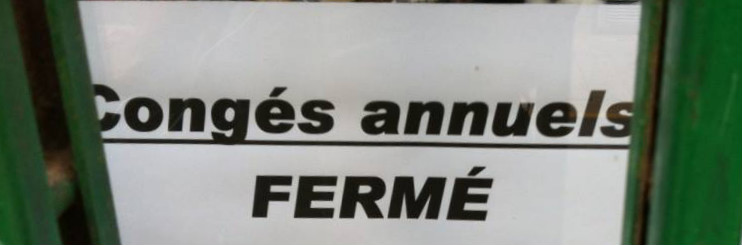
In the months of July and especially August, it is not unusual for Tracy and I to see a local French businesses closed with a sign on the door saying, “Congés Annuels -Fermé” (closed for annual leave).

This slideshow requires JavaScript.

I was recently visiting our local pet store buying dog food for Sami the MinPin and the proprietors made a point of reminding me that they would be closed for the month of August for their Congés Annuels.  So I purchased a second bag of dog food to get us through the month and wished them a bonnes vacances.

It is a norm for French people to take a month off in July or August for annual vacation with often entire businesses closing for the month.  Tracy and I are learning to plan our shopping and dining accordingly around Congés Annuels. Some French people identify themselves as “Julyists” (who take their month-long vacations in July)  and “Augustists,” (who take their vacation in August.)  Since we currently live in a tourist town where many French people visit during their holidays, some businesses and workers will take their Congés Annuels later in the year, often over the Christmas/New Years season. Coming from America, it’s a major culture shift to see these annual month-long holidays in France (and there are additional holidays throughout the year.)  The French have long cherished their vacation time with family and enjoying recreation prior to returning to their careers refreshed and rejuvenated.

France has a social culture that makes full use of holiday time, requires most businesses to be closed on Sundays, encourages turning off business cell phones after hours, and allowing office e-mails to wait for the following workday. France has a different tone toward vacation than we are used to in the US.  French people often see Americans as obsessed with work and unwilling to relax.  “Americans work 137 more hours per year than Japanese workers, 260 more hours per year than British workers, and 499 more hours per year than French workers.”

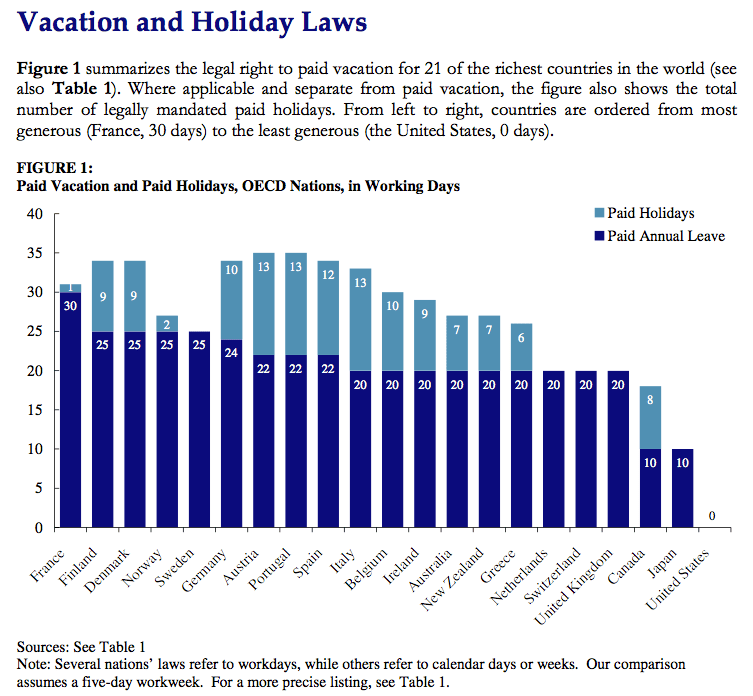
It was interesting to learn that there is no statutory requirement for paid vacation in the US.  The US  is the only advanced economy in the world that doesn’t require employers provide workers with paid vacation.  This is especially true of low-wage workers, part-time employees, and workers at small businesses.  The EU requires “at least 20 paid vacation days per year, with 25 and even 30 or more days in some countries.  Canada and Japan guarantee at least 10 days of paid vacation per year.”

Vacation laws by country CEPR http://www.cepr.net/index.php/press-releases/press-releases/us-only-advanced-economy-that-does-not-guarantee-workers-paid-vacation/
Vacation laws by country
CEPR
http://www.cepr.net/index.php/press-releases/press-releases/us-only-advanced-economy-that-does-not-guarantee-workers-paid-vacation/

Unlike 25% of American workers, I did have employer-paid vacation during my careers.  But I learned that in the US since “1976, (there has been) a huge decline in the share of workers taking vacations.  Some rough calculations show, in fact, that about 80 percent of workers once took an annual weeklong vacation — and now, just 56 percent do.”   “(In the US) 15% (of workers never) take any vacation at all.

The vacation company Expedia conducted a survey in the US and learned “that Americans are only using 10 of the 14 days they are given. That’s a whopping 577,212,000 vacation days left on the table.”  Glassdoor Survey say “61 percent (of) employees who have taken vacation/paid time off admit working at least some while on vacation. One in four (24 percent) report being contacted by a colleague about a work-related matter while taking time off, and one in five (20 percent) have been contacted by their boss.”  Tracy had a former boss (who was seriously lacking in managerial skills, but big into “letting people know where they are on the organizational chart”) who telephoned her twice about work matters during our honeymoon. (Yes, our cell phone was on in case of an emergency with one of the kids.)  Tracy was a graphic designer at the time and still jokes about the “urgent design emergencies” that necessitated interrupting our honeymoon; where she had no access to her work computer. And this was after having planned our wedding around the college’s publications schedule.

Why don’t Americans use their vacation time?  The Wall Street Journal says  “Workers pay a career penalty for vacation.” Although there are ” . .  ill effects of refusing to go on vacation, documented in research, include fatigue, poor morale, heart problems and reduced productivity,” according to Forbes magazine, people are afraid to take vacation time.   ” . . . (P)eople suffer from feeling like their employer really doesn’t want them to take time off.  In order to increase their sense of employment security, employees are trying harder every year to make themselves “indispensable.” This leads us to believe we really can’t be gone, or there will be a huge mountain of work facing us (and countless unpaid overtime hours spent digging out) when we return from a break.  Or worse, the job won’t be there when we come back.    . . . (C)all this the “work martyr complex.”  No matter how much we love family, we are martyrs to employers in order to keep that incredibly necessary, and fleeting paycheck. . . .  After 2 decades of CEOs who lead by “operational improvements,” causing round after round of cost cuts and layoffs, employees have learned that the day they take off could be the day their budget is slashed, or their job eliminated.”

While some businesses and organizations may believe they are enjoying short-term savings and productivity from unused vacation days, many other organizations are realizing the long-term costs of employee burn-out and increased attrition for their organizations.  Some US businesses and organizations are now trying to create a culture of encouraging employees to make full use of vacation time or even requiring its use.

Some workers are able to “roll over” vacation time to their advantage for planning an extended vacation or an extended maternity/paternity leave.  On retirement, Tracy had an exceptional option of having her remaining vacation days, along with her sick days, paid off at separation, an option she made full use of during our retirement planning. As faculty I had no vacation time or sick time at retirement (like many peoples’ excess annual vacation time) was “use it or lose it.”

In the mean time,  Tracy and I are enjoying the phenomenon of “Congés Annuels” in France and thinking how we would have greatly enjoyed the extra vacation time with our children when they were growing up.

No one ever said on their deathbed, ‘I wish I’d spent more time at the office.’ ” ~ Harold Kushner

No Permanent Address

I recently read a Buzzfeed humor article, 31 Important Things You Learn When You Move Across The World. The article had two lines that really struck a chord with me: “You learn that forms that ask for a “permanent address” are evil, and didn’t account for people like you” and “ Please provide a permanent address.’ *Cue Panic Attack*

There is a lot truth in those lines, with Tracy and my retirement lifestyle of selling our home, being expats living abroad, short-term renting, and changing our city of residence every year or two has made us – by some definitions – without a permanent address.

In my previous career in police work, “No Permanent Address” or “No Fixed Address” was a euphemism for a person being homeless. (Tracy and I commented about being “homeless” after selling our house and the lease running out on our apartment rental just prior to our departure to Europe. It was an unsettled feeling for us, but certainly not the same as the reality faced by real homeless people.)

Wikipedia defines ” ‘No Fixed Abode’ or ‘Without Fixed Abode’ (as) a legal term generally applied to those who do not have a fixed geographical location as their residence. This is applicable to several groups:

  • People who have a home, but which is not always in the same place:
    • Those whose occupation requires them to live permanently on boats, ships, or movable oil platforms, or to travel constantly (as showmen, for example).
    • Nomadic peoples (e.g. Indigenous Norwegian Travellers and Romanichal) and traveller groups (e.g. Irish Travellers, Scottish Gypsy and Traveller groups, New Age Travellers, Norwegian and Swedish Travellers); as well as individuals who adopt a mobile lifestyle, living in narrowboats, recreational vehicles, or the like.

While we do have friends who are full-time RV travelers in the US, almost all of them currently own a piece of real estate or physical home somewhere (even if it is currently rented to a tenant.)  Tracy are I are hardly vagabonds who are randomly camping in Roma settlements around France, but our process of moving frequently creates a necessity of updating our visa status, address, and other issues with French government agencies.  Our French visas actually classifies us as long-term “visiteurs” rather than as residents.

No longer owning a home in America and not physically living there has created a bit of a “grey area” with residency.  What is our “permanent address?”

The concept of “no permanent address” is a legitimate concern in today’s world.  In these modern times, if you want to vote, have a driver’s license, open a bank account, register a vehicle, have a credit card, or obtain health insurance, it isn’t just enough to have a U.S. passport, you need a permanent address.  In addition to American expatriates living abroad, this is a very common problem in the full-time RV community in the US. A post office box in many states is insufficient for a legal domicile. The demand for a “permanent address” has spawned companies (especially in Texas and South Dakota, Escapees RV Club being one example) who cater to full-time travelers by legally providing a permanent address.

Tracy and I, like many expats, have elected to use a family member’s address as our  permanent address in our former hometown of Reno, Nevada.  (When I was college-aged I used my parent’s address as my permanent address as I “hopscotched” between living arrangements and roommates.)  Because of Tracy and my decades-long connection to Reno and Sparks as residents, students, workers, taxpayers, homeowners, raising children and still having local family, and it being our last home, Reno serves as our official, permanent US residence.

This need for a permanent address isn’t  just an issue for RVers and expats. George H. W. Bush had a long career of public service as a congressman, ambassador to the UN, envoy to China, director of the CIA, vice president, and finally president of the US. That career frequently required that he lived in Washington D.C., New York, Virginia, Maryland, or overseas. From 1985 until his retirement in 1993 he used the Houstonian Hotel, Club & Spa in Houston, Texas as his legal domicile and official voting address (although he moved out of Houston in 1981, stayed at the Houstonian intermittently, paid rent only for days his rooms were actually occupied, and owned an actual residence in Kennebunkport, Maine.)  Former President Bush had signed an affidavit stating that he would build his retirement home in Houston and the “intent” stated in that document satisfied Texas that he was a bona fide resident of Texas (although Texas’ action did annoy some residents of Maine who, because of his home in Maine, felt former President Bush should have been considered a Maine resident and pay the Maine state income tax.)  After leaving public office former President Bush did make good on his promise and retired to Houston.

By no means do Tracy and I attempt to be “Perpetual Travelers” whose primary motive is to avoid becoming legal residents of any country with the ultimate goal of tax avoidance and evading any legal responsibilities of residency.  We contribute our fair share and fulfill our responsibilities to our countries of citizenship and occupancy.

While Tracy and I like to entertain a romantic fantasy of ourselves living a free-spirited, Bohemian, and unconventional expat life (cue images of Hemingways’s “Lost Generation” traveling from Paris to Pamplona in the 1920s or Montmartre’s diverse arts community from the movie, “Moulin Rouge!”), we are actually fairly orthodox, living within the many rules of “the system,” and we are definitely “on the grid” with a permanent address . . . but with an untraditional – and ever-changing – physical address.

Ernest Hemingway seated in 1925 with the persons depicted in the novel "The Sun Also Rises." The individuals depicted include Hemingway, Harold Loeb, Lady Duff Twysden; and Hadley Richardson, Ogden Stewart and Pat Guthrie. John F. Kennedy Presidential Library and Museum, Boston
Ernest Hemingway seated in 1925 with the persons depicted in the novel “The Sun Also Rises.” The individuals depicted include Hemingway, Harold Loeb, Lady Duff Twysden; and Hadley Richardson, Ogden Stewart and Pat Guthrie.
John F. Kennedy Presidential Library and Museum, Boston


Carcassonne with Casey and Megan: La Cité De Carcassonne, Château de Montségur, Mirepoix

“I thought to see fair Carcassonne, that lovely city—Carcassonne!” ~ Gustave Nadaud

Our return flight from Rome to Marseille via Ryanair went as smoothly as the initial flight.  However we did have some concerns since the French rail strike was still going on. But our train was one of the 60% still scheduled and running. At the “moment of truth” the train arrived and we had our assigned seats waiting for us with no overcrowding. All in all we had been extremely lucky working around the national rail strike.

This slideshow requires JavaScript.

We enjoyed the trip west along the Mediterranean coast and made it back to our current home in Carcassonne.

This slideshow requires JavaScript.

We took a day to hike to the top of Château de Montségur is a former fortress located about 80 kilometers (50 miles) southwest of Carcassonne near the Pyrénées mountains and the Spanish border. The ruins are the site of a razed stronghold of the Cathars. The fortress is referred to as one of the “Cathar castles” that gave shelter to Cathars during the Albigensian Crusades.

This slideshow requires JavaScript.

We also visited the nearby village of Mirepoix which has a substantial medieval ambience.

This slideshow requires JavaScript.

Casey and Megan were finally able to catch up on some much-needed rest in Carcassonne and enjoy the vacation part of their trip. And Casey discovered Ricard pastis as a traditional summer-time French beverage. At the end of their stay (with the rail strike finally over) Casey and Megan took the train back to Paris for a two-night stay with tickets for a day at Disneyland-Paris. Knowing he is a big fan of Mickey, it was our birthday present to him.

This slideshow requires JavaScript.

We waited until the last possible minute to warn them that there was talk of an air-traffic controller strike. Our silence paid off as at the last-minute the strike was culled down to only 10% of planes and limited to those going to other European countries. The kids made it to the airport and their British Airways flight without suffering through any more of France’s transportation worker strikes.

All in all it was a fantastic visit. We enjoyed meeting Megan and seeing Casey. We were overjoyed to finally being able to congratulate him in person for his university completion. The kids followed up their visit with a nice long Skype date so that we could meet their daughter, Izzy. The best thank you ever!


Part 1:  Paris with Casey and Megan: Notre Dame, Palace of Versaille, Eiffel Tower, Love Locks, and the Louvre

Part 2:  Marseille with Casey and Megan:  Train Strike, Chateau d’If, Vieux-Port, Phare de Sainte Marie, and Notre-Dame-de-la-Garde

Part 3:  Rome with Casey and Megan:  RyanAir, Pantheon, Colesseum, Roman Forum, and Trevi Fountain

Part 4:  Vatican City with Casey and Megan:  Vatican Museum, Sistine Chapel, Necropolis Tour, Saint Peter’s Basilica, and Saint Peter’s Square

Part 5:  Carcassonne with Casey and Megan: La Cité De Carcassonne, Château de Montségur, Mirepoix
Vatican City with Casey and Megan: Vatican Museum, Sistine Chapel, Necropolis Tour, Saint Peter’s Basilica, and Saint Peter’s Square

“St. Peter’s Basilica, the greatest church in Christendom, representing the power and splendor of Rome’s 2,000-year domination of the Western world.” ~ Rick Steves

Casey wanted to visit a micro-nation.  Originally he wanted to see Monaco (I believe because of his computer-like math capacities and  the world-famous casinos – see the film, “21“), but the idea of walking completely across a country in just minutes intrigued Casey too.  He enjoyed the concept and structure of a modern city-state, complete with its own military, police, broadcast facilities, and international ambassadors known as Nuncios.

We started with a visit to the famous Musei Vaticani (Vatican Museum) and the adjacent Cappella Sistina (Sistine Chapel.)  While we stood in line Casey and Megan went far to try real Italian gelato which they gave two “Thumbs Up.”  While waiting the clouds gathered again and we were rained on once more as we waited for entry.  True to our past experience, new immigrants arrived to the waiting visitor with a selection of folding and full size umbrellas, ponchos, and rain coats.  Fifteen minutes before the storm the same men had been selling souvenirs.  Our “entrepreneurs” worked the line almost to the point of aggressiveness, wanting to make their money quickly before the rain stopped.  Each of us were holding an umbrella, but that did not deter several of our impromptu salesmen.  “Would you like a poncho too?”  “A larger umbrella?”

For fun we overlapped our umbrellas like ancient warriors would overlap their shields on the battlefield.  Tracy selected one particular friendly, but persistent salesman as our principle nemesis:  “Poncho-man.”  Poncho-man would check with us every time he passed, about every 10-15 minutes if we were certain we didn’t need two umbrellas each rather than our paltry one.  The approach of Poncho-man would cause us to tighten our umbrellas into a “turtleshell” and a verbal response of, “No, Poncho-man, no!”  It became a game to pass the time with Poncho-man approaching with a smile and “Hello, my friends!” through the gaps in our umbrella and our cries of, “No, Poncho-man, no!”  Nice way to pass the time while waiting in the rain. Meanwhile, inside the museum, patrons were declining to exit considerably slowing the entrance of new patrons.

Casey hadn’t realized that the Vatican Museum had 55 galleries and was the fifth most visited museum in the world with more than 4 million visitors a year.  He was very pleasantly surprised at the size and variety of the collections.  Casey and Megan were especially impressed with Michelangelo’s 500-year-old paintings the The Last Judgement on the ceiling of the Sistine Chapel.  Sadly no photos are allowed inside the chapel.


This slideshow requires JavaScript.

Coming out of the museum we headed inside Vatican City, behind where most visitors get a chance to see.  Tracy had arranged for us to take the “Scavi” tour.  It is a tour of the excavations of the underground necropolis that lies beneath Saint Peter’s Basilica.  Our guide was a Ph.D. archeologist who is one of the supervisors in the work. He shared amazing insights into the excavations, the controversy of Saint Peter’s tomb inside the necropolis, and the history surrounding the basilica.

This slideshow requires JavaScript.

After exiting the Scavi tour, we visited Basilica di San Pietro in Vaticano (St. Peter’s Basilica), the largest church in the world able to hold over 80,000 parishioners at a single service.  Afterwards we explored Saint Peter’s Square outside the basilica and just outside Vatican City we followed the Passetto di Borgo (the covered fortified corridor) to Castel Sant’Angelo (Castle of the Holy Angel) and the Ponte Sant’Angelo (after a stop for adult beverages to re-hydrate from all our hiking.)

This slideshow requires JavaScript.

Although not nearly a long enough visit to Rome and Vatican City, it’s time to show Casey and Megan our current home in Carcassonne, France.


Part 1:  Paris with Casey and Megan: Notre Dame, Palace of Versaille, Eiffel Tower, Love Locks, and the Louvre

Part 2:  Marseille with Casey and Megan:  Train Strike, Chateau d’If, Vieux-Port, Phare de Sainte Marie, and Notre-Dame-de-la-Garde

Part 3:  Rome with Casey and Megan:  RyanAir, Pantheon, Colesseum, Roman Forum, and Trevi Fountain

Part 4:  Vatican City with Casey and Megan:  Vatican Museum, Sistine Chapel, Necropolis Tour, Saint Peter’s Basilica, and Saint Peter’s Square

Part 5:  Carcassonne with Casey and Megan: La Cité De Carcassonne, Château de Montségur, Mirepoix
Rome with Casey and Megan: RyanAir, Pantheon, Colosseum, Roman Forum, and Trevi Fountain

“All roads indeed lead to Rome, but theirs also is a more mystical destination, some borne of which no traveller knows the name, some city, they all seem to hint, even more eternal.” ~ Richard Le Gallienne

Arriving at Aéroport de Marseille Provence (Marseille Provence Airport) we intend to fly Ryanair for the first time.  Tracy has seen several reality TV shows which featured Ryanair’s uncompromising rules which allows the airplane to offer its cut-rate fares.  When Casey and Megan were still in the US we had sent Ryanair’s strict carry-on baggage rules:  one carry-on bag no larger than 55 cm x 40 cm x 20 cm (21.6″ x 15.7″ x 7.8″) plus one small bag of up to 35 cm x 20 cm x 20 cm (13.7″ x 7.9″ x 7.9″). (Tracy and I purchased new backpacks specifically to meet Ryanair’s requirements.)  But even this these notoriously small bag requirements, Ryanair does not guarantee that your bag will be allowed in the cabin.  If there is no more room in the overhead bins bags are stored in the hold for free.  Oversized luggage will be charged at substantial additional fees.  The reality show Tracy watched had numerous incidents of displeased passengers with oversized bags being billed additional fees or denied boarding and some passengers missing flights due to Ryanair’s strict check-in policy.  Ryanair has a 98% on-time departure record that comes with a requirement to have passport visas verified, passing through security screening, and admission to the boarding area at least 45 minutes before departure.

We were pleasantly surprised.  Although we showed up substantially early (concerned about an overflowing airport due to the train strike) we passed through easily and were treated very professionally by the Ryanair staff.  Horror stories aside, we were pleased with traveling Ryanair and decided to make use of their discount flights in the future.

This slideshow requires JavaScript.

It was a quick flight to Ciampino–Aeroporto Internazionale (Rome Ciampino Airport) [about 12 kilometer (7.5 mi) south of Rome] we took the bus to the tram into Termini Station and a street car out to our hotel.  Tracy found a wonderful hotel in a suburb of Rome, while it was about a 30 minute ride outside central Rome, we had large comfortable rooms, a breakfast buffet, and paid “locals” prices at wonderful family trattorias in the hotel’s neighborhood.  We were treated wonderfully, paid a quarter of the cost for meals in Paris, and we kept wanting to return to try different dishes on the menu.  All that and the carafes of vino della casa (house wines) were inexpensive and delicious.

Roman Street Car
Roman Street Car

The Metropolitana di Roma (Rome subway) with only two “crossed” lines are not nearly as comprehensive as Paris, but most of the major sights are accessible off the subway.  Although Tracy and I have used the Rome bus system, we didn’t use it this trip.

We had a great time exploring the Roman Forum and the Colosseum. Although the rain would start and stop during the day, it helped to minimize the crowds.  It really is a “small world,” our friends Ron and Cyndy Coscuna just happen to be in Rome and we met them near the Fontana del Pantheon for lunch and later watched the rain fall through the oculus in the ceiling of the Pantheon.

We did get caught in a torrential downpour after leaving the Pantheon. Megan stopped at a little store to pick up a sweatshirt, Tracy and I headed next door to the bar to find refuge from the storm. When Casey and Megan joined us they found seats next to a couple from South Africa and had a nice chat while the bartender and owner tried to mix up a White Russian for Megan. With nearly four times the alcohol content, they finally succeeded. Megan stayed fairly warm afterwards. The owner didn’t quite believe that Megan was old enough to have the drink. Tracy reassured him that she was indeed old enough to order alcohol and though still a bit doubtful, he delivered her drink to the table. He did, however, need reassurance an additional six times. Yes, she really does look that young!


This slideshow requires JavaScript.

Casey and Megan stopped to throw coins in the Trevi Fountain to observe the tradition that throwing coins with ensure you will return to Rome.  Unfortunately the fountain was largely covered with scaffolding for refurbishing.  But that gave Casey and Megan another reason to return to Rome in the future, to see the fountain flowing in it’s full glory.

After exploring Roma, it was time to visit the smallest country in the world, Vatican City.


Part 1:  Paris with Casey and Megan: Notre Dame, Palace of Versaille, Eiffel Tower, Love Locks, and the Louvre

Part 2:  Marseille with Casey and Megan:  Train Strike, Chateau d’If, Vieux-Port, Phare de Sainte Marie, and Notre-Dame-de-la-Garde

Part 3:  Rome with Casey and Megan:  RyanAir, Pantheon, Colesseum, Roman Forum, and Trevi Fountain

Part 4:  Vatican City with Casey and Megan:  Vatican Museum, Sistine Chapel, Necropolis Tour, Saint Peter’s Basilica, and Saint Peter’s Square

Part 5:  Carcassonne with Casey and Megan: La Cité De Carcassonne, Château de Montségur, Mirepoix


Marseille with Casey and Megan: Train Strike, Chateau d’If, Vieux-Port, Phare de Sainte Marie, and Notre-Dame-de-la-Garde

“No, my dear Dantes. I know perfectly well that you are innocent. Why else would you be here? If you were truly guilty, there are a hundred prisons in France where they would lock you away. But Chateau d’If is where is they put the ones they’re ashamed of.” ~ Dorleac, The Count of Monte Cristo 

After arriving at Marne la Vallée-Chessy train station outside of Paris to catch our Ouigo high-speed train to Marseille we are told that a surprise rail worker strike has caused that train and two prior trains’ cancellation.  (The strike is eventually 10 days, the longest rail strike since 2008.)  Casey and Megan were getting a truly French experience of dealing with a large-scale rail strike.  We were told there was a chance of getting on high-speed TGV train still scheduled to depart in 2 1/2 hours.  IF it arrived we may be able to get on board.  IF we got inside and the doors were able to close we could go as far as the train continued to run. IF. We decided to “take the shot” at getting on that train.  In the mean time we “camped out” at the front of the line, talked, played cards, and worked on Soduku puzzles.

This slideshow requires JavaScript.

The train did arrive and we were able to squeeze into the hallway of a first-class carriage.  Other passengers were friendly with the “Life Boat” atmosphere and we stood or sat on the hallway floor for the first 2 1/2 hours of the nearly 900 kilometer trip.  About an hour out of Marseille departing passengers allowed us to finally get seats and we enjoyed the first-class luxury for the final hour of the trip, visiting with our neighbors in the cabin who were en route to the Côte d’Azur.  They were very friendly to their “refugee” seat-mates crashing first-class.  One gentleman was a French engineer who Casey had an animated discussion about their shared profession.  We would later read in the newspapers about people being stranded in rail stations for days and marvel that we were able to “pull off the impossible” and get one of the few remaining working trains to Marseille.

Marseille was completely unexpected.  I thought the city would be a gritty, slightly run-down port town.  Instead in was a clean, intriguing city that reminded me of San Francisco or Seattle. After wandering through the city I now understand why in 2013 it was awarded the title of Europe’s Capital of Culture.

This slideshow requires JavaScript.

Our literary adventure was taking the boat out to Chateau d’Id, the historic prison off the Vieux-Port (Old Port) of Marseille, to experience the setting of Dumas’ fictional “The Count of Monte Cristo” and “The man in the Iron Mask” in real life.  Reminiscent of visits to the former Alcatraz Federal Prison Museum off the coast of San Francisco.

This slideshow requires JavaScript.

Casey and Megan enjoyed taking the petit train up to Basilique de Notre Dame de la Garde located at the highest point in Marseille, about 150 meters (490 feet) above the south side of the Vieux-Port (Old Port), visiting the Musée Cantini with a collection including Picasso, Matisse, and Cézanne, and the strikingly unique Musée des Civilisations de l’Europe et de la Méditerranée [Museum of Civilisations from Europe and the Mediterranean (MuCEM).]

Notre-Dame de la Garde
Museum of European and Mediterranean Civilizations (MuCEM)

After a too-short visit and a sample of great seafood, we committing ourselves to returning in the near future and exploring more of Marseille at a future date.  We now headed by bus (the rail strike was still going on) to Aéroport de Marseille Provence (Marseille Provence Airport) to catch Ryanair for Rome.


Part 1:  Paris with Casey and Megan: Notre Dame, Palace of Versaille, Eiffel Tower, Love Locks, and the Louvre

Part 2:  Marseille with Casey and Megan:  Train Strike, Chateau d’If, Vieux-Port, Phare de Sainte Marie, and Notre-Dame-de-la-Garde

Part 3:  Rome with Casey and Megan:  RyanAir, Pantheon, Colesseum, Roman Forum, and Trevi Fountain

Part 4:  Vatican City with Casey and Megan:  Vatican Museum, Sistine Chapel, Necropolis Tour, Saint Peter’s Basilica, and Saint Peter’s Square

Part 5:  Carcassonne with Casey and Megan: La Cité De Carcassonne, Château de Montségur, Mirepoix