Carcassonne is filled with historic houses of worship.
1. Basilique Saint-Nazaire-et-Saint-Celse de Carcassonne (Basilica of Saint Nazaire and Saint Celsus) Located within the citadel of la Cité de Carcassonne, the “Jewel of the City,” has a harmonious coexistence between the Romanesque and Gothic windows which are the finest in the South of France. The first church was built in the sixth century, under the reign of the Visigoths. The first written record of the church dates from 925. In 1096, Pope Urban II came to Carcassonne and blessed the construction of what would become the Basilica of Saint Nazaire and Saint Celsus. The building was completed in the first half of the twelfth century. The nave and aisles remain in the Romanesque style. Gothic alterations were completed in the fourteenth century. The church was rebuilt many times and eventually lost its cathedral status in 1803 to Saint Michael’s Cathedral in the Bastide. Saint-Nazaire-et-Saint-Celse received the title of Basilica in 1898 from Pope Leo XIII.
Basilique Saint-Nazaire-et-Saint-Celse de Carcassonne (Basilica of Saint Nazaire and Saint Celsus)Basilique Saint-Nazaire-et-Saint-Celse de Carcassonne (Basilica of Saint Nazaire and Saint Celsus)
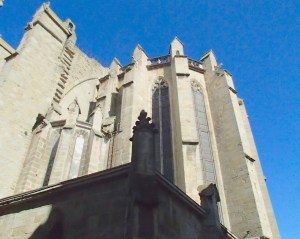
2.) Cathédrale Saint-Michel de Carcassonne (Saint Michael’s Cathedral of Carcassonne) The church was designed in the Languedoc Gothic style. Built and rebuilt over the thirteenth, fourteenth, and nineteenth centuries, Saint Michael’s Cathedral originated as a parish church until 1803 when it was elevated as the seat of the Roman Catholic bishop for Carcassonne replacing Saint-Nazaire-et-Saint-Celse as the Cathedral for the diocese and used by the Priestly Order of Saint Peter. The Cathedral is designated as a French National Monument. Rebuilding the church was required after the invasion of the Black Prince and the destruction of the Ville Basse in 1355. There was also a devastating fire in 1849 that ravaged the church. Famous architect Eugène Emmanuel Viollet-le-Duc, known for his restoration of French historical monuments, led nearly 20 years of extensive restoration to the church.
Cathédrale Saint-Michel de Carcassonne (Saint Michael’s Cathedral of Carcassonne)Cathédrale Saint-Michel de Carcassonne (Saint Michael’s Cathedral of Carcassonne)
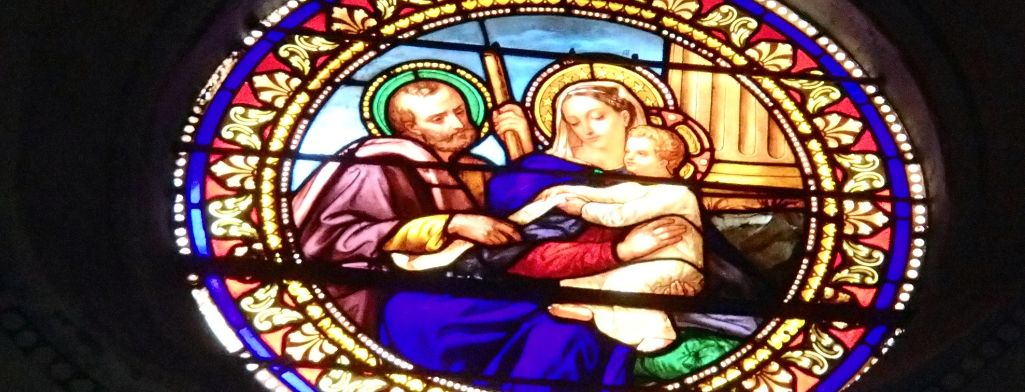
3.) Eglise Saint-Vincent (Saint Vincent Church) This thirteenth century Roman Catholic church was also designed in the Languedoc Gothic style with an impressive 23.5 meter high vaulted roof. Climbing the 234 steps of the 54 meter high octagonal bell tower will lead past the 47 bells to a view of the Ville Basse and La Cite’. In the fifteenth century, rose windows and stained-glass windows were added to the church.
Eglise Saint-Vincent (Saint Vincent Church)Eglise Saint-Vincent (Saint Vincent Church)
4.) Eglise des Carmes (Church of the Carmelites) The sparse Languedoc Gothic style Roman Catholic church was built at the end of the thirteenth century by the Order of the Brothers of Our Lady of Mount Carmel. There is also a Carmelite Covent. In 1966, the Carmelite chapel became a parish church and in the 1970s it became an annex parish to Saint Michael and Saint Vincent. The former convent, located on Rue de la Liberté, has been the offices of the diocese since 1981.
Eglise des Carmes (Church of the Carmelites)Eglise des Carmes (Church of the Carmelites)
5.) Chapelle Notre Dame de la Santé (Chapel of Our Lady of Health) This small Roman Catholic chapel was built on the west side of the Pont Vieux (old bridge) with money from the legacy of Jean de Saix in 1527 for the creation of the plague hospital. The chapel’s gothic interior features beautiful ribbed vaults and tiercerons. The chapel was used by patients and families of the former hospital.
Chapelle Notre Dame de la Santé (Chapel of Our Lady of Health)Chapelle Notre Dame de la Santé (Chapel of Our Lady of Health)
6.) Eglise Protestante Unie De Carcassonne – Communion Luthériens et Réformés (Protestant Church – French United Reformed Church) France is about 86% Roman Catholic, 7% Muslim, 2% Protestest, 1% Jewish, with 4% unaffiliated. This is literally the protestant church in Carcassonne. Apparently this church was established in 1562 by the Reformed Church of France after persecution of the Huguenots had subsided. There appears to have been a major renovation was started in 1888 and completed in 1890. Protestant church worshippers are mainly found in southeastern France.
Eglise Protestante Unie De Carcassonne – Communion Luthériens et Réformés (Protestant Church – French United Reformed Church)Eglise Protestante Unie De Carcassonne – Communion Luthériens et Réformés (Protestant Church – French United Reformed Church)
7.) Mosquée Salam à Carcassonne(Salam Mosque in Carcassonne) French of Maghreb origin (having at least one grandparent from the former French colonies of Algeria, Morocco or Tunisia) in France form the largest ethnic group after French of European origin. This Maghreb influence is also reflected in 7% of the population being Muslim.
Mosquée Salam à Carcassonne (Salam Mosque in Carcassonne)Mosquée Salam à Carcassonne (Salam Mosque in Carcassonne)
There is no Jewish Synagogue in Carcassonne. In 1394 Jews, blamed for the Black Death among other imaginary crimes, were expelled from Carcassonne and fled to Provence. After the invasion of France by the Nazis during World War II, a number of Jews returned and found refuge in Carcassonne, then in the unoccupied zone. Today the small Jewish population of Carcassonne has to travel to Toulouse or Montpellier for synagogue.
Pretty much every trip out of the apartment I have my Every Day Carry (EDC) bag, my essentials for every day in our new home of Carcassonne.
This carry bag is a bit different from my current and former law enforcement colleagues, with their EDC gear including their department or LEOSA authorized essentials for making an arrest or resolving a self-defense situation, but the principles of being self-sufficient are the same.
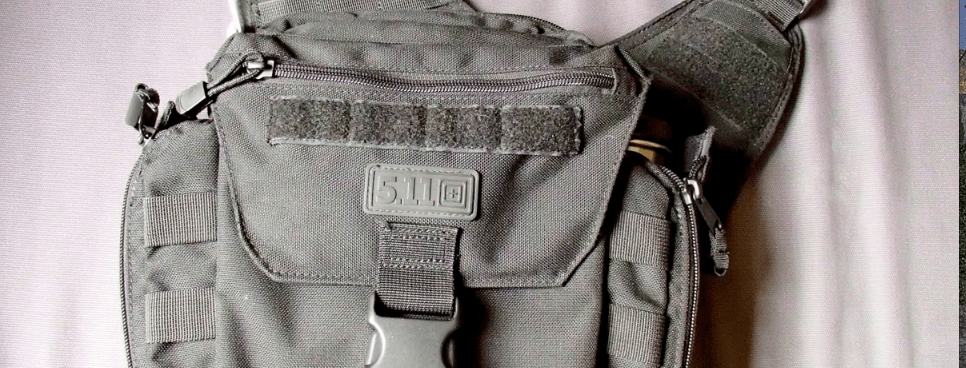
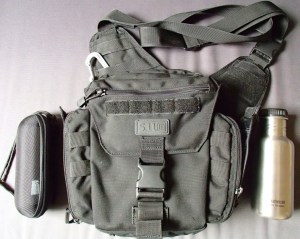
I like a carry bag that I can organize my gear and use winter or summer. A carry bag can be carried over a heavy jacket or a shirt. There is no forgetting a piece of gear being left in the pocket of my other jacket or left on a nightstand, it is all in one place. I like the 5.11 brand for its low-key practicality and toughness. The pockets are secure so there are fewer worries about a pickpocket lifting my wallet or camera and the bag’s ballistic nylon deters access by cutting into the bag. The P.U.S.H. pack doesn’t scream “expensive camera bag,” “military bag,” or “cop bag” and it isn’t an oversized messenger/computer bag.
Alan wearing 5.11 P.U.S.H. pack
There is a “man bag” culture in France and the Mediterranean areas with many local men wearing a shoulder bag “cross chest carry,” a sacs en bandoulière, so my carry bag, while a bit larger than average here, blends well into everyday life without making me looking like a tourist. (Think, “Fanny pack.”)
The P.U.S.H. pack has two side expanding pockets that I make use of for a water bottle and sunglasses case.
5.11 Tactical PUSH (Practical Utility Shoulder Hold-all) Pack5.11 Tactical PUSH (Practical Utility Shoulder Hold-all) Pack with Sunglasses and water bottle
2. Kleen Kanteen Classic 18 ounces water bottle
I carry Kleen Kanteen stainless steel water bottle with 18 ounce capacity. With us walking more in our new home, we never have to scramble for something to drink. Carrying a water bottle eliminates the cost of buying water and the impact of all those empty plastic bottles. The Kleen Kanteen is free of BPAs and has no plastic or epoxy linings that can crack like in aluminum water bottles.
Kleen Kanteen 18oz Classic
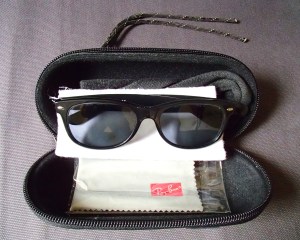
3 & 4. Ray Ban Prescription Original Wayfarers Sunglasses and Hazard 4 Sub-Pod Sunglasses Case
With making the decision to be pedestrians most of the time, I end up wearing my sunglasses nearly all the time when I’m outdoors in the daytime. I opted for the darkest polarized lenses available and a nearly “crush-proof” Hazard 4 sunglasses case. I trade out my standard eyeglasses and sunglasses in the case so I always have both with me.
Hazard 4 Sub-Pod Sunglasses CaseRay Ban Prescription Original Wayfarers Sunglasses and Hazard 4 Sub-Pod Sunglasses Case
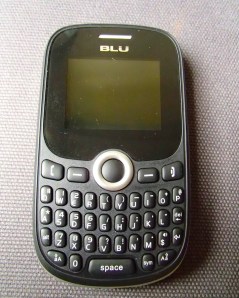
5. BLU Samba Jr Cellphone
Tracy and I needed phone communication in France immediately upon arrival. We purchased an unlocked cellphone and SIM card with a French telephone number from Cellular Abroad, a National Geographic affiliated company. It’s a “pay-as-you-go” system where you can add time through an English-speaking operator. We wanted to “unplug” for a while from always having smart phones, but wanted a basic phone for emergency “112” calls (French “911”), calls from home, and a local phone number for French government agencies and businesses. After our French bank account is established we will consider whether or not to reactivate our unlocked iPhones with a French provider.
BLU Samba Jr Cellphone
6 & 7. Business Cards and Dog Waste Bags
We have business/calling cards printed with our e-mail for use with new friends and local businesses. The dog waste bags are so we can be good neighbors cleaning up after Kiara (although it seems that, regardless of signs everywhere, few French dog owners follow suit).
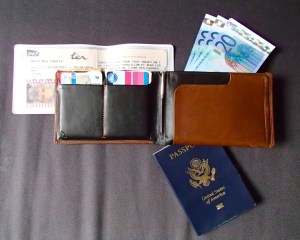
There is a Bellroy travel wallet in carry bag’s zippered inner pocket. I wanted to stop wearing my wallet in my back pocket where it is more accessible to pickpockets. It now takes a very concerted effort to obtain my wallet from its location in my carry bag. My travel wallet holds my passport (France wants you to have your Carte d’Identité or passport with you.), currency, driver’s license, credit cards, SNCF and TER (national and regional train systems) discount cards, and French supermarket loyalty cards.
Bellroy Travel Wallet
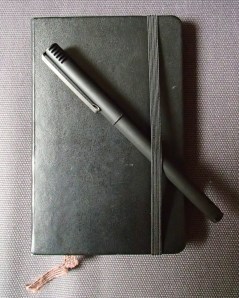
12 & 13. Moleskine Notebook and Pen
My second most used tools in the bag. I am constantly writing notes to myself, making lists, listing directions, translating French phrases to request assistance, and writing down personal observations. One of those old police habits of always having paper and pen available and making frequent notes.
Moleskine Notebook and Pen
14 & 15. Folding Nylon Shopping Bags and Spare Reading Glasses for Tracy
“Paper or plastic?” is not usually an option here. If you want a bag for your groceries you need to bring one (or several) yourself. Being primarily pedestrians, running back to the apartment to get shopping bags when we suddenly remember that we needed some things for the kitchen is awkward and time-consuming. The thin, folding nylon bags take little space and are always helpful. I also carry an extra spare of Tracy’s reading glasses in my carry bag since she often doesn’t carry a purse or camera bag..
Shopping bags and Tracy’s reading glasses
16. Olympus E-PL2 Mirrorless Digital Camera and Electronic Viewfinder with an Olympus M.Zuiko 14-150 mm Zoom Lens with lens hood and an Olympus M.Zuiko 17 mm “pancake lens” or a Olympus Tough TG820 Waterproof/Shockproof Digital Compact Camera
My most used tools since arriving in France have been my cameras. I alternate between carrying the compact Olympus TG820 when I want something lightweight in my bag all the time or in adverse weather and the Olympus Pen Camera with interchangeable lenses when I want more professional shooting options. When we decided to minimize one area was my photography. I had a larger prosumer Canon DSLR with multiple lenses which I really enjoyed. But two years ago when I carried my Canon outfit to the top of Florence’s cathedral dome, up all 463 steps, I realized that: 1.) I wasn’t getting any younger (that was a “killer” climb even without the heavy gear) and 2.) I wasn’t shooting photos professionally anymore. Today I shoot photos to share events and travels with family and friends. I decided to explore the new smaller and lighter “mirrorless” digital camera systems and return to a more classic “Robert Capa” photojournalism style of shooting images.
The carry bag allows me to “stash” the cameras out of sight in a low-key bag to avoid being targeted for camera theft and to avoid the perception of the stereotypical tourist. I always have at least the compact camera and extra batteries in my carry bag so I hope to never lose a “photo op” because I didn’t want to carry a DSLR camera with me.
Olympus Tough TG820 Waterproof/Shockproof Digital Compact CameraOlympus E-PL2 Mirrorless Digital Camera and Electronic Viewfinder with an Olympus M.Zuiko 14-150 mm Zoom Lens with lens hood and an Olympus M.Zuiko 17 mm “pancake lens”
17. Carabiner
I carry a carabiner on my bag to quickly secure my carry bag if I remove it while eating or having an espresso at an outdoor cafe. Anytime I take my carry bag off, the shoulder strap is looped around a chair or the table (or in a pinch, my leg) and secured with the carabiner. Anyone attempting to “grab and run” is going have to be able to outrun me while dragging along a large piece of the restaurant’s furniture attached to my bag.
Carabiner
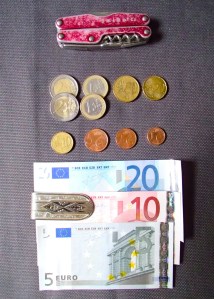
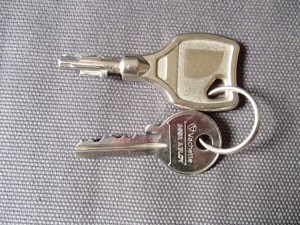
18, 19, 20, & 21. Change, Money Clip, Leatherman Juice Tool, and Apartment Keys
The final parts of my EDC gear is actually located on my person, rather than in my carry bag. I carry loose change is in my pockets. Europe uses one and two Euro coins which have proven very convenient. The lowest paper denomination for Euros is a five Euro note. I carry a money clip with currency in my pocket to avoid having to reach into my bag and displaying my wallet for every purchase. I don’t want a prospective thief to constantly see where my wallet is coming and going to.
A Leatherman Juice C2 multi-tool takes care of most tool needs with needle-nose pliers, a knife blade, screwdrivers, and the very necessary corkscrew. I’ve carried this versatile pocket tool for years.
I still wear a wristwatch, another “cop habit,” although cellphones have nearly eliminated the need for one. I rotate wearing a Seiko Black Monster dive watch, a Victorinox Swiss Army Maverick II Dual Time Zone watch, a Longines dress watch that was a college graduation gift from my parents, a Citizen Eco-Drive watch that was a gift from Tracy, and a Seiko custom TMCC retirement watch, a personalized gift from Tim Dees.
My final essential is the apartment’s keys. After years of having the “school custodian’s” size rings of home, cars, and office keys, I now carry only a building key and apartment door key.
Leatherman Juice C2 muliti-tool, Euro coins and currency, and money clipWatchesKeys
Even with the above items, There is still room in my EDC carry bag for whatever else the day’s activities might require: an umbrella, map, shopping list, Kindle, camera flash, dog’s medical records, camera tripod, flashlight, or something for Tracy.
The Eagle Scout in me has a difficult time leaving for the day without remembering to “Be Prepared” which has been serving us both well in our daily exploits here in Carcassonne.
One of our goals with our new retired life is to eat healthier.
In the past it was always faster and often more convenient to swing by a “drive-up window” and pick up a quick meal. Even though I knew better about nutrition, it was quick and satisfying to grab Quarter Pounder with Cheese, a Baconator, or Extreme Sausage Sandwich. I love a good cheeseburger, et. al, but “everything in moderation” and sometimes I wasn’t moderate in my dining habits. (You would think that after documentaries like “Super Size Me” I would have long ago been avoiding fast foods.) Please don’t think Tracy and I raised the kids on fast food and that we didn’t use healthy foods to prepare meals, but we also took our fair share of “short-cuts” to the “drive-up.”
With a major change in environment and limited access to fast food, Tracy and I wanted to create new eating habits that actually follow the USDA Food Pyramid recommendations we previous ignored if it wasn’t convenient. (But still enjoy an occasional, emphasis on “occasional,” indulgence.)
Tracy and I both love to cook and try new recipes. Now we have a lot of brand new ingredients to explore with our cooking. We want to minimize meat and emphasize vegetables, fruits, and grains. We also wanted to use farm fresh, local foods as much as possible and avoid frozen, canned, and pre-packaged foods. There are no excuses as we now have the time with retirement to enjoy making our meals completely from scratch.
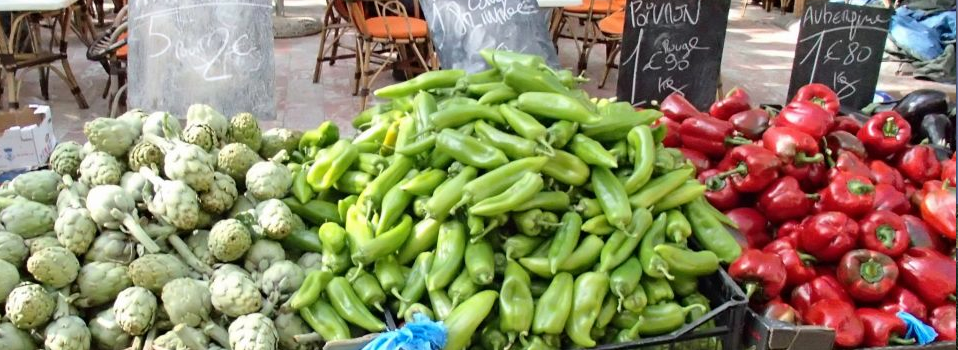
One pleasure has been shopping at the open air market in Place Carnot. Every Tuesday, Thursday, and Saturday is market day in Carcassonne. The town square in Place Carnot is full of tables with vegetables, fruits, honey, breads, meats, and flowers. We are now shopping for seasonal and fresh foods, usually directly from and sold by the farmers themselves. (There are also some imports from Spain, Italy, and North Africa also available. The country of origins on all foods are clearly identified.) Colors are often vivid with some shocking differences in foods’ colors that we only used to see in heirloom and heritage produce in the U.S.
I realize I am stating the obvious regarding the local food being is raised for its taste, rather than its ability to be trucked long distances and to last longer on store shelves. There are many new and different flavors to experience. (And new names for old favorites: mushroom are des champignons, potatoes are des pommes de terre, and strawberries as des fraises.) Yes, I already knew about the improved quality of local foods but it’s an evolution for me to experience it on a continuous basis. I never had or took the time to shop farmer’s markets or to garden at home. (I have a “black thumb” when plants are involved. There were only silk plants in my old office.) Previously tt was always a matter of running by the supermarket’s vegetable section or stocking frozen vegetables in the freezer.
The experience of shopping at the open air market is a theater upon itself: all different kinds of people coming and going, the various interactions between buyers and sellers, people looking for the best quality at the best value, friendly “bonjours” and “au revoirs,” and us standing in the middle of it. We are already choosing our favorite vendors. We have our farmer with the freshest and best tasting tomatoes. There is our “Melon Man” who insists we taste a slice of his cantaloupes first before he hand-picks the ripest melons for us. There are the vendors who are exceedingly patient with my limited French when they ask for, “Trois euros cinquante-cinq centimes” (3 euros 55 cents) and make a point to write the amount out on a pad of paper or show me the amount on the calculator.
And the best part is, of course, cooking and eating our bounty then returning to the market do it all again.
“Where in the world are . . . Tracy, Alan, and Kiara the micro-dog?”
“Where the heck is Carcassonne? I know France . . . a little. Paris . . . and the Normandy Beaches from WWII . . . and Provence from all those photos of fields of lavender . . . the French Riviera . . . the Canne Film Festival . . . and those wine places: Burgundy, Champaign, and Bordeaux. Alright, I really don’t know anything about France and never, ever heard of Carcassonne before.”
So, what about France?
France, the République Française, is the largest country in western Europe and the third largest in Europe overall. The “Hexagon” — the approximate shape of France — is a little smaller in area than Texas and basically located in the center of western Europe. To the north is the Atlantic Ocean and English Channel and to the south is the Mediterranean Sea, France is bordered by Spain, Andorra, Monaco, Italy, Switzerland, Germany, Luxembourg, and Belgium. France has overseas regions including French Guiana, Guadeloupe, Martinique, Reunion and Mayotte and additional territories like French Polynesia. This is similar to Alaska and Hawaii being U.S. states although not part of the contiguous United States and U.S. territories like Puerto Rico, Guam, and the U.S. Virgin Islands. France has about 1/5 the total population of the U.S. with 65 million citizens, compared to 316 million in the U.S. France has been the number one tourist destination in the world for the last 20 years. Geographically diverse with three major mountain ranges, major beaches, and scenic valleys, France is also ethnically diverse. France’s colonial past and tolerant culture has made it as much of a “melting pot” of peoples and cultures as the United States. Paris is the capitol to France’s semi-presidential constitutional republic that shares many aspects with the U.S. system of government. France is the fifth largest economy in the world and the second largest economy in Europe. And yes, the language in France is French.
France in the dark green (Wikipedia Commons)
So, exactly where in France are we?
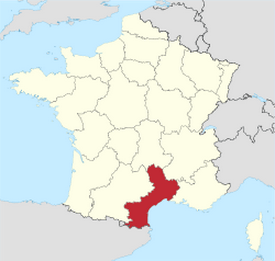
There are 22 regions in Metropolitan France and 5 regions overseas. The regions are roughly the same as states in the U.S. but with less autonomy. Each region has a capital (think state capital). We live in the Languedoc-Roussillon region and our regional capital is in Montpellier. It is the eighth largest city in France and its fastest growing for over 25 years — it’s also the size of Reno, Nevada with approximately 255,000 residents. The immigration office we work with is headquartered there. We live in the city of Carcassonne, about 90 miles from Montpellier.
Languedoc-Roussillon Region in red. (Wikipedia Commons)
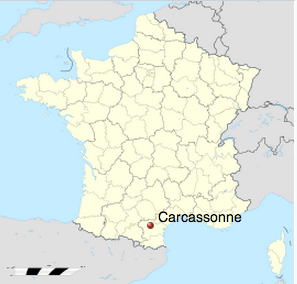
Within the region of Languedoc-Roussillon there are five departments (think of the departments like a county): Aude, Gard, Hérault, Lozère, and Pyrénées-Orientales. Carcassonne is located within the Department of Aude and is its Prefecture (the “county seat”). With Languedoc-Roussillon being adjacent to Spain and the Pyrenees there is a Spanish Catalonian influence to food and culture here. There is also the local regional dialect of Occitan (a mix of French, Spanish and Italian) still spoken in the region although French is the official language.
Carcassonne (Wikipedia Commons)
Carcassonne’s history as a settlement dates back to about 3500 BCE. There was the Roman colony Carsac on the same site in 100 BCE. Carcassonne has been occupied by Romans, Visigoths, Saracens, and Crusaders. The beginning of what was to become the largest existing walled city in Europe started in the 3rd Century with the Romans fortifying their outpost with walls. Through the centuries the fortifications continued to grow and expanded to today’s huge citadel with two massive outer walls three kilometers in length with 52 towers and barbicans. One of these towers housed the Inquisition in the 13th Century and is still known as ‘Inquisition Tower’. There are drawbridges, portcullis, arrow slits, and machicolations (murder holes – basically holes in the ceilings to drop rocks on people’s heads) to defend the fortress. Portions of the film “Robin Hood: Prince of Thieves” (1991) with Kevin Costner and Morgan Freeman were shot in and around Carcassonne. In 1997, le Cité de Carcassonne was added to UNESCO’s list of World Heritage sites.
Tracy, Alan, and Kiara in front of le Cité de Carcassonne
Carcassonne has a current population of about 48,000 residents (somewhat smaller than Carson City’s 55,000) and consists of three distinct areas.
1.) Le Cité de Carcassonne, the historic fortified citadel located at the top of the hill on the right bank of the River Aude. Le Cité is home to museums, restaurants, shops, and hotels.
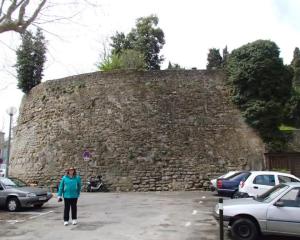
2.) The Ville Basse (the lower town) or le Bastide de Saint-Louis is located on the left bank of the River Aude. The Ville Basse, our current home, is an irregular hexagram with narrow streets in the typical grid layout of the 13th Century. The Ville Basse has historic reminders of it’s former walls with three of the town’s four original bastions at the town’s corners and the impressive medieval Jacobin Gate (Porte des Jacobin).
3.) The new town. The modern city and suburbs that has grown around the original medieval city .
Tracy in front of one of Carcassonne’s Ville Basse’s remaining bastions
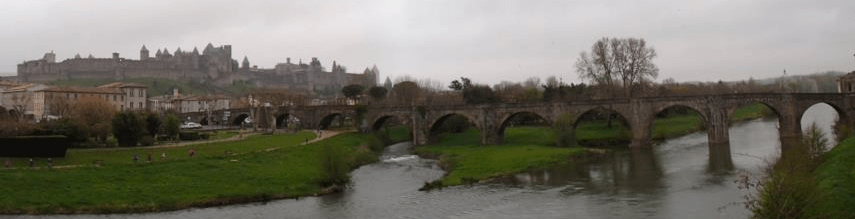
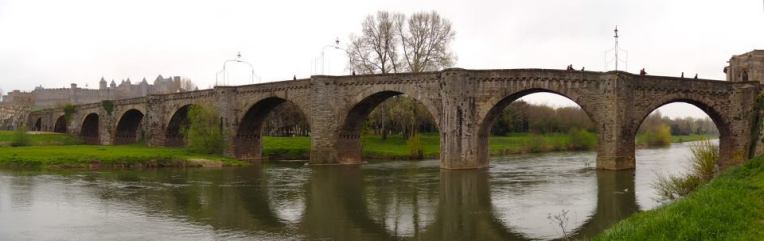
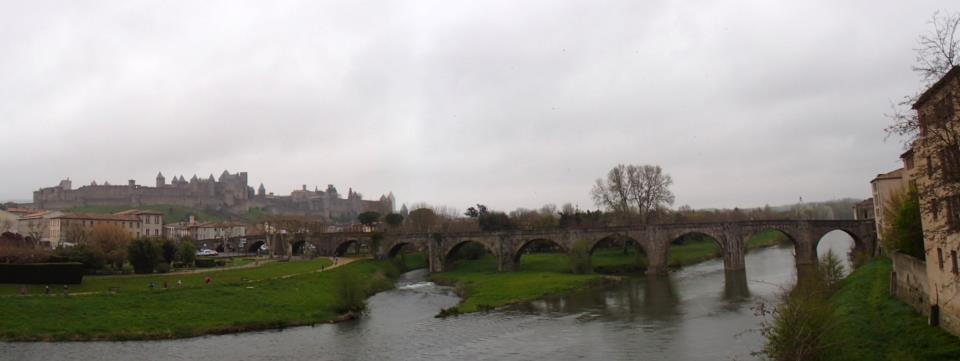
We are enjoying our new home in the Ville Basse. At the end of our block is Pont Vieux (the old bridge), the stone bridge built with its twelve semi-circular arches in the early 1300s. This pedestrian bridge crosses the River Aude and leads up to le Cité de Carcassonne. The parks on both the left and right banks of the Aude are Kiara’s favorite places to walk and play.
Du Pont Vieux
In Carcassonne’s Ville Basse we have been finding many new favorite spots, one of which is La Petit Moka with its outdoor seating and great coffee. Near our apartment is Square Gambetta, host to a rotating variety of special events including open air markets, new car shows, and flea markets. The Musée des Beaux Arts (Museum of Fine Arts) is at the west end of Square Gambetta inside an 18th century hôtel.
Carcassonne Map
The town square, Place Carnot, is home to the open air market on Tuesdays, Thursdays, and Saturdays, where we shop for fresh fruits and vegetables The square has a fountain of Neptune at the center and a grandstand at one end. Its perimeter is lined with cafes and shops. Place Carnot is a perfect location for people watching and a morning café creme, an afternoon café, or an evening pichet de vin (carafe of wine). Interesting historical note: during the French Revolution and Reign of Terror, four people were guillotined in the Place Carnot. Nowadays, our favorite coffee place La Petit Moka is there.
Place Carnot
At the north end of the Ville Basse is the Gare de Carcassonne (train station) and the section of the Canal du Midi thatflows through Carcassonne.The Canal du Midi, like Le Cité de Carcassonne isa UNESCO World Hertiage Site, it is a 225 mile long network of navigable waterways linking the Mediterranean to the Atlantic through 328 structures (locks, aqueducts, bridges, and tunnels.) Built between 1667 and 1694 ,the Canal du Midi paved the way for the Industrial Revolution in France. There are now recreational barge cruises on the canal.
Canal du Midi
To the south of the Ville Basse, is the Jacobins’ Gate, Porte des Jacobins, a remaining example of the four former gates when the Ville Basse was still surrounded by a wall. The Jacobins’ Gate is registered as a historical monument. Outside the gate are fountains and gardens.
Jacobins Gate
Our apartment is located one block west of Square Gambetta, approximately six blocks from Place Carnot and 1/2 block from Pont Vieux. A 20-minute walk from our front door will find you at either the train station (Gare de Carcassonne) or Le Cite (the citadel) depending on whether you head north or south. The Jacobins’ Gate is less than 5 minutes from our apartment.
How Carcassonne originally got its name is lost in antiquity.
However, there is a favorite local folk tale about how le Citéde Carcassonne got its name in the legend of Madam Carcas.
According to one version of the legend, in the 800’s Emperor Charlemagne’s troops surrounded le Cité in an attempt for the Frankish king to seize the city for his own. Knowing the fortress of le Cité was impenetrable, Charlemagne’s troops laid siege to starve the occupants out of le Cité. The siege continued for years and years with food stores in le Cité eventually running desperately low. Just when food supplies were nearly exhausted and it looked like a surrender of le Cité was the only option, Madam Carcas had the very last of the city’s grain force-fed into one of the remaining pigs. The pig was then thrown over the battlement down at the troops below. The pig hit the ground and burst open from being so over-stuffed with grain. Charlemagne’s troops despaired that even le Cité’s livestock was still being fed grain and the occupants had enough food that they could waste it by throwing surplus food at the troops. If after years of siege le Citéstill had those kinds of food reserves, there was no hope of starving the city’s occupants out of the fortress. Charlemagne withdrew his troops and Madam Carcas taunted the troops by yelling, “Carcas te sonne!” or “Carcas is calling you!” In appreciation for saving le Cité, the town people changed the name of the town to “le Citéde Carcassonne.”
None of this story is historically true, but never let the truth get in the way of a great tale. Around 100 BCE le Cité was a Roman colony already known as Carcasum.
But the legend of Madam Carcas is a great story and maybe the origin of the phrase, “When pigs fly?”
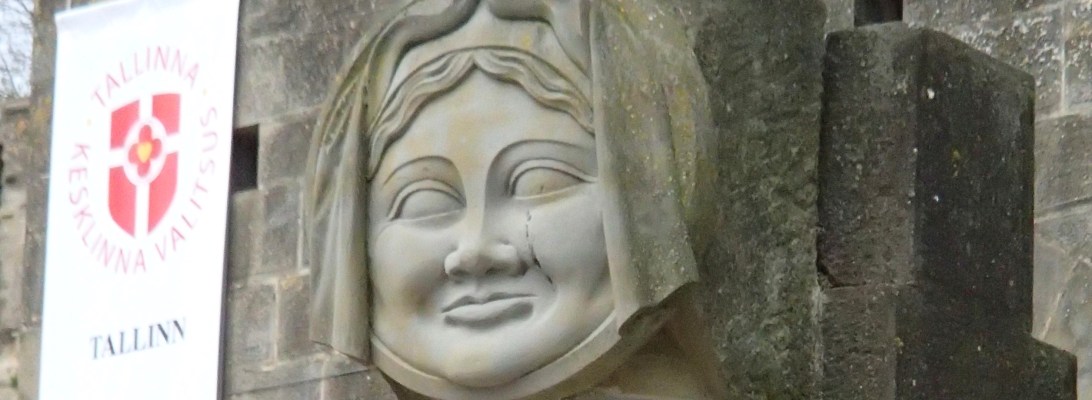
Regardless of facts, today there is a sculpture of Madam Carcas welcoming visitors at the entrance of le Cité de Carcassonne.
“False friends” are pairs of words in different languages which have similar spelling, so you assume they must have similar roots and meanings. Well that assumption can sometimes be embarrassingly wrong.
Our total immersion into French culture and language has presented many opportunities to embarrass myself, thankfully not all of my assumptions made it past my lips in front of Tracy or folks on the street. I am still inching my way toward a basic working knowledge and fear there will be many more of these opportunities to embarrass myself with a “false friend.”
While many of these words may be well understood by anyone with a couple of years of high school French, I’ve posted below some of my more embarrassing/funny misunderstandings:
1. La Mie de Pain
I assumed with the popularity of Fifty Shades of Grey that this might be a S&M dungeon. It’s actually a bakery whose name is “The Breadcrumbs.” Pain is the French word for bread.
La Mie de Pain
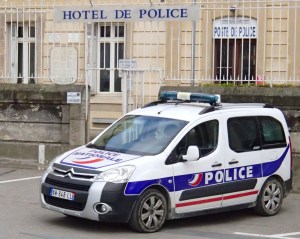
2. Hôtel de Police
A travel hotel exclusively for visiting police officers? No, the local offices of the police department.
Hotel de Police
3. Librairie
Rather than being a public library with books to lend to the pubic, this is a very comprehensive bookstore and stationery business.
4. Menu
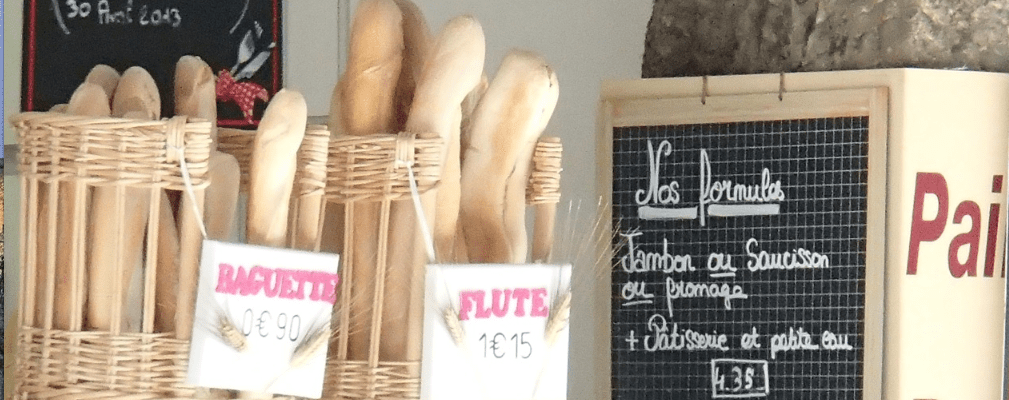
Where as in the US the menu is the brochure with a listing of meal offerings, menu in France is often posted on a notice board with a fixed-price meal of three or four courses: “Menu = Plat du jour (the plate of the day, the day’s special with meat and vegetable) + 1/4 vin (1/4 liter of the house wine) + desserte (dessert) + café (after meal espresso).” Asking for a menu may result in the arrival of an unexpected meal. The menu is also known as the formula.
MenuFormules
5. Entrée
This has got to mean the same thing, right? We use the French word in the U.S. However, entrée is France is not the main course, it is the starter course or appetizer. The main course is the “plats principaux.”
6. Immobilier
I kept walking around and seeing Immobilier offices on every block of the business district. My mind went to a “wheel boot,” a wheel clamp used to immobilize a car with excessive parking violations, but I couldn’t understand the need for so many offices. A closer look revealed that these were real estate agencies (real estate = immobile property.)
Immobilier
7. Lycées
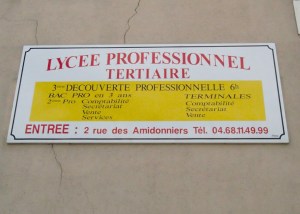
Lycées in large buildings in residential areasare obviously not Asian lychee fruits. Lycées are senior high schools for pupil 15 to 18 years old. Lycée général andlycée technologiques normally lead to university study. Lycée Professionnel leads to different kinds of vocational diplomas.
Lycee
8. Collège
Collège in France is not post-secondary education. It is junior high school for pupils from the ages of 11 to 14 years old. These collégien and collégienne (boys and girls) are taught by a professeur. Institutions of higher education in France are referred to as université and taught by professeurs des universités or aprofesseurs titulaire d’une chaire.
Collège
9. Defense
Rather than defense meaning “personal protection,” défense d’entrermeans “no admittance!”
Défense d’Entrer
10. Cabinet
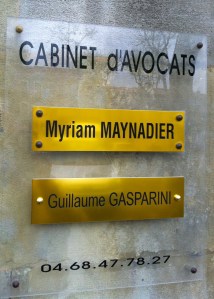
A cabinet is not a piece of furniture, but a business or professional practice like attorneys’ or doctors’ offices. Think about the term like the President’s cabinet.
Cabinet
In addition to the language faux paus I have also had the joy of trying to translate the operator’s manual for our clothes washer/dryer from French into English to sort out the directions on how to safely wash a load of laundry without ruining our minimized wardrobe. I am fairly certain that I didn’t study that hard for my Ph.D. comprehensive exams.
With a little more than a week in residence, there are a few observations I have made. It will be interesting to see if those observations remain true over time.
1. I can’t tell you how often I’ve been asked about French men wearing berets. Here in 2013 France I have only seen one older man, in Charles De Gaulle Airport, wearing a beret and I don’t know whether or not if he was actually French. The only other berets I have seen are the red military berets worn by members of the French 11th Parachute Brigade, 3rd Marine Infantry Parachute Regiment ( 3e Régiment de Parachutistes d’Infanterie de Marine, 3e RPIMa), a French Army paratrooper unit stationed here in Carcassonne. I did see two young French men in uniformed service with Kepi caps and train conductors wearing service caps. As a whole I would say most French men seldom wear hats at all during this time of year. If there was currently an iconic piece of French menswear during this time of year I woud say it is short scarfs tied with a Parisian knot.
2. Seldom do you see coffee in a “take-away” cup. Coffee culture here is such that you get your coffee in a ceramic or glass cup with the intent that you will savor it either sitting at a table or standing at the bar. Here coffee is a little harder to locate than in Italy were there were at least two coffee bars on every block.
3. However, in France it seems that there is at least two bakeries, boulangeries, on every block. The smell of fresh baked bread will make you detour to get a better whiff of the aroma. Bread appears to be king and you really do see people carrying their loaves of baguettes home. Bread is made without preservatives so it seldom lasts more than a couple days. And yes! The French pantries from the local pâtisserie really are as delicious as their reputation.
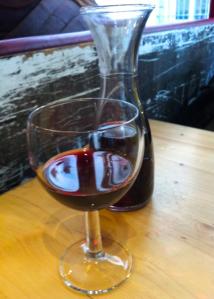
4. The local table wine by the carafe, un pichet de vin de maison, is always a good choice. Inexpensive and available by the quarter, half, or full liter carafe it can make a meal or just a break in the day more enjoyable. Blanc, rouge, rosé, surprisingly rose’ wine is a respected wine choice here.
5. It is true that French people are more reserved and formal. One will get an odd look if you wish a stranger a bonjour while walking down the street. But it is expected and polite to say bonjour and au revoir when entering or leaving a shop or restaurant. Please and thank you, s’il vous plaît and merci, are a necessary part of our vocabulary. But we have also found French people to be extremely friendly and helpful. Not as many people here speak English as we found in Italy, but all are patient with our broken French, pantomime, hand signals, and pre-translated notes. Attempting to speak French is normally greeted with a smile and an attempt to speak some words of English back.
6. The “reserved and formal” aspect of French behavior will often melt in the face of a two pound Chihuahua. Kiara is often greeted with smiles, praises, and even kisses. She is an amazing icebreaker in a sea of formality.
7. At least in this time and place we are frequently seen by French people as “generic English speakers” and most often mistaken as being from the United Kingdom. We assume the majority of English speaking visitors here are from the UK. We haven’t met any one that can differentiate a British from an American accent yet.
8. French people take great pride in their work. Baristas, wait staff, ticket agents, sales people, conductors, information desk staff all have a great work ethic and try to completely satisfy you. They often add personal touches above their basic job tasks. I was watching a window washer clean windows with a perfectionist’s attention. It seems the attitude was a job is required to be dome completely and right the first time. The éclairs that I picked up on the run today were exquisitely wrapped and in a precisely sized box, like a gift from Nordstrom’s at Christmas time.
9. Amazing the conventions you take for granted. Keyboards here are not the “QWERTY” style and surprisingly difficult to use after years of typing in the US. The hand sign for “one” is not the index finger, but the thumb. The French start counting with the thumb. Holding up an index finger will make a counter person assume “two.” Good table service is being left alone to enjoy your meal. Your coffee or meal “rents” you your table for as long as you want it. If you want your bill you need to request l’addition.
10. It is much quieter here. The volume is at a very genteel level in restaurants, stores, on the train, or walking down a city street. The volome of speaking is at a much quieter level. There is still the outburst of laughing, children playing, and public dispute between people, but in all the general tone of conversation is closer to what we expect in a library.
Tracy’s MacBook waited until after we arrived in Carcassonne to start having difficulties, so a trip to the Apple Store was in order. That accelerated us making use of the French train system sooner than we anticipated. While we have taken trains in Europe before, it was never with a set appointment at the other end so we needed a bit more planning.
Some background first. France has three levels of train service run by the SNCF (Société Nationale des Chemins de fer Français), the French National Railway Company. That includes the TGV (Train à Grande Vitesse) high-speed “bullet trains,” Intercités for long distance express passenger trains, and the TER (Transport Express Régional) for urban and regional passenger rail travel.
Since we are now retired and on a fixed income, we are very aware that we need to save money where we can on everyday items to have more money to spend on the luxuries. Twenty of France’s twenty-seven regions (a region being roughly equivalent to a state in the US) with TER service has a discount plan that allows discounts train travel for residents within a region. Within our region of Languedoc-Roussillon, for 26€ a year you can purchase a Carte Via Liberte discount card for up to four people to receive a 25% discount on weekdays and 50% off all weekends and school holidays. There are some additional discount plans for outside the region too.
With my trusty Carte Via Liberte’ in hand, Tracy and I strolled over to the Carcassonne Train Station (Gare de Carcassonne) which is .6 miles away from the apartment. The train station was built in 1857 and has one of those classic clock tower passages . It is located next to the Canal du Midi, the canal connects the Garonne River to the Etang de Thau on the Mediterranen Sea and along with the 120 mile long Canal de Garonne forms the Canal des Deux Mers joining the Atlantic to the Mediterranean in 1681. A barging canal like the Erie Canal in New York, it is kind of the French equivalent of the Panama Canal connecting two major bodies of water.
My French is very, very basic at this point. My old “police Spanglish,” high school-college German, and Italian are all better than my French. My “go to” method at this point is to anticipate what I need to request and to pre-write the questions that I translated using Google Translate into my handy pocket notebook (some police habits never go away). If the ticket agent doesn’t speak English (and we are finding very few people do speak English) I hand them my notebook so they can read my request. That and a friendly bonjour, big smiles, and many s’il vous plait and merci.
“S’il vous plait Madam, est‐ce que vous comprenez l’anglais?” Good Karma day for me. The very helpful ticket agent spoke English fairly well. She scheduled Tracy and I for our round-trip ticket from Carcassonne with a train change in Narbonne for final arrival in Montpellier. Since the trip was on a Saturday we received a 50% discount with our Carte Via Liberte‘.
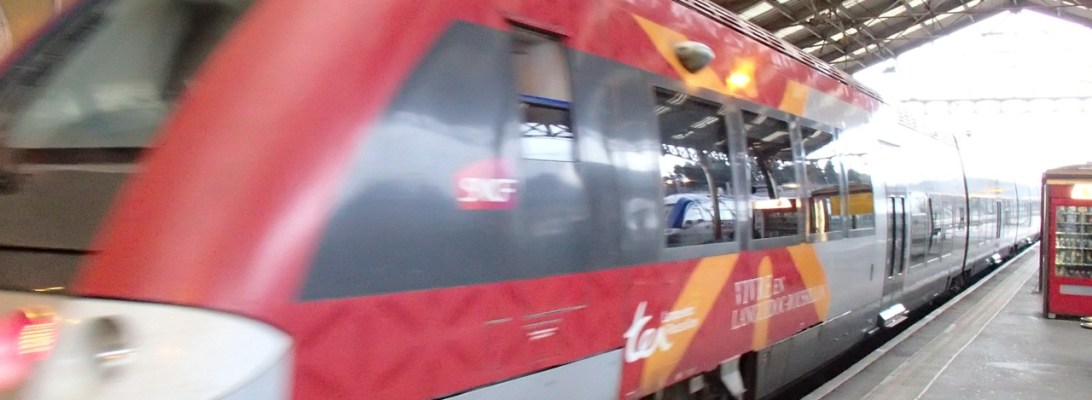
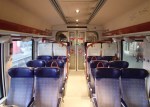
The TER trains are modern, clean and very comfortable. They arrive and leave on the minute to their schedules. (Although there has been rail strikes in the past.) We travelled second class, the only real difference between first and second being reservations and seats three abreast in first class and “first come – first served” and seats that are four abreast in second class. There are large windows to watch the scenery go past with sunshades on all the windows. Arrival and departure times are indicted on electronic display boards throughout the stations, although in French but easy to puzzle out.
While no one checked our ticket outbound, on the return trip our tickets, along with my Carte Via Liberte’ was checked by friendly conductors. Apparently some people try to ride for free. They are escorted off the train by the conductor and met by Surveillance Générale, which I understand is SNCF’s private security that has limited police authority. My understanding is that riders without tickets are fined on the spot. There are also divisions of the Police Nationale that work on the train lines and metro in Paris and its suburbs (Police Regionale des transport) and major rail lines (Service National de Police Ferroviaire.)
The trip to Montpellier was a pleasant way to do some sight-seeing from the train, get Tracy’s MacBook repaired, and better understand the train system. And we get to do all again in a week or so when Tracy’s MacBook has been repaired.
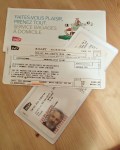
Rail Ticket and TER Carte Via Liberte
At Gare de Carcassonne for our first train trip!
Canal du Midi Outside the Carcassonne Train Station
Canal du Midi Outside the Carcassonne Train Station
Our route from Carcassonne to Montpellier
Languedoc-Roussillon location in France
SNCF TER Train Second-Class Interior
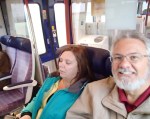
Tracy napping while riding the train to Montpellier
On Easter morning, Sunday the 31st, we checked out of our hotel room and headed to Reno-Tahoe International Airport with all our (much downsized) worldly possessions and Kiara the Chihuahua.
I dropped Tracy, Kiara, and the bags out in front of the main terminal and swung around to return the rental car. As I walked back to the terminal I found our niece Lyssa, her husband Chris, and baby Selah saying farewell to Tracy and Kiara. Tracy also had for Lyssa a bag of 110 volt hair care appliances that would completely “self-destruct” if used with Europe’s 220 voltage system. With final good-byes complete we headed inside to check-in with Delta Airlines.
To our surprise we found that our two checked bags would go all the way through to Toulouse. No having to reclaim the bags for customs inspection in Paris. Yippee!
The we met Delta agent, Sarah. What a joy! She was extremely helpful ensuring Kiara was booked for cabin travel with us on every leg of the flight. She made sure we had copies of Kiara’s cabin booking to show the gate agents in Salt Lake City and Paris, if needed. Especially in Paris where we would switch from Delta to Air France.
Interesting to note that with the exception of asking if we had Kiara’s veterinary and USDA clearances, no one ever actually examined the documents. Although we will need the documents for the French veterinarian for Kiara’s EU Pet Passport, apparently we could have flown without all the effort of seeing the vet and USDA. But we operate on the “better safe than sorry” principle and we didn’t want the nightmare of being stopped at customs in Paris and refused admission or worse, Kiara being quarantined.
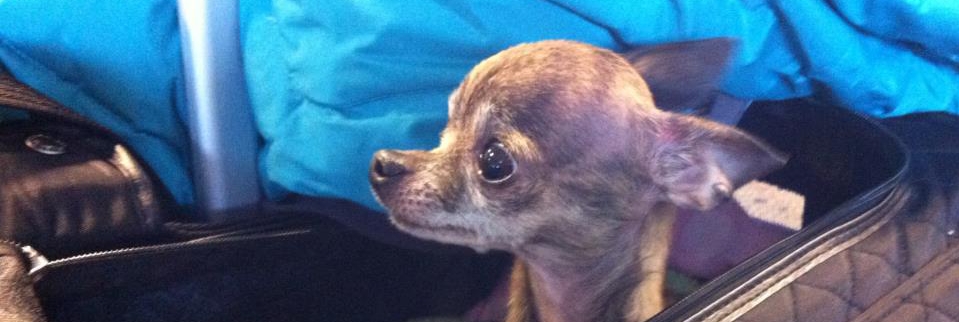
Although Kiara had to stay in her carrier aboard the plane, the gate agents in Reno-Tahoe, Salt Lake City and Charles De Gaulle airports graciously allowed Kiara to get out of her carrier, stretch her legs, and “strut her stuff” as an international jet-setter, a status she has long aspired to.
Kiara slept quietly and did not seem upset by the flights, although she would have been happier in one of our laps. Tracy did the closest thing possible to that with putting Kiara’s carrier in her lap with slipping her hand through the zippered door. No problems even medicating Kiara while enroute, though Tracy did forewarn the flight attendants that it would be necessary to do so because of her medical condition. Thankfully the flight attendants were more than understanding regarding the medication issue.
Upon our arrival in Toulouse we had the most amazing surprise of all . . . our checked luggage actually arriving with us! It was quite the relief to realize that there IS an airline that can get both you and your luggage to the same destination, at the same time. A feat that United, US Airways and Continental Airlines have never, ever been able to accomplish . . . ever!
Our final surprise was that our new landlords, British expats Jason and Annette, happened to be in Toulouse dropping off some paperwork for their daughter and offered to swing by the airport to pick us up rather than Tracy and I taking the train to Carcassonne. They were kind enough to drive us (and our luggage) the 54 miles to our apartment. That let Kiara ride in our laps for the final lap to our new home, and gave us a chance to get acquainted with another expat couple.
In all, the trip for Kiara (and us) was minimally traumatic, although our new “Miss International Diva” believes she now merits living in the adjacent castle of la Cité de Carcassonne. In the mean time, we are settling into our new apartment . . . without issue, well mostly without issue.
Kiara in her flight carrier
Tracy with our luggage, Kiara is in her carrier, top right bag.




























 An Italian Point Of View