We were thrilled to have our first visitors since we started our expat life abroad.
Our youngest son Adam and his fiancée Liz spent 18 days with us. We combined the visit with travel to Paris, Barcelona, the Mediterranean Sea, and sharing our adopted home in Carcassonne. I plan to write about their visit by breaking it up into an individual blog postings for each of the different locations we enjoyed exploring together.
Alan, Tracy, Liz, and Adam in front of the Pyramid at the Louvre Museum in Paris
It was such a pleasure to share our new life with Adam and Liz (and to congratulate Adam on earning his bachelor degree just a few weeks previous to their visit.) We explored shared interests in great cities, history, cultures, lifestyles, art, travel, architecture and enjoyed conversation, food, and drink. Adam and Liz are vegetarians so we had an opportunity to examine a totally different food culture in our travels than we had previously had a chance to try. Adam juggled on the streets of Paris, Liz sampled Sangria in Barcelona, we splashed in the Mediterranean, Adam and Liz demonstrated their Spanish language skills, we celebrated Adam’s 22 birthday (and Adam and Liz attended a performance of his favorite band that just happened to be in town on his birthday for Festival de Carcassonne), and all of us (including Kiara) watched France’s biggest fireworks extravaganza for Bastille Day with the medieval city of Carcassonne as a backdrop.
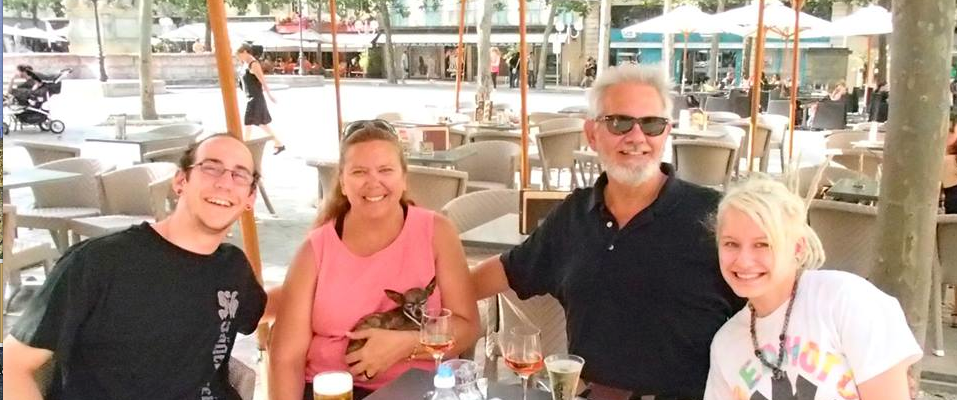
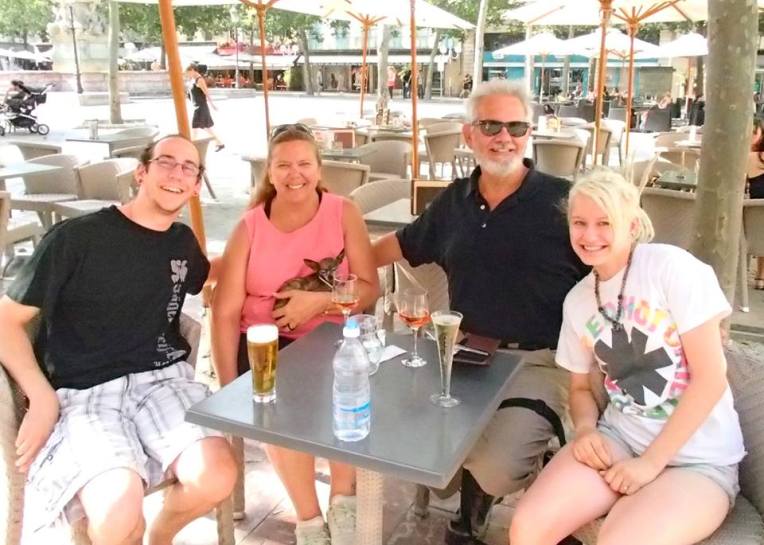
Adam, Tracy, Kiara, Alan, and Liz having a wine, beer, and champagne break in Place Carnot in the Bastide of Carcassonne
All in all, it was a spectacular visit which made us look forward to our next visitors.
So what about French pastries? Are they really as good as their reputation? The answer is: Absolutely!
Going to a real pâtisserie is an amazing experience. One of the modern laments in France in that neighborhood bakeries are getting fewer and fewer because of the growing number of supermarkets and that many bakeries attempt to be both a pâtisserie (pastry bakery) and boulangerie (bread bakery.) It is a commonly held belief that a pâtissier (pastry chef)and a boulanger (baker),while both well-respected as professionals, have totally different skill sets. Purists argue a good boulanger cannot also be a good pâtissier. Visiting dedicated pâtisseries and trying their pastries have made me a believer of that assertion.
Pâtisserie
I thought I would discuss the classic French pastry, the éclair, first. An éclair is made with pâte à choux, a light pastry dough. The reason a pâtisserie’s expertise is required is that éclairs are baked without using any rising agent. The pâtisserie uses only the moisture in the pâte à choux dough to create steam that “puffs” the pastry.
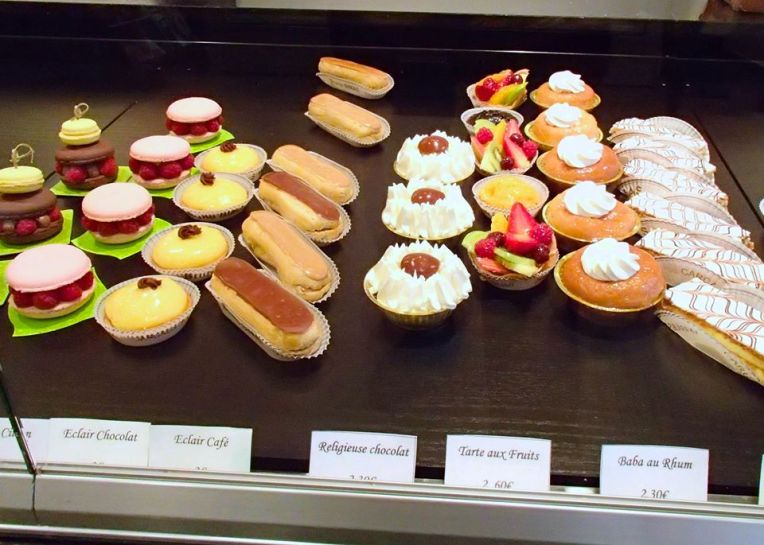
I visited my neighborhood pâtisserie saw and smelled some incredible treats on display. The window had large empty spaces from early rising shoppers.
Pâtisserie DisplayPâtisserie Display
I purchased two éclairs and the pâtisserie proceeded to carefully box and wrap the pastries, in Tracy’s words, “like a Christmas gift from Nordstroms.”
Éclair Box
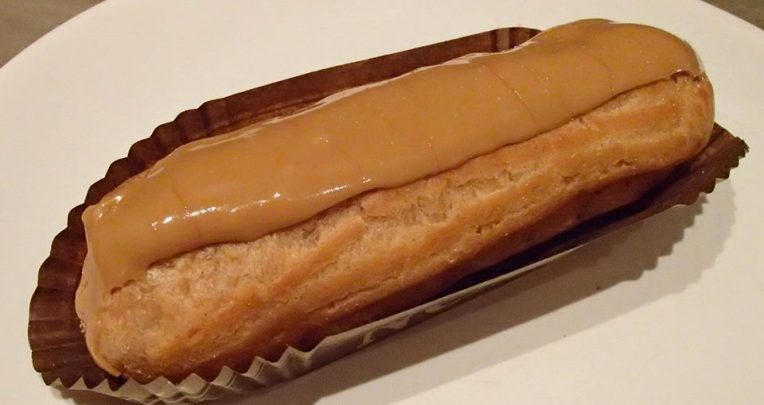
So how do they taste? Incredibly good! The éclair’s exterior is tan and crisp with layers of soft pastry inside. The filling is actually custard, rich and thick, not whipped cream or pudding. Chocolate and coffee iced éclairs arethe most common with matching chocolate and coffee custard filling inside. The richness of the pastry and custard make a single éclair a complete treat. Melt in your mouth delicious.
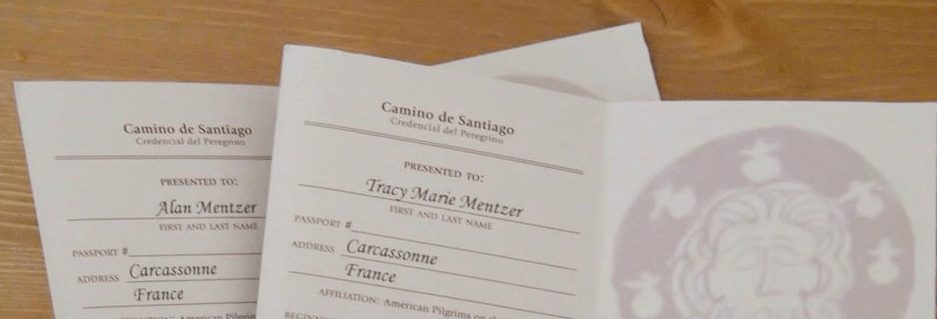
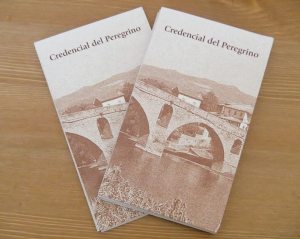
Tracy and I received our Credencials del Peregrino (Pilgrims’ Passports) this week from American Pilgrims on the Camino, a non-profit organization that facilitates and assists North American pilgrims, particularly those in the United States. (http://www.americanpilgrims.com/) Credencials are also available from other authorized organizations, confraternities, and at pilgrims offices on the route.
Credencial del Peregrino
The credencials are part of the thousand-year old tradition of the Camino de Santiago. The credencial is a modern version of letters of safe-conduct letters or letters of introductions carried by medieval pilgrims. The document shows that you are a bona fide pilgrim and entitled to have access to low-cost albergues and refugios (hostels.) The credencial is also used to authenticate your process by dated sellos (stamps, similar to a passport stamps) being added along the way.
Sello Stamps (Wikimedia Commons)
Pilgrims normally need to obtain one sello per day from alburgues, churches, town halls, or police stations to document their progress. To ensure pilgrims are actually walking the route and not making use of motor transportation, over the last 100 kilometers pilgrims are required to get two sellos each day. (Pilgrims using bicycles or horses must obtain two sellos daily from 200 kilometers outside Santiago de Compostela.) We are hoping walk enough miles daily on our 500 mile (800 kilometers) trek as to not run out of room for sellos and require us having to obtain a second credencial to allow for additional sellos.
Credencial del Peregrino
At the conclusion of the pilgrimage and reaching Santiago de Compostela we will need to present ourselves at the Cathedral’s Pilgrims Office to have our credencials reviewed prior to being awarded a Compostela. The Compostela isa certificate of accomplishment that is presented to pilgrims who complete at least the last 100 kilometers of the Camino de Santiago and have undertaken the pilgrimage for spiritual or religious motivations. The Compostela dates back to the early middle ages and its text is still in the original Latin. There are over 100,000 Compostelas awarded every year to pilgrims from more than 100 countries. For those pilgrims completing the Camino, but not for spiritual or religious reasons, a Certificate of Completion is alternatively issued in Spanish.
We are now about eight weeks out from our departure date and we are getting very anxious to start walking the Camino.
Suze is a bitter wine based aperitif made from distilling the roots of the gentian plant and sold by the Pernod-Ricard Liqueur Company. Suze is the fifth most popular aperitif in France. Apparently this 15% ABV liqueur has recently also become available for purchase in the United States.
Suze was created by Fernand Moureaux in Paris in 1885, but not marketed until 1889. Suze is known for its slender amber bottle, designed in 1896 by Henri Porte. A Suze bottle is the subject of Picasso’s 1912 cubist image “Verre et bouteille de Suze” (Glass and Bottle of Suze) that is currently on displayed at the Mildred Lane Kemper Art Museum located on the campus at Washington University in St. Louis, Missouri. http://www.kemperartmuseum.wustl.edu/collection/explore/artwork/1105
According to Pernod-Richard, who owns the brand, “The origin of the name “Suze” is disputed. According to the first theory, it was named after Fernand Moureaux’s sister-in-law, whose name was Suzanne and who loved the aperitif. Second theory: the drink was named after a little river in Switzerland, one of the first countries to adopt the drink.”
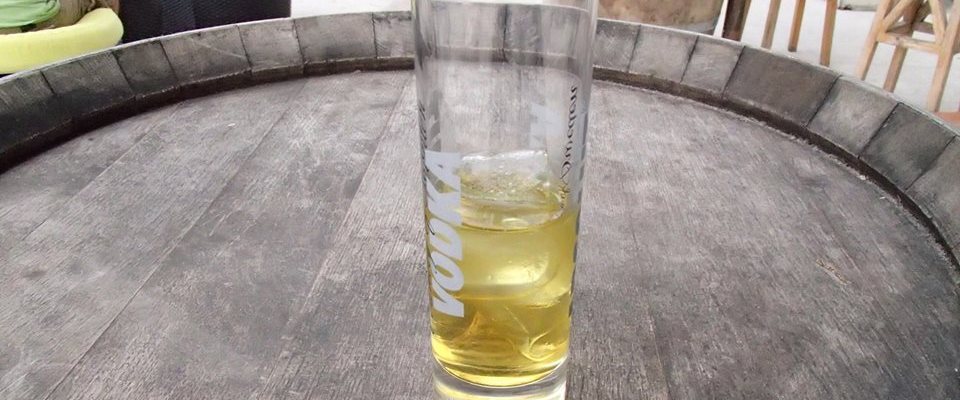
With the history behind Suze, I was looking forward to trying it. In Carcassonne, I was served Suze as two ounces of the chartreuse colored liqueur over ice.
What do I think? Once was enough. It has a very distinct bitter taste that was unpleasant for me. While not actually tasting “burnt,” it’s the word that first came into my mind. I really cannot think of ever wanting another. I don’t dislike strong liquors or liqueurs straight, in fact I prefer my Scotch and other whiskeys “neat,” but there was nothing redeeming in the taste of Suze for me.
At the Suze website, www.suze.com, there are some Suze based cocktails that might mitigate the taste. But I believe if you have to hide the taste of a liqueur you have to ask yourself, “Why am I drinking this?”
Sometimes the universe presents a chain of events that require that you “make a leap of faith” and embrace it.
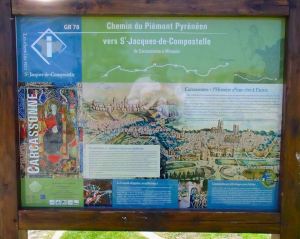
Recently fate led us to being on one of the secondary routes of the Camino de Santiago de Compostela pilgrimage trail. While living in Carcassonne we slowly realized that the start of the Chemin du Piémont Pyrénéen branch of Les Chemins de Saint-Jacques-de-Compostele (the French name for the Camino de Santiago de Compostela) was right at the end of our block.
Chemin du Piémont Pyrénéen
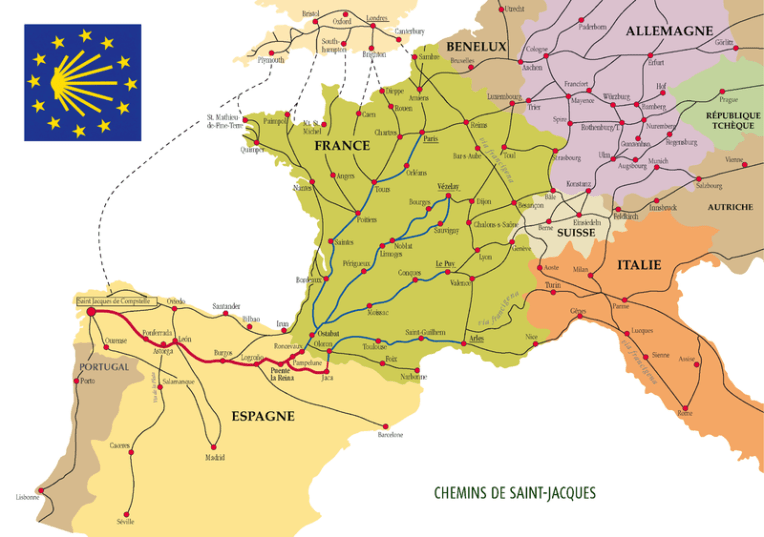
El Camino de Santiago de Compostelaor The Way of Saint James is a series of pilgrimage trails across Europe all leading to Santiago de Compostela Cathedral in Galicia, Spain which Christian tradition holds is the resting place for Saint James the Greater, one of Jesus of Nazareth’s disciples. Dating back 1,200 years, pilgrims of all faiths and backgrounds have been walking the Santiago de Compostela for religious, spiritual, or cultural reasons; for enlightenment; as penance; or as a personal challenge.
Map of Camino de Santiago – Chemins de Saint Jacques From Wikimedia Commons
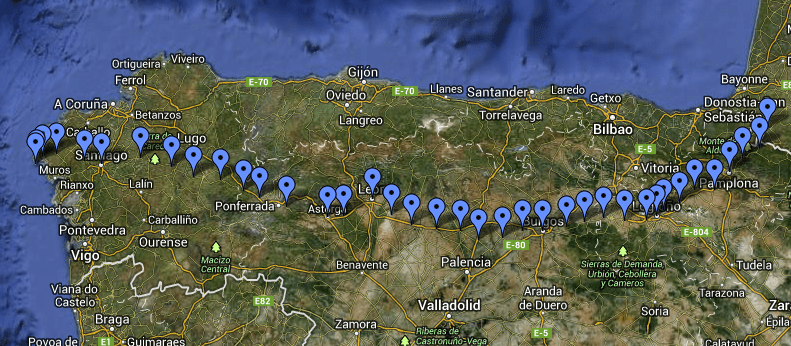
Tracy and I (with Kiara the micro-dog) have decided starting August 26 we will begin the pilgrimage and backpack the 500 miles (800 kilometer) path from Saint-Jean-Pied-de-Port on France’s Western border; over the Pyrenees Mountains and through Basque country; passing through the cities of Pamplona (famous for the “Running of the Bulls and Hemingway’s “The Sun Also Rises”), Logroño, Burgo, and León; across the Meseta plains; into the green hills of Galicia; and ending at the UNESCO World Heritage Site of the city of Santiago de Compostela and its cathedral. The trek should take us a minimum of five weeks.
Camino de Santiago – The French Route (Google Maps)
Our preparations so far:
1. Our hiking equipment has been obtained, most importantly our boots. The number one issue we hear from every guidebook, website, and blog is to have shoes appropriate for you and to break those shoes in thoroughly. I’m an old Boy Scout who has sprained his ankles frequently in the past so I’m an advocate of wearing boots for ankle support although there are many supporter of wearing lightweight hiking shoes for the Camino. The hiking gear we didn’t bring to France was purchased at Decathlon Sports in Carcassonne (a French sports megastore.) Many of the products we obtained are made by Quechua, a French version of “The North Face.” We will post our final equipment list in a later blog.
Tracy’s Camino Gear
2. We requested our credencial, our pilgrim’s passport, from American Pilgrims on the Camino (http://www.americanpilgrims.com), the United States’ confraternity for Camino pilgrims. The credencial allows us to stay at pilgrim albergues and refugio (hostels along the route) and to authenticate our progress with sellos stamps (like a passport stamps) at albergues, churches, town halls, and police stations along the way.
3. We researched and obtained guidebooks that explain the various routes, history, and provide maps of the Camino. We selected John Brierley’s A Pilgrim’s Guide to the Camino de Santiago, the Confraternity of Saint James’ The Camino Francés: St-Jean-Pied-de-Port to Santiago de Compostela, and CaminoGuide.net’sCamino Francés.We wanted some alternative views but plan to only bring one guide with us on the Camino. We have been reading blogs and forums about walking the Camino, we both greatly enjoyed and recommend http://www.girlsontheway.com/.
4. We selected the Camino Francés as our route (Saint-Jean-Pied-de-Port, France to Santiago de Compostela, Spain across the entire Northern end of Spain), picked our departure date as the last week in August, and made hotel and train reservations for Saint-Jean-Pied-de-Port where we will start the journey. We decided on a final night in a hotel to be well rested before our departure. The hotel is located near the Pilgrim’s Office so we can arrange our final details before leaving.
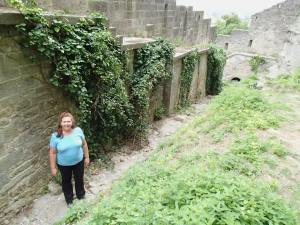
5. We have started a daily training regimen that includes walking the biggest hill nearby, the road to the medieval city of la Cité de Carcassonne. The training is also part of our process to “break in” our boots and get acclimatized to carrying backpacks, something I did all through my youth and young adulthood but an activity I haven’t done in more than a decade.
Tracy hiking the barbicane at la Cité de CarcassonneAlan hiking the bailey in la Cité de Carcassonne
6. We obtained a chest carrier for Kiara. Yes, Kiara the Chihuahua is traveling the Camino with us. We understand that many albergues do not allow dogs, but we intend to camp whenever that occurs. Kiara will do some daily walking, but most of her traveling will be as a passenger on her “beasts of burden” (the two of us) like the horseback pilgrims who also travel the Camino.
So our Camino preparations continue and we will post more updates as we go.
Tracy’s boot over the scallop shell sign marking the Camino
No, these are not my beloved gin Martini (two ounces Bombay Sapphire Gin, scant capful of Martini & Rossi Dry Vermouth, shaken until freezing cold, with three blue cheese stuffed olives added) or James Bond’s famous vodka Martini ( . . . with a thin slice of lemon, shaken, not stirred.)
These classic French before-dinner drinksare simply a glass of white or red vermouth. While vermouth is most commonly just a mixer in the US, in Europe it is also served as a stand alone aperitif of 2 to 3 ounces (6 to 9 centilitre) either neat, chilled, or over ice. Vermouth is a fortified wine (13-24% alcohol content), that has been aromatized by infusing it with botanicals: spices and herbs, the most notable of which is wormwood. The modern version of vermouth was created in Turin, Italy in 1768. Vermouth quickly became a popular drink at the Turin Royal Court and its popularity spread throughout Europe from there.
Martini Blanc (Martini White)
Martini Blanc
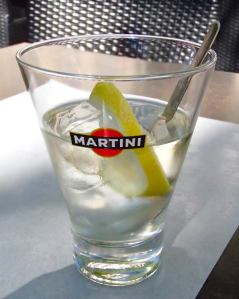
Here in Carcassonne I am served two ounces of Martini Bianco vermouth over ice with a slice of lemon with a small spoon in a specific Martini Logo glass. The spoon is used to stir the drink to cool the vermouth. This is sweet vermouth with a slightly bitter citrus taste and an undertaste of vanilla.
Martini Rouge (Martini Red)
Martini Rouge
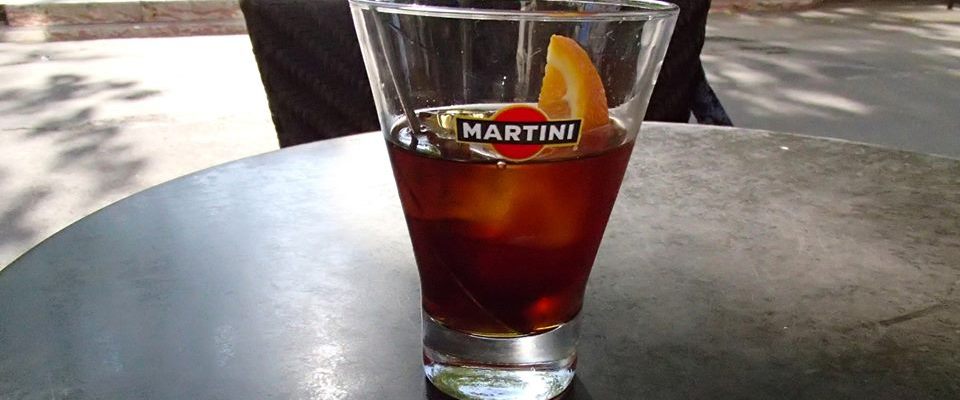
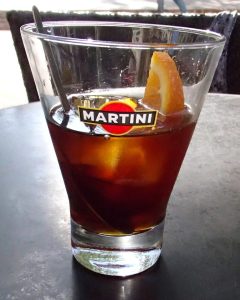
The Rouge version of the Martini has two ounces of Martini Rosso vermouth poured over ice with a slice of orange. Like the Blanc, it is served in a Martini Logo glass with a small spoon. Another sweet vermouth, but this one has notes of slightly bitter orange.
The Italian vermouth Cinzano and French vermouth Noilly Prat are widely available in France. There are also straw-colored dry and rosé vermouths choices available.
So what do I think? I would be happy to accept a Martini Rouge from a host as an aperitif at a gathering. It’s pleasant, refreshing, and I would prefer the Rouge to the Blanc. The Rouge has more of a “wine-like” quality to its flavor than the Blanc.
I enjoyed both drinks, although while having them it brought back the memory of the pained look on Bill Murray’s face in the film “Groundhog Day” when he is forced to drink Andie MacDowell’s character’s favorite drink, “Sweet vermouth on the rocks with a twist.” These would not be my “go to” beverages.
With all said and done, I really prefer to have my vermouth as a few drops of dry vermouth added to a traditional gin Martini. In order to get that classic Martini cocktail in France one must specifically order a “Dry Martini” or a Martini sec.
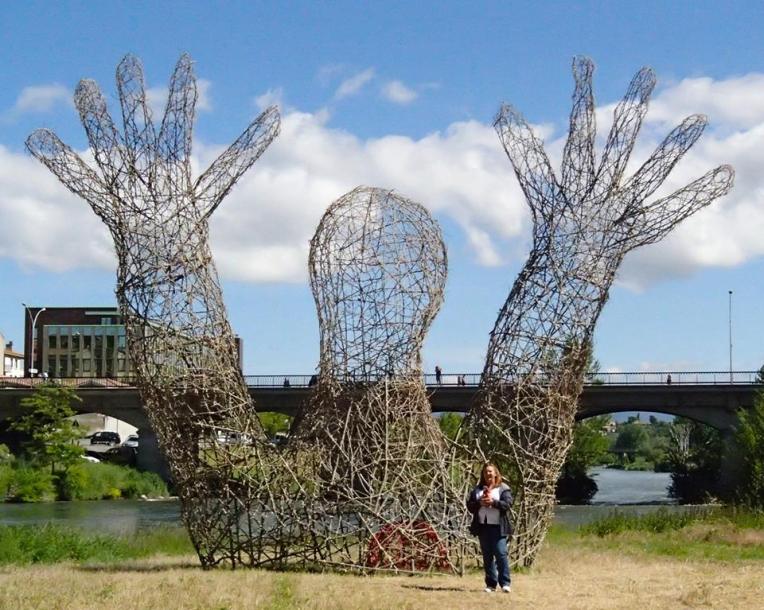
Franco-Canadian artist Marc Walter created five large sculptures in Carcassonne as part of the annual Festival de Carcassonne.
The first and largest is the “L’embrassade” (“The Hug”) sculpture located on the tip of l’île de la Cité Park and below the Pont Vieux (Old Bridge.) The sculpture is 7 meters tall and 9 meters wide. Marc Walter uses natural materials like wood, rock and earth to create his “Land Art” sculptures. For this project he used tree branches collected from Carcassonne’s public works after pruning the local trees. The sculpture is made by weaving the branches and securing with twine to created a large figure of a man with arms outstretched to the sky. A bright red heart can be seen inside the sculpture. The image is very reminiscent of an 3-D version of a Keith Haring painting.
Tracy and Kiara in front of Marc Walter’s “Land Art” Sculpture “L’embrassade” (“The Hug”)
This slideshow requires JavaScript.
In Square Gambetta the artist created four additional sculptures. Standing five to six meters high, I thought these “Invités du Coeur” (“Guests of the Heart”) sculptures had a Native America feeling. The weaving of the branches creates a vision of Indian basket weaving and the silhouette reminds me of woman with a blanket draped over her shoulders. Again created using recycled tree branches and twine, the four figures allow you to step inside and experience the art from the interior. Each sculpture has a distinctly red heart like the “L’embrassade” sculpture, but these figures were somewhat more abstract in appearance. We watched the artist and volunteers from the community build the sculptures over the last six weeks. I spoke briefly with artist Marc Walter while he was working. He was very friendly, accessible, and happy to discuss his work. I was thankful because of Marc’s Canadian roots I was able to communicate in English. He works very hard to actively involved the entire local community in the work as a collective effort in the art. The completion of the project was marked with a picnic celebration with the community invited to attend.
Tracy with one of the “Invités du Coeur” (“Guests of the Heart”) Marc Walter sculptures in Square Gambetta
This slideshow requires JavaScript.
In all, a remarkable exhibition of public art by artist Marc Walker using local recycled materials and involving community volunteers.
On May 30 through June 2, Cité de Carcassonne hosted Le 20e Festival Œnovidéo, véritable moment de rencontre internationale entre le monde du cinéma et du vin, vient de se clôturer (the 20th Annual Oenovideo International Grape and Wine Film Festival) and le 8e Torroirs d’Images Exposition Internationale de Photographies sur la Vigne et le Vin (the 8th Annual Terroirs d’Images Exhibition of Vine and Wine Photography.)
Oenovideo Film FestivalTerroirs d’Images Photo Exhibition
The Oenovidéo International Grape and Wine Film Festival featured 26 films from 14 countries competing for the title of best film on the vine and wine in 2013. The Terroirs d’Images Photo Exhibition hosted 105 photos from photographers from 14 countries on the theme “Enjoy and celebrate wines on five continents.
After going to the website I was able to request tickets to the film showings and to attend the photography exhibition. The event’s headquarter was at Hôtel de la Cité Carcassonne, a four star hotel located inside the medieval city and next to Basilique Saint-Nazaire-et-Saint-Celse de Carcassonne (the Basilica of St. Nazaire and St. Celse). The hotel has stunning private gardens where several events were held.
View from the garden in Hôtel de la Cité Carcassonne.
The garden in Hôtel de la Cité Carcassonne.
The garden in Hôtel de la Cité Carcassonne.
The garden in Hôtel de la Cité Carcassonne.
The garden in Hôtel de la Cité Carcassonne.
The films screened at the festival included several English language films including my favorite selection, “No Wine Left Behind,” a “kickstarter-funded” independent film which is described as, “When US Marine Sergeant Josh Laine returned from intense fighting in Iraq to his native Livermore, CA, he couldn’t find a job anywhere. When a girlfriend got him into wine, he decided to take a crack at winemaking and with the help of the other Marines that he served with, Lavish Laines Winery was born. The winery has since become a place where returning veterans can find a job, camaraderie, and a sense of purpose. The film follows Josh and his fellow vets as they try to take the winery from a garage start-up to a fully-fledged operation and in the process explores the challenges vets face in transitioning back to civilian life.”
Tracy and I really enjoyed the Terroirs d’Images Photo Exhibition. The gallery was set up inside leCité de Carcassonne’s Trésau Tower and the venue gave the photos a powerful setting. The images were suspended on thin wires to emphasize the photographer’s work. There was a “No Photos” inside the gallery rule, but I took one overall shot to give you an impression of the exhibition and the presentation of the art.
Photo gallery inside Trésau Tower.
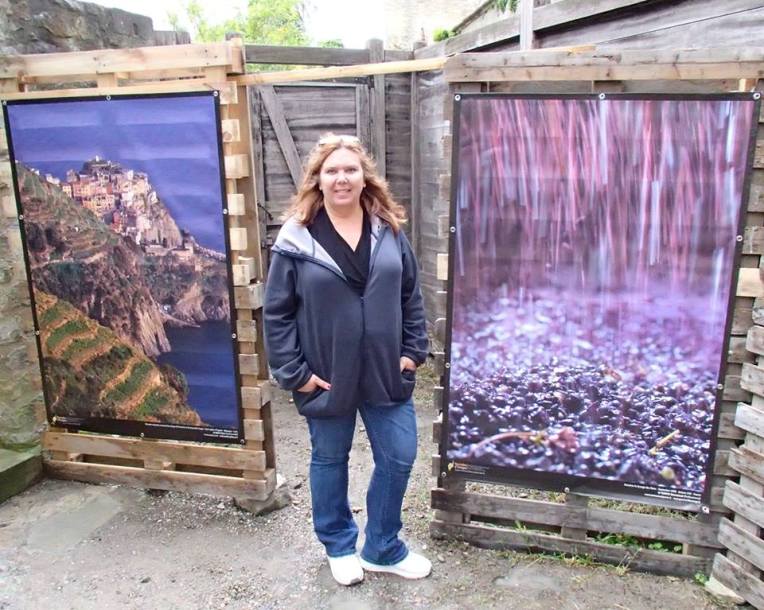
Some of the photos were “blown-up” and displayed outside the gallery so I can share some of those below.
Tracy outside the exhibition with two photos displayed inside. Eighth Annual Terroirs d’Images International Photo Exposition.
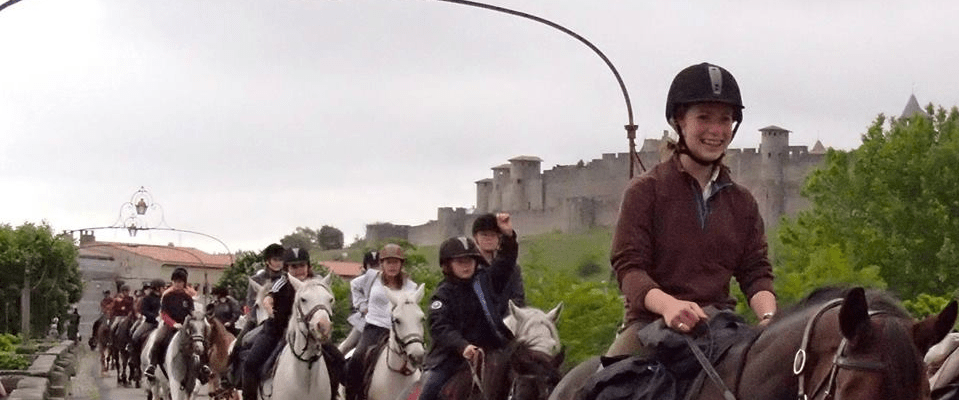
We had a great time at the Cheval en Fête (Horse Festival) today. We watched more than 100 riders participate in the Equiaude Equestrian Parade. The cavaliers rode from the medieval citadel of la Cité de Carcassonne, down and across du Pont Vieux (the Old Bridge), around Square Gambetta, through the streets of Carcassonne, and ending at the Hippodrome de la Fajeolle.
Equiaude Equestrian Parade passing over the Pont Vieux (Old Bridge) with la Cité de Carcassonne in the background.
The participants ranged from mature to the very young. There appeared to be several riding schools with groups of young people in matching shirts singing together as they rode. Riders were using western saddles, dressage saddles, Australian saddles, and jumping saddles and there was a couple of horse-drawn carriages also participating. With the municipal police taking front and rear of the procession for safety, the parade passed through town with the children happily waving to spectators.
The parade is part of a two-day equestrian competition at Carcassonne’s hippodrome. The Equiaude Parade (Equi = equestrian, Aude = our department in France) is anticipated in Carcassonne like the annual Reno Rodeo Cattle Drive.
Equiaude Equestrian Parade
It was odd not to see iconic American Mustangs or Quarter Horses among the horses, but there were some beautiful Arabians and Thoroughbreds, with ponies and horse/mule hybrids for the children. While I’ve been in a saddle fewer times than I have fingers, Tracy is a former horsewoman who explained tack and horses breds as they passed.
The part we enjoyed the most was the smiles and laughter of all the young riders as they enjoyed being the center of the attention while waving to the spectators and singing in unison.

















 An Italian Point Of View