600th Anniversary of the Procession de la Sanch à Perpignan

Tracy and my most recent micro-adventure was joining 10,000 other spectators at the 600th observance of the annual Procession de la Sanch (The March of the Penitents) in Perpignan on Good Friday, 2016. (La Sanch is pronounced “lah sank.”)
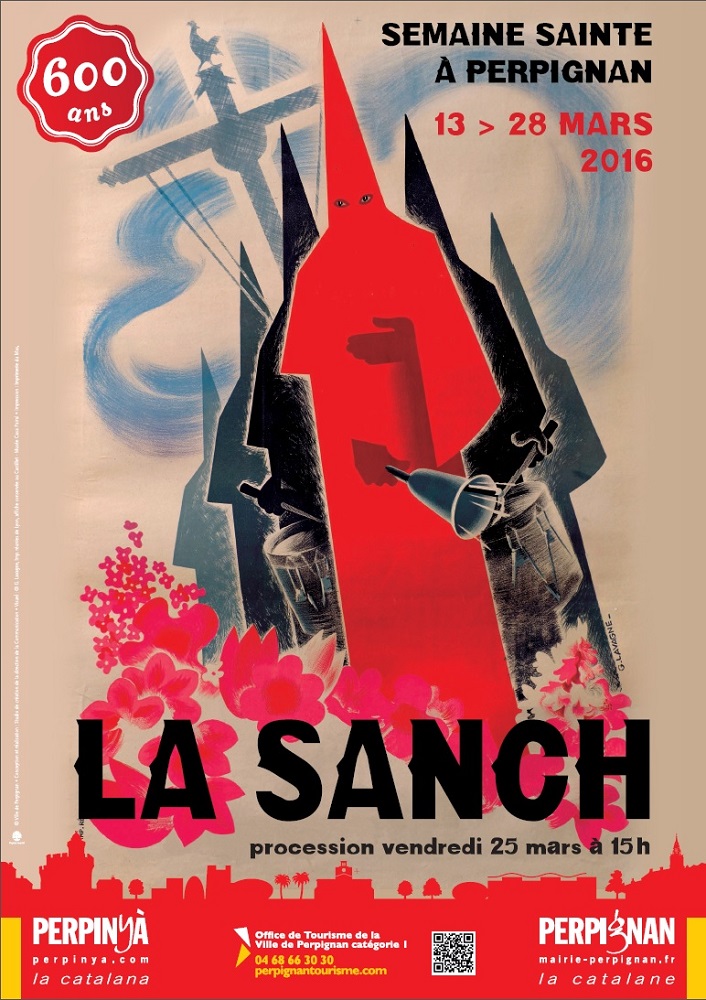
Poster of the Procession de la Sanch à Perpignan (Perpignan Tourism Office)
Poster of the Procession de la Sanch à Perpignan
(Perpignan Tourism Office)

Outside of Spain, the Procession de la Sanch isn’t really performed any longer. In France, it is only held in the southern Catalan country. The largest and most famous of the French penance processions still performed during the Semaine Sainte (Easter Holy Week) is the Procession de la Sanch a Perpignan. Nearby Arles-sur-Tech and Collioure also still perform la Sanch ceremonies, though on a smaller scale. The event was originally brought to Perpignan in 1416 by Saint Vincent Ferrier, a Valencian Dominican. (Remember, Columbus reached the “New World” in 1492, 76 years after the first Procession de la Sanch.) The Pyrénées-Orientales département (which includes Perpignan, Arles-sur-Tech and Collioure, sometimes referred to as Catalunya Nord) has strong Spanish and Catalan roots that has helped this French department retain a traditional event that is typical of the Semana Santa (Spanish Holy Week). The strength of this French-Catalan-Spanish blend can be easily seen in the departments’ flag, gold and red stripes, the same colors as those used in Catalan and Spanish flags.

The somber, masked procession began centuries ago as a method to support condemned men on their final march to execution and ensure their Christian burial. La Sanch’s robes and the conical hoods (the hood is called a Caperutx — today the entire ensemble is referred to as Caperutx) were worn by the executioners and the prisoners to conceal their identities. Apparently early on in history the victims and families of the victims were a bit too happy to pull them out of the procession and just beat them violently to death in the streets.

The Caperutx worn during La Sanch are either black (worn by the penitents representing death) or red (worn by the leader, the Regidor, representing blood), only the children and priests in the procession (representing the innocents and the saved) wear white. A Regidor, in his red Caperutx is at the head of the procession and rings an iron bell to warn of the coming procession. The robes worn in la Sanch, while reminiscent to the costumes worn by the Ku Klux Klan, actually predate the Klan’s by 500 years and have a completely different origin and meaning.

About 700 members of local associations, Confrérie de la Sanch, organize, march, and carry the approximately 35 “misteris” in the procession. (“Misteris” mean mysteries in Catalan.) The misteris are litters with life-size portrayals of scenes from the Passion of Christ. Weighing between 60 and 100 pounds, the misteris may be carried by up to eight persons. Some of the penitents in Caperutx carried drums and beat a steady, slow tattoo for the procession. Penitents also may sing”goigs,” traditional songs dating back before the 15th century, that recount the sadness of Mary’s suffering in Calvary. We didn’t hear a “goig” being sung while we were watching the procession.

The Procession de la Sanch takes three hours (from 3:00 to 6:00 p.m.) to circle the historic downtown of Perpignan and passing other parishes, starting and ending at Église Saint-Jacques (Saint James’ Church) which dates back to 1245.  

Prior to the procession start, we visited Église Saint-Jacques. We found a beautiful 13th century church with a unique bell tower that was built in the southern Gothic style. Its most unusual feature is that there are two Catalan-styled altarpieces at opposite ends of the single nave with the organ at the center. Inside the church were many of the Misteris with their fresh flowers being displayed before the procession. We had a wonderful opportunity to see the Misteris up close and appreciate their size and weight. We spoke with another visitor to the church who was admiring the Misteris. He was French, but had completed his doctorate at the University of Minnesota. He recounted the history of the event with us and told us we were very welcome there and encouraged us to have a look around the church. Since Tracy and I share an appreciation of sacred architecture, his invitation was quite welcome.
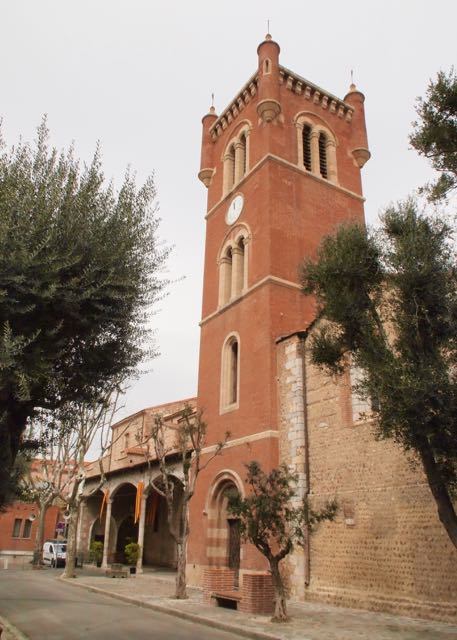
Église Saint-Jacques de Perpignan (Saint James' Church)
Église Saint-Jacques de Perpignan (Saint James’ Church)

This slideshow requires JavaScript.

We choose a location to watch the procession in Place Puig (Puig Square) in the Quartier Saint-Jacques which is also referred to as the Quartier Gitan because of its significant Gitan (Roma people, often called Gypsies or Gitanos in Spain) community. While waiting for the event to start we visited with a local Gitan man who explained the Gypsy history of the area and how the former military barracks adjacent to Place Puig were converted to public housing and was now home to primarily Gitan peoples.

Procession de la Sanch Map (Perpignan Tourism Office)

The procession was preceded with a loudspeaker explanation about the history and meaning of the event.  After the announcement we heard the tattoo of drums and the procession became a solemn, slow-moving parade.  Approximately 700 men, women, and children participated in the procession.  Although it is easy to fixate on the penitents wearing the Caperutx hoods and robes, there are a surprising number of women dressed in black marching in the procession.  The misteris on their litters looked impressively heavy as their were carried on the procession. Both the men and the women carried misteris.  The carriers had an unusual technique of using a forked walking stick under the carrying poles to support the weight of the misteris when the procession stopped and to trade carriers. The use of the forked sticks was performed without verbal direction with orders by tapped by the team leaders with their stick on the ground to alert the other carriers. Tracy noticed that several women were wearing heels up to 4 inches to allow all the women carriers to be the same height. Several of the hooded penitents wearing the Caperutx elected to walk the entire route and to carry the misteris in their bare feet. 

I spoke with one of the marchers who was collecting charity contributions from the crowd.  He attempted to chat with us in French, Spanish, Catalan, and, I think, Caló (Gitano-Roma) before I explained that our French and Spanish was very poor and that we were Americans. While saying he didn’t speak English, he spoke enough English welcome us, thank us for a supporting the procession,and gave us a prayer card with the “Our Father,” . . .  in Catalan, of course. It is always amazing to us the number of multilingual people we meet in the Pyrénées-Orientales département, even though English is seldom one of those second languages, usually the French people in this area of the south will most often also speak Catalan, Spanish, or Maghrebi (Moroccan Arabic – Darija.)

At the end of the official procession pasted, members of the public joined at the end of the parade and followed the official participants.

In all, it was a unique opportunity to watch the 600 year old Procession de la Sanch in person. A chance to observe a traditional Catalan and Spanish religious ceremony performed in a very secular modern France. To be involved in the conclusion to the penance and atonement of the Lenten season in a historic ritual dating back to 1416. It was an extremely powerful experience.

Wishing you all a very Happy Easter.
This slideshow requires JavaScript.


Parfait! Third Renewal of Our Residency Permits (Cartes de Séjour) Part 1

Our third effort at renewing our Cartes de Séjour (residency permits) was exceptionally easy. We seem to understand the renewal process well now and are experienced with the requirements at the Bureau des étrangers (immigration office) at the Préfecture des PyrénéesOrientales in Perpignan.  It also help that we started preparing in January although the permits do not expire until the end of March.

The Préfecture des PyrénéesOrientales is extremely responsive to e-mail.  I was uncertain about which forms to download from the Préfecture’s website, but an e-mail was answered in 24 hours with links to the correct forms and a currently list of supporting documents.  The list of documents was the same as last year. They were also kind enough to make an appointment for us to submit our renewal application.  The Préfecture’s e-mail responsiveness saved us from making a physical trip to Perpignan to pick up forms and make an appointment saving us a great deal of time while we were in the process of changing residences.

The list of supporting documents for our renewal appointment is actually short and straight forward.  Bring the original document and a copy of the following:

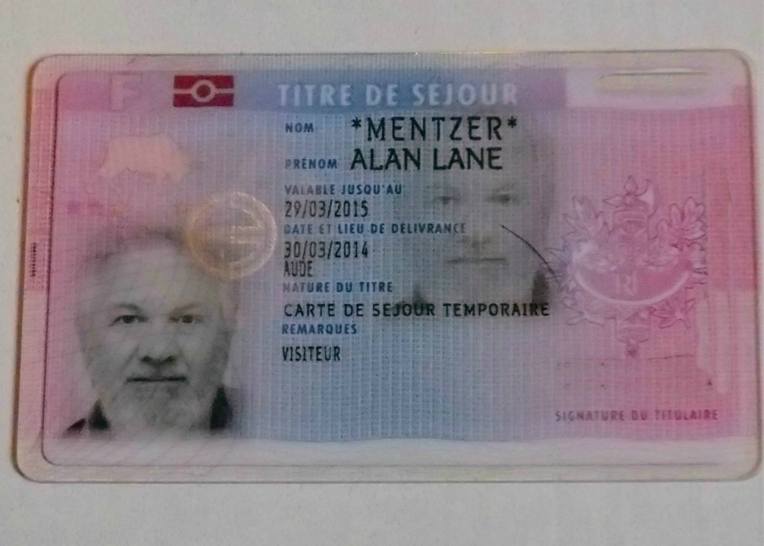
1. Current Carte de Séjour (residency permit) that is being renewed. Something that was different this time: during our appointment our Préfecture officer made an extra copy of both Carte de Séjours and added them to each other’s renewal application.

Carte de Sejour
Carte de Sejour

2. Passport with copies of pages with identification information, expiration dates, with all entry stamps, and visas.

3. Marriage certificate since our passports do not confirm marital status. This document was not specifically on our list from the Préfecture des PyrénéesOrientales but from past experience we knew marriage status had to be confirmed at each renewal.  There is also an attestation that we are married on the renewal form that our Préfecture officer witnessed us signing.

4. Birth certificate.

5. Proof of the location of residency with our lease, rent receipts from last year, and our power bill (A French Power Bill is the Ultimate Identity Document)

6.  Four recent passport-style photographs.  There are passport photo machines everywhere from retail stores to train stations.  Photos are required with almost all government applications.

7.  €106 payment for each of us submitted by timbres fiscaux (tax stamps.)  The tax stamps are sold in specific Tabacs (tobacco and convenience stores).  This was a bit more challenging since I couldn’t find a Tabac in Argelès-sur-Mer who sold them and in Perpignan I was also having difficulties.  We were finally sent to the Trésor Public (Public Treasurer) at the Centre Des Finances Publiques à Perpignan where there was a helpful gentleman at a cashier window who was happy to sell us the timbres fiscaux.

 Tax Stamps (timbres fiscaux)
Tax Stamps (timbres fiscaux)

8. Proof of financial independence equivalent to 12 times the monthly French minimum wage.  I had previously requested an income verification letter about our pensions from the Nevada Public Employees Retirement System.  We also prepared a translation including a conversion of dollars to euros at the current exchange rate.  That was the only document we bothered to translate.  We submitted a confirmation letter from our French bank that stated that we were customers in good standing too.

9. Sworn handwritten attestation not to exercise any occupation in France. There is also an attestation on the renewal form that our Préfecture officer witnessed us sign.  Our visa status is specifically for retirees and prohibits us from working in France.

10.  Self-addressed, stamped envelopes which are available from any supermarket or post office.

Tracy (A.K.A. the “Queen of Organization”) took my collection of paperwork, rearranged and organized our documents exactly in the order of the checklist, and made certain the required spaces on the renewal form were filled in.

Carte de Sejour Renewal Paperwork with our mobile file of personal documents

On our appointment date of March 15, (yes, the ominous ‘Ides of March’)  we took the €1 Bus the 23 kilometers (14.5 miles) from Argelès-sur-Mer to Perpignan.

Préfet des Pyrénées-Orientales, Perpignan.

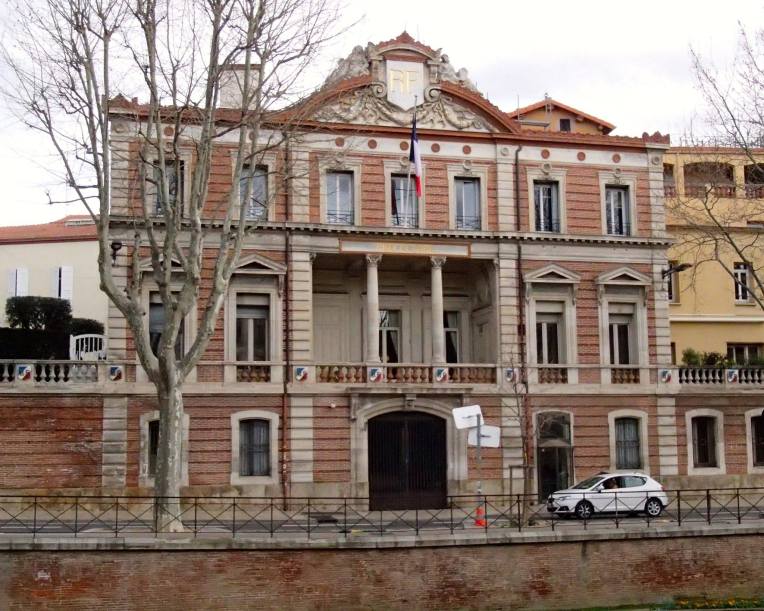
Our appointment was at 9:15. so we took the early bus and arrived in Perpignan with time to enjoy a café crème and a pain au chocolat before walking to Préfecture’s annex in the Hôtel D’Ortaffa located behind the actual Préfecture. We arrived as the office opened at 9:00 and waited as a police officer from the Police Nationale hand-checked the bags of visitors as they entered.

Tracy having a café crème at Le Grand Café de la Poste in Perpignan
Hôtel D'Ortaffa, Perpignan
Hôtel D’Ortaffa, Perpignan

There was a short line at the check-in window, but before we could reach the window, a young customer service representative in a red vest looked at our appointment e-mail and walked us into the immigration office.  We waited a couple of minutes and were called to a window for our appointment at exactly at 9:15.

Our very helpful and friendly immigration officer was extremely impressed with Tracy’s organization and deemed it “Parfait!” (Perfect!) The only issue was with the electronic fingerprint scanner which had difficulties reading my dry hands and it took several attempts to get readable prints.  Tracy had no such problems.

This renewal was much simpler than last years since we were not changing regions and we had a regular lease and power bill.

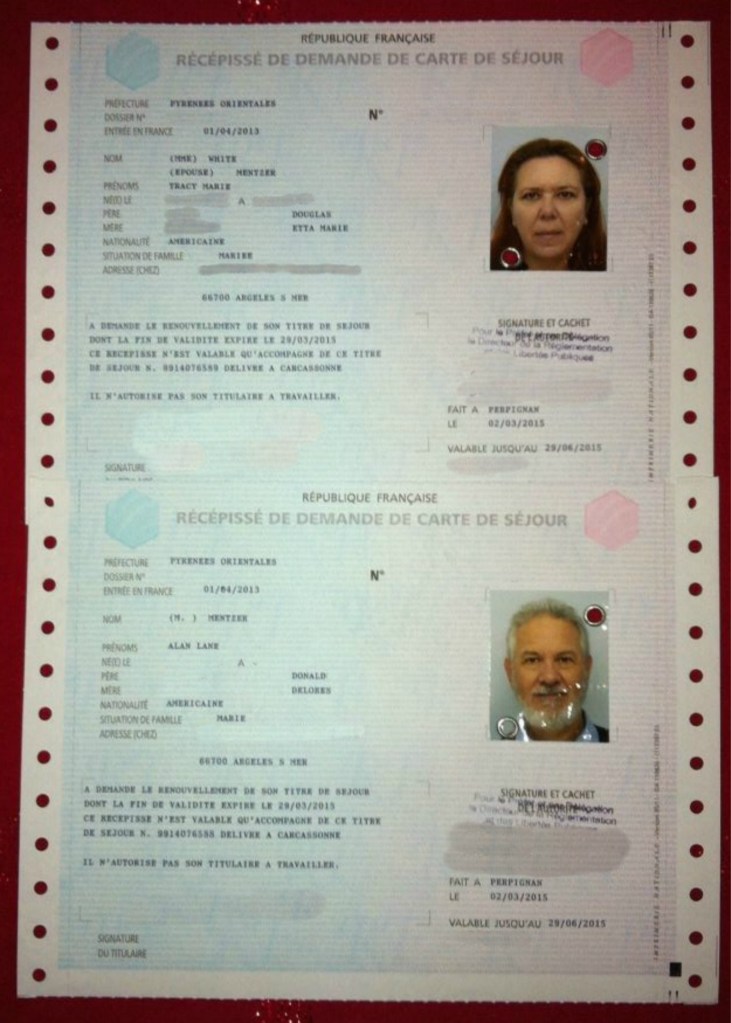
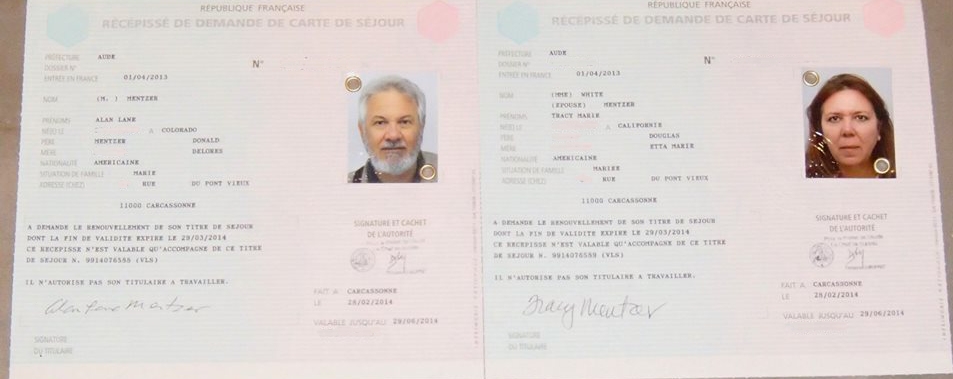
Our final step was to sign and accept our Récépissés de Demande de Titre de Séjour (receipt of application for residency permits) that serve as temporary Cartes de Sejours. Our immigration officer advised us that we will be sent notification letters that will let us know that we can return with our timbres fiscaux (tax stamps), passports, and Récépissés de Demande de Titre de Séjour to collect our new  Cartes de Sejours for 2016-2017.

Récépissés de Demande de Titre de Séjour 2015

Success!

And Tracy received official recognition that she is, “Parfait!” But I already knew that. We were “in-and-out” of the Préfecture in 45 minutes total after processing  both our renewals.  I know there is a stereotype of cumbersome French bureaucracy, but (“knock on wood”) we have had minimal challenges and all the representatives have been very patient and helpful.

Now we just have to wait for our notice in the mail to arrive and our return trip to Perpignan..

Tracy in front of the Castillet near the Prefecture in Perpignan

Related posts: First Renewal of Our Residency Permit (Titre de SéjourCartes de Séjour Arrived To Help Celebrate Our First Year In France,  Second Renewal of Our Residency Permits (Cartes de Séjour) Part 1, and Second Renewal of Our Residency Permits (Cartes de Séjour) Part 2