Carcassonne with Deb and Gerry: Le Cité de Carcassonne, Château de Montségur, Mirepoix

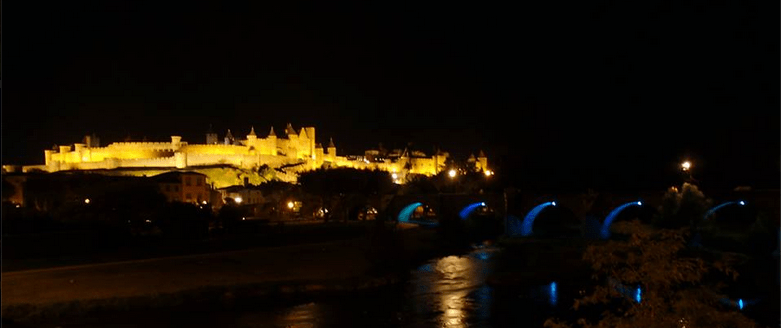
After visiting Paris and Normandy we finally had the opportunity to share with Deb and Gerry our home in Carcassonne and to walk up the hill from our apartment to explore the medieval double-walled city, la Cité de Carcassonne. We enjoyed the three kilometers walk around the walls of la Cité, viewed its 52 towers, saw the count’s château, and visited the many shops, restaurants, and hotels within.  The citadel of la Cité is a UNESCO World Heritage Site.

For Tracy and I it is, “The view that never gets old.”

Deb, Gerry, Tracy, Alan, and Sami the MinPin at the Aude gate of la Cite de Carcassonne

This slideshow requires JavaScript.

We took advantage of having a car to see one of the many Cathar castles that are scattered throughout the region, the ruins of the Château de Montségur.  It is a legacy of the Albigensian Crusade (1209–1229), a 20-year military campaign initiated by Pope Innocent III to purge the Cathar sect from the Languedoc region in the south of France.  The ruins of Montségur are at the top of 1,200 metres (3,900 feet) pog (an Occitan word meaning “peak, hill, mountain”) near the start the Pyrenees Mountain range.

The trip had the double purpose of “warming up” Tracy and Deb for their upcoming trek on the Camino de Santiago across Spain.

After their climb to the top of Montségur, we headed over to the town of Mirepoix. The small village of Mirepoix has managed to retain the classic architecture and charm of its original town square but with updated shops and businesses. The city is known for its overhanging arcade which has 150 individually carved wooden heads.  A quaint place for a relaxing afternoon.

This slideshow requires JavaScript.

The time had come to split up.  We drove to St. Jean-Pied-de-Port to deliver Tracy and Deb at the traditional start of the Camino Francés of the Camino de Santiago, the 1200 year old pilgrimage route of the 800 kilometers (500 miles) long Camino de Santiag0 (The Way of Saint James).  Deb was limited to only having two weeks to hike, so they planned to walk the first 164 kilometers (102 miles) over the Pyrenees Mountains and through the Basque country of Navarre to Logroño, Spain, then skip ahead by train to Sarria, and finish the last 107 kilometers (67 miles) hiking through the Galicia region to Compostela de Santiago.

Gerry and I (with a continuous “comedy of errors” of finding our way along the French highways) continued on to Paris (after a brief overnight stop in Limoges.) Gerry and I enjoyed a final evening in Paris with a “Steak frites” (Steak and French fried potatoes) in the Montmartre district in the 18th arrondissement.  We admired the sight of the Basilique du Sacré-Cœur,  watched the unruly crush of bicycles, scooters, motorcycles, cars, trucks, and buses work their way (miraculously without a single collision) through the intersection near the Avner Métro station, and had a final ice cream.  The next morning Gerry took the RER B to Charles DeGaulle Airport for his flight back to California and I caught The RER A to Marne-la-Vallée – Chessy and my Ouigo TVG train home to Carcassone.

Deb and Tracy in St. Jean-Pied-de-Port at the start of the French route of the Camino de  Santiago.
Deb and Tracy in St. Jean-Pied-de-Port at the start of the French route of the Camino de Santiago.

Part 1:  Paris with Deb and Gerry: Eiffel Tower, Notre Dame, Love Locks, Arc de Triomphe, and the Luxembourg Garden

Part 2:  France with Deb and Gerry: Mont Saint-Michel, Normandy

Part 3:  France with Deb and Gerry: Omaha Beach, Normandy American Cemetery and Memorial
France with Deb and Gerry: Omaha Beach, Normandy American Cemetery and Memorial

It is the 70th anniversary of the D-Day Invasion this year, and we wanted to visit the sites of the Normandy landings from June 6, 1944 during Deb and Gerry’s visit with us.  After seeing Mont Saint-Michel, we drove to Saint Laurent-sur-Mer to see Omaha Beach and Colleville-sur-Mer to see the Normandy American Cemetery and Memorial.

Signs to Omaha Beach

It was a beautiful day on Omaha Beach, the weather was perfect.  The ocean looking toward the English Channel was also perfect, not like on D-Day 70 years ago with 5 to 6 foot swells, 59 degree temperature, and force 4 winds. The day we were there we saw swimmers in the water, kitesurfers working the waves, and people walking the beach barefoot.  I kept looking at how exposed WWII troops would have been on the beach, thinking about the books I’ve read describing the D-Day landings, and seeing in my mind that horrific 25-minute opening scene to the film “Saving Private Ryan.”  Massive sacrifice and history was made at that location. Tracy said it was like seeing an old photo overlaid atop a recent one, an odd sense of realism and history merged together in your mind – both compelling and disconcerting at the same time.

We did get the opportunity to chat for a while with an author who had a display highlighting veterans of WWII whom he interviewed both for the display near the beach and his current book. He shared stories of the battle, some of which we knew and some we had never heard. Though we didn’t buy his book, we did enjoy talking with him for a while and appreciated his insight and suggestions.

This slideshow requires JavaScript.

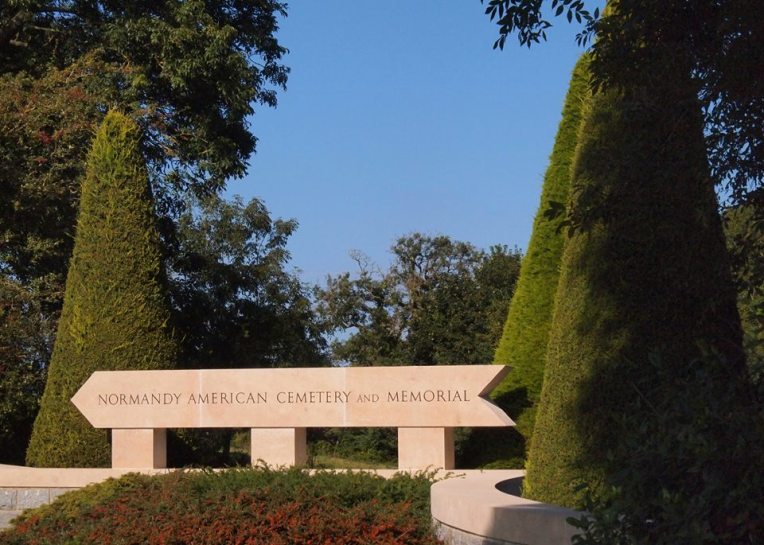
Normandy American Cemetery and Memorial

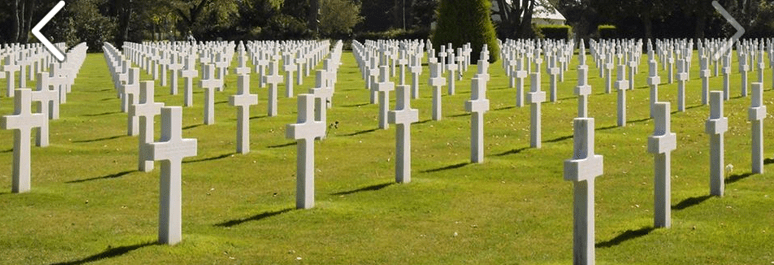
The Normandy American Cemetery and Memorial is located on a bluff overlooking Omaha Beach. It covers 172 acres (70 hectare) and commemorates the remains of 9,387 American military dead, most of whom were killed during the invasion of Normandy and the ensuing military operations in World War II. The names of 1,557 Americans who lost their lives in the Normandy campaign but could not be located or identified are inscribed on the walls of a semicircular garden at the east side of the memorial. There is also a 22 foot tall bronze sculpture, The Spirit of American Youth Rising from the Waves.

Like all other overseas American cemeteries in France for World War I and II, France has granted the United States a special, perpetual concession to the land occupied by the cemetery, free of any charge or any tax. This cemetery is managed by the American government by the American Battle Monuments Commission.  The US Flag flies over the cemetery.

Deb and Tracy were able to locate the markers for the Niland brothers, whose story was part of the inspiration for the movie “Saving Private Ryan.” Though they did have to wait for a bit while a group of French tourists finished visiting, they did get the opportunity for a few photos of the brothers’ markers which are side-by-side in the cemetery. There are 45 sets of brothers buried here, only 33 of them are buried side-by-side. In addition there are 3 medal of honor recipients, a father and son (also buried side-by-side), 307 unknown burials and four women.

The Normandy American Cemetery and Memorial is the American Battle Monuments Commission’s most visited cemetery, receiving about a million visitors each year.

This slideshow requires JavaScript.

Part 1:  Paris with Deb and Gerry: Eiffel Tower, Notre Dame, Love Locks, Arc de Triomphe, and the Luxembourg Garden

Part 2:  France with Deb and Gerry: Mont Saint-Michel, Normandy

Part 4:  Carcassonne with Deb and Gerry: Le Cité de Carcassonne, Château de Montségur, Mirepoix

France with Deb and Gerry: Mont Saint-Michel, Normandy

After visiting Paris, we picked up our rental car in Versailles and drove to Normandy to see Mont Saint-Michel, the ‘Wonder of the West.’

The car rental process was slightly more complicated than it sounds.  Prior to Deb and Gerry’s arrival, Tracy tried to reserve a rental car with the standard unlimited mileage option that is available from the US websites. However, the results she kept getting was a low mileage, not unlimited mileage quote. Tracy asked Deb to try making a reservation from the US and Deb was able to get a quote with unlimited mileage for the same car from the same rental agency.  Tracy wasn’t sure why there was a difference depending which country a rental inquiry originates from. Perhaps the rental agencies’ websites track the potential client IP addresses. In the end, Deb had to reserve the car while she was still in the US so that we could get the unlimited mileage package we wanted. Another oddity of life in France.

Mont Saint-Michel is a small tidal island with a Gothic-style Benedictine abbey, monastery, and city surrounded by fortifications dating back to the 8th century. The Abbey was built between the 11th and 16th centuries. It is located approximately 600 metres (0.6 miles) off the coast of Normandy, at the mouth of the Couesnon River. This island is about 100 hectares (247 acres) in size. One of France’s best known landmarks, it is a UNESCO World Heritage Site. Over 3 million people visit Mont Saint-Michel annually.

Located between the regions of Brittany and Normandy, Mont Saint-Michel’s unique location created a tidal causeway (a path uncovered only at low tide) that allowed early pilgrims to walk to the island’s abbey during low tide.  However, high tide made the island extremely defensible with the possibility of drowning or stranding attackers caught on the causeway when the tide would come in and fully surround the island. There is an impressive 14 metres (46 feet) difference between the high and low water marks. Mont Saint-Michel was unconquered during the Hundred Year War. In 1433 a small garrison was able to defend the island from an England assault.  The island, like Alcatraz in San Francisco Bay, was also used as a prison in the 1600-1700’s.

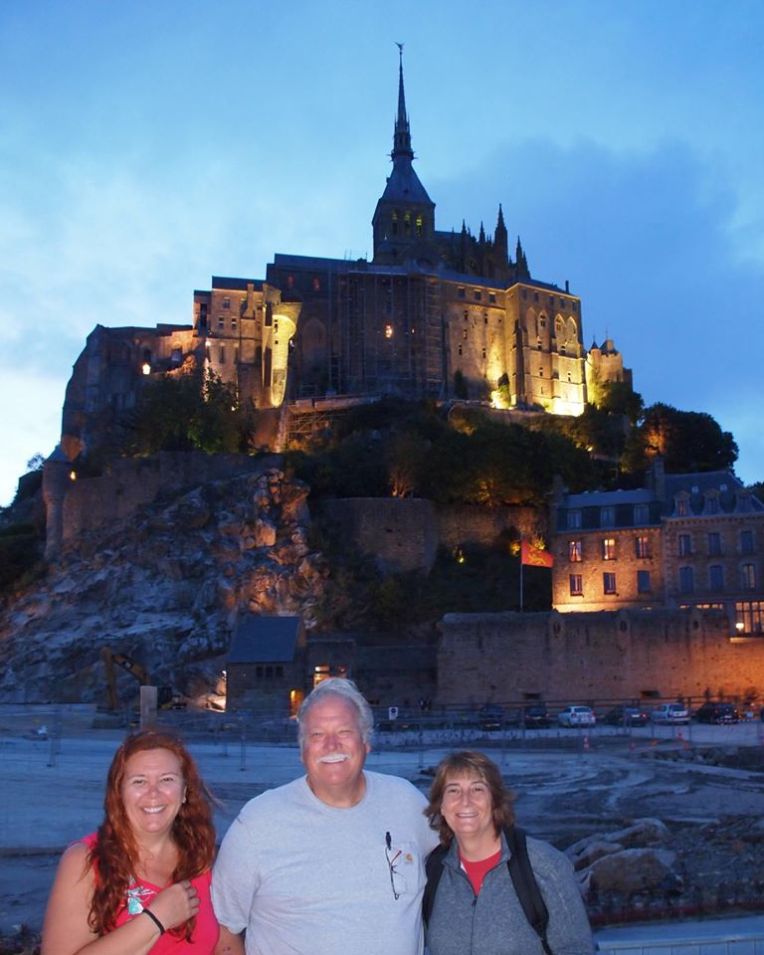
Tracy, Gerry, and Deb at Mont Saint-Michel, Normandy, France

We stayed in a cabin at the beautiful Camping Haliotis in Pontorson. The cabin was only 9 km from Mont Saint-Michele, we liked the facility and its amenities so much we decided to stay an extra night. We were lucky to be visiting on the last night that Mont Saint-Michele was open in the evening, so we explored the island as it transitioned from daylight to night time.  We drove to the parking area and took the shuttle bus out the raised causeway to Mont Saint-Michele.  We had a great time exploring the Abbey, the town, the fortifications, and watching the resident nuns use a hoist to transfer groceries and supplies up a cable into the upper Abbey.

The sunset was absolutely beautiful over Mont Saint-Michele.  It really is a “wonder.”

This slideshow requires JavaScript.

Part 1:  Paris with Deb and Gerry: Eiffel Tower, Notre Dame, Love Locks, Arc de Triomphe, and the Luxembourg Garden

Part 3:  France with Deb and Gerry: Omaha Beach, Normandy American Cemetery and Memorial

Part 4:  Carcassonne with Deb and Gerry: Le Cité de Carcassonne, Château de Montségur, Mirepoix

Paris with Deb and Gerry: Eiffel Tower, Notre Dame, Love Locks, Arc de Triomphe, and the Luxembourg Garden

The end of August and into September we were lucky to have Tracy’s Aunt Deb and Uncle Gerry come and visit us in France.  Deb had come to Paris before, but always on business trips that limited her opportunity to tour the city.  This was Gerry’s first travel outside the United States except as a guest of Uncle Sam and the US Army with an all-expense paid trip to Southeast Asia in 1969 where the locals were  hostile.

Gerry, Deb, and Tracy in front of the Cathédrale Notre Dame de Paris
Gerry, Deb, and Tracy in front of the Cathédrale Notre Dame de Paris.

En route to Paris, Tracy and I stopped for a short layover in Montpellier.  We enjoyed a coffee and a walked through the Place de la Comédie while waiting for the OUIGO TGV to arrive and take us to Paris.  We have become big fans of the French national rail system’s, SNCF, discount high-speed train.  The train gets us from Montpellier to Paris (465 miles [750 km]) in 3 hours and the cost is only €10 if you book your tickets early.

This slideshow requires JavaScript.

When we arrived in Paris, we found that there was a problem with apartment that Tracy had reserved.  Since the apartment was unavailable we received an upgrade to a much larger apartment in the Trocadéro district in the 16th arrondissement.  The apartment was located behind the Palais de Chaillot in easy walking distance to the Eiffel Tower.  Great serendipity for our stay in Paris.  Tracy and I are getting to know Paris, its sights, its Métro (the second busiest subway system in Europe after Moscow), and the RER (Réseau Express Régional) system better with each visit.

This slideshow requires JavaScript.

We met Deb and Gerry at Paris’ Charles de Gaulle Airport (Aéroport de Paris-Charles-de-Gaulle) and zipped into town on the RER and the Métro to drop their bags off. Then is was out into Paris to see the city.  While in Paris we enjoyed the Eiffel Tower Romance tour and had a private view of Paris from above the Jules Verne Restaurant on the second level of the Eiffel Tower.  We enjoyed the daytime and nighttime views of Eiffel Tower and the city of Paris from the Palais de Chaillot near our apartment.  The Palais de Chaillot and its grounds over looks the Eiffel Tower and was built as part of the Exposition International of 1937.

We walked along the River Seine to the Île de la Cité (one of the two islands on the Seine at the city’ center) to visit the Cathédrale NotreDame de Paris.  It is always a stunning sight and Tracy and Deb conducted “zoom lens” wars searching for the most interesting gargoyle and detail on the Cathedral.  I always enjoy admiring the flying buttress and hearing the bells ring.  On the nearby Pont de l’Archevêché (Archbishop’s Bridge) we introduced Gerry and Deb to the “Love Lock” controversy of visitors securing a padlock to a bridge as a symbol of their love and their visit.  It has become such a popular practice many historic bridges are festooned with locks and suffer damage.  According to the Daily Telegraph in September 2014″ (All the love locks’) weight caused a section of metal mesh to collapse this summer on the Pont des Arts under the strain of some 54 tons of padlocks.”  While not illegal, Paris is responding by replacing the grates with clear plexiglass panel to prevent locks being attached.  Tracy and I became “part of the problem” by adding our own “love lock” prior to the practice being banned.

We walked the Avenue des Champs-Élysées from the Arc de Triomphe and the Tomb of the Unknown Soldier to the Grand Palais des Champs-Elysées (that was originally built as an exhibition hall for the Universal Exposition of 1900) with its stunning glass and steel roof.  We spent time photographing the nearby Pont Alexandre III bridge’s Art Nouveau lamps, cherubs, nymphs, winged horses, and its view of the Seine and the Eiffel Tower.

Across the Pont Alexandre III,  Tracy and Deb enjoyed exploring the L’Hôtel National des Invalides. Les Invalides was originally a home and hospital for disabled veterans (a role it still serves), it now contains Musée de l’Armée (military museum of the Army of France) the Musée des PlansReliefs (that displays military models), the Musée d’Histoire Contemporaine (with non-military contemporary history), and serves as a burial site for many of France’s war heroes, including Napoleon’s Tomb.

We liked exploring the grounds of the Musée du Louvre.  Fantastic location to people-watch since the museum entertains nearly 10 million visitor from around the world every year.  Tracy led Deb down to the Carrousel du Louvre (the underground shopping mall adjacent to the Lourve) for photo ops of La Pyramide Inversée (the inverted pyramid.)

At Deb’s suggestion we visited the Luxembourg Garden, (Jardin du Luxembourg) for the first time.  Fantastic location to explore and a “must return” place for Tracy and me.  The 57 acres (23 hectares) of public park was originally built as a private garden in 1612 by Marie de’ Medici (the widow of King Henry IV) as part of her new residence, the Luxembourg Palace (which now serves as the seat of the French Senate.)  The Luxembourg Garden has amazing lawns, tree-lined promenades, sculptures, flowerbeds, playground, tennis courts, a large circular basin with children sailing model sailboats, and several fountains, including the stunning Medici Fountain.   On the ground is the original model of Frédéric Auguste Bartholdi’s Statue of Liberty that has been in the park since 1906.  The park has chairs everywhere and Parisians and visitors alike enjoy relaxing at their favorite spots in the garden.

Part 2:  France with Deb and Gerry: Mont Saint-Michel, Normandy

Part 3:  France with Deb and Gerry: Omaha Beach, Normandy American Cemetery and Memorial

Part 4:  Carcassonne with Deb and Gerry: Le Cité de Carcassonne, Château de Montségur, Mirepoix